Why the Netherlands Is at the Center of the AI Skills Conversation
The Netherlands punches well above its weight in the European tech landscape. Amsterdam consistently ranks among Europe’s top tech hubs. The country is home to global giants like ASML, Philips, ING, and Booking.com, all of which are deeply invested in AI-driven transformation. Add to that a highly educated, multilingual workforce and world-class universities like TU Delft, Eindhoven University of Technology, and the University of Amsterdam, and you have a country that is genuinely primed for an AI skills revolution.
Yet despite these advantages, a skills gap is emerging. Demand for AI talent is outpacing supply, not just in tech roles, but across sectors including healthcare, logistics, finance, agriculture, and education. Business leaders, HR managers, and policymakers are all sounding the same alarm: the Netherlands has the infrastructure and the ambition, but it urgently needs more people with the right AI competencies to turn that ambition into sustained competitive advantage.
This is your moment. Whether you are a recent graduate, a mid-career professional, or a business leader mapping your company’s future, understanding which AI skills matter most in the Dutch context is the competitive edge you cannot afford to ignore.
The AI Skills the Netherlands Actually Needs Right Now
Not all AI skills are created equal, and the Dutch market has some very particular needs shaped by its economic structure, regulatory environment, and cultural priorities.
1. Prompt Engineering and Generative AI Literacy
You have probably heard of ChatGPT. You might even use it. But there is a meaningful difference between someone who casually asks an AI chatbot a question and someone who knows how to engineer precise, contextual, and effective prompts to extract genuinely useful outputs.
Prompt engineering is quickly becoming one of the most sought-after practical skills across industries. Dutch marketing agencies, legal firms, HR departments, and consulting companies are all integrating generative AI tools into daily workflows. Professionals who can communicate with these systems fluently and critically are worth their weight in gold.
Think of it this way: a lawyer who knows how to use AI to summarize case law, draft contract clauses, and flag legal risks is not being replaced. They are becoming ten times more productive than the lawyer who refuses to engage with the tool. The same logic applies to a financial analyst in Amsterdam or a logistics coordinator in Rotterdam. Generative AI literacy is not just a nice-to-have anymore. It is rapidly becoming a baseline professional expectation across virtually every sector.
2. Data Analysis and Interpretation
The Netherlands is one of Europe’s most data-intensive economies. From precision agriculture in the Greenport regions to algorithmic operations at Dutch financial institutions, data is the lifeblood of competitive advantage.
But here is the nuance that many people miss: AI does not remove the need for human data interpretation. It amplifies it. AI tools can process and pattern-match enormous datasets, but they still need humans who can ask the right questions, spot the anomalies that matter, and translate raw insights into business decisions.
Skills in tools like Python, R, SQL, and platforms like Microsoft Power BI or Tableau are increasingly expected not just from data scientists but from business analysts, product managers, and even senior marketers. The Dutch education system and bootcamp ecosystem, including programmes from organizations like Bit Academy and Le Wagon Amsterdam, are responding to this demand, but the gap remains wide. If you are not yet comfortable working with data, now is the time to start. Even a foundational understanding of data visualization and statistical thinking will set you apart.

3. AI Ethics and Responsible Innovation
Here is where the Netherlands gets particularly interesting from a global perspective. The Dutch have a well-established culture of governance, consensus-building, and ethical deliberation, often described through the concept of the “polder model.” This cultural DNA translates directly into a national strength when it comes to AI ethics and responsible innovation.
Dutch companies operating in these spaces need professionals who understand not just how AI works, but how to deploy it responsibly, transparently, and in compliance with EU regulations, with full application rolling through 2026 and specific obligations extending to 2027.
AI ethicists, compliance officers with AI expertise, and policy advisors who can bridge the gap between technical teams and regulatory frameworks are in growing demand. Organizations like the Dutch AI Coalition (NL AIC), which brings together government, industry, and academia, are actively pushing for responsible AI development as a national priority. If you have a background in law, philosophy, public policy, or social sciences, this is an AI career path with your name on it.
4. Machine Learning and MLOps
For those with a more technical inclination, machine learning engineering and MLOps (Machine Learning Operations) are among the hottest specializations in the Dutch tech job market. Numerous fast-growing scale-ups and established enterprises across the Amsterdam and Eindhoven tech ecosystems are building and maintaining sophisticated AI models that need constant monitoring, retraining, and optimization.
MLOps professionals ensure that AI models don’t just work in a research setting but perform reliably and efficiently in real-world production environments. This is a highly specialized field, but the career prospects are outstanding. Dutch tech salaries for senior machine learning engineers and MLOps specialists consistently rank among the highest in Europe, with Amsterdam and Eindhoven leading the way.
5. Human-AI Collaboration and Change Management
Let’s talk about a skill that doesn’t get nearly enough attention: the ability to lead people through AI-driven change. Introducing AI into an organization is not purely a technical challenge. It is a deeply human one. Employees worry about job security. Teams resist new tools they don’t understand. Leadership struggles to articulate a clear vision.
The Netherlands has a strong tradition of collaborative workplace culture. Dutch organizations tend to value employee input and democratic decision-making. Professionals who can facilitate the human side of AI adoption, running training sessions, designing human-AI workflows, and helping teams build confidence with new tools, are becoming essential to every major transformation project. If you work in HR, organizational development, or management consulting, developing fluency in AI change management is one of the smartest career moves you can make right now.
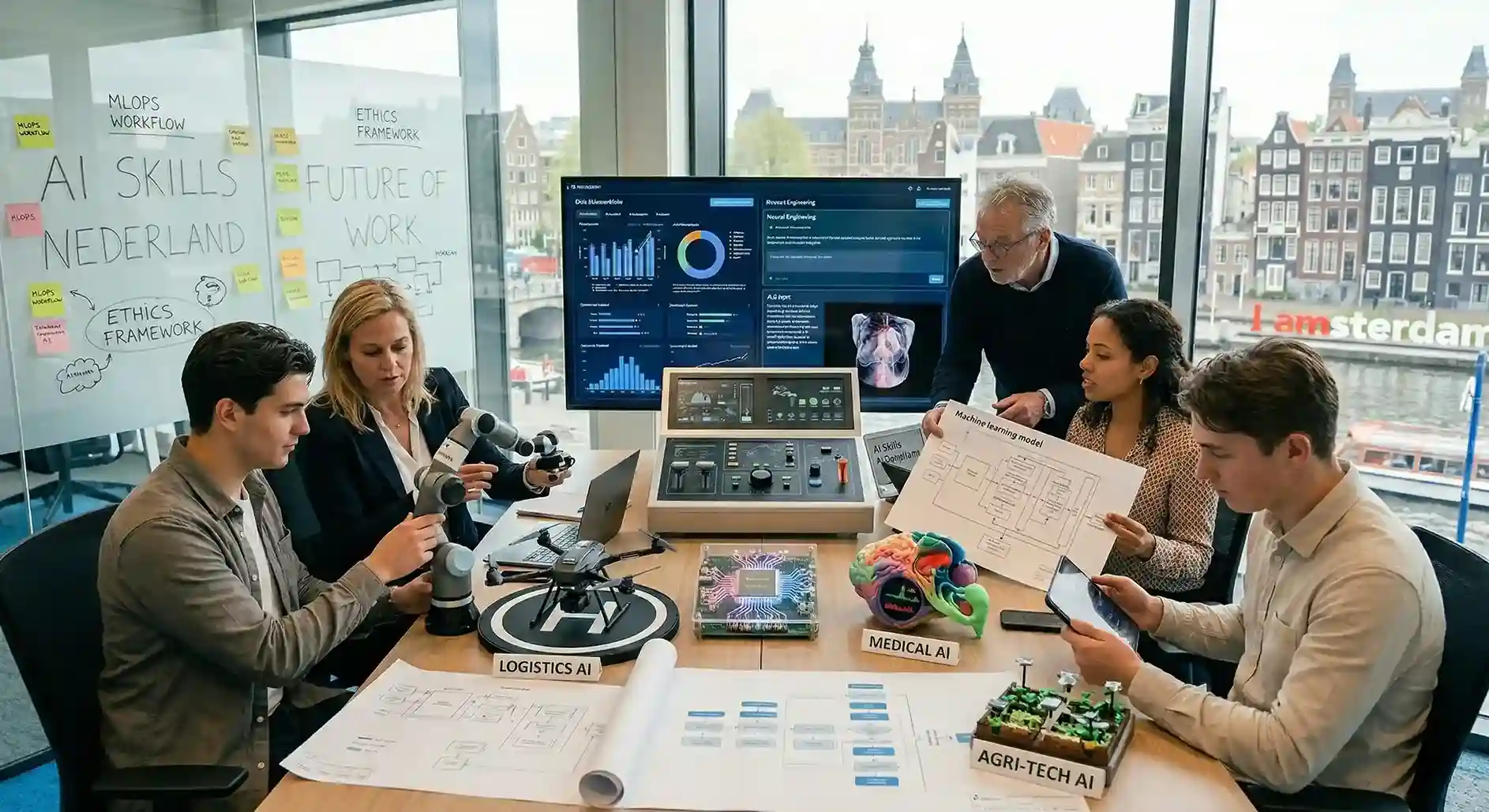
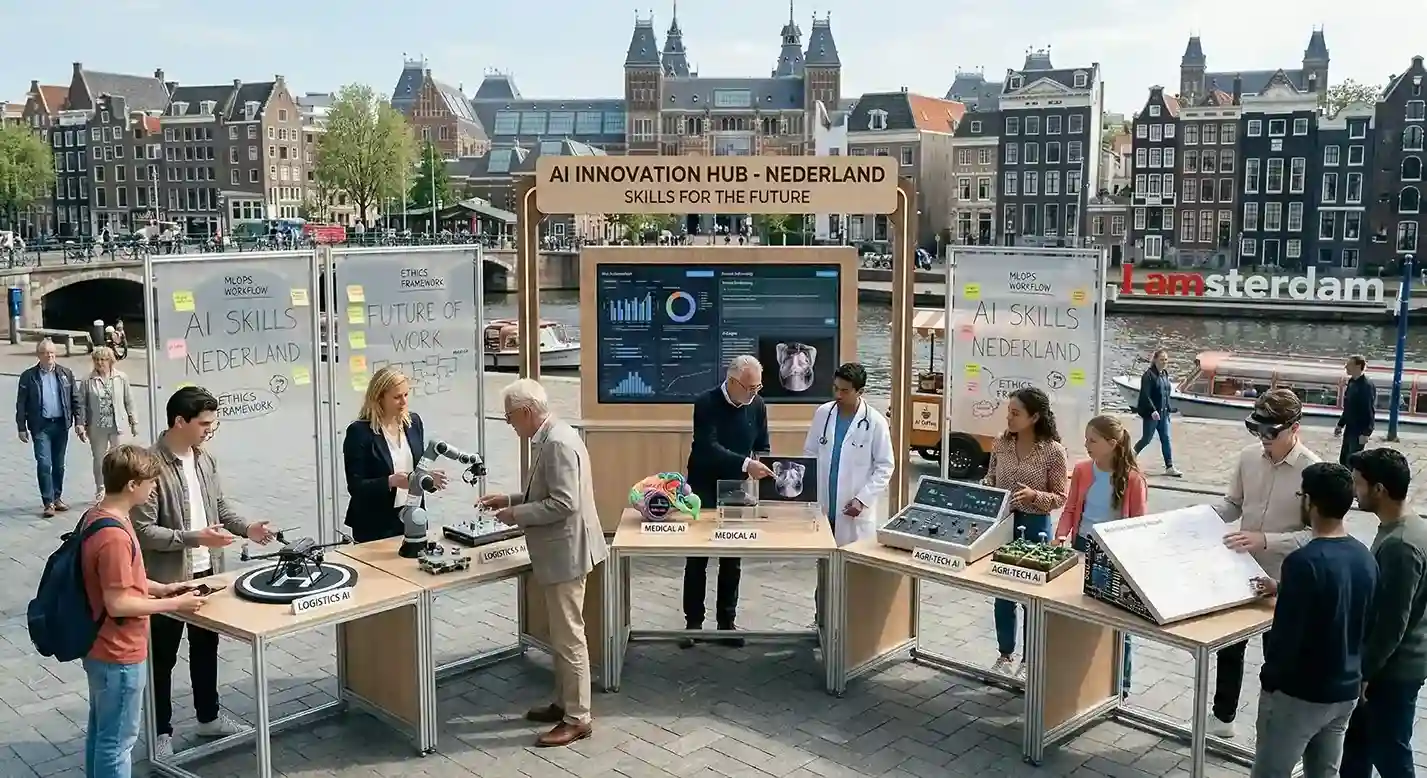
6. AI in Specialized Sectors: Healthcare, Agri-Tech, and Logistics
The Netherlands has three world-class sectors where AI is creating extraordinary opportunities for specialists who combine domain knowledge with AI fluency.
In healthcare, Dutch hospitals and healthtech companies are deploying AI for diagnostic imaging, patient flow optimization, and personalized treatment planning. Professionals with clinical backgrounds who also understand AI tools are becoming uniquely valuable in organizations like Philips Healthtech and Amsterdam UMC.
In agri-tech, the Netherlands is a globally recognized leader in agricultural innovation and food production technology. Precision farming technologies powered by AI are central to maintaining that edge. Agronomists and agricultural engineers who understand computer vision, sensor data, and predictive analytics are in high demand in Wageningen and the broader Food Valley region.
In logistics and supply chain, the Port of Rotterdam is the largest seaport in Europe and a vital hub for AI-driven optimization. From autonomous vehicles to predictive maintenance and smart warehousing, logistics professionals who can work alongside AI systems are redefining what supply chain management looks like in the 21st century.
What Dutch Employers Are Actually Looking For
Beyond specific technical skills, Dutch employers are increasingly looking for what researchers sometimes call “T-shaped” professionals: people with deep expertise in one domain combined with broad fluency across adjacent AI-related competencies.
A marketing director who understands how large language models work. A nurse who is comfortable interpreting AI-generated diagnostic suggestions. A supply chain manager who can read a machine learning model’s output and challenge its assumptions. These hybrid profiles are among the most sought-after in the current Dutch job market.
Soft skills are also back in the spotlight, and with good reason. Critical thinking, creative problem-solving, cross-cultural communication, and ethical reasoning are all becoming more valuable as AI handles routine cognitive tasks. These are capabilities that AI cannot replicate, and Dutch professionals who invest in developing them alongside technical AI skills will be the ones thriving a decade from now.
Where to Build These Skills in the Netherlands
The good news is that you don’t need to go back to university for four years to future-proof your career. The Dutch learning ecosystem has expanded rapidly to meet AI upskilling demand.
Coursera, edX, and LinkedIn Learning offer world-class AI and data science courses that can be completed flexibly around a working schedule. TU Delft offers highly regarded online AI and data courses through its OpenCourseWare platform. The University of Amsterdam’s AI programmes are internationally recognized. The Dutch government, through initiatives like NLDIGITAL and the Digital Trust Center, is actively supporting AI training for businesses and individuals across the country.
For those looking to go deeper, bootcamps like Le Wagon Amsterdam offer intensive hands-on training in data science and AI, while Eindhoven’s thriving tech ecosystem provides excellent networking and professional development opportunities for AI practitioners at every level. The investment you make in AI skills today is compounding interest on your career capital tomorrow.
Don’t Watch the Future Happen; Help Build It
The future of work in the Netherlands is not being decided by algorithms. It is being shaped by the choices that Dutch professionals, educators, and business leaders are making today.
The skills covered in this piece, from prompt engineering and data literacy to AI ethics and sector-specific expertise, are not abstract career concepts. They are practical, learnable, and increasingly essential. The Netherlands has every structural advantage needed to become Europe’s most AI-ready workforce. What it needs now is individuals willing to lean into that opportunity with curiosity and ambition.
So here is your call to action: pick one skill from this list. Just one. Spend the next 30 days actively learning it, whether that means completing an online module, joining a professional community, attending an event at Amsterdam Tech Week, or simply having honest conversations with colleagues about how AI is changing your field.
The wave is coming. And it is a pretty exciting time to be learning how to surf.
Start today. The future of Dutch work is yours to shape.