
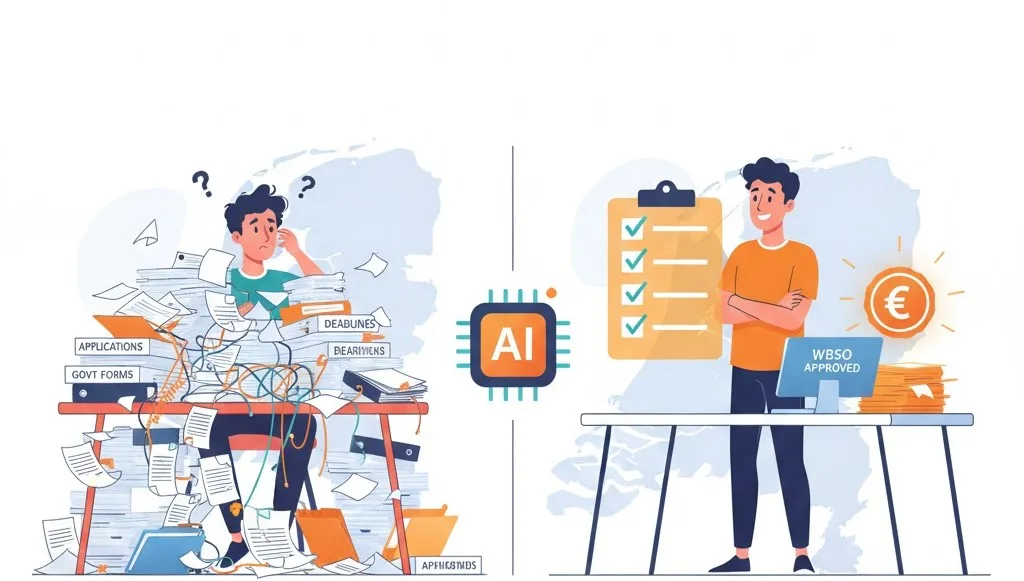
The Netherlands is quietly becoming one of Europe’s most fertile grounds for artificial intelligence innovation. While Silicon Valley grabs headlines and London courts venture capital, Dutch cities from Amsterdam to Eindhoven are cultivating something different: a pragmatic, well-funded ecosystem where AI startups and scaleups can access serious government support without the usual bureaucratic maze.
If you’re building AI technology in the Netherlands, you’re sitting on a goldmine of subsidy opportunities that many founders either overlook entirely or assume are too complex to pursue. The reality? Understanding subsidies for AI innovation in the Netherlands can mean the difference between burning through your runway in eighteen months and securing multi-year funding that accelerates your product roadmap, strengthens your team, and positions you ahead of competitors who are still pitching tired angel investors.
This walks you through exactly where to start, which programs matter most, and how to approach AI subsidies with the strategic mindset that actually wins funding.
Why The Netherlands Is Betting Big On AI Subsidies
The Dutch government isn’t funding AI innovation out of altruism. It’s a calculated economic strategy built on three realities: the country’s ambition to remain competitive in the global tech economy, the recognition that AI will reshape industries from agriculture to healthcare, and the acknowledgment that early-stage innovation requires capital that traditional markets often won’t provide.
Consider the Dutch AI Coalition, a national collaboration between government, industry, and academia that has identified AI as a cornerstone of future economic growth. This isn’t abstract policy talk. It translates into tangible funding mechanisms designed to support companies working on everything from machine learning infrastructure to sector-specific AI applications.
The challenge isn’t availability. It’s knowing which subsidies align with your specific needs and how to position your AI innovation in a way that resonates with evaluators who review hundreds of applications.
Understanding The Main Categories Of AI Subsidies
Before diving into specific programs, it’s essential to understand how AI subsidies in the Netherlands are generally structured. This framework will help you identify where your company fits and which funding tracks make strategic sense.
Research and Development Subsidies focus on technical innovation and scientific advancement. These programs support companies developing novel AI algorithms, exploring new applications of machine learning, or conducting applied research that pushes technological boundaries. If your team is working on something genuinely new rather than implementing existing AI solutions, R&D subsidies should be your primary target.
Innovation Vouchers and Small Grants serve as entry points for earlier-stage companies or those testing new AI applications. These smaller funding mechanisms, typically ranging from €2,500 to €50,000, help validate concepts, fund pilot projects, or facilitate collaboration with research institutions. They’re faster to secure and require less administrative overhead than major subsidy programs.
Tax incentives like the WBSO (Research and Development Tax Credit) don’t give you cash upfront but reduce your tax burden significantly when you’re investing in AI development. For companies with technical staff working on innovation, WBSO can meaningfully lower your development costs on an ongoing basis; making it one of the most valuable sustained benefits available.

Scale-Up and Market Development Subsidies come into play once you’ve proven technical feasibility and need capital to expand, enter new markets, or commercialise your AI solution. These programs recognise that innovation doesn’t end with a working prototype; bringing AI technology to market requires substantial investment in sales, marketing, and operational infrastructure.
WBSO: Your First Stop For AI Development Tax Benefits
If you’re employing developers, data scientists, or researchers working on AI innovation, the WBSO should be your immediate priority. This isn’t technically a subsidy in the traditional sense, but a tax incentive that reduces wage taxes for hours spent on research and development activities.
Here’s what makes WBSO particularly valuable for AI companies: the definition of R&D is broad enough to cover most genuine AI development work. Training custom machine learning models, developing novel algorithms, creating new AI applications, or significantly improving existing AI systems all typically qualify.
WBSO applications can be submitted up to four times per year, for periods of at least three months each. An application must be filed before the end of the month to take effect from the start of the following month. This is not a one-time grant; it’s a sustained reduction in your development costs that compounds as your team and R&D investment grow.
The application process is relatively straightforward compared to grant programs. You describe your R&D activities, estimate the hours that will be spent on innovation work, and receive a decision from RVO. The key is clearly articulating what makes your AI work innovative rather than a routine application of existing technology.
Innovation Credit: Funding Technical AI Projects That Push Boundaries
When your AI innovation requires significant technical development that goes beyond what WBSO can support, the Innovation Credit becomes relevant. This is a loan facility designed specifically for high-risk, high-reward technical development projects.
Loan Size and Structure
The Innovation Credit provides conditional loans of up to €10 million for technical development projects; significantly more than is commonly reported. The conditional repayment structure is what makes this particularly attractive: if your project succeeds commercially, you repay the loan with interest (a fixed mark-up of 15% for technical projects, plus 3% annual compound interest). If the technical development fails despite your best efforts, a significant portion of the loan may be forgiven.
It’s worth noting that RVO takes collateral; a first claim on all project-related tangible and intangible assets such as IP and prototypes; until the credit is fully repaid or forgiven. This is an important practical consideration when assessing whether the Innovation Credit is right for your situation.
For AI companies, this structure matters because it aligns funding with the realities of technical risk. Developing novel AI applications, especially in complex domains like healthcare, autonomous systems, or industrial optimisation, carries inherent uncertainty. Traditional bank financing doesn’t accommodate this risk profile. The Innovation Credit does.
Eligibility requires that your project involves substantial technical challenges, has clear commercial potential, and needs funding that wouldn’t be available through conventional financing. The application process is rigorous, requiring detailed technical descriptions, project plans, and financial forecasts; but for projects that genuinely push AI boundaries, the effort is worthwhile.

MIT Subsidies: Collaborative AI Innovation
The MIT (MKB Innovatiestimulering Regio en Topsectoren) scheme creates opportunities for small and medium-sized enterprises to fund collaborative AI innovation projects. It’s important to understand how the scheme is actually structured, as there are multiple distinct instruments within MIT that are frequently confused with one another.
How MIT Is Really Structured?
MIT R&D Collaboration Projects: The primary and most substantial MIT instrument requires at least two SMEs to collaborate on a joint R&D project. This is not primarily about collaborating with universities or knowledge institutions; it’s fundamentally an SME-to-SME collaboration scheme. The subsidy covers approximately 35% of eligible project costs, up to around €350,000.
MIT Feasibility Studies: A separate instrument covering 40% of eligible costs (up to €20,000) for companies exploring whether a particular AI application or innovation is technically and commercially viable. This is useful for earlier-stage validation.
MIT Knowledge Vouchers: A smaller instrument that facilitates access to knowledge institutions such as universities and applied research centres. These vouchers are specifically designed for knowledge transfer, rather than collaborative R&D.
For AI startups with limited capital, the cost-sharing arrangements across MIT instruments make ambitious technical projects feasible that would otherwise strain resources too severely. The key is choosing the right instrument for your actual situation; don’t apply for an SME collaboration project if what you really need is a knowledge voucher, and vice versa.
Eurostars: Cross-Border AI Innovation For European Ambitions
If your AI innovation has European market potential and you’re open to international collaboration, Eurostars deserves serious attention. This program funds collaborative R&D projects between companies in different European countries, with subsidies that can reach up to 50% of project costs for Dutch participants.
Eurostars is particularly relevant for AI companies because machine learning applications often transcend national boundaries. A computer vision solution developed for Dutch logistics companies might have immediate applications in German manufacturing or French retail. An NLP model trained on multilingual data might serve customers across multiple European markets simultaneously.
The program requires that you partner with at least one company from another Eurostars participating country and that your project results in a new product, process, or service with clear commercial potential. For AI innovations targeting B2B markets across Europe, this international collaboration often accelerates market entry and provides valuable partnerships that extend beyond the funded project.
The application process is competitive and requires coordination among international partners, but successful Eurostars projects receive multi-year funding that can transform development timelines and market reach.
Navigating The Application Process: Practical Steps That Actually Work
Understanding which subsidies exist is only half the challenge. Securing funding requires approaching applications strategically, with clarity about what evaluators actually care about.
Start by assessing where your AI innovation genuinely fits. Are you conducting cutting-edge research that advances the state of the art? Focus on R&D-oriented subsidies and the Innovation Credit. Are you applying proven AI techniques to a new industry or use case? MIT feasibility studies or innovation vouchers might be more appropriate.
The single biggest mistake founders make is treating subsidy applications like investor pitches. Government evaluators aren’t looking for hockey-stick growth projections and visionary rhetoric. They want clear evidence of technical innovation, realistic project plans, and credible budgets that demonstrate you understand exactly how funding will be used.
Be specific about your AI methodology. Explain what makes your approach novel, why existing solutions are inadequate, and what technical challenges you’ll need to overcome. Use precise terminology. If you’re developing a reinforcement learning system, explain the specific architecture and why it’s suited to your application. If you’re creating a custom NLP model, describe the training approach and why off-the-shelf models won’t suffice.
Budget realism matters more than most founders expect. Padding costs or including questionable expenses raises red flags. Evaluators review hundreds of applications and can spot inflated budgets instantly. Your budget should reflect genuine project needs with clear justification for every significant line item.
Finally, don’t go it alone if you’re unsure. Innovation consultants who specialise in Dutch subsidy applications can dramatically improve your success rate. A well-crafted application that secures €200,000 in funding pays for itself many times over.
Common Mistakes That Sink AI Subsidy Applications
Even technically brilliant AI companies make avoidable errors that doom otherwise strong applications.
Failing to clearly articulate innovation: Describing your AI solution as ‘leveraging machine learning to optimise business processes’ is too vague. Evaluators need to understand specifically what’s novel about your approach, what technical challenges exist, and why your innovation represents a meaningful advance over existing solutions.
Underestimating administrative requirements: Subsidy programs require ongoing reporting, financial documentation, and proof that funds are being used as proposed. If your operational infrastructure can’t handle this burden, you’ll struggle to maintain compliance and risk having to return funding.
Timing errors: Some subsidies require that projects haven’t started yet when you apply. Others have specific submission windows. Missing deadlines or applying for funding for work you’ve already completed can disqualify otherwise excellent proposals.
Mismatching programs to your stage: A pre-revenue startup applying for scale-up subsidies designed for established companies wastes time and signals poor strategic judgment. Match your applications to your actual situation and needs.
Confusing WBSO rates. The 40% rate applies only to qualifying startups, not all applicants. Assuming you qualify at the higher rate without verifying your startup status with RVO can lead to financial surprises later.
Your Next Steps: Building A Subsidy Strategy That Fuels Growth
Subsidies for AI innovation in the Netherlands represent a substantial competitive advantage; but only if you approach them strategically rather than opportunistically.
• Map your development roadmap against available funding mechanisms, identifying which subsidies align with your current stage and which may become relevant as your company grows.
• Prioritise WBSO first. It’s the most accessible to secure, provides ongoing benefits, and establishes a relationship with RVO, the government agency that administers most innovation subsidies. Success with WBSO builds credibility for future applications.
• Verify your startup status for WBSO, as this determines whether you qualify for the 32% or 40% rate on the first €350,000 of R&D labour costs.
• Build subsidy planning into your financial forecasting, factoring in realistic subsidy income based on programs you’re eligible for and likely to win.
• Treat subsidy applications as an investment. The discipline required to clearly articulate your innovation, document your methodology, and project realistic budgets makes you a better operator regardless of funding outcomes.
The Netherlands has built one of Europe’s most supportive ecosystems for AI innovation. The subsidies are real, the funding is substantial, and the opportunities are available to any company genuinely pushing technical boundaries. Your job is simply to understand where you fit, craft applications that demonstrate clear value, and claim the support that’s waiting for you.