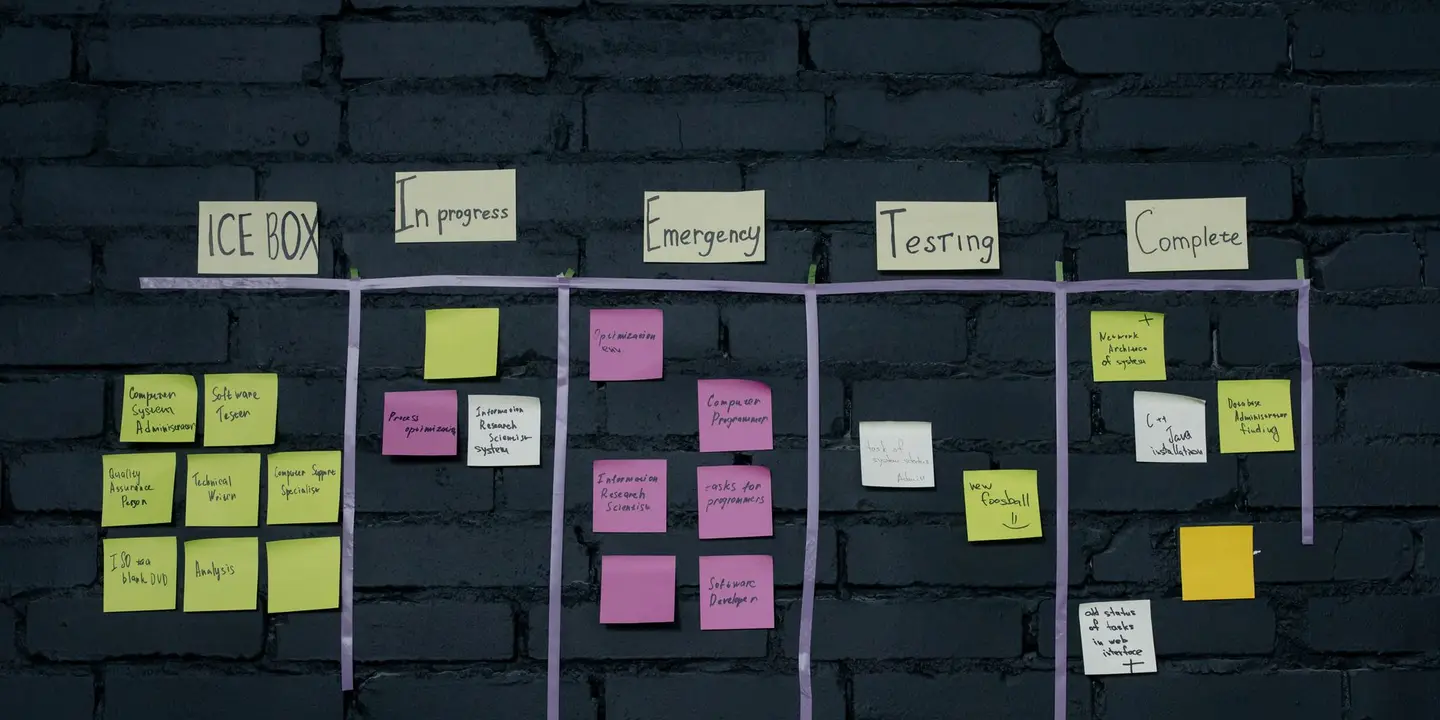
Process automation is having software carry out the repeatable steps of a business process, so people only handle the exceptions and the judgement calls. The gain is usually consistency and traceability rather than raw speed.
Process automation is having software carry out the repeatable steps of a business process, so people handle only the exceptions and the judgement calls.
Most material on the subject explains how. The harder and more valuable question is which — because automating the wrong process is the most common way the budget disappears without the operation improving.
1. Volume. Enough repetitions that a small saving compounds. Twice a week is almost never worth it, whatever the effort per run.
2. Rule clarity. Someone can state the decision as rules without saying "it depends". If two experienced people disagree on the same case, you have a judgement task wearing a process costume.
3. Stable inputs. The data arrives in a predictable shape. A process fed by free-text email from two hundred customers is an extraction problem first.
4. A measurable outcome. Something someone already reports, so improvement is visible without building a new report to prove it.
5. A tolerable failure. What happens when it gets one wrong, and can that be caught? Processes where a silent error compounds need human checkpoints, which changes the economics.
A great deal of what is sold as process automation is a scheduled script with a user interface. That is not an insult — for a fixed, well-understood sequence, a script is cheaper to build, faster to run and far easier to reason about than a workflow platform.
Platforms earn their cost when you need visibility (non-technical people must see where work is), human steps in the middle (approvals, exception handling), or many variants of a similar flow. If none of those apply, the platform is licence cost buying you a diagram. Our audit exists partly to say when a €4,000 script does the job a €20,000 build was scoped for.
The rule that saves the most money: remove steps before encoding them. Automating a process you have not simplified locks in its complexity, because the code becomes the documentation of decisions nobody remembers making.
Most administrative processes contain steps that exist because of a system limitation that no longer applies, a person who left, or an incident five years ago. Walk one real case, ask of each step what would break if it were removed, and expect a third of the answers to be nothing.
Automation is excellent at the normal case and needs a person for everything else. The exception route decides whether the whole thing works.
Three things it needs: a named owner rather than a shared inbox, a time limit so a queue does not become an archive, and a feedback loop so that recurring exceptions change the rules rather than being re-handled forever. An exception queue with none of these is where automated processes quietly go to die.
A realistic target for a well-chosen administrative process is that 70–85% of cases run without a human. Pushing past 90% usually costs more in rule complexity than it returns.
At Crux Digits: a €2,500 audit applies the five tests above and states which process — if any — is worth automating. A €20,000 proof of concept runs four to six weeks on real cases against a measured baseline, and production starts from €50,000.
High volume, clear rules, stable inputs, a measurable outcome someone already owns, and a failure mode you can catch. Missing any one of those usually means the automation disappoints.
RPA is one technique: software that operates existing applications the way a person would, through their interface. Process automation is the broader goal, and often the better route is an API rather than a robot driving a screen.
70–85% of cases for a well-chosen administrative process, with the remainder routed to people. Chasing 100% usually costs more than it returns.
Want this applied in your business? See how we take it to production:
We build this AI in production — at fixed prices, with one named expert. Start with a free consultation.
Book a free consultation →