Home / Case studies
Case Studies — Applied AI & Computer Vision

AI that earns its place in your business

Real AI and computer-vision systems we have designed and shipped for businesses across the Benelux — from precast concrete lines and low-emission zones to cold-chain fleets and clinical workflows. No jargon, no vapourware: just systems built to run in production.

13AI systems shipped
Real-timeEdge inference
NL · BE · LUBenelux at heart
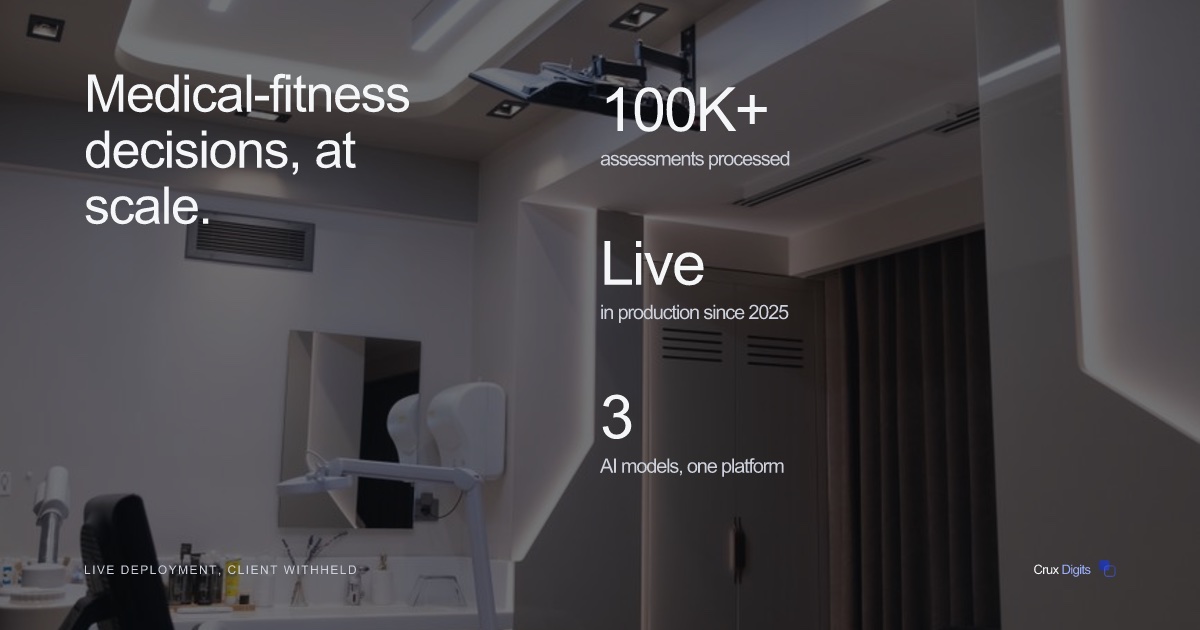
~100kAssessments processed (AMAN AI)
A note on the numbers

Where you see a result tagged Industry benchmark, that figure comes from peer-reviewed studies or sector reporting for the underlying technology — not from our own client deployments. We show it to set realistic expectations for what the approach can achieve. The figures we report for your project always come from a field trial on your own data and operations. Cases tagged Client result or Live deployment are real Crux Digits engagements, with the client name withheld until we have written permission to publish it.

The work

Thirteen AI systems, built for production

Each card jumps to the full write-up: the problem, how the system works, the honest results framing, and a short FAQ.

Construction · Precast & Tunnels

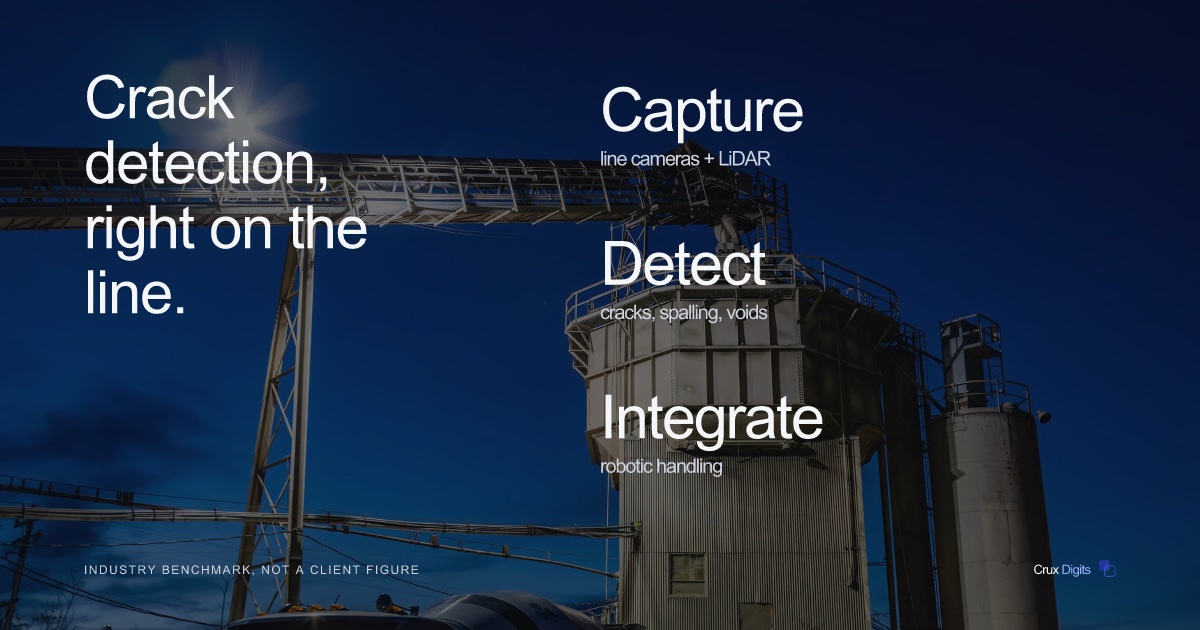
AI Concrete Crack Detection for Precast Segments

Catch cracks, spalling, chipping and voids on precast segments automatically, right on the production line.

In short →
Smart Cities · Municipality of Antwerpen (PoC)

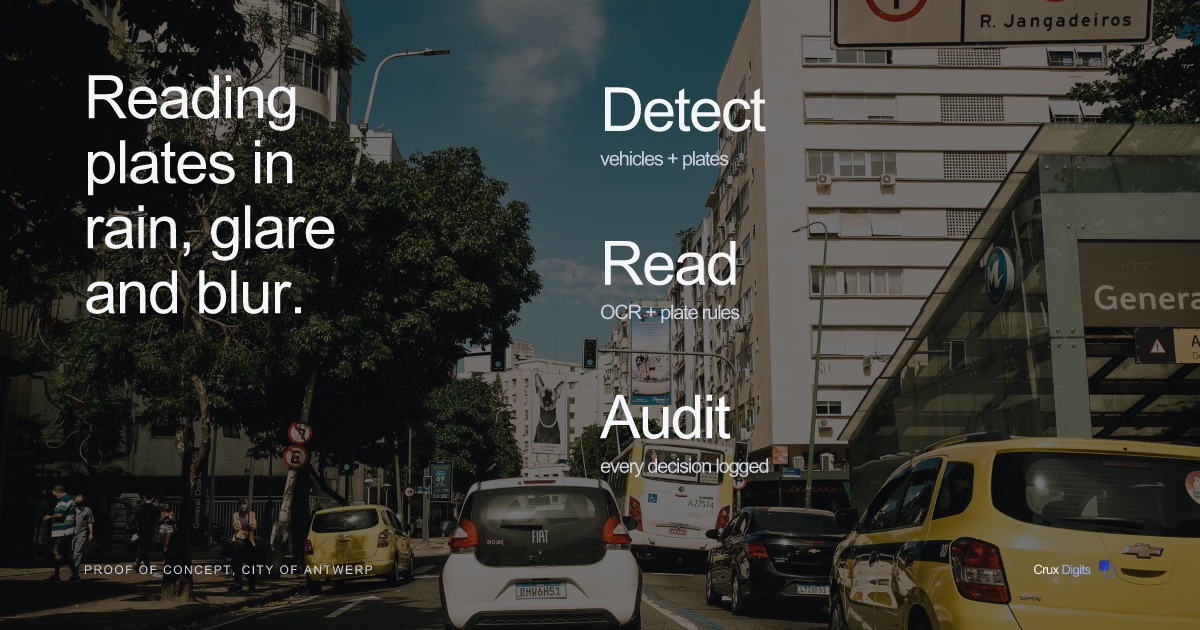
AI Licence Plate Recognition for Low-Emission Zones

Read plates and check zone eligibility in real time — rain, glare or motion blur — with an audit trail behind every decision.

In short →
Infrastructure · Asset Management

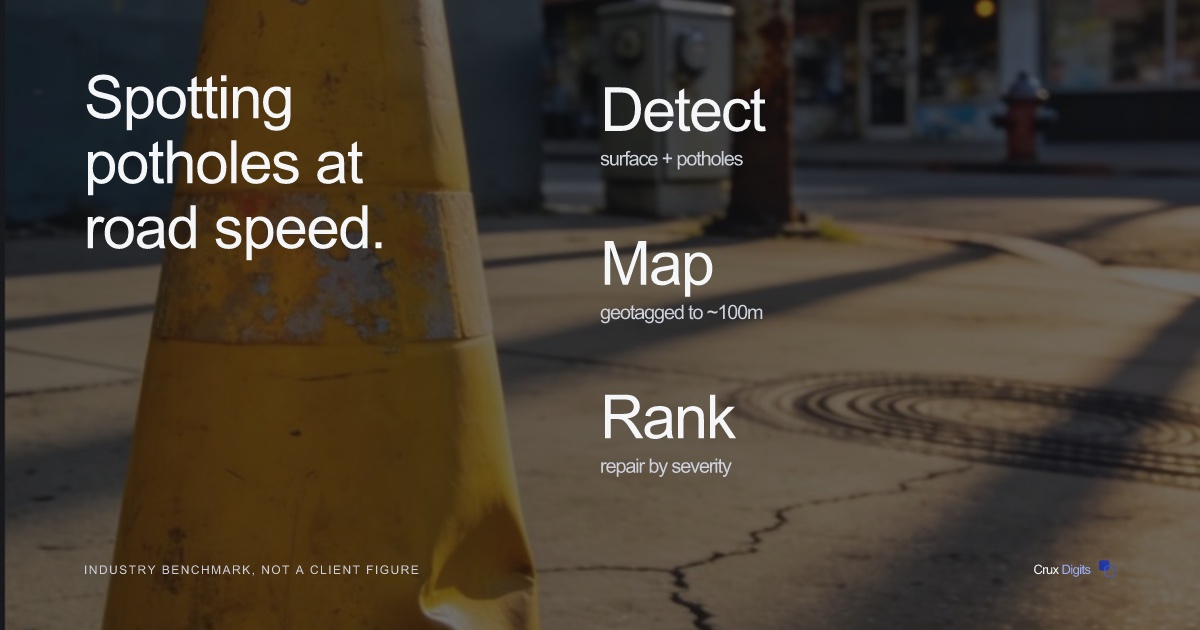
AI Road Surface & Pothole Detection

Turn ordinary road footage into a live, prioritised map of potholes, cracks and obstacles — so teams fix the right defects first.

In short →
Logistics · Cold Chain

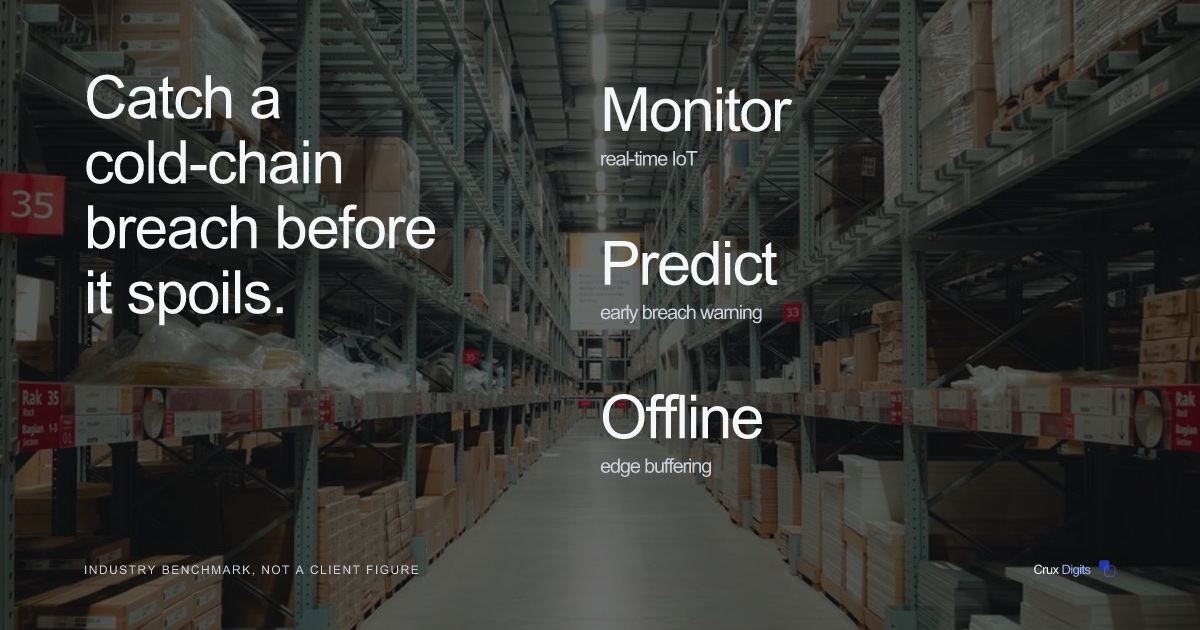
AI Cold-Chain Monitoring & Logistics Visibility

Tell a real temperature excursion apart from normal fluctuation — and alert the team early enough to save the load.

In short →
Healthcare · Decision Support

AI ECG Interpretation & Medical Document Decision Support

Read ECGs and scanned reports, extract the clinically relevant features, show the reasoning — and keep the clinician in control.

In short →
Healthcare · Neurology Screening

Neuro Path Finder — AI Screening Support for Parkinson’s

Adaptive questionnaire screening that helps clinicians focus the right questions and surfaces a structured likelihood summary.

In short →
Healthcare · Occupational Health

AMAN AI — AI Decision Support for Medical Fitness

A live occupational-health platform that speeds up and standardises medical-fitness evaluations — already processing assessments at national scale.

In short →
Manufacturing · Demand & Production Planning

AI Demand Forecasting & Production Planning

Turn demand signals into a production plan, smooth mould-change losses and defend market position — for a €235M footwear manufacturer.

In short →
Consumer Goods · Retention Analytics

AI Customer Churn Prediction & Retention

Find at-risk customers and the levers to keep them — so marketing targets the right cohorts instead of spraying spend.

In short →
Agriculture · Crop Quality & Workforce

AI Crop-Quality Detection & Workforce Allocation

Spot the prized two-leaves-and-a-bud growth, catch pests and disease early, and put crews where they matter most — across 3,200 ha.

In short →
Industrial · Predictive Maintenance

AI Predictive Maintenance for Industrial Plants

Learn the signatures of failure and flag them early — so maintenance happens on schedule, not in a crisis.

In short →
Healthcare · Clinical Documentation (NLP)

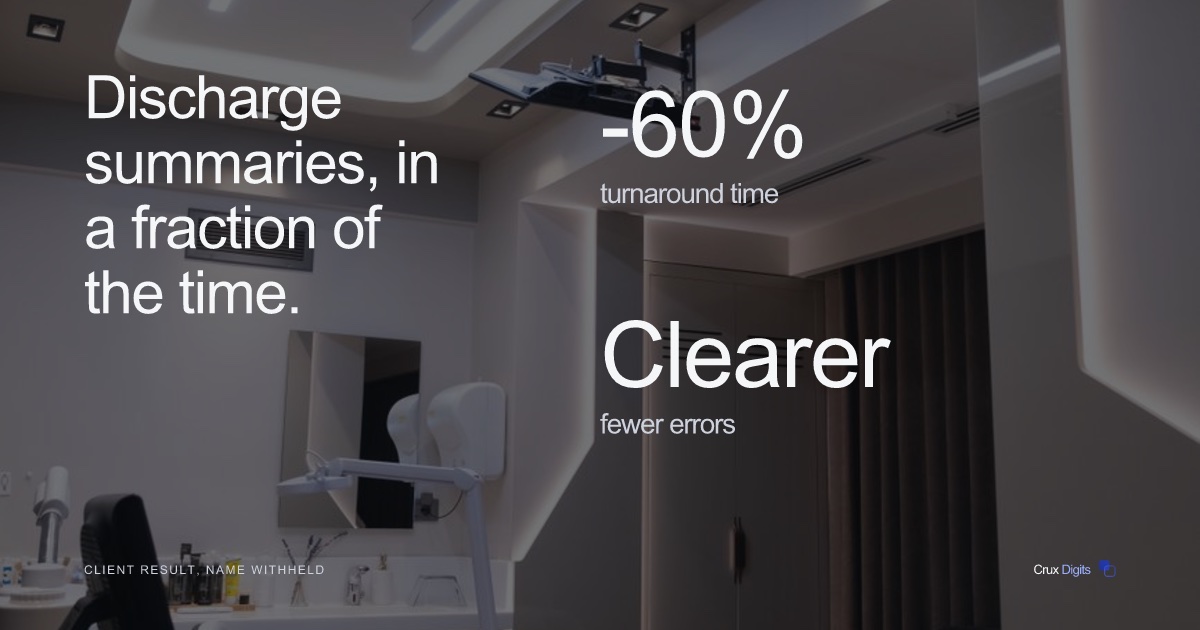
AI Discharge-Summary Automation (Clinical NLP)

Draft and clarify discharge summaries fast — cutting turnaround and documentation-error risk while the clinician keeps sign-off.

In short →
E-commerce · Retail Media (Bol.com)

Automated Ads Bid Optimization for Bol.com

Watch ad positions and adjust bids in real time to hit target placements within a set budget — no manual bid-watching.

In short →
Construction · Precast & Tunnels

AI Concrete Crack Detection for Precast Segments

Precast is only as reliable as its inspection. A defective segment that reaches a tunnel is expensive — or dangerous — to replace. We built a vision system that catches cracks, spalling, chipping and voids the same way, every time.

In short

We build AI vision systems that detect and classify damage on precast concrete — cracks, spalling, chipping, voids — directly on the production line or during tunnel inspection. Detection and segmentation models (YOLO, U-Net, Mask R-CNN, Vision Transformers) are adapted for construction materials and run at the edge, so the line never waits and your inspectors review only the uncertain cases.

The challenge

Manual inspection is slow, subjective and hard to scale. Inspectors judge severity differently, casting-yard light is uneven, and dust, form-release agent and water staining trigger constant false alarms. The client needed inspection that was objective, traceable and fast enough to keep pace with production — and could later feed a robotic cell.

How the system works

01

Capture & sync

Real-time intake from line cameras and 3D/LiDAR, aligned by a synchronisation framework.

02

Preprocess

De-noising, illumination and geometry correction, with optional visual + LiDAR fusion to kill false positives.

03

Detect & classify

Cracks segmented at pixel level; spalling, chipping and voids categorised by likely severity.

04

Decide & integrate

Results pushed via API to robotic manipulators; low-confidence cases flagged for human review.

Results

Industry benchmark — not our own client figures
91–98%Crack-detection precision (peer-reviewed YOLOv8 / U-Net)
~93%Recall / overall accuracy on crack datasets
Real-timeEdge inference at line speed

Benchmark basis: peer-reviewed studies, 2023–2025 (e.g. YOLOv8 concrete-crack: 91.8% precision / 92.5% recall; SDNET2018 ensembles up to ~98%). These are sector benchmarks for the technology — not Crux Digits’ own results. For your project we report the verified precision and recall from a field trial on your own segments.

How accurate is AI concrete crack detection?

With a controlled line camera and a model retrained on your own segments, detection of fine-width cracks is reliable. We report precision and recall from a field-trial baseline on your material — not generic benchmarks.

Can it run in real time on the production line?

Yes. Inference runs at the edge, so detection keeps pace with line speed and can trigger robotic handling decisions immediately.

Does it replace human inspectors?

No. It standardises detection and flags low-confidence cases for review, so inspectors spend their time on judgement, not repetitive scanning.

↑ All cases

Smart Cities · Municipality of Antwerpen (PoC)

AI Licence Plate Recognition for Low-Emission Zones

A low-emission zone only works if enforcement is reliable and fair. Manual checks do not scale; brittle cameras fail in rain and glare. We built a system that reads plates and verifies eligibility in real time — with an audit trail behind every decision.

In short

Computer vision (YOLOv8) detects vehicles and plates in rain, glare and motion blur, OCR reads the plate, and a rule engine cross-references registration data to confirm emission category or eligibility — flagging violations and logging an auditable record, with role-based dashboards for operators.

The challenge

Manual enforcement cannot cover a zone around the clock, and off-the-shelf cameras drop accuracy the moment conditions get hard: night, rain, low sun, partial occlusion, motion blur. The city needed enforcement that was consistent, fair and fully auditable — every decision backed by evidence.

How the system works

01

Detect

A fine-tuned YOLOv8 finds vehicles and plates through occlusion, motion blur and variable light.

02

Read (OCR)

Contrast, binarisation and skew correction, then OCR with plate-format and regional rules.

03

Cross-reference

Plates validated against registration APIs for make, year, emission category and ownership.

04

Decide & log

A rule engine evaluates eligibility, flags violations and logs everything with role-based access.

Results

Industry benchmark — not our own client figures
90–98%Real-world plate-read accuracy (controlled conditions: >99%)
~95%Typical OCR read rate (≈98% capture rate)
AuditedEvery decision logged with role-based access

Benchmark basis: ANPR industry reporting and studies — real-world accuracy typically 90–98%, capture/read rates ≈98%/95%. These are sector benchmarks, not Crux Digits’ own deployment figures. We report verified read-accuracy from your own roadside footage. Built as a proof of concept for the Municipality of Antwerpen (District Antwerpen).

How accurate is plate recognition in bad weather?

A YOLOv8 detector plus OCR preprocessing handles rain, glare, motion blur and partial occlusion; we report read-accuracy from your own roadside footage, not lab conditions.

Is it GDPR-compliant?

Plate data is personal data. We design with data minimisation, retention limits and access control; the legal basis and retention policy are set by the operating authority.

Can it feed an existing enforcement workflow?

Yes. Structured results and an auditable log are exposed via API, so violations and evidence drop straight into the systems your operators already use.

↑ All cases

Infrastructure · Asset Management

AI Road Surface & Pothole Detection

Roads degrade continuously, but inspection budgets are fixed. We built a system that turns ordinary road footage into a live, prioritised map of potholes, cracks and obstacles — so teams fix the right defects first.

In short

Semantic segmentation finds cracks and surface wear; object detection (YOLOv8) finds potholes and debris; temporal filtering across frames cuts false positives; and every defect is mapped to GPS coordinates and ranked by severity in dashboards built for road authorities.

The challenge

Periodic manual surveys are expensive and always slightly out of date, while single-frame detectors mistake shadows and wet patches for damage. The authority needed continuous, prioritised visibility of the network — without commissioning a fleet of specialist survey vehicles.

How the system works

01

Capture

Multi-view video with GPS sync, then stabilisation, deblurring and colour normalisation.

02

Detect

Segmentation for cracks and wear; YOLOv8 for potholes and debris, trained on dust and glare.

03

Filter

Consecutive-frame comparison and optical flow suppress shadows and wet patches.

04

Map & rank

Each defect is pinned to GPS; dashboards show heatmaps and maintenance priorities.

Results

Industry benchmark — not our own client figures
81–86%Pothole-detection mAP (real-time YOLO studies)
up to 95%mAP with tuned / augmented models
~20 FPSReal-time, detection to ~100 m

Benchmark basis: peer-reviewed road-defect studies, 2022–2025 (YOLOv8 pothole mAP ≈81–86%; tuned models to ~95%; ~20 FPS real-time). These are sector benchmarks, not Crux Digits’ own route results. For your network we report mAP and false-positive rates from a route trial on your own footage.

How does AI tell a pothole from a shadow or a wet patch?

Temporal filtering — consecutive-frame comparison and optical flow — plus augmentation on dust, glare and motion suppress the artefacts that single-frame detectors mistake for defects.

What hardware does it need?

Vehicle-mounted or roadside cameras with GPS sync — no specialist survey vehicle required.

How are defects prioritised?

Each defect is graded by severity and pinned to GPS, so dashboards surface the highest-risk repairs first instead of a flat list.

↑ All cases

Logistics · Cold Chain

AI Cold-Chain Monitoring & Logistics Visibility

One undetected temperature excursion can write off a whole pharma or food shipment. We built an AI-plus-IoT system that tells a real anomaly apart from normal fluctuation — and alerts the team early enough to act.

In short

Real-time streams of temperature, humidity, vibration and GPS feed anomaly-detection models that separate true deviations from normal variation, link readings to route and environment, and trigger alerts before a breach spoils a load — with dashboards for live fleet status and historical analysis. Edge buffering keeps it working when connectivity drops.

The challenge

Threshold alarms either miss slow drifts or cry wolf at every door opening, so teams learn to ignore them. The operator needed early, trustworthy warnings that distinguished a genuine excursion from harmless variation — and kept working through the connectivity dead zones on a route.

How the system works

01

Sense

Stream temperature, humidity, vibration and GPS, with edge buffering for dead zones.

02

Analyse

Anomaly models flag deviations; temporal smoothing separates noise from real drift.

03

Predict & alert

Automated alerts for breaches and predicted deviations — before they happen.

04

Visualise

Live fleet dashboards plus historical trends for audits and SLAs.

Results

Industry benchmark — not our own client figures
up to 30%Spoilage / waste reduction with real-time IoT monitoring
PredictiveEarly warning before a breach
Offline-safeEdge buffering through connectivity gaps

Benchmark basis: cold-chain and UN/FAO reporting, 2024–2026 — real-time IoT monitoring is associated with up to ~30% spoilage reduction, and roughly 30% of food waste is preventable through a better cold chain. These are sector benchmarks, not Crux Digits’ own fleet results. For your fleet we report verified spoilage and alert-accuracy figures from a live trial.

How does AI reduce false cold-chain alerts?

Temporal smoothing and contextual analysis distinguish normal variation — a door opening, a gradient — from true anomalies, so alerts fire on real risk instead of every fluctuation.

Does it keep working when connectivity drops?

Yes. Edge buffering stores readings during outages and syncs when the connection returns.

Can it predict a breach before it happens?

Yes. The models project the temperature trajectory and warn when a load is heading for an excursion, giving the team time to intervene.

↑ All cases

Healthcare · Decision Support

AI ECG Interpretation & Medical Document Decision Support

Cardiology generates more ECGs and scanned reports than clinicians can review at leisure. We built decision support that reads them, extracts the clinically relevant features and shows its reasoning — so clinicians spend time on judgement, not transcription.

In short

Vision models segment multi-lead ECGs and extract waveform features (P-wave, QRS, T-wave), combine predictions with rule-based clinical heuristics for explainable, lead-wise reasoning, score scan quality, and flag low-confidence cases for clinician review. It supports clinicians — it does not replace them.

The challenge

High volumes of ECGs and scanned reports arrive faster than they can be read carefully, and a black-box label is no use to a clinician who needs to justify a decision. The team needed support that was fast, explainable, and honest about its own uncertainty.

How the system works

01

Ingest

Scanned PDFs, ECG images and report photos; deskew, denoise, normalise; segment leads.

02

Extract

Vision models pull P/QRS/T morphology and flag possible arrhythmia or ischaemia.

03

Reason

AI predictions combined with clinical heuristics for explainable, lead-wise output.

04

Route

Structured findings with confidence scores; low-confidence cases go to a clinician.

Results

Industry benchmark — not our own client figures
88–94%AI ECG diagnostic accuracy (cardiologist-level, benchmark datasets)
0.96–0.99AUC across diagnostic tasks
ExplainableLead-wise reasoning, not a black-box label

Benchmark basis: peer-reviewed cardiology studies, 2024–2025 (deep-learning ECG models reach cardiologist-level accuracy ~88–94%; AUC up to ~0.99 on large datasets). These are sector benchmarks for decision-support models — not Crux Digits’ own validation. Any clinical claim must come from your own validated study. Decision support only; not an autonomous diagnosis, and clinical use requires appropriate regulatory clearance (e.g. EU MDR) and clinician oversight.

Does AI ECG interpretation replace a cardiologist?

No. It is decision support: it extracts features and suggests findings with confidence scores and reasoning, and routes uncertain cases to a clinician.

Is the output explainable?

Yes. It combines model predictions with rule-based clinical heuristics to give lead-wise reasoning, not a black-box label.

What about regulatory approval?

Clinical deployment requires the appropriate clearance (for example EU MDR) and clinician oversight; the system is built to support that process, not to bypass it.

↑ All cases

Healthcare · Neurology Screening

Neuro Path Finder — AI Screening Support for Parkinson’s

Early signs of Parkinson’s and Parkinsonian syndromes are easy to miss in a busy clinic. We built an adaptive, questionnaire-based screening tool that helps clinicians focus the right questions and surfaces a structured likelihood summary — support for the preliminary evaluation, not a diagnosis.

In short

A dynamic, condition-driven questionnaire adapts to each response, collecting only what is relevant. AI classifies the answers into defined likelihood categories and produces a consolidated, clinician-friendly summary to support — not replace — clinical judgement. It is privacy-first by design: no personally identifiable information, with age the only demographic used for context.

The challenge

Early Parkinsonian signs are subtle and easy to miss in a short consultation, while a rigid questionnaire wastes time on irrelevant items. The clinic needed a tool that adapted to each patient, respected privacy, and produced something a clinician could actually act on — without ever implying a diagnosis.

How the system works

01

Adaptive intake

A condition-driven questionnaire adapts in real time, asking only the relevant follow-ups.

02

Privacy-first

No personally identifiable information is collected; age is the only demographic used for context.

03

Classify

AI maps responses to predefined likelihood levels for the relevant conditions.

04

Summarise

A consolidated summary supports clinical interpretation — never a definitive diagnosis.

Results

Industry benchmark — not our own client figures
78–96%AI Parkinson’s detection accuracy across methods (peer-reviewed)
>95%Accuracy / AUC reported for questionnaire-based ML models
Privacy-firstNo personally identifiable information collected

Benchmark basis: peer-reviewed neurology studies, 2018–2026 — AI Parkinson’s detection spans ~78–96% accuracy across modalities, with questionnaire-based ML (MDS-UPDRS) models reaching >95% accuracy and AUC. These are sector benchmarks, not Neuro Path Finder’s own validated metrics. Developed with input from a board-certified neurologist specialising in movement disorders. Screening-support only — it produces an indicative likelihood summary, not a diagnosis, and clinical use requires clinician oversight and appropriate regulatory clearance.

Does Neuro Path Finder diagnose Parkinson’s?

No. It classifies questionnaire responses into likelihood levels and produces a summary to support a clinician’s preliminary evaluation — the diagnosis remains the clinician’s.

How does it protect patient privacy?

It is privacy-first by design: no personally identifiable information is collected, and age is the only demographic parameter used to add clinical context.

How does the questionnaire adapt?

It is condition-driven: each answer shapes the next set of questions, so the tool only collects what is clinically relevant for that patient.

↑ All cases

Healthcare · Occupational Health

AMAN AI — AI Decision Support for Medical Fitness

Large-scale occupational-health screening is high-volume, repetitive and easy to apply inconsistently. AMAN AI is a live platform that speeds up and standardises medical-fitness evaluations while keeping clinicians firmly in charge — already processing assessments at national scale.

In short

AMAN AI is a customised suite of AI models and agents that runs inside existing clinical workflows to make medical-fitness evaluations faster, more consistent and guideline-aligned. It combines three decision-support models — a Classification model that consolidates multi-source medical data, a cardiovascular-risk model that flags latent risk from biomarker correlations, and a mental-fitness model — under a clinician-led "maker-checker" approach.

The challenge

National-scale fitness screening is high-volume and repetitive, which makes consistency hard and latent risk easy to overlook. The provider needed to speed evaluations up and standardise them without taking the final decision out of clinicians’ hands — and without ripping out the workflows their teams already use.

How the system works

01

Classification AI

Extracts and consolidates clinical parameters from unstructured data, correlates anomalies with guideline criteria, and proposes an indicative fitness classification the clinician can accept, modify or override.

02

Cardiovascular risk

Machine learning on vital signs and biomarkers surfaces latent cardiac risk — even in people who look normal on standard indicators like ECG — as an interpretable, explainable risk score.

03

Mental fitness (MHRQoL)

Analyses physiological and biological markers to produce an indicative Mental Fitness Score that supplements established fitness guidelines.

Results

Live deployment — verified
~100,000Occupational-health assessment cases processed
Live since Feb 2025In production within existing clinical workflows
3 modelsAI decision-support models in one platform

Live deployment: delivered by Crux Digits and partners at a national occupational-health provider, in production since February 2025, supporting large-scale medical-fitness evaluations for contractor recruitment and onboarding in the energy sector. Client name withheld pending permission. A clinician-led maker-checker model keeps every fitness, cardiovascular and mental-health output indicative — supporting, never replacing, the clinician’s final decision; deployment requires appropriate regulatory clearance.

Does AMAN AI make the final fitness decision?

No. It proposes an indicative classification that the clinician can accept, modify or override — a controlled maker-checker approach that keeps decisions clinician-led while adding systematic AI validation.

How can it flag cardiac risk when the ECG looks normal?

It learns correlations among indirect biomarkers and longitudinal physiological patterns, identifying latent risk that may not be visible through standard indicators alone, and reports it as an explainable risk score.

Does it fit existing clinical workflows?

Yes. It is a customised suite of models and agents designed to operate inside existing workflows, aligned with established occupational-health guidelines.

↑ All cases

Manufacturing · Demand & Production Planning

AI Demand Forecasting & Production Planning

A leading footwear manufacturer (€235M turnover) was wrestling with complex day-to-day production planning and resource loss during mould changes. We built forecasting that turns demand signals into a production plan — and protects market position.

In short

Time-series and gradient-boosting models (Prophet + XGBoost) forecast demand and feed day-to-day production planning, smoothing mould-change losses and aligning capacity to real demand.

The challenge

Day-to-day planning across a wide SKU range was largely manual, and every mould change leaked capacity. Without a reliable demand signal, the manufacturer was over- and under-producing in turn — and losing ground to aggressive competitors.

How the system works

01

Forecast

Prophet models seasonality and trend in demand across SKUs.

02

Refine

XGBoost layers in drivers and corrects the forecast on fresh data.

03

Plan

Forecasts drive production scheduling and reduce mould-change waste.

Results

Client result — name withheld
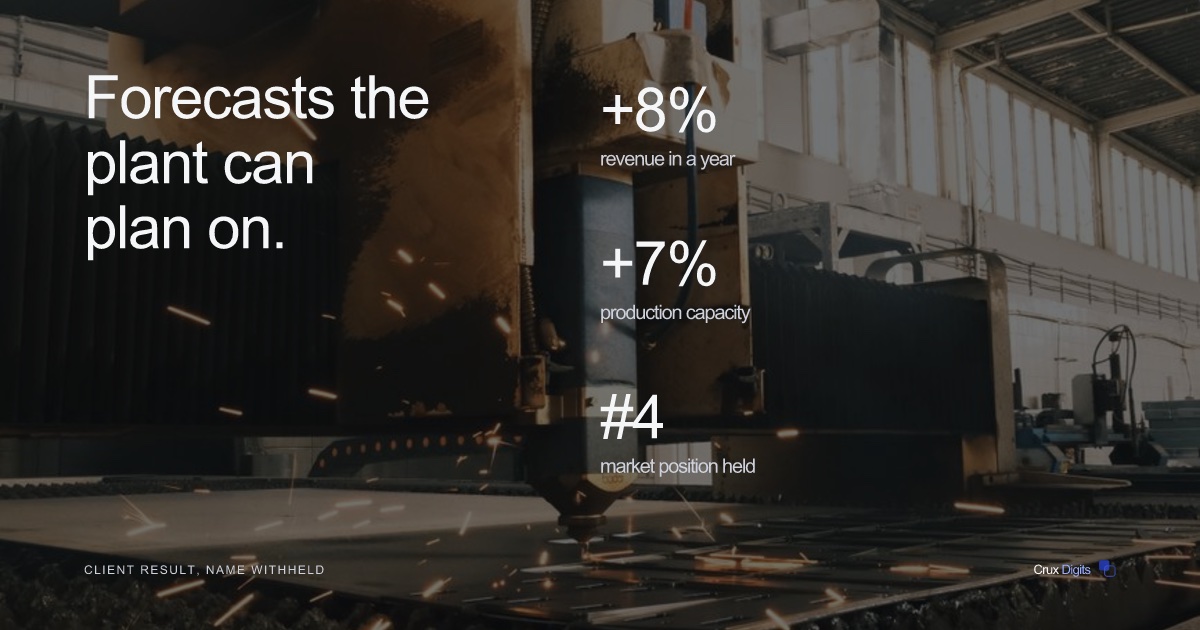
+8%Revenue growth within a year
+7%Production-capacity improvement
#4Market position retained vs. heavy competition

Real result from a Crux Digits engagement; client name withheld pending permission.

Why combine Prophet and XGBoost?

Prophet captures seasonality and trend cleanly; XGBoost layers in the additional drivers and corrects the forecast as fresh data arrives — together they are more accurate than either alone.

How does forecasting cut mould-change waste?

A reliable demand signal lets the plant sequence production so mould changes line up with real need, instead of reacting to surprises.

↑ All cases

Consumer Goods · Retention Analytics

AI Customer Churn Prediction & Retention

A major spice exporter faced rising churn from shifting market preferences and campaigns that were not landing. We built churn prediction that finds at-risk customers and the levers to keep them.

In short

Decision-tree and K-means models segment customers and score churn risk, so marketing can target the right cohorts with the right campaigns instead of spraying spend.

The challenge

Retention spend was spread evenly across the whole base, so campaigns were expensive and underwhelming. The exporter needed to know which customers were actually about to leave — and what would make them stay — before the budget was gone.

How the system works

01

Segment

K-means groups customers by behaviour and value.

02

Score

Decision trees score churn risk and surface the drivers.

03

Target

Tailored campaigns aim at the cohorts most worth keeping.

Results

Client result — name withheld
−13%Customer churn
+€1.7MAdditional sales per campaign

Real result from a Crux Digits engagement; client name withheld pending permission.

How does the model know who is about to churn?

Decision-tree models score each customer on churn risk and surface the behavioural drivers behind that score, so the signal is actionable, not just a number.

Why segment customers first?

K-means groups customers by behaviour and value so campaigns can be tailored to each cohort, concentrating retention spend where it returns the most.

↑ All cases

Agriculture · Crop Quality & Workforce

AI Crop-Quality Detection & Workforce Allocation

A large tea-estate group (3,200 ha across 7 estates, 10,000+ field workers) needed to spot the prized two-leaves-and-a-bud growth, catch pests and disease early, and put crews where they mattered. We built vision that does exactly that.

In short

A convolutional vision model (VGG-19) identifies the high-value two-leaves-and-a-bud composition and flags potential pest and disease issues early, so workforce and plant-protection spend go where they earn their keep.

The challenge

Across thousands of hectares and a 10,000-strong workforce, quality and plant-protection decisions relied on manual spot-checks and experience. Effort and chemicals were spread too thinly to be efficient, and early pest or disease signs were easy to miss until they spread.

How the system works

01

Detect

VGG-19 grades leaf composition and spots early pest / disease signs.

02

Map

High-quality and at-risk areas are mapped across the estates.

03

Allocate

Crews and plant-protection effort follow the map, not guesswork.

Results

Client result — name withheld
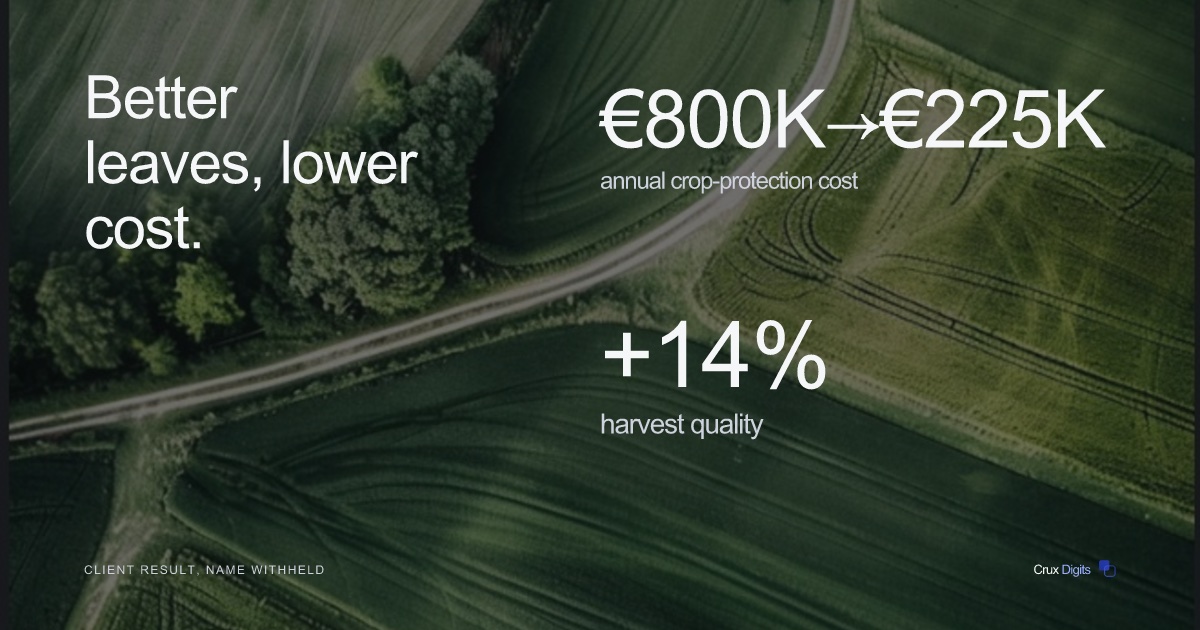
€800K → €225KAnnual plant-protection cost
+14%Quality of tea leaves harvested

Real result from a Crux Digits engagement; client name withheld pending permission.

How does vision improve tea quality?

The model identifies the high-value two-leaves-and-a-bud composition and maps where it is concentrated, so harvesting effort focuses on the most valuable growth.

How did plant-protection cost fall so much?

By mapping at-risk areas precisely, crews and chemicals are applied where they are actually needed instead of blanket-treating every estate.

↑ All cases

Industrial · Predictive Maintenance

AI Predictive Maintenance for Industrial Plants

A sugar producer was losing efficiency to recurring, unplanned downtime. We built models that learn the signatures of failure and flag them early — so maintenance happens on schedule, not in a crisis.

In short

Convolutional models (CNNs) learn the patterns that precede equipment failure from sensor and inspection data, flagging issues early so teams intervene before a breakdown — turning unplanned downtime into planned maintenance.

The challenge

Run-to-failure maintenance meant recurring, unplanned stoppages that cost output and forced expensive emergency repairs. The producer needed early warning of failures so work could be scheduled into planned windows instead of triggered by a breakdown.

How the system works

01

Learn

CNNs learn normal vs. pre-failure signatures from plant data.

02

Flag

Early anomalies trigger an alert before failure occurs.

03

Schedule

Maintenance is planned into the window, not forced by a breakdown.

Results

Client result — name withheld
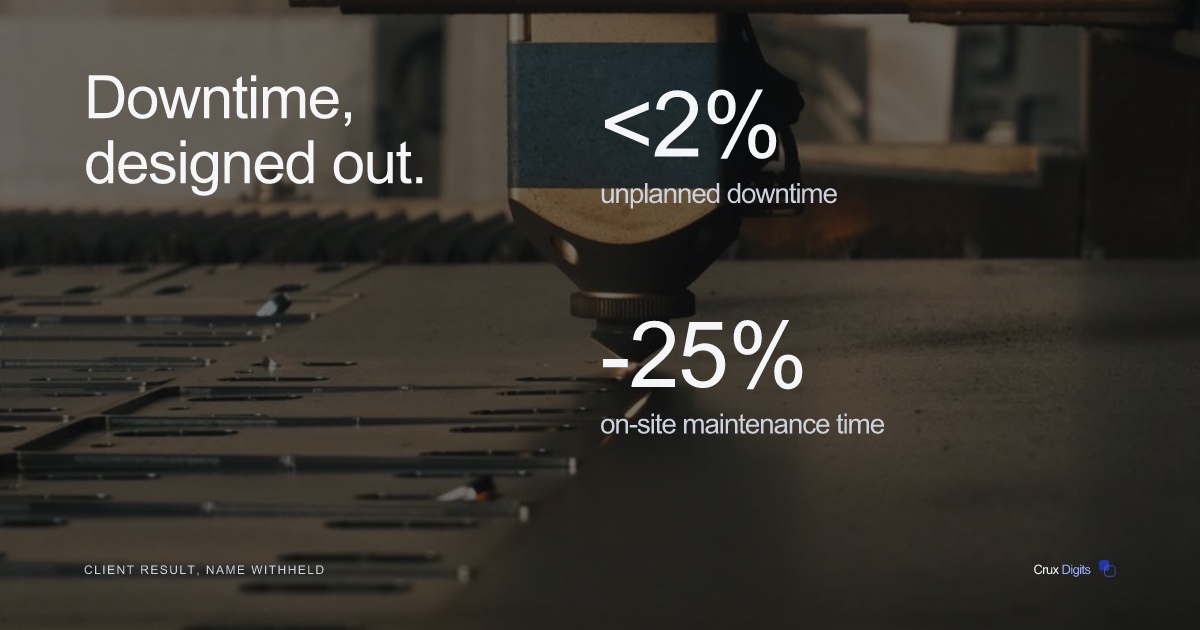
<2%Unplanned downtime (down from recurring)
−25%On-site maintenance time

Real result from a Crux Digits engagement; client name withheld pending permission.

What data does predictive maintenance need?

Sensor and inspection data from the equipment; the CNN learns the difference between normal operation and the patterns that precede a failure.

How does it cut on-site maintenance time?

Early, specific warnings let teams plan the right intervention in advance, so work is targeted and scheduled rather than diagnosed under pressure during a breakdown.

↑ All cases

Healthcare · Clinical Documentation (NLP)

AI Discharge-Summary Automation (Clinical NLP)

A hospital group was burning clinician time reading and interpreting discharge summaries, with delays and a real risk of documentation errors. We built NLP that drafts and clarifies them, fast.

In short

NLP models read clinical inputs, draft a clear, structured discharge summary and cut the manual reading and interpretation that slowed clinicians down — reducing both turnaround and documentation-error risk.

The challenge

Producing and interpreting discharge summaries by hand was slow and error-prone, holding up the discharge process and pulling clinicians away from care. The group needed faster, clearer documentation without compromising the clinician’s final review.

How the system works

01

Read

NLP parses the clinical record and key parameters.

02

Draft

A clear, structured discharge summary is generated for review.

03

Review

The clinician checks and signs off — faster, with fewer errors.

Results

Client result — name withheld
−60%Discharge-process turnaround time
ClearerDischarge summaries, fewer errors

Real result from a Crux Digits engagement; client name withheld pending permission. Decision support only — the clinician retains sign-off on every summary.

Does the AI write the final discharge summary?

It drafts a clear, structured summary, but the clinician always reviews and signs off — the system speeds the work up without removing clinical control.

How does it reduce documentation errors?

By extracting and structuring the record consistently, it removes much of the manual transcription where errors and omissions creep in.

↑ All cases

E-commerce · Retail Media (Bol.com)

Automated Ads Bid Optimization for Bol.com

A Benelux seller on Bol.com wanted better product visibility without overpaying for ads. We built a system that watches ad positions and adjusts bids in real time to hit target placements within a set budget.

In short

The system reads current ad positions via the Bol.com Advertising API and adjusts bids dynamically against the seller’s max-bid and target pages — automatically defending the placements that drive sales, without manual bid-watching.

The challenge

Marketplace ad positions shift constantly as competitors change their bids, so manual bidding either overpays to stay visible or quietly loses placement. The seller wanted to hold target positions within a fixed budget — without watching bids all day.

How the system works

01

Configure

Set a maximum bid and the target product pages to optimise.

02

Monitor

The system retrieves live ad positions and the competition.

03

Adjust

Bids update automatically via the Bol.com Advertising API.

Results

Client result — name withheld
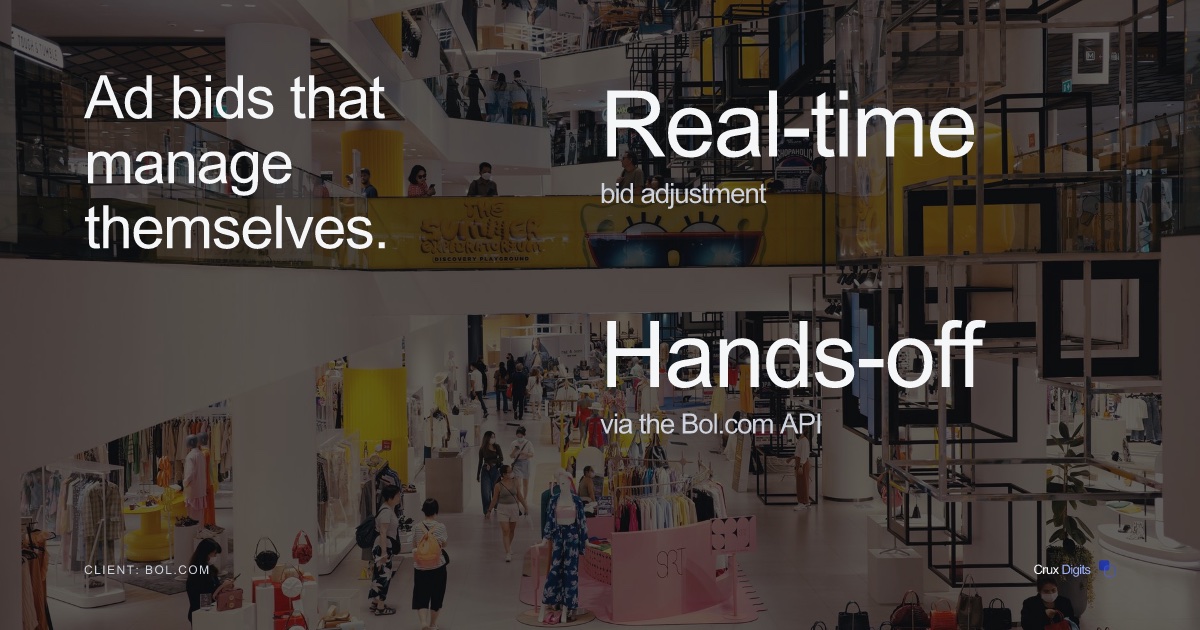
Real-timeBid adjustment to target ad positions
Hands-offAutomated via the Bol.com Advertising API

Real Crux Digits engagement; client name withheld pending permission. Capability described as delivered — no published outcome metric is claimed.

How does it decide what to bid?

It reads live ad positions via the Bol.com Advertising API and adjusts bids toward your target placement, always staying inside the maximum bid you set.

Do I keep control of the budget?

Yes. You configure the maximum bid and the target product pages; the system optimises within those limits and never bids past them.

↑ All cases

Have a problem that looks like one of these?

Tell us what you are trying to fix. We will scope a focused pilot on your own data and report real numbers — not promises.

Book a free consultation →