
Insights & guides
Practical AI for business
No-hype thinking for business leaders — cost guides, honest comparisons and plain-language explainers on getting real value from AI.
No-hype thinking for business leaders — cost guides, honest comparisons and plain-language explainers on getting real value from AI.

Usage-based billing goes default-on for Microsoft 365 Copilot Business on 1 December 2026, but not yet in the Netherlands or Belgium, and not for the enterprise licence at all. What an IT manager at 250 to 5,000 FTE is actually exposed to, and what one Activate click delegates.
Read more →22 October 2026
PHP2Shell is fixed in PHP 8.2 to 8.5, and that part is a package update. Applications still on PHP 8.1 or older get no upstream fix, and their code is nobody's job by default. The three owners, the inventory fields that matter, and a plan for this week.
Read more →22 October 2026
Gemini 4 Argon doubles on 1 December. The full tier table against Claude Opus 5.5 and Sonnet 5.5, why you cannot provision the cached rate, and which lever is actually bigger than the date.
Read more →21 October 2026
EU hosted describes where the inference runs. A model call also leaves through retention, human review and operator access, and Microsoft's 20 October 2026 sovereignty announcement is about the last of those. The four paths, the artefact that evidences each, and what a 250 to 5,000 FTE IT department can ask for.
Read more →21 October 2026
Your supplier switched AI on in software you already licensed. The Dutch state's three-step handreiking dead-ends for a private buyer at step one; the processor agreement and a 2 December 2026 AI Act deadline do not.
Read more →21 October 2026
Models get better and prices fall, so should you wait? A founder on what waiting buys, what it never buys, and how to start so the next model release does not undo your work.
Read more →20 October 2026
Three LiteLLM vulnerabilities reached CISA's exploited list in four months, one of them a day before its own CVE record existed. The dated signal timeline, why EPSS still ranks it in the bottom half, and who in a 250 to 5,000 FTE estate owns an AI gateway's version number.
Read more →20 October 2026
Entra Agent ID is generally available and governs agents properly. The gap is the population that never entered it, and the three agent credentials launched in October 2026 add issuers without adding a single off switch that reaches them.
Read more →20 October 2026
Nobody licenses an AI consultant in the Netherlands. A founder on what Anthropic's new Frontier Academy badges prove, what they leave out, and five checks that work without any credential.
Read more →19 October 2026
Under the Dutch Cyberbeveiligingswet, three parties around one AI system have three different legal positions. Why the standard supplier questionnaire over-asks the party nobody supervises and under-asks the one that is regulated.
Read more →19 October 2026
Mistral Large 4's open weights are due 31 October 2026 and no licence text exists yet. What a trillion parameters actually cost to self-host, why the break-even is 42 billion tokens a month, and what an IT manager can decide before the date.
Read more →16 October 2026
Dutch organisations put AI on the IT department's desk this year while policy-based use fell from 27 to 19 percent. The two groups of AI decisions, which ones an IT manager can settle alone, and three artefacts that make ad hoc use auditable in a fortnight.
Read more →14 October 2026
Google and Microsoft now ship the agent with the platform. A founder's account of when that is enough, the four tests I apply in a first call, and the four jobs an AI consultant still has once the assistant comes in the box.
Read more →13 October 2026
Microsoft Execution Containers reached GA on 7 October 2026 and Anthropic cut internet access to its own evaluations two days later. Both moved containment into the environment. The gap nobody has written down: enforcement is cross-platform, the denial record is Windows-only.
Read more →13 October 2026
A proposal is a promise written before anyone has seen your data. The lines a founder reads first: what done means, who owns exceptions, what is left out and what happens after delivery.
Read more →12 October 2026
Your housing corporation's IT estate already runs on CORA, five Aedes data standards and a thirty-supplier covenant. Your AI supplier signed none of them. What to require instead.
Read more →12 October 2026
Incident-Arena gave frontier agents 20 human-built incidents on live Kubernetes clusters and checked both whether the service recovered and whether the repair stayed in scope. Of the episodes that applied the full reference fix, only 59 percent passed. Why the approval gate misses the failure class that dominates.
Read more →9 October 2026
A 1983 Belgian collective agreement requires written information and consultation three months before you roll out new technology. It reaches AI, it ignores risk class, and the AI Act's deferral does not touch it.
Read more →8 October 2026
TOPdesk Robin rolls out from October 2026. Before you switch on AI in your service desk, measure the share of your own closed tickets a knowledge article could already have answered. Here is the method, the arithmetic and why a Dutch queue behaves differently.
Read more →7 October 2026
DAYJOB scores an agent attempt as a pass only if it meets every one of about fifty binary criteria. Decompose the 24.7 percent headline and you get roughly 97 percent per criterion, and a scoping rule: about four checkable criteria per agent handoff.
Read more →6 October 2026
FinOps for AI makes an AI system's running bill visible, owned and measured per case. A founder on where the invoice should land, why finance should never see tokens, and what the 2023 Dutch energy price cap teaches about AI budgets.
Read more →6 October 2026
We pulled five years of Eurostat survey data on AI use in Belgian companies and compared it with the Netherlands and the EU. Belgium went from seventh to fourth, its large firms are second in the EU, and its manufacturers use AI at more than twice the EU rate. The barriers rose with it.
Read more →5 October 2026
We pulled five years of Eurostat survey data on AI use in Dutch companies and split it by size, sector and type of AI. Two thirds of large Dutch firms now use AI, the Netherlands fell from third to sixth in the EU, and AI inside the process did not move for three years.
Read more →5 October 2026
An AI RACI sets out who builds, who decides, who is consulted and who is informed for each part of an AI system. A founder on why he draws it with your IT team and ICT partner before any code, and the rows generic templates miss.
Read more →5 October 2026
Your ICT partner added an AI line this year, and their own industry survey says 48% of providers call AI the top client need while 13% earn real money from it. How to read the Microsoft badge, and the three offers hiding behind one sentence.
Read more →5 October 2026
NVIDIA's Open Agent Safety Platform put the headline on silicon. The part you can deploy now is Apache 2.0 and runs on an ordinary Linux host. Four choices decide whether an agent sandbox survives your change process and your audit.
Read more →4 October 2026
The EU model AI clauses and GIBIT 2025 are the only AI procurement templates a Dutch buyer can reach, and both were written before the Digital Omnibus. A clause-by-clause verdict for a private mid-market IT organisation.
Read more →1 October 2026
The EU model AI clauses and GIBIT 2025 are the only AI procurement templates a Dutch buyer can reach, and both were written before the Digital Omnibus. A clause-by-clause verdict for a private mid-market IT organisation.
Read more →1 October 2026
Your certified ISMS transfers more machinery to ISO 42001 than you expect and almost none of the content. And the certificate answers a procurement question, not an AI Act one.
Read more →30 September 2026
OpenAI Dots launched on 29 September 2026, and in Europe it arrives through business plans only. A comparison with Grok Bot, Hermes Agent, OpenClaw, Scout and Cowork on identity, approvals, memory and exit, for IT managers in the Netherlands and Belgium.
Read more →29 September 2026
AI change management for IT managers: sort changes to an AI system by what they can break, not by which file they touched. A founder's three tiers that keep routine prompt edits out of the CAB and the dangerous ones in.
Read more →29 September 2026
The Claude Marketplace opened with 2,000+ listings and three assurances: a review, a safety scan and a pinned commit. Each has a documented gap, and they share one cause.
Read more →29 September 2026
An AI exit strategy is three things your IT organisation keeps: the evaluation set, the data contracts and the prompt and model registry. OpenAI retires its hosted versions of two of them on 30 November. A founder on where to draw the in-house line with a specialist AI supplier.
Read more →28 September 2026
Every shadow AI playbook says discover first, then block. In a Dutch organisation the discovery layer is the part that needs works council consent, and the sanctioned tool is the part that does not. So invert the order.
Read more →28 September 2026
DAREBench ran 35 models through one agent runtime over six workload groups. No model led more than three, the best multimodal score with tools was 61.8 percent, and 124 of 143 false passes came from locally served models. What that changes in a model choice and a supplier acceptance test.
Read more →25 September 2026
The Belgian NIS2 supply chain duty reaches your direct suppliers only. For an AI system, that stops one tier short of the party holding the answers. What to ask, and what to put in the contract instead.
Read more →24 September 2026
A model returns a wrong answer at 02:00. ITIL says that is not an incident, the NLdigital Voorwaarden 2025 say it is not an error, and the model provider disclaims accuracy outright. Three definitions, one uncovered failure, and four sentences that close it before go-live.
Read more →23 September 2026
Anthropic published Claude Opus 5.5 on 22 September 2026: 40% lower cost on typical workloads, cache reads down 60%, and a lead on agentic coding. What that changes for a company already running AI, and what it does not.
Read more →23 September 2026
Making AI use compulsory produces one number: usage. It was never the number in doubt. A founder on what a mandate actually measures, what Dutch and Belgian law says about requiring it, and the three things worth requiring instead.
Read more →22 September 2026
A June 2026 gap analysis scored five agent protocols on governance and MCP got one point out of twelve, for audit. Four weeks later the 2026-07-28 spec retired one of the two constructs that point rested on. What an agent audit record has to contain, and which log a Dutch SME actually owes today.
Read more →22 September 2026
Jev returns typed decisions instead of text, and the community rebuilt its interface on open weights within days. The guarantee covers shape, not truth, and the calibration plot that would justify automating on it has not been published.
Read more →22 September 2026
A RAG index goes stale in two ways, and most of the 2026 advice fixes only one. Change lag yields to faster re-indexing; version collision does not. What the new enterprise benchmarks measure, what re-embedding a 40,000-document corpus actually costs, and why the Dutch bewaarplicht makes pruning unavailable.
Read more →18 September 2026
The AI Act now extends part of its SME relief to small mid-caps under 750 staff. Which reliefs a 250 to 500 FTE Dutch firm actually gets, which four it does not, and why the 750 threshold is the only one that counts for AI.
Read more →17 September 2026
Of the Dutch micro-firms that considered AI and said no, 71.6 percent blamed lack of experience and only 20.3 percent the cost. What the CBS figures for 2 to 10 staff actually say, why cost stopped being the barrier, and which objection your sector hits first.
Read more →16 September 2026
OpenAI's Agents API, Anthropic's Managed Agents and Google ADK 2.0 moved the agent loop onto the vendor's control plane. What that costs in data retention, EU residency, billing shape and portability, read off the endpoint tables rather than the launch posts.
Read more →15 September 2026
Process automation is scoped from a diagram that only describes the happy path. A founder on why the exceptions decide the outcome, how to sort them into three kinds, and what to write down before anyone quotes a price.
Read more →15 September 2026
Dutch research says 57% of employees who use AI at work now have it in their fixed routine, while only 42% of them say their organisation has rules for it. A founder on why that gap is about recall, not policy.
Read more →14 September 2026
Every AI-agent identity draft at the IETF is an individual submission with no formal standing, and two of the four most-cited have already expired. What actually ships today, and the pattern to build now.
Read more →14 September 2026
AI implementation rarely stalls on the technology. It stalls because nobody inside the company owns the system after go-live. A founder's account of the difference between a sponsor and an owner, how to pick one, and the hours it honestly takes.
Read more →14 September 2026
The Wtta admission is decided by an inspection that draws 10 or 15 worker files at random and traces each across ten documents. Why that makes it a reconciliation problem for Dutch staffing agencies, and what to automate before 1 November 2026.
Read more →14 September 2026
Regulation (EU) 2026/1744 is now binding law: high-risk AI Act deadlines move to December 2027, SME documentation gets a simplified template, and AI-literacy duties soften. What actually changed for Belgian SMEs, and what still applies on schedule.
Read more →14 September 2026
The model you built on has a published retirement date, and three other things break in year two. A founder's view on what AI implementation actually costs in attention after go-live.
Read more →14 September 2026
Two in three notaries in the KNB survey use AI and a third have no office rules for it. A register-based test for what a notariskantoor should automate, and what it must not.
Read more →14 September 2026
Astra scores 72.6 percent on OSWorld. Humans score 72.36 percent on the same 369 tasks. That parity matters most for the Dutch systems that never had an API worth using, and the footnote in the version number decides how much.
Read more →11 September 2026
ViDoRe V3 shows visual retrievers beating text pipelines on real enterprise pages. Its corpora are French and English only, and the small models lose half their score when the language shifts. What that means before you drop OCR for Dutch documents.
Read more →11 September 2026
What AI may do in a Dutch brokerage, and the three points where Wwft and NRVT rules keep a named person signing. With the stack, the limits and the payback maths.
Read more →10 September 2026
AI drafts a quote in seconds. It should not own the calculation. Why a generated price binds you under Dutch law, what a stale cost base costs in 2026, and the setup that works at 20 to 50 people.
Read more →9 September 2026
Article 50 has applied since 2 August 2026. Why C2PA marking dies in your publishing pipeline, what the Commission says a deployer still owes, and the three fields that fix it.
Read more →8 September 2026
Almost every AI strategy you can read was written for a company a hundred times your size. A founder on which enterprise doctrine to translate, which to skip, and the one page a firm of thirty actually needs.
Read more →7 September 2026
Dutch advice offices have had a machine-readable data standard since the 1980s. That changes which AI is worth buying, and which is theatre.
Read more →7 September 2026
OpenAI shipped GPT-6 Astra on 4 September. The headline benchmark is a harness artefact, the identical list price hides a fourfold gap on the line that dominates agent bills, and the reasoning trace you were logging as an audit trail was never evidence.
Read more →5 September 2026
The 2026-07-28 MCP spec deprecated Dynamic Client Registration for Client ID Metadata Documents. Why the DCR error is misleading, who supports CIMD, and why Entra ID supports neither.
Read more →4 September 2026
Belgium's Peppol mandate deleted the invoice-reading project and left three harder ones. What a Flemish SME should automate in 2026, and why an MLS is not an acceptance.
Read more →3 September 2026
If you use AI tools but do not train models, four GDPR articles decide your duties. The 2026 Digital Omnibus state of play, what vendors actually retain, and when a DPIA is mandatory.
Read more →2 September 2026
Fable 5.1 kept its $10/$50 price and cut cache reads 75 percent. What that saves, what a task really costs, the effort dial, three breaking changes, and what to do.
Read more →2 September 2026
AI automation projects rarely agree on how wrong the system is allowed to be, so nobody can say afterwards whether it worked. A founder on error rates, detection speed and recoverability, and what the Dutch dike norms get right that most AI projects do not.
Read more →1 September 2026
MCP Tasks left the experimental core and became an extension on 28 July 2026, flipping from client-requested to server-directed. What changed, why polling became the only option once sessions were removed, and what the 22 August roadmap will change next.
Read more →1 September 2026
Excel is still right for many stockrooms, and a growing risk for the rest. The three signals you have outgrown it, and five rules that keep it healthy meanwhile.
Read more →29 August 2026
A 2026 benchmark over 23,088 queries found BM25 beating a top embedding model on text-and-table documents, and in a sampled failure audit, 73% of retrieval misses were table structure, not vocabulary. What to fix, in what order.
Read more →21 August 2026
Layout is a sequence: flow first, then zoning by movement, then aisle width. Get the order wrong and you work around the building for years.
Read more →20 August 2026
In a sector turning work away for lack of monteurs, an AI project that saves office hours optimises the wrong variable. A capacity-first test for ranking AI use cases in an installation company, what the 1 July 2026 grid queue changed about intake, and the payback math worked out for a 30-person firm.
Read more →20 August 2026
Most SMEs asking to train AI on their own data need retrieval or a tool call instead. The four mechanisms, the real cost of each, and how to choose.
Read more →19 August 2026
A first AI project can succeed for reasons that never repeat: novelty, senior attention and one volunteer. The second AI project is where a company finds out whether it actually changed, and Dutch healthcare had a word for the failure mode long before AI did.
Read more →18 August 2026
Every agentic checkout protocol assumes a card. Around seven in ten Dutch online payments run on iDEAL, a bank redirect mid-migration to Wero, so no agent will be completing Dutch checkouts soon. What UCP, ACP and AP2 each cover, and what to build instead.
Read more →18 August 2026
A TMS owns the shipment, the tariff, the subcontractor and the paperwork. What that means in practice, and how it differs from telematics, planning and a WMS.
Read more →18 August 2026
Google reshuffled its AI leadership and lost four senior researchers in one week. Here's the model-router architecture: rule-based, semantic and predictive routing, circuit breakers, multi-provider failover. It keeps a production agent stack running no matter which lab has a bad quarter.
Read more →14 August 2026
In most industries you buy by default and build by exception. Medical publishing flips that more often, not because the tools are worse, but because of a cost that appears on neither side of the usual comparison.
Read more →12 August 2026
Vendors selling data warehouse projects say build the foundation first. For most 20–50 FTE Dutch SMEs, a direct AI connection to Exact Online or AFAS works from day one, and the numbers show exactly when a warehouse earns its cost instead.
Read more →12 August 2026
The incentive difference between 3PL and 4PL, the six messages that decide day-to-day quality, and two Benelux specifics that quietly cost money: laadmeter billing and ladingdrager balances.
Read more →11 August 2026
Three words used interchangeably in the same meeting, answering three different questions. Which one you actually need, and what it costs to choose wrong.
Read more →11 August 2026
Most P2P projects start at the invoice, which is the wrong end. Three-way matching, straight-through rate, PO coverage, and the fraud controls automation must not remove.
Read more →11 August 2026
An ERP knows what you own; a WMS knows where it is and who touched it. The boundary, the three things that kill implementations, and when you do not need one.
Read more →11 August 2026
Building software became affordable, so deciding what to build became the expensive part. That changes how many experiments you should run, and what actually limits you.
Read more →11 August 2026
Automation removes the incidental second pair of eyes. Where four-eyes genuinely belongs, what an audit trail must contain, and why a retried instruction becomes a duplicate payment.
Read more →11 August 2026
95% on time × 97% in full is 92.2% OTIF, not 96%. The four definitions that move the number ten points without anything changing, and what actually improves it.
Read more →11 August 2026
A quotation with forty minutes of work can take nine days. The waiting is the lead time, and most of it is created by handovers, not tasks. How to find it and remove it.
Read more →11 August 2026
A baseline, a pass mark, one counter-metric and a named owner. Four things written down before the build, and the difference between a pilot that concludes and one that just ends.
Read more →11 August 2026
AI vendor lock-in got real in June 2026 when an export-control order took a frontier model offline overnight. But the lock-in I actually see wreck Dutch mkb projects is quieter: depending on the consultant who built the system, not the platform it runs on.
Read more →11 August 2026
Everyone quotes AI time savings. Almost nobody publishes the arithmetic. Here is a worked model of a five-person publications team, with every assumption stated so you can disagree with it precisely.
Read more →11 August 2026
n8n's August 2026 Metabase breach and the February sandbox-escape CVE chain both prove the same point: n8n is a credential vault. What SMEs running Exact, AFAS or e-Boekhouden through it need to check this week.
Read more →11 August 2026
Lay summaries are mandatory, high-volume, multilingual and derived from already-approved text, which makes them the one place in medical publishing where the usual AI constraint barely applies. Almost nobody says so.
Read more →10 August 2026
For a Dutch webshop with one to ten people, AI already pays off in recommendations, chatbots and product copy, not yet in an in-chat checkout. What fresh CBS data on micro-businesses, the 2 August AI Act deadline and the 2026 agentic-commerce stall mean in practice.
Read more →10 August 2026
Regulatory medical writing produces the documents a medicines authority reads. It is a different discipline from publications work, with different rules, and it is where the largest published AI time savings have appeared.
Read more →9 August 2026
Every medical affairs team runs on a spreadsheet that has outlived its author. It is not a sign of backwardness. It is a monument to somebody who cared. It is also where the compliance risk quietly lives.
Read more →8 August 2026
Four separate regimes govern AI in medical publications, and they are constantly confused. The one that bites first is not the law. It is your publisher contract. Here is the map, with what changed in July 2026.
Read more →7 August 2026
MLR stands for Medical, Legal and Regulatory: the cross-functional sign-off every piece of pharma promotional and scientific content must pass. Here is how it works, why it takes weeks, and which parts AI can compress.
Read more →6 August 2026
Not on current rules, and the reason is structural, not sentimental. ICMJE forbids AI authorship because authorship carries accountability a model cannot hold. What changes is which parts of the job survive.
Read more →6 August 2026
For a Dutch care practice of twenty to fifty people, AI pays off in the scribe and the intake bot, not the diagnosis. What the AVG, NEN 7510, Wkkgz and the EU AI Act's new transparency duty actually require, the payback math for a group practice, and where a first pilot should start.
Read more →6 August 2026
Dutch law gives every new hire a proeftijd before they get real authority. Most businesses skip that step entirely with their first AI agent. A founder's framework for graduated trust, built on Gartner's autonomy levels and Dutch employment law, before you hand an agent the keys.
Read more →5 August 2026
A chatbot answers; an agent acts. For a 20-50 FTE Dutch business, the real question is which tasks need that autonomy, not which label to buy. A five-level framework, four worked examples, and the honest failure-rate numbers.
Read more →5 August 2026
A July 2026 benchmark tested whether AI agents actually follow long company policy documents, not just whether they finish the task. The best model passed 36.2% of trials. Here's what that means for guardrail design and AI Act timing.
Read more →4 August 2026
Most AI projects don't fail in production. They fail before they start, when nobody was honest about whether the business was ready. A founder's honest account of the test I actually use before I'll take a project on, and why saying no early is often the most useful thing I do.
Read more →3 August 2026
A 250–500 FTE Brainport-tier supplier is too big for SLIM and MIT subsidies and too lean for an enterprise AI budget. Where the payback actually is, worked out with real numbers.
Read more →3 August 2026
For a Dutch contractor of five to fifty people, AI pays off in quoting, meerwerk capture and the handover file, not on site. Where the admin hours actually go, why the Wkb does not yet cover renovation despite what software marketing implies, and which process to automate first.
Read more →31 July 2026
Computer-use AI agents can browse, click and fill in forms with your credentials, and a June 2026 University of Washington study found four of seven agentic browsers let attackers bypass the same-origin policy. What changed since, what Anthropic's Opus 5 numbers actually mean, and how to deploy one safely.
Read more →31 July 2026
The final MCP 2026-07-28 specification shipped on 28 July 2026 with breaking changes across transport, server-initiated requests and authorization. A practitioner's migration order, and why MRTR, not the stateless core, is the change most likely to break something you depend on.
Read more →31 July 2026
Belgium uses AI more than the Netherlands (34.5% vs 33.2%, Eurostat). Which applications pay back for Flemish SMEs, what they cost here, and why the kmo-portefeuille no longer funds AI advice: only training.
Read more →31 July 2026
Part 5 of the MCP series: the demo works. Now it has to work on a Tuesday in November when the API is slow, the schema changed and nobody remembers who built it.
Read more →31 July 2026
Open-weight models trail the closed frontier by roughly four months, a gap that has not widened materially in two years. Why capability stopped being the deciding number, what the Dutch pc-privéregeling tells us about how this transition actually plays out, and when a Dutch or Flemish SME should still pay for a closed model.
Read more →31 July 2026
Part 4 of the MCP series: an MCP server does exactly what its access allows, so the design work is deciding what it may not do. Prompt injection, scoping, approval steps and audit trails.
Read more →31 July 2026
Part 3 of the MCP series: the reconciliation, reformatting and copy-paste work that quietly consumes a week a month, and how to automate it without handing a model a live workbook.
Read more →31 July 2026
Part 2 of the MCP series: which systems are worth wrapping first, how to choose between a local and a remote server, and why the shape of your tools matters more than the transport.
Read more →31 July 2026
AI agent observability, unpacked for 2026: the OpenTelemetry GenAI tracing standard, the Langfuse/Arize/Confident AI eval layer, and a concrete cost-per-trace budget for Dutch SMEs running agents in production.
Read more →31 July 2026
MCP is a standard way for an AI assistant to reach your systems, so you build one connector per system instead of one per assistant. Here is what it is, what it is not, and the three pieces you actually need to understand.
Read more →31 July 2026
Flanders approved a renewed AI-training Kenniscentrum on 3 July 2026, backed by AI-Barometer data showing adoption nearly doubled while skills remain the top barrier. What changes, what doesn't, and what to do now.
Read more →30 July 2026
Most SMEs pick their first AI process by gut feeling and burn months on the wrong one. A 3-factor framework (volume, rule-clarity, stability) to score your processes, plus the real payback math behind invoice automation.
Read more →29 July 2026
Most automation plans don't die from bad thinking. They die when the comfortable 60% is done and the harder, disruptive 40% quietly gets shelved. Why the cash-flow-comfort trap stalls execution, and how one HR hiring platform automated its way to serving more clients with the same team.
Read more →28 July 2026
Most AI pilots don't die from a bad model. They die when nobody redesigns the job around them. A founder's honest look at why AI adoption fails, and the unglamorous work that makes it stick.
Read more →28 July 2026
In the first seven months of 2026, five competing agent frameworks (LangGraph, Microsoft Agent Framework, Google ADK, Pydantic AI and Bedrock AgentCore) independently converged on the same architecture: graph-based execution with mandatory human approval built in. Here's what changed, what a 64-subagent math proof reveals about the ceiling, and how a Dutch technical team should choose.
Read more →28 July 2026
The number in a quote predicts almost nothing. How a client reacts to it predicts almost everything. A founder's field guide to what the pricing conversation actually reveals before any work begins.
Read more →27 July 2026
AI trims 20-30% off inventory costs for Dutch wholesalers, and the EU's coming e-invoicing rules will force the same clean data anyway. What a 20-50 FTE distributor should automate first.
Read more →27 July 2026
The Netherlands built its agritech lead on hardware: Lely's robots, Westland's greenhouses, Wageningen's research. The next wave is software: data layers, AI models, decision support. What that means for agtech product companies.
Read more →26 July 2026
A feeding robot executes a schedule; it cannot tell you whether the ration works. What AI adds on top of a voerrobot: linking feed data to per-cow yield and health, ration scenario support, cost forecasting and early alerts, on your own data, vendor-independent.
Read more →26 July 2026
A definitional explainer written the way a practitioner would: what Industrie 4.0 actually is, and how a Dutch SME starts small (connecting existing machines and adding one useful analytics use case) instead of buying a platform that never gets used.
Read more →26 July 2026
Most 'what is SCADA' pages stop at supervise-and-control. They skip the part that actually pays off years later: the historian. Here is what a SCADA system does, what its data really contains, and why clean tags and sample rates decide whether that data ever becomes predictive maintenance, energy savings or OEE.
Read more →26 July 2026
Dutch dairy farms are among the most sensor-dense workplaces in agriculture: milking robots, activity collars, feed systems, herd management software. AI turns that stream into per-cow decisions: health flags, heat timing, feed efficiency, forecasts. The blocker is rarely the model; it is the data silos.
Read more →26 July 2026
Precision agriculture works in 2026, but not everywhere. What genuinely pays on Dutch farms (section control, variable-rate taakkaarten, yield maps), what is still research, and why the real bottleneck is data integration rather than sensors.
Read more →26 July 2026
A digital twin is a live, data-fed model of a real asset that mirrors and predicts its behaviour, not a 3D visualisation. Here is what it actually needs and when it pays off.
Read more →26 July 2026
A milking robot measures every cow at every milking: yield, conductivity, behaviour, feed intake. Most of that data never leaves the vendor platform. Here is what AI models trained on your own herd data can do with it, and the practical route from export to a small proof of concept.
Read more →26 July 2026
Dutch farms are full of robots and sensors, yet daily decisions still run on gut feel and five separate apps. Smart farming starts where data crosses vendor silos and actually drives decisions. Here is what that layer looks like.
Read more →26 July 2026
What custom software development really costs in the Netherlands: hourly rates, project ranges by size, what drives the price, and how to spend less for the same outcome.
Read more →26 July 2026
Anthropic's Claude Opus 5 landed 24 July 2026, closing most of the gap to flagship Fable 5 at half the price. Here's what the benchmarks, alignment results and early customer use cases actually show.
Read more →24 July 2026
Microsoft, IBM, Gartner, McKinsey and Deloitte all published their 2026 AI predictions within weeks of each other. Filtered for what a Dutch SME actually has to decide this year, the list is short, and it isn't the one making headlines.
Read more →24 July 2026
Context engineering, not bigger context windows, is what separates production AI agents from demos. What it means, why context rot is real, and a practical token budget for Dutch SME agent projects.
Read more →24 July 2026
GraphRAG's indexing cost collapsed from $33,000 to near-vector-RAG parity in 2026, but that doesn't mean every AI agent needs a knowledge graph. A practitioner's decision framework, with the numbers.
Read more →24 July 2026
AI route planning saves Dutch carriers 15-25% on fuel, while the EU's eFTI deadline is about to force freight paperwork electronic either way. What to automate first, by fleet size.
Read more →23 July 2026
AI cuts invoice processing cost by 70-90% for a 20-50 FTE Dutch SME, and the Netherlands' looming Peppol e-invoicing decision changes what to build first. The numbers, the chain, and who it pays off for now.
Read more →22 July 2026
Every headline says there's an AI talent shortage. After four years running an AI consultancy for Dutch SMEs, here's the skills gap that actually kills projects, and it isn't the one on LinkedIn.
Read more →21 July 2026
n8n, Make and Zapier all shipped AI agents in 2026 with near-identical feature lists. The real decision is billing model and data residency. Here is the framework, with real numbers.
Read more →21 July 2026
AI in Dutch vehicle repair is built for 80-location chains and insurer platforms, not the independent garage. What's actually realistic for a 3-20 person shop in 2026 (WhatsApp photo intake, scheduling automation, status updates) and the payback math behind it.
Read more →20 July 2026
Everyone calls themselves an AI consultant in 2026. After four years running one, here is the one question that actually separates the good ones from the rest.
Read more →20 July 2026
95% of enterprise AI pilots never reach production. Four frameworks (Pydantic AI v2, LlamaIndex Workflows 1.0, the Claude Agent SDK and n8n) shipped durable-execution primitives in June and July 2026 to fix exactly that. Here is the reliability math and which one fits your stack.
Read more →17 July 2026
The EU AI Act's high-risk deadline moved to 2027, but chatbot disclosure and AI-literacy duties still land on 2 August 2026. What Flemish SMEs (1–50 FTE) must actually do before then.
Read more →16 July 2026
Can an AI voice agent answer your business phone? A practical 2026 guide for Dutch SMEs: the tool stack, Dutch-language quality, cost per minute, the AI Act disclosure rule, and when voice beats WhatsApp or email.
Read more →15 July 2026
What an AI agent actually is versus a chatbot, how it plugs into the software you already run, six processes it can take over today, and what it honestly costs to build and govern one.
Read more →14 July 2026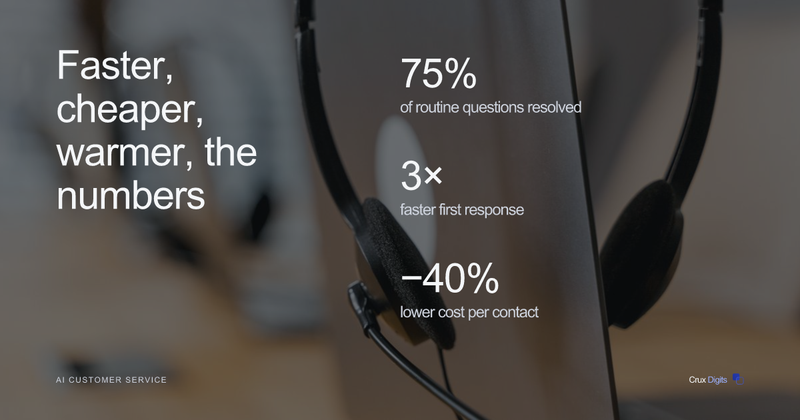
How an MKB business gets enterprise-grade customer service with AI: the numbers, the four moving parts, the AVG and EU AI Act guardrails, and the bot pitfalls that turn a good idea into an angry customer.
Read more →14 July 2026
Every founder asks which AI model to use. After four years running an AI consultancy, here is why your AI strategy should not depend on the answer.
Read more →14 July 2026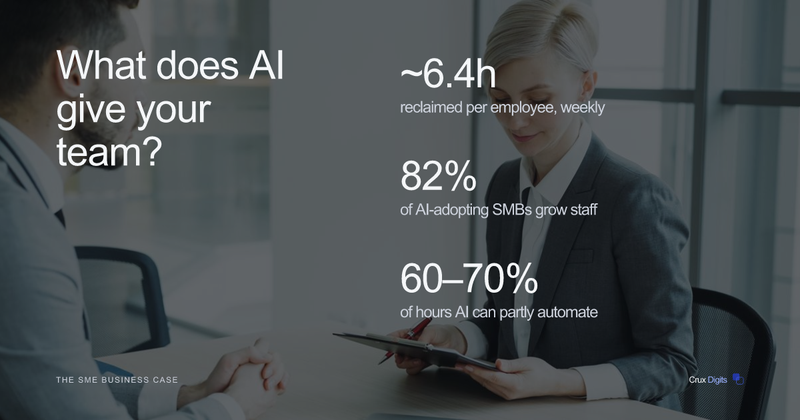
The honest business case for AI in a small business, built around augmentation, not the replacement fantasy. Where the hours go, what AI takes off people's plates, and a simple framework to reason about the return.
Read more →14 July 2026
Connecting an AI agent to your tools rewrites your threat model. The lethal trifecta, the Langflow breach, MCP risks and a practical checklist for SMEs.
Read more →14 July 2026
Which AI use cases return more than they cost, and how soon? Twelve concrete ones for the Dutch MKB, each framed as problem, what AI does, and the return, with every number cited.
Read more →14 July 2026
78% of Dutch accountancy firms already use AI, but half don't know how to use it well. A practitioner's order of operations: which tasks to automate first, what the new NBA/NOREA guideline requires, and how it maps to Exact, Yuki, Twinfield and e-Boekhouden.
Read more →13 July 2026
A founder's build-or-buy framework for AI implementation: buy the boring eighty percent, build the rare twenty percent that is actually your edge, and why low-cost 2026 plumbing makes that discipline harder.
Read more →13 July 2026
Moravec's Paradox explains why AI breezes through analysis, drafting and forecasting yet fumbles the physical and social tasks any employee finds trivial, and why that flips the usual case for where AI pays off.
Read more →12 July 2026
AI agents forget because the model is stateless. Here is the memory architecture that fixes it: the four memory types, the 2026 tools, and when a Dutch SME actually needs one.
Read more →10 July 2026
OpenAI’s GPT-5.6 arrived 9 July in three tiers. We compare it with Claude Fable 5, Google’s Gemini 3.5 and China’s open-weight models (on benchmarks, price and real agentic work) and what it means for a Dutch SME.
Read more →10 July 2026
MCP, RAG, AI agents and A2A aren't rivals: they're four layers of one 2026 AI stack. How each works, how they compose, and which layer your problem actually needs.
Read more →9 July 2026
How AI on WhatsApp answers customer questions: the moving parts, the pricing model (inbound replies are free), the AVG and AI Act rules, and where it pays off for Dutch SMEs.
Read more →9 July 2026
Exact, AFAS and e-Boekhouden already ship AI, so where does a custom koppeling actually pay off? The integration patterns, API limits and a size-based decision framework for Dutch SMEs.
Read more →9 July 2026
Murati, Karpathy and Sutskever all left OpenAI to build rival labs. Here is what the 2026 AI talent war signals, and the model-agnostic playbook a Dutch SME should follow.
Read more →8 July 2026
A working AI demo is not the hard part. AI implementation is. A founder's take on what breaks between a slick demo and daily use, and how the rare projects cross from pilot to production.
Read more →8 July 2026
AI can read, draft and even send customer service email in 2026, but auto-send is a per-category decision, not a switch. A practical decision framework, the payback maths, and the Article 50 disclosure duty that was not postponed.
Read more →8 July 2026
On 28 July 2026 the Model Context Protocol gets its largest revision since launch: a stateless core, Tasks and MCP Apps. What changes, what breaks, and what SMEs buying or building agent integrations should do now.
Read more →7 July 2026
A practical, stack-agnostic guide to LLMOps: tracing, logging, quality and cost dashboards, drift detection, evals in CI, feedback loops, and on-call for AI.
Read more →7 July 2026
What Vlaio still funds for AI in 2026: kmo-portefeuille training support (30%/20%, €7,500 cap), the February 2026 advice abolition, innovation instruments, and how Flanders compares with the Netherlands.
Read more →6 July 2026
Your 15-year-old ERP is not a blocker for AI. Three integration patterns: read-only, write-back, wrap-and-extend. They put AI on top of legacy software in 60–90 days, no replacement needed.
Read more →6 July 2026
Technicians lose hours each week on paper work orders, retyped hours and chasing signatures. How Dutch installation companies automate the work-order chain, from voice note to invoice, and what it realistically saves.
Read more →6 July 2026
A practical, honest guide to LLM guardrails — the layered controls that stop hallucination, prompt injection and data leakage in production AI.
Read more →6 July 2026
A practical guide to LLM evaluation: task-specific metrics, an offline eval harness, LLM-as-judge pitfalls, regression testing in CI, and guarding against model drift.
Read more →4 July 2026
A practical guide to RAG evaluation: retrieval metrics, faithfulness and answer relevance, LLM-as-judge, and building the golden test set that makes quality measurable.
Read more →3 July 2026
A vendor-neutral 2026 comparison of pgvector, Qdrant, Weaviate and Pinecone for RAG — performance, filtering, cost, ops and EU data residency.
Read more →2 July 2026
Why AI projects fail is rarely about the technology. Here are the red flags I hear in the first conversation — and how to fix them before you spend a euro.
Read more →1 July 2026
A vendor-neutral guide to the best AI automation tools in 2026 — Zapier, Make, n8n, AI-native agents and more — with the trade-offs, pricing traps, and how to choose.
Read more →30 June 2026
Knowing when not to use AI is one of the most valuable things an honest consultant can offer. Why doing nothing is often the highest-return call.
Read more →30 June 2026
Enterprise AI adoption is where most pilots stall. A practical guide to scaling AI from proof of concept to production — with the integration, trust, and governance that make it stick.
Read more →29 June 2026
A founder's honest take on what a great AI consultation feels like — not a pitch, just two people trying to solve the right problem together.
Read more →28 June 2026
The 2026 World Cup runs on one of the largest real-time AI systems ever built: a 500Hz sensor inside the Adidas Trionda ball, sixteen limb-tracking cameras per stadium, and software that fuses it all in seconds. This guide explains how the smart ball and semi-automated offside technology actually work, who built them, and the engineering reality — sensor fusion, real-time pipelines and edge inference — that businesses can learn from.
Read more →27 June 2026
What a real enterprise AI strategy contains — portfolio, operating model, governance, funding — how it differs from a project plan, and how to build one that works.
Read more →26 June 2026
How to start an AI project: name the feeling underneath it first. Uncertainty, frustration, ambition or hope each point at a different, smaller first step.
Read more →25 June 2026
Machine learning earns its keep on high-volume, repetitive prediction problems where you already have good data. Here is where it pays off, where it is overkill, and when bringing in help is the smart move.
Read more →24 June 2026
A model that works in a notebook is a prototype, not a product. Here is how the train, test, deploy and monitor loop of MLOps turns a promising experiment into something your business can actually rely on.
Read more →24 June 2026
AI is the broad goal of making machines act intelligently; machine learning is the most common method for getting there. Here is the difference in plain English, and how to tell which one your business actually needs.
Read more →24 June 2026
A trained machine learning model is frozen the moment training stops. It does not keep learning from the data it sees in the real world, and over time the world moves on without it. Here is what that means for your business and what to do about it.
Read more →24 June 2026
Training AI on your existing company or customer data is usually lawful under GDPR/AVG, provided you have a valid lawful basis, respect the purpose you originally collected the data for, and protect any personal information. Here's what that means in practice for a Dutch business.
Read more →24 June 2026
Data engineering is the plumbing that turns scattered, messy company data into clean, reliable fuel for AI. Here is what it involves, how the pipelines work, and how to build ones you can trust in production.
Read more →24 June 2026
A practical, jargon-free checklist for business owners to judge whether their data is ready for AI or machine learning, spot the red flags, and fix the gaps before spending a cent on a model.
Read more →24 June 2026
We track frontier AI research so applied teams can see where things are heading. Four recent papers — on protein language models, self-play LLMs, streaming voice RAG, and formal verification in Lean — signal what's coming for capable, trustworthy systems.
Read more →24 June 2026
Most companies are sitting on enough data to build genuinely useful AI — the catch is whether that data is accessible, accurate and properly consented. Here's a plain-English walkthrough of what it actually takes.
Read more →24 June 2026
An impressive demo is not trust. Here is the practical framework for benchmarking AI against your own human experts, setting acceptance criteria, and keeping humans in the loop so you can defend relying on it in high-stakes work.
Read more →24 June 2026
An honest take on what a good AI consultation looks like: no pressure, no pitch. Why we'd rather you self-select than be sold — and why that makes better partnerships.
Read more →24 June 2026
A pragmatic, vendor-neutral roadmap for enterprise AI implementation in 2026 — phases, costs, the EU AI Act, and why projects stall before production.
Read more →23 June 2026
What an enterprise AI consultancy must deliver — procurement, security, EU AI Act governance, integration and multi-stakeholder buy-in — and how to choose one.
Read more →22 June 2026
A founder's view on building client trust: the shift in a first conversation that turns a guarded prospect honest, what earns it, and what quietly destroys it.
Read more →21 June 2026
A research-led synthesis of where AI is heading across the energy value chain, the productivity gains the major reports document, what is proven versus hyped, and what 2030 means for European utilities.
Read more →21 June 2026
How do large language models actually generate answers? A clear, no-maths explanation of next-token prediction — why LLMs are fluent, why they sometimes invent things, and how to make them answer from real facts.
Read more →21 June 2026
AI is pushing data-centre electricity demand up fast and straining grids from the Netherlands to the US, yet the same technology is one of the strongest tools to make networks more productive. The honest two-sided picture for energy leaders.
Read more →20 June 2026
The energy transition is, at its core, a forecasting and optimisation problem — exactly the kind of problem machine learning solves. Here is the research-backed view of where AI raises productivity across renewables, storage, grids and demand-side flexibility, with figures from the IEA, IRENA, NREL, DNV and peer-reviewed work.
Read more →19 June 2026
How standard-setting and certification organisations can turn dense technical documents into one governed, always-current, queryable knowledge layer with AI — without losing accuracy or control.
Read more →19 June 2026
How AI conformity assessment speeds up document-based pre-audit checks — reviewing evidence against a standard, auto-populating audit forms and flagging gaps — while the human auditor stays in charge.
Read more →19 June 2026
Why generic AI translation fails on technical standards and audit findings — and how a domain-specific, human-in-the-loop approach removes language barriers without sacrificing accuracy or control.
Read more →19 June 2026
An engineer's plain-language walk through EU AI Act compliance for high-risk AI systems — Articles 9 to 15, what they mean for MLOps, and the Aug 2026/2027 timeline.
Read more →18 June 2026
Do you need new software, or do you need clarity? After years with founders and operators, here's why the reflex to buy another tool is usually the wrong fix.
Read more →18 June 2026
A plain-language decision guide to work out whether your AI system is high-risk under the EU AI Act — the four risk tiers, Annex III, the Article 6 product route, and worked examples.
Read more →17 June 2026
Most people brace for a polished pitch. Here is what to expect from an AI consultant when the first conversation is built to find the truth, not to sell you a roadmap.
Read more →17 June 2026
What is RAG (retrieval-augmented generation)? A plain-language explainer of how the retrieve-augment-generate pipeline grounds AI answers in your own documents.
Read more →17 June 2026
Explaining AI in plain language is a discipline, not a dumbing-down. Here's why I dropped the buzzwords and started talking about problems people actually have.
Read more →16 June 2026
How machine learning helps DSOs, TSOs and aggregators manage grid congestion across Europe — forecasting, redispatch optimisation and flexibility market dispatch, with humans in control.
Read more →16 June 2026
What an AI hallucination is, why language models invent confident but false answers, the real business risk, and how to reduce hallucinations in practice with grounding and review.
Read more →15 June 2026
How AI predictive maintenance for offshore wind farms cuts unplanned vessel trips, extends component life and lifts availability across the North Sea.
Read more →15 June 2026
EU AI Act compliance manufacturing is now on the agenda for every Dutch factory running AI on the shop floor. Most predictive maintenance and quality-inspection systems are limited-risk, but AI embedded in safety-critical machinery or worker-monitoring tools can be high-risk. This guide explains how the Act applies, how it interacts with the Machinery Regulation, and how to build an AI strategy that is ready for both.
Read more →15 June 2026
Manufacturing data engineering for AI is the unglamorous foundation that determines whether your factory AI actually works. SCADA, MES, ERP, and IIoT data must be integrated, cleaned, and structured before any model can deliver value. Here is what Dutch manufacturers need to know before building a shop-floor AI platform.
Read more →15 June 2026
AI worker safety monitoring manufacturing systems use computer vision to detect missing PPE, flag hazard zones and spot ergonomic risks in real time — without turning your factory floor into a surveillance operation. This guide covers how the technology works, where the genuine privacy and legal boundaries lie, and what responsible deployment looks like for Dutch manufacturers.
Read more →15 June 2026
Dutch healthcare organisations face real pressure to adopt AI responsibly — but without a clear strategy, pilots stall and investments are wasted. This guide from Crux Digits, a vendor-neutral AI strategy consultancy in Utrecht, covers readiness assessment, use-case prioritisation, data foundations, EU AI Act compliance, and how to run a safe AI pilot in a regulated clinical environment.
Read more →15 June 2026
Medical AI in the Netherlands sits at the intersection of three major regulatory frameworks: the EU AI Act, the EU Medical Device Regulation, and the GDPR. Most diagnostic and decision-support AI tools are classified as high-risk. Here is what Dutch healthcare organisations need to know before deploying.
Read more →15 June 2026
AI healthcare billing automation in the Netherlands is helping clinics reduce administrative overhead, accelerate DBC declaratie workflows, and process insurance claims with fewer manual errors — while keeping clinicians in full control of every coding decision.
Read more →15 June 2026
EU AI Act compliance for professional services is not a distant concern — the regulation is live and obligations are already taking effect. This guide explains how the EU AI Act risk tiers apply to AI tools used by law firms and accountancies, how GDPR duties interact with AI data processing, and what practical steps Dutch professional-services firms can take now to protect client confidentiality, professional privilege, and their compliance posture.
Read more →15 June 2026
AI due diligence automation is reshaping how Dutch M&A lawyers and corporate legal teams review data rooms, extract red flags and produce findings reports — cutting document review time without replacing the professional judgement that makes due diligence meaningful. Here is what deal teams need to know before deploying it.
Read more →15 June 2026
AI billing automation for law firms captures time entries from emails, documents and calendar events, drafts invoices, and flags write-offs — before a fee-earner opens a billing screen. Here is what Dutch law firms and accountancies need to know before deploying intelligent time capture.
Read more →15 June 2026
AI sustainability reporting energy utilities are facing a step-change in disclosure obligations under CSRD. This vendor-neutral guide explains how AI can automate data collection, structure Scope 1-3 emissions records and draft ESRS-aligned reports — while keeping humans accountable for accuracy and auditability.
Read more →15 June 2026
AI smart meter data analytics is transforming how Dutch energy suppliers understand their customers — from machine learning energy consumption profiling and AI energy disaggregation to churn prediction and demand response. This guide explains how the technology works, what data and ethics obligations apply, and how Crux Digits helps utilities build these capabilities.
Read more →15 June 2026
AI energy trading price forecasting is transforming how Dutch traders and utilities navigate day-ahead and intraday electricity markets. A vendor-neutral, honest guide to machine learning models, data requirements, and the limits you must understand before deploying.
Read more →15 June 2026
EU AI Act recruitment high-risk AI obligations are now a reality for every Dutch employer using automated hiring tools. This guide explains what HR teams must do — from risk management and data governance to candidate transparency and human oversight — before the high-risk obligations apply.
Read more →15 June 2026
Bias in AI hiring algorithms can silently disadvantage candidates on the basis of gender, age or background — and expose Dutch employers to legal risk under both the EU AI Act and Dutch non-discrimination law. Here is how to detect it, measure it and fix it.
Read more →15 June 2026
HR analytics AI attrition prediction helps organisations identify flight risks before resignation letters arrive. This guide explains how predictive employee turnover models work, what data they need, how to handle GDPR and fairness obligations, and how Dutch HR teams can start from existing data.
Read more →15 June 2026
Telling a client not to build cost me a project and earned me years of trust. Why the best AI consultant in the Netherlands is the one who says you do not need this yet.
Read more →15 June 2026
AI OEE improvement manufacturing is no longer a pilot-programme concept — Dutch factories are using machine learning to raise availability, performance and quality simultaneously. An honest, vendor-neutral guide from Crux Digits.
Read more →14 June 2026
AI supply chain optimisation for manufacturing enables sharper demand forecasting, leaner inventory and earlier supplier risk signals — without pretending that models are infallible or that data quality problems solve themselves. A frank, practical guide from Crux Digits, Utrecht.
Read more →14 June 2026
Digital twin AI manufacturing and Industry 4.0 are reshaping how Dutch factories operate — but the value comes from decisions, not models. Here is what manufacturing leaders need to know before investing.
Read more →14 June 2026
AI visual inspection manufacturing systems are moving from pilot projects to full production-line deployment across Dutch factories. This guide covers how computer vision defect detection works in practice, what image-data and infrastructure requirements look like, where honest trade-offs lie, and how Crux Digits builds bespoke systems trained on your own product images.
Read more →14 June 2026
How Dutch manufacturers use AI predictive maintenance to forecast equipment failures, reduce unplanned downtime and schedule maintenance around production — and what it really takes to do it well.
Read more →14 June 2026
AI medical imaging diagnostic support is reshaping how Dutch radiology and pathology departments handle scan volumes — not by replacing clinicians, but by giving them better triage tools and decision support grounded in deep learning.
Read more →14 June 2026
AI appointment scheduling healthcare systems can predict which patients are likely to miss their slot, send personalised reminders and trigger automated rebooking — all while keeping clinical staff in control. Here is how Dutch clinics and hospitals can reduce patient no-shows responsibly.
Read more →14 June 2026
Retrieval-Augmented Generation can give clinicians instant, cited access to clinical guidelines and protocols at the point of care — without replacing the clinician's judgement. Here is what Dutch GPs, specialists and healthcare IT leaders need to know about RAG for clinical guidelines AI healthcare.
Read more →14 June 2026
An AI patient triage chatbot can gather symptoms, medical history and urgency signals before a GP appointment — reducing administrative pressure and helping clinicians prioritise. Here is what Dutch clinic and practice managers need to know about safe, GDPR-compliant deployment.
Read more →14 June 2026
AI clinical documentation automation is reducing the administrative burden on Dutch GPs and specialists — transcribing consultations in real time and structuring notes directly into the EHR. Here is what clinic managers and healthcare IT leaders need to know before deploying an ambient scribe.
Read more →14 June 2026
AI proposal generation is reshaping how consulting firms respond to RFPs and tenders. Here is what works, what to watch out for, and how Crux Digits builds bespoke drafting assistants for Dutch consultancies.
Read more →14 June 2026
An AI client intake chatbot for professional services captures enquiries around the clock, qualifies matters, prompts conflict checks and books consultations — before a fee-earner picks up the phone. Here is what Dutch law firms, accountancies and consultancies need to know before deploying one.
Read more →14 June 2026
AI legal research automation is reshaping how Dutch law firms and financial institutions search case law, monitor regulation and conduct due diligence. Here is what works, what the real risks are and how to deploy it responsibly.
Read more →14 June 2026
A RAG knowledge assistant lets lawyers, accountants and consultants ask plain-language questions of their firm’s own documents and get cited, auditable answers — without sending client data to a public cloud. Here is what Dutch professional-services leaders need to know.
Read more →14 June 2026
AI contract analysis software is reshaping how Dutch and EU law firms handle due diligence, risk review and document automation. This guide covers how NLP-powered systems work, where the genuine gains are, what the EU AI Act and GDPR require, and how Crux Digits builds bespoke contract-review solutions with confidentiality at the core.
Read more →14 June 2026
AI anomaly detection on energy grids is moving from research to production: Dutch network operators are using machine learning over smart-meter and sensor data to catch faults, predict outages and flag non-technical losses before they escalate. Here is what grid and utilities data leaders need to know.
Read more →14 June 2026
Computer vision energy infrastructure inspection is reshaping how Dutch utilities find faults in power lines, solar arrays, wind turbines and substations — before those faults become failures.
Read more →14 June 2026
Smart grid AI energy management lets DSOs and TSOs balance electricity in real time. How an AI energy management system handles load balancing, congestion and voltage regulation — with human operators firmly in control.
Read more →14 June 2026
AI energy demand forecasting helps Dutch utilities and grid operators balance load, reduce imbalance costs and plan capacity — without pretending the models are perfect. A practical, honest guide.
Read more →14 June 2026
How Dutch energy and utility companies use AI predictive maintenance to forecast equipment failures on transformers, turbines and substations — and what it really takes to do it well.
Read more →14 June 2026
AI recruitment chatbots handle candidate pre-screening, FAQ answering and application intake around the clock — freeing recruiters to focus on the conversations that matter. Here is what Dutch HR teams need to know before deploying one.
Read more →14 June 2026
AI employee onboarding automation can turn a week of chasing forms into a smooth, personalised first experience — while keeping your HR team in control and your GDPR obligations intact.
Read more →14 June 2026
AI interview scheduling automation removes the email ping-pong between recruiters and candidates. Here's how AI agents handle availability, calendar booking and reminders — and where human judgement still belongs.
Read more →14 June 2026
AI candidate matching platforms use vector embeddings and LLMs to surface best-fit talent in seconds. Here is how the technology works, what it means for recruiters and HR leaders, and what EU AI Act compliance looks like in practice.
Read more →14 June 2026
AI CV screening software can process hundreds of applications in minutes — but it also carries real risks around bias, GDPR and EU AI Act compliance. Here is a plain-language guide for HR and recruitment leaders in the Netherlands.
Read more →14 June 2026
Build an internal AI team or partner with a consultancy? The honest answer depends on strategy, urgency, talent and budget. Here's how to decide — and why most organisations end up doing both.
Read more →14 June 2026
AI agents vs RPA is the automation question every CTO faces in 2026. Here is an honest, vendor-neutral breakdown of when to use each — and why the smartest teams combine both.
Read more →14 June 2026
A vendor-neutral guide to choosing between OpenAI, Anthropic Claude, and open-source LLMs for your business in 2026.
Read more →14 June 2026
Azure OpenAI vs AWS Bedrock vs Vertex AI: an honest, vendor-neutral 2026 comparison on models, EU data residency and how to choose the right enterprise AI platform.
Read more →14 June 2026
A short discovery call is not me rushing you — it's me proving I understood the problem fast. Here's what I learn in 30 minutes and why clarity beats slides.
Read more →14 June 2026
A plain-language buyer's guide to choosing an EU-based AI partner: what GDPR by default, data residency, and EU AI Act alignment actually mean in practice.
Read more →14 June 2026
Agentic AI vs generative AI, explained plainly: one produces content from a prompt, the other plans and acts toward a goal. When to use which, and how they work together.
Read more →14 June 2026
A practical guide to AI for SMEs in Europe: realistic high-ROI starting points, the boutique-vs-big-consultancy gap, and how to start small with fixed-scope projects you own.
Read more →13 June 2026
An honest breakdown of what AI implementation costs — realistic ranges by project size, the real cost drivers, hidden run costs, and how fixed-scope pricing de-risks your budget.
Read more →12 June 2026
How computer vision works for GMP and pharma quality inspection — automated visual inspection of vials, blisters and labels — and why validation, not the model, is the hard part.
Read more →12 June 2026
How I know in the first ten minutes whether we can genuinely help with AI — before any talk of models, budgets, or timelines. The signals I listen for.
Read more →12 June 2026
How AI helps freight forwarders, customs brokers and 3PLs across the EU corridor cut manual document handling, classify HS codes, prepare ICS2/ENS data and clear faster.
Read more →11 June 2026
An AI readiness assessment checks your data, processes, skills, and governance before you invest. Here's what it covers and a self-assessment checklist to start.
Read more →11 June 2026
What does AI automation cost in practice? A plain-language breakdown of the real cost drivers, low-cost vs expensive automations, build vs subscribe, and how to estimate payback.
Read more →11 June 2026
Where AI pays off across the Rotterdam-Antwerp port corridor and Flanders: vessel ETA prediction, berth and yard planning, terminal optimisation, drayage, crane maintenance and customs automation.
Read more →10 June 2026
How to scope a narrow, measurable AI proof of concept with a clear success metric and a real path to production — and how to avoid pilot purgatory.
Read more →10 June 2026
A vendor-neutral framework for build vs buy AI decisions across cost, differentiation, data sensitivity, integration and lock-in — including when buying is simply right.
Read more →10 June 2026
Practical, low-risk generative AI use cases for Dutch SMEs, with rough cost bands and how to stay GDPR- and EU AI Act-aware.
Read more →10 June 2026
Fixed-price, time-and-materials, or staff augmentation? A plain-language guide to AI project pricing models, who carries the risk, and how to pick one without getting burned.
Read more →9 June 2026
A lawyer interprets the law, an auditor certifies it — but neither builds the system. Here is who you need for EU AI Act compliance, and why building it in beats bolting it on.
Read more →9 June 2026
AI in space is reshaping satellites, earth observation, and missions — from autonomous navigation to debris avoidance. A clear, vendor-neutral overview.
Read more →9 June 2026
A practical, repeatable method to measure AI ROI — set baselines, pick a high-volume use case, model the savings, then verify them after launch.
Read more →9 June 2026
A practical decision guide to RAG vs fine-tuning: what each does, when retrieval wins, when fine-tuning helps, and why many systems use both.
Read more →9 June 2026
A senior practitioner's honest read on the AI consulting trends and predictions shaping 2026: working software over strategy decks, agentic delivery, outcome-based pricing, the end of the pilot graveyard, EU AI Act compliance as a deliverable, and how to pick a future-ready partner.
Read more →8 June 2026
Most AI consulting ends in a 60-page strategy document and no software. Crux Digits works differently: by the second call you see a working AI MVP built on your own data — a proof of concept you can click, not slides. Here is why that changes everything about risk, buy-in and ROI.
Read more →8 June 2026
Design-first AI starts an AI product from the user experience, not the model. Why model-first projects stall, the principles that make AI products people actually use, and how Crux Digits applies design-first from audit to production.
Read more →8 June 2026
A clear, technical explainer on AI agents: what they are, how they work (LLM, tools, planning, memory), how they differ from chatbots, copilots and RPA, plus concrete business use cases, limits and a sensible way to start.
Read more →8 June 2026
A practical guide to AI for small and mid-sized businesses in the Netherlands: where it pays off, real use cases by function, what it costs, and the first three steps to take — without the hype.
Read more →8 June 2026
What the EU AI Act means for Dutch businesses, what applies from 2 August 2026, who enforces it, and a practical readiness checklist — in plain language.
Read more →8 June 2026
A grounded, hype-free read on the future of AI: the AI trends 2026 actually point to — agentic and multimodal systems, smaller and less expensive models, grounding by default, reliability as the new bottleneck, the EU AI Act, and the move from pilots to production ROI. What enterprise AI means for Dutch and Benelux businesses, and how to prepare.
Read more →8 June 2026
How to automate your quotation process with AI — extract requirements, suggest pricing, draft the quote, and chase follow-ups, with your sales rep still in control.
Read more →8 June 2026
A vendor-neutral, technical tour of the modern production AI stack — data pipelines, retrieval and RAG, the model layer, orchestration, evaluation, LLMOps observability and EU governance — with clear guidance on RAG vs fine-tuning and how to ship reliably.
Read more →8 June 2026
A practical guide to predictive analytics for real estate and property management — maintenance prediction, rent forecasting, vacancy risk, lease automation, and the data you actually need first.
Read more →6 June 2026
A practical guide to automating accounts payable with AI: intelligent invoice capture, 2/3-way matching, approval routing, fraud detection, and clean posting to your ERP.
Read more →5 June 2026
A practical, no-panic guide to the EU AI Act for SMEs in the Netherlands. What the Act means for the MKB, which risk tier you likely fall in, the key dates, and the first steps to take.
Read more →3 June 2026
A plain-language implementer's guide to EU AI Act Article 50 transparency obligations, which apply from 2 August 2026: chatbot disclosure, deepfake labelling, and what providers and deployers must do.
Read more →2 June 2026
A practical, step-by-step EU AI Act compliance checklist for teams that build, buy, or use AI. Inventory, risk tiers, documentation, oversight, dates.
Read more →31 May 2026
A clear, technical-but-accessible guide on how to build an AI agent — architecture, a step-by-step method, frameworks, the hard parts, and build-vs-buy.
Read more →30 May 2026
Concrete AI agent use cases for business, organised by function — customer service, operations, sales, finance, IT/HR, and research — plus where agents are the wrong tool.
Read more →28 May 2026
What agentic AI really means for a smaller Dutch company, where it pays off, how to start with one well-scoped agent, and how to keep humans in control.
Read more →27 May 2026
AI-native software delivery means rebuilding the whole lifecycle — plan, build, test, ship — around AI, not bolting a copilot onto an unchanged process. Here's what it means, why 2026 is the turning point, and how Dutch and Benelux engineering leaders should respond.
Read more →2 April 2026
A practical, balanced comparison of n8n, Make and Zapier — pricing model, self-hosting, complexity and AI fit — for Dutch and Benelux ops and tech leads choosing a workflow automation platform.
Read more →12 March 2026
A plain-language breakdown of AI consultancy costs in the Netherlands and Benelux: real pricing models, indicative ranges, what drives the number, and how to keep your AI project budget under control.
Read more →15 January 2026
Off-the-shelf AI tools solve generic problems. Custom AI software solves your specific problem — exactly how your process works, integrated with your systems, and owned entirely by you.
Read more →1 June 2025
AI helps manufacturers cut defects, reduce downtime and improve production planning — without replacing the expertise on the shop floor. Here is what is worth doing first.
Read more →1 April 2025An AI scan gives you an honest, expert assessment of where AI can cut costs and save time in your business — in one week, at a fixed price. No obligation, no hype.
Read more →1 March 2025Skip the reading — book a free consultation and we will answer your AI questions directly.
Book a free consultation →