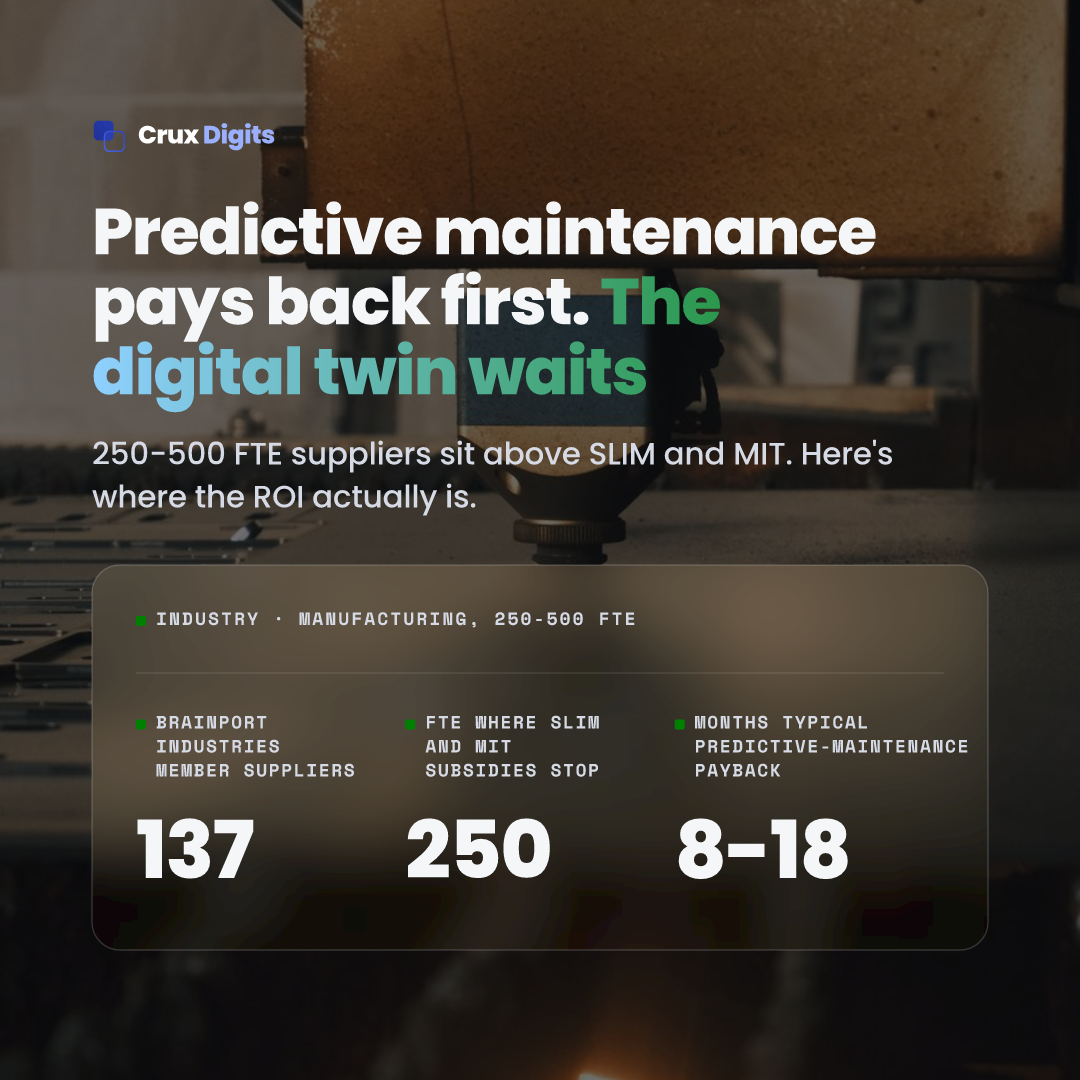
For a 250–500 FTE Brainport-tier supplier, AI pays back fastest through predictive maintenance and camera-based quality control on the bottleneck line — not through a full digital twin. The size band matters more than most guides admit: at 250+ employees your company legally leaves the mkb, and with it the SLIM and MIT subsidies most Dutch AI advice assumes you can still claim.
Why generic AI-for-mkb advice skips this segment
Most “AI for manufacturing” content written for the Dutch market targets one of two audiences: the enterprise floor, with a dedicated digital-transformation team, or the classic mkb workshop under 50 people. A 250–500 FTE first- or second-line supplier in the Brainport ecosystem sits in neither camp. Brainport Industries, the region’s high-tech supplier cooperative, currently counts 137 member companies — precision manufacturers, machine builders and electronics suppliers mostly in exactly this size range. It runs the process discipline of a large OEM: ISO 9001 as standard, often IATF 16949 or AS9100 depending on the customer, PPAP documentation, supplier scorecards set by the likes of Philips, ASML or VDL. But it carries the lean staff and CFO-level cost scrutiny of a much smaller company.
Advice written for a five-person garage doesn’t scale to a three-shift production floor; advice written for a 5,000-person OEM assumes a data-science team and IT budget that simply isn’t there. That mismatch is where AI pilots at this size either stall quietly or get bought as an oversized platform nobody on the floor actually uses.
The subsidy trap nobody mentions
The Dutch mkb definition is a hard line: a maximum of 250 employees, and a maximum of €50 million annual turnover or €43 million balance-sheet total. Cross that line and two of the subsidies every generic “AI subsidies for Dutch business” article recommends close to you. The SLIM-regeling — up to €25,000 at a 60% rate for learning-and-development costs, including AI-skills training — is mkb-only. The MIT Haalbaarheidsproject, capped at €20,000 per feasibility study and administered per province rather than nationally, is also explicitly restricted to mkb applicants. A 300-employee toeleverancier is, for subsidy purposes, a grootbedrijf — even if it still runs like a family business.
What stays open regardless of size is the WBSO, the R&D tax credit: 36% of qualifying R&D wage costs for established companies, with no employee-count ceiling. RVO’s own reporting shows AI-related WBSO applications growing sharply — roughly 30% more than the year before, and about 77% higher than five years ago — against a 2026 WBSO budget of €1.817 billion. If your project involves genuine technical uncertainty, such as a custom computer-vision model trained on your own scrap data rather than an off-the-shelf SaaS subscription, WBSO is the instrument built for exactly this size of company. The honest subsidy conversation for a 250–500 FTE supplier is not “which grant covers this,” it’s “structure the project so its R&D component qualifies for WBSO” — something most mkb-focused advice never mentions, because it is written for companies that still qualify for SLIM and MIT.
Where the payback actually is — three technologies, in order
Three Industry 4.0 building blocks get pitched to this segment, usually in the wrong order.
- Predictive maintenance on the bottleneck machine, first. Sensors on one or two critical assets feeding a maintenance model, often bolted onto an existing SCADA or MES historian rather than a new platform — see our explainer on what SCADA data is actually worth. Industry benchmarks aggregated from Deloitte and McKinsey studies and cited by independent analyses show 25–30% fewer unplanned breakdowns and a typical payback of 8–18 months once a pilot line is live. This is the highest-confidence starting point because it needs the least new infrastructure.
- Computer-vision quality control on the highest-scrap line, second. One documented case: a steel producer working with Matroid’s computer-vision platform lifted defect-detection accuracy from roughly 60% to over 98%, reached 99.8% precision, and reported over $2 million in annual savings and a 1,900% first-year ROI. That is one vendor’s best case, not a guarantee — but it shows the ceiling when scrap cost is already tracked and the defect is visually distinguishable.
- A digital twin, last — not first. A real digital twin is a live, data-fed model that mirrors and predicts behaviour, not the 3D visualisation most vendor demos show — we go deeper on that distinction here. For almost every supplier in this size band, a twin project only earns its cost after steps one and two are running and feeding clean, structured data. Twin-first proposals are usually selling a data foundation the plant doesn’t have yet.
The payback math, worked out
Take a 300 FTE Tier-2 supplier running a bottleneck CNC or assembly line. Unplanned downtime on that line costs, conservatively, €800 per hour in lost throughput and expedited-shipping penalties to the OEM customer. Without condition monitoring, assume 120 hours of unplanned downtime a year — roughly 2.5 hours a week, typical for a machine running without sensors.
- Downtime avoided: a predictive-maintenance layer that cuts unplanned downtime by 40% on that one line — a conservative slice of the 25–30% sector average, sized for a single-machine pilot rather than a facility-wide rollout — recovers 48 hours a year. At €800/hour, that is €38,400 in avoided downtime annually.
- Programme cost: sensors, an edge gateway and a monitoring subscription for one line typically run €15,000–€25,000 a year all-in at this scale, plus a one-off integration cost against the existing MES.
- Payback: under twelve months on the downtime saving alone, before counting the avoided emergency-repair premium (rush parts, overtime call-outs) or the extended service life of the asset.
Scaling matters here: a second and third line reuse the same model and integration pipeline, so they typically cost less to add than the first. The honest caveat — this is a single-machine business case, not a facility-wide one. Do not budget a plant-wide rollout on the strength of one line’s numbers; validate the model on the pilot machine for at least one full maintenance cycle before expanding.
Where digital-twin vendors oversell at this scale
The most common overselling aimed at 250–500 FTE suppliers is the full 3D digital twin, pitched as a strategic platform before the underlying data exists. A twin is only as good as the sensor data feeding it — if the plant doesn’t yet have reliable machine-level data capture, a twin project spends its first six months building that data layer anyway, just inside a far more expensive contract with a 3D visualisation bolted on top that nobody on the floor actually opens day to day. The practitioner’s rule: if you cannot currently answer “which machine will most likely fail this month” from your existing data, you are not ready for a twin — you are ready for predictive maintenance. Buy the twin once that question already has a confident, data-backed answer.
The governance gap that stalls pilots at this size
A five-person workshop decides on AI on Monday and runs it Tuesday — the owner is both budget holder and end user. A 5,000-person OEM has a formal digital-transformation office to own the pilot-to-production handoff. A 250–500 FTE supplier usually has neither. The technically successful pilot stalls because nobody is formally accountable for what happens after go-live: who retrains the model when a new material batch shifts sensor readings, who is on the hook when a false positive stops the line during a customer audit, and which budget line pays for year two once the “innovation project” label no longer applies. The fix is unglamorous but effective: name one internal owner before the pilot starts — not a committee — and budget a model-maintenance contract for year one alongside the installation cost, not as an afterthought once something breaks.
Five signs your supply business is ready
You run at least one machine or line where unplanned downtime demonstrably costs more than a few hundred euro per hour; you already have some form of MES or SCADA historian, even a basic one; a specific line’s scrap or rework rate is tracked well enough to have a number, not just a feeling; your workforce today spends real time on manual visual inspection that a camera could partly take over; and you can name, right now, who inside the company would own an AI pilot day to day. Three or more of these, and predictive maintenance or vision-based QC is your highest-confidence starting point — well ahead of a digital twin or a generic “AI strategy.”
Where to start
Dutch AI adoption is climbing fast — CBS reports 22.7% of companies with 10 or more employees used at least one AI technology in 2024, up nearly 9 points on the year before, but adoption still splits sharply by size (59.2% at 500+ employees versus 17.8% at the smallest firms). A 250–500 FTE supplier sits in the gap between those two numbers, which is exactly why generic advice fits so poorly. Our mid-market AI page is written specifically for this band — pilot-to-production governance, not a from-scratch strategy deck. For the subsidy routing above and current project cost ranges, see our cost and subsidy pages; for the building blocks mentioned here, our explainers on SCADA data, Industrie 4.0 without a big IT project and what a digital twin actually is go deeper on each piece.