AI in Dutch healthcare pays off first in administration, not diagnosis. For a practice of twenty to fifty people — a group huisartsenpraktijk, a fysiotherapie chain, a GGZ practice — the realistic first win is voice-to-record documentation, automated intake and scheduling, not clinical decision support. That is also where the compliance load is lightest: the AVG and NEN 7510 apply regardless, but a documentation assistant sits well outside medical-device territory, and responsibility stays exactly where the Wkkgz already places it — with you.
Why administration eats the biggest chunk of the week
The scale of the problem is well documented, even if the most recent hard numbers come from a 2023 LHV survey rather than a fresh 2026 count: four in five GPs said they spent more time on administration than five years earlier, a majority reported more than a day a week on administrative obligations outside direct patient care, and 85% said they spent too much time on tasks unrelated to care itself. Almost half of practice holders in that survey said they sometimes consider quitting because of it. Across a practice of twenty to fifty FTE — say eight GPs plus assistants, POH-GGZ staff and secretariaat — a majority losing a full day a week to admin is close to an entire clinician's worth of capacity disappearing into paperwork every week, before a single extra patient walks in.
Most of that time doesn't go to the parts of the job clinicians actually trained for. It goes to double registration across systems that don't talk to each other, information that's hard to retrieve, manual reconciliation between the EPD, the declaratiesysteem and the planning tool, and coordination with other care providers that never quite runs smoothly. None of that requires clinical judgement. It's exactly the kind of structured, repetitive, rule-bound work that a well-scoped AI layer is good at — provided it's built on top of the systems you already use, not instead of them.
What you can actually automate — and what you shouldn't
The realistic use cases for a practice this size cluster around four tasks. Voice-to-record scribing turns a consultation into a structured SOEP note automatically — Dutch vendors like Autoscriber and IntraGPT already integrate directly with HiX, Chipsoft and comparable EPD systems, and a specialised option, Robin, targets GGZ documentation specifically. Automated intake handles the non-urgent questions that currently sit in a triage nurse's inbox — appointment requests, repeat prescriptions, simple administrative queries — and routes anything ambiguous to a person. Scheduling and no-show reduction uses reminders and smart rebooking to close gaps in the agenda. And declaratie reconciliation matches what was billed against what was delivered, catching mismatches before they become a dispute with the zorgverzekeraar. What doesn't belong on this list, at this size, is anything that makes or materially influences a clinical decision — diagnosis support, treatment recommendation, risk scoring. That's not a capability gap; it's a scope choice. The moment a tool starts shaping a clinical judgement, it moves into a different, much heavier regulatory category, and a practice of this size rarely has the case volume to justify that complexity.
Three regulatory layers apply at once — and none of them is optional
Three frameworks stack on top of each other whenever a Dutch care practice touches patient data with a digital tool, AI or not. The AVG sets what must happen with personal health data; NEN 7510 — the Dutch information-security standard for healthcare — describes how you organise and demonstrate that in practice, and becomes effectively mandatory the moment you process a BSN, which almost every practice does. The Wkkgz sits underneath both: it makes the care provider — not the software vendor — responsible for ensuring any tool used in the care process is safe and of good quality. That responsibility doesn't transfer when you buy a product instead of building one. And the Inspectie Gezondheidszorg en Jeugd is rolling out a new, more preventive supervision framework through 2026, built around four questions: is it safe, does it actually help, does a person stay in control of the decisions that matter, and can you show your homework.
IGJ's sharpest attention goes to systems that could harm a patient directly — diagnostic support, treatment robots — well above an appointment app or a documentation assistant. That's a genuine argument for keeping a first AI project firmly on the administrative side of the line: not because the rules don't apply, but because the burden of proof is proportionate to the risk, and admin automation carries the lightest one.
New since 2 August 2026 — the duty to say "this is AI"
One rule changed very recently and applies regardless of practice size. Article 50 of the EU AI Act's transparency obligations took effect on 2 August 2026, and — unlike most of the Act's high-risk provisions, which the European Parliament pushed out to December 2027 and August 2028 — this deadline was not delayed. Any AI system that interacts directly with a person, including a practice's own intake bot, symptom checker or WhatsApp assistant, must make clear that the person is dealing with AI, and that has to be perceivable inside the interaction itself — a line buried in the terms and conditions, or a vague label like 'assistant', doesn't satisfy the duty. As the deployer, a practice takes on that disclosure responsibility toward its own patients even when a vendor built the underlying system. Fines for non-compliance reach €15 million or 3% of worldwide turnover, though for a practice this size the realistic risk is a regulator asking you to fix a missing disclosure — the point is that it now has to be asked for, and answered, in writing before you go live.
The payback math for a twenty-to-fifty-FTE practice
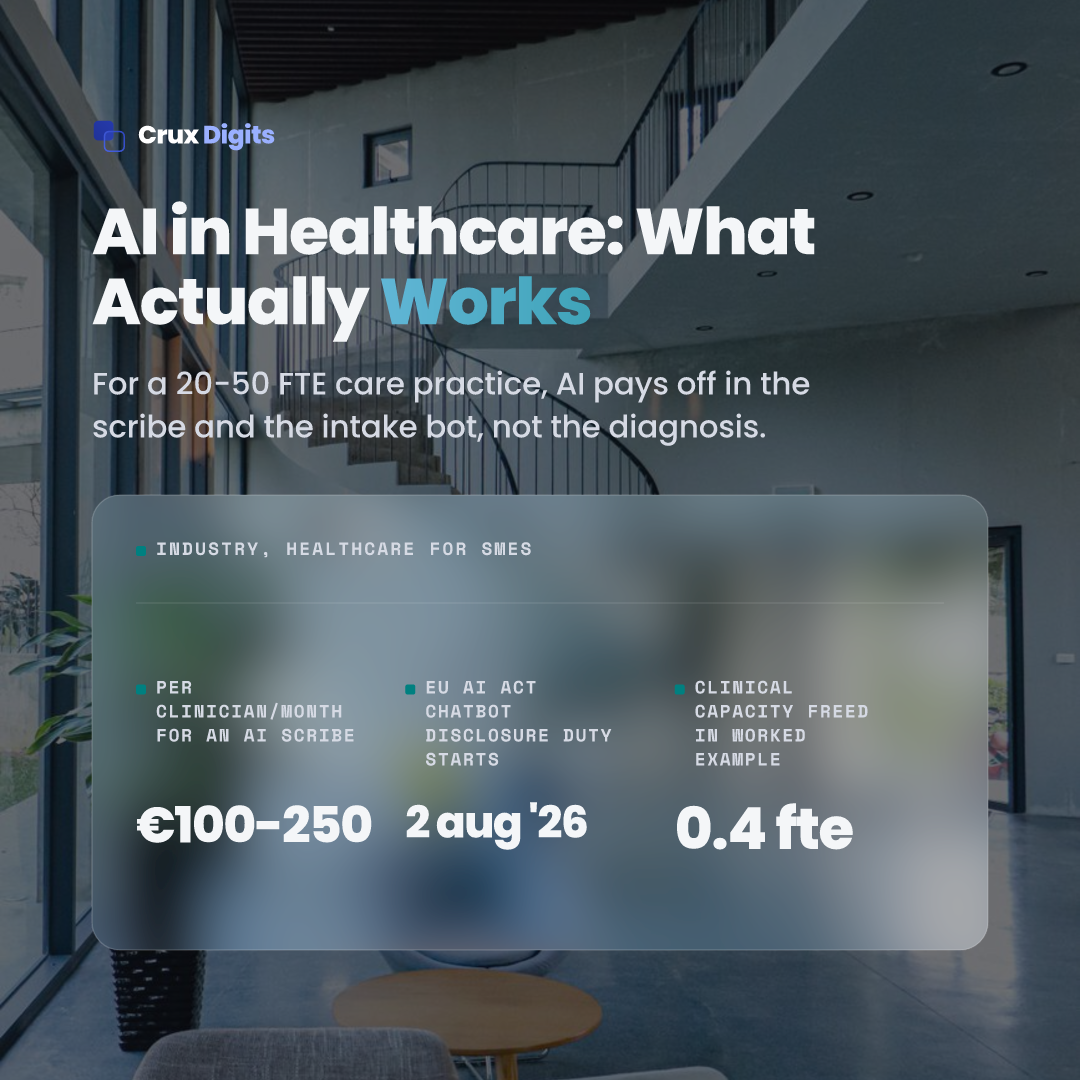
Here's the calculation we'd walk a practice of this size through, with every assumption visible. Take a group practice with eight GPs and roughly twenty FTE in total. If a majority spend a full eight-hour day a week on non-care administration — the LHV's own finding — and an AI scribe plus automated intake conservatively recovers a quarter of that, because exceptions, complex cases and legally required paperwork still need a person, that's two hours a week freed per GP. Across eight GPs, that's sixteen hours a week, or roughly 0.4 FTE of clinical capacity — not nothing, and not the 'hours back every day' vendors sometimes promise either. At a ten-minute consult, an NHG-standard slot, that's up to ninety extra slots a week available across the practice, if the practice chooses to use the time that way.
Whether it should is worth stating honestly. Some of that freed time should go toward reducing overtime and burnout, not toward more consults — the LHV survey found administrative load is a direct factor in nearly half of practice holders considering giving up their practice altogether, and a tool that just backfills the schedule solves the wrong problem. But some capacity genuinely matters at the system level: the Algemene Rekenkamer estimated in 2025 that between 45,000 and 194,000 people in the Netherlands currently have no GP, one in twenty residents is searching for one, and 60% of practices imposed a registration stop in the past year. Freed admin time is one of the few levers an individual practice actually controls.
On cost: vendor-published pricing for Dutch AI-scribe tools generally clusters around €100 to €250 per clinician per month, on top of implementation time and EPD-integration work. That's a starting range, not a quote — for the full picture on what a project like this costs in practice, including implementation, see our page on what an AI project costs.
Common mistakes practices make with this
- Trusting 'AI inside' without testing your own consultation room. A clean sentence dictated in a quiet demo is not the same as a GP talking over a crying toddler with the door open — test any scribe on your actual audio before you buy it.
- No visible exception route. If the system silently guesses at a missing symptom or medication, it erodes trust fast. Every gap the AI can't fill with confidence should route to a person, visibly.
- Treating documentation and diagnosis as one product. The moment an assistant starts suggesting what to do rather than recording what happened, you've left the low-risk category — know exactly where that line sits in whatever you buy.
- Skipping staff and the ondernemingsraad. Adoption in a care team lives or dies on trust, and voice data touches employee-monitoring rules just as much as patient privacy.
Five signs your practice is ready
You're at twenty-plus FTE; you already run a digital EPD; administrative load shows up as a top complaint in staff surveys or exit interviews; no-shows or a backlog in the agenda cost real capacity; and you've had to impose or consider a registration stop. Three or more of these, and a documentation or intake pilot is very likely your highest-payback first step — well ahead of anything that touches a clinical decision.
Where to start
Start with one team and one task — voice-to-record for two or three GPs is a realistic four-to-six-week pilot, not a practice-wide rollout on day one. Map what currently happens to a consultation note between the room and the EPD before choosing a vendor; that tells you whether your system can be fed via an API, and whether your AVG and NEN 7510 obligations are already covered by existing data-processing agreements or need updating. See how we scope AI projects for Dutch SMEs on our AI consultant page, what AI Act compliance actually requires on our AI Act checklist, and more healthcare use cases on our healthcare industry page.