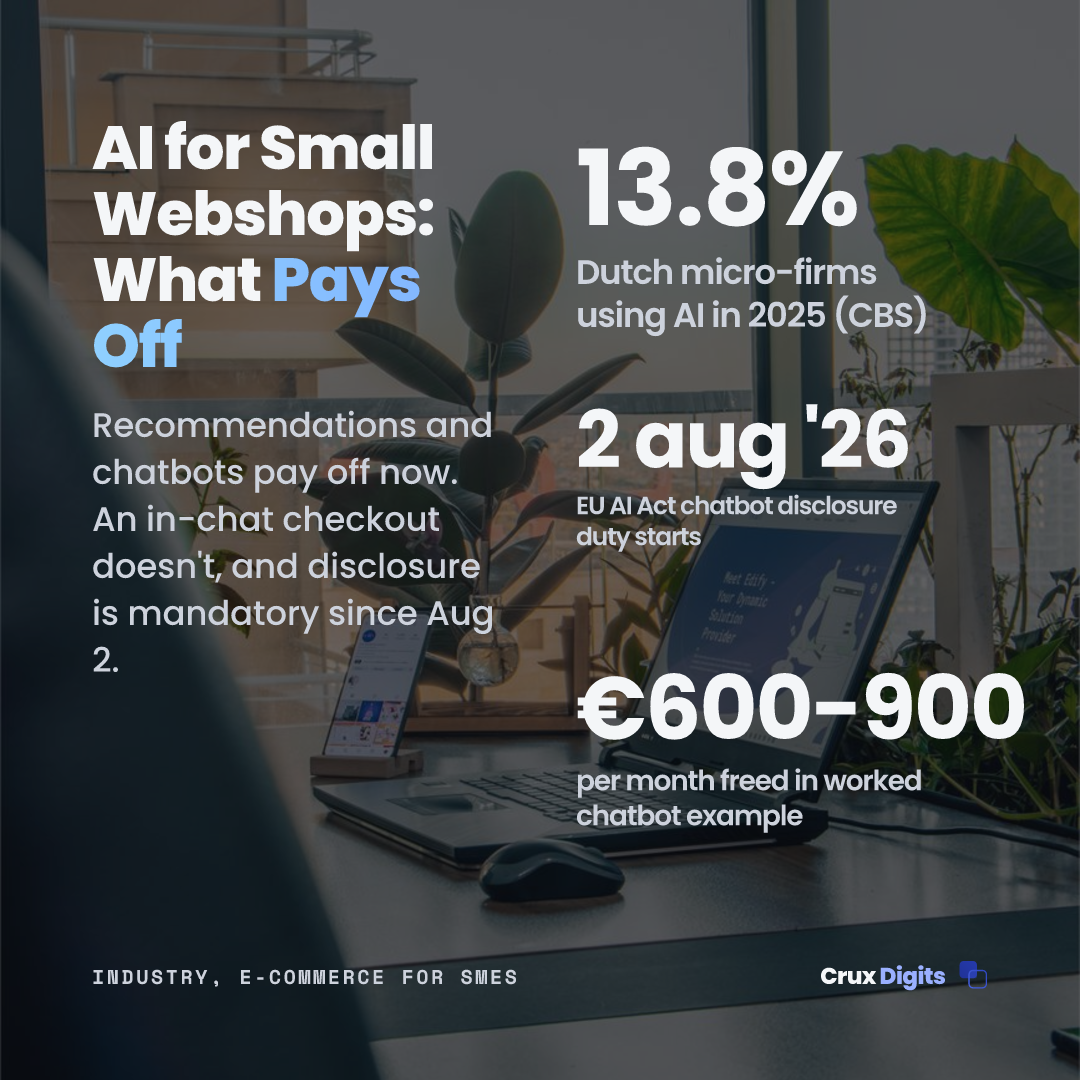
For a Dutch webshop run by one to ten people, AI already earns its keep in three places: product recommendations and on-site search that lift average order value, a customer-service chatbot that clears order-status and returns questions, and AI-written product descriptions. It does not yet earn its keep as an in-chat checkout inside ChatGPT — and since 2 August 2026, any chatbot you run must legally say it is AI.
Where AI already earns its keep in a one-person webshop
Start with what is already proven at small scale. On Shopify, apps such as LimeSpot and Rebuy add “customers also bought” recommendation blocks that typically lift average order value by a few percentage points without touching your theme code. On WooCommerce, plugins such as Recom.ai do the same job against your existing product catalogue. Neither requires a developer for the first version — most owners have a working recommendation widget live within a day.
For the fuller picture of where AI fits across an online store — recommendations, on-site search, cart recovery, dynamic pricing and marketplace optimisation — see our e-commerce industry page.
What the CBS actually found about AI use among Dutch micro-businesses
This is not guesswork. The Dutch statistics office CBS published its first dedicated report on AI use among micro-businesses (2 to 10 employees) in March 2026, covering 2023-2025. The headline: 13.8% of Dutch micro-businesses used at least one of seven AI technologies in 2025, up more than 3 percentage points on 2024. That is well behind the 29.8% adoption rate among the 10-250 FTE mkb segment and the 66.2% rate among companies of 250 or more — but it is real, growing adoption, not hype.
Two findings matter specifically for a webshop. First, marketing and sales is the single most common reason a Dutch micro-business uses AI (32.7% of AI-using micro-firms), ahead of administrative processes (25.9%) — the opposite ranking from larger companies, where admin leads. Product recommendations, on-site search and product-description generation sit squarely in that marketing-and-sales category, which is exactly why they are the highest-payback starting point for a small store, not a side experiment. Second, 48.2% of micro-businesses that use AI acquired it through direct use of commercial software — not a custom build. Among firms that considered AI and decided against it, 71.6% cited lack of experience as the main reason, ahead of cost or trust. Starting with an off-the-shelf recommendation app or chatbot is not a compromise; it is what nearly half of AI-using Dutch micro-businesses already do.
Your chatbot and the AI Act: what changed on 2 August 2026
Article 50 of the EU AI Act became enforceable on 2 August 2026 — one of the few AI Act deadlines the Digital Omnibus did not push back. It requires that any AI system interacting directly with a natural person — a website chatbot, a WhatsApp bot, a voice assistant — makes clear to that person that they are dealing with AI, unless that is already obvious from context. This applies regardless of company size and regardless of whether the system counts as “high-risk” under the wider Act; a customer-service chatbot on a five-person webshop is squarely in scope. Enforcement sits with national market surveillance authorities, and penalties for non-compliance can reach €15 million or 3% of global turnover — the same tier as the GDPR's higher bracket, though in practice regulators are expected to start with warnings for small deployers before fines.
In practice, compliance for a small webshop is a five-minute fix: one clear line in the chatbot's opening message — something like “I am an AI assistant; a colleague can take over at any time” — satisfies the obligation for most retail use cases. Giving the bot a human-sounding name is not itself a problem, as long as disclosure still happens. For the wider set of AI Act obligations that apply to a Dutch mkb — not just chatbots — see our AI Act checklist for the mkb.
Should you worry about AI shopping agents buying from your store?
2026 has been the year agentic commerce actually shipped. OpenAI launched ChatGPT Instant Checkout in September 2025 and, via the Agentic Commerce Protocol it built with Stripe, extended it to more than a million Shopify merchants plus PayPal in February 2026. Google's Universal Commerce Protocol went live in January 2026 with Shopify, Wayfair, Target, Etsy and Walmart as founding partners. On paper, that means an AI assistant can now discover, compare and buy a product without the shopper ever loading your website.
In practice, the early data complicates the story. Walmart's own EVP of product, Daniel Danker, disclosed that checkout completed inside ChatGPT converted roughly three times worse than a click-through to walmart.com, even though ChatGPT referrals produced about double the new-customer rate of ordinary search traffic — first reported by MarTech in March 2026. The pattern reported across the sector through 2026 has shifted from “buy inside the chat” to “discover in AI, buy on your own site” — shoppers are using AI to find and shortlist, then completing the purchase where they already trust the checkout.
The practical conclusion for a Dutch webshop with one to ten people: do not spend this year's budget wiring up an in-chat checkout integration. Spend it making your product pages readable by AI agents in the first place — accurate Product schema with GTIN, price and availability, plus MerchantReturnPolicy and shipping-time markup at the product level. AI shopping agents and AI Overviews query these structured fields directly rather than parsing your homepage copy; a product with clean schema and no marketing budget beats a product with a large budget and incomplete data. It is also the same technical work that improves ordinary Google rankings, so it pays off even if agentic commerce stays niche in the Netherlands longer than in the US.
What an AI chatbot for a small webshop actually costs
Here is the calculation worth running before you commit, with every assumption visible. Say your webshop handles 300 customer-service questions a month by e-mail or WhatsApp, each taking an average of six minutes to answer — 30 hours a month of owner or staff time. A chatbot that reliably deflects half of those questions — order status, return policy, delivery times, the genuinely repetitive tier-1 traffic — frees roughly 15 hours a month. At a blended value of €40-60 an hour for an owner's time, that is €600-900 a month in freed capacity.
Against that: Dutch mkb pricing for a chatbot platform typically runs €50-300 a month, with a one-off setup of €500-1,500 to connect it to your order system and train it on your actual return policy and FAQ. The case is strongest above roughly 150-200 recurring questions a month; a webshop handling less than that is usually better served by a well-written, prominent FAQ page than a chatbot subscription — the honest advice most vendors will not volunteer. For a broader view of what a realistic AI project costs beyond just a chatbot, see our page on AI project costs.
Which platform you are on changes what is possible
Shopify merchants have the shortest path: Sidekick, Shopify's built-in AI assistant, ships free on every plan and can generate product images, draft store content, build simple automations and surface opportunities from your own store data through natural-language prompts — no separate subscription needed for the basics. WooCommerce gives more flexibility through its plugin ecosystem (Recom.ai and similar tools handle recommendations) but expects more setup work from you or a developer.
Lightspeed and CCV Shop — both common choices for Dutch retailers moving from a physical till to online, especially where Dutch-language support and CCV kassa integration matter — have thinner native AI. Lightspeed AI began rolling out for Retail and Hospitality from January 2026, with more retail-specific features expected through the year, but the e-commerce side is still catching up. For both platforms, most Dutch merchants connect AI through an external automation layer sitting over the existing catalogue and order API, using a tool such as n8n or Make; see our comparison of n8n, Make and Zapier for how that glue layer works in practice.
Five steps to start this month
In order of payback, not order of excitement:
- Turn on what you already have. Shopify's Sidekick or your platform's built-in recommendation engine, before buying anything new — the free option is usually good enough for a first test.
- Write down your ten most repeated customer questions. This becomes your chatbot's training data and costs nothing; no vendor needs to define it for you.
- Add or check Product and MerchantReturnPolicy schema on your product pages. Likely the single highest-leverage hour you spend on your webshop all year, and it pays off in ordinary Google results too, not only for AI agents.
- Add the one-line AI disclosure to any bot you already run. Five minutes of work, required since 2 August 2026, and easy to forget on a bot that has been running quietly for a year.
- Measure before you scale. Track hours saved or conversion lift for one full quarter before adding a second AI use case — the CBS data shows most micro-businesses that succeed start with one thing done well, not five things done half-heartedly.
None of this requires a platform migration or a six-figure project. For a size-appropriate view of what to prioritise first and in what order for a Dutch mkb, see our page on AI voor het mkb.
A consultant tells you where AI pays off; Crux Digits also builds it. A fixed price per step, one named expert, from Utrecht.
AI consultancy in the Netherlands →