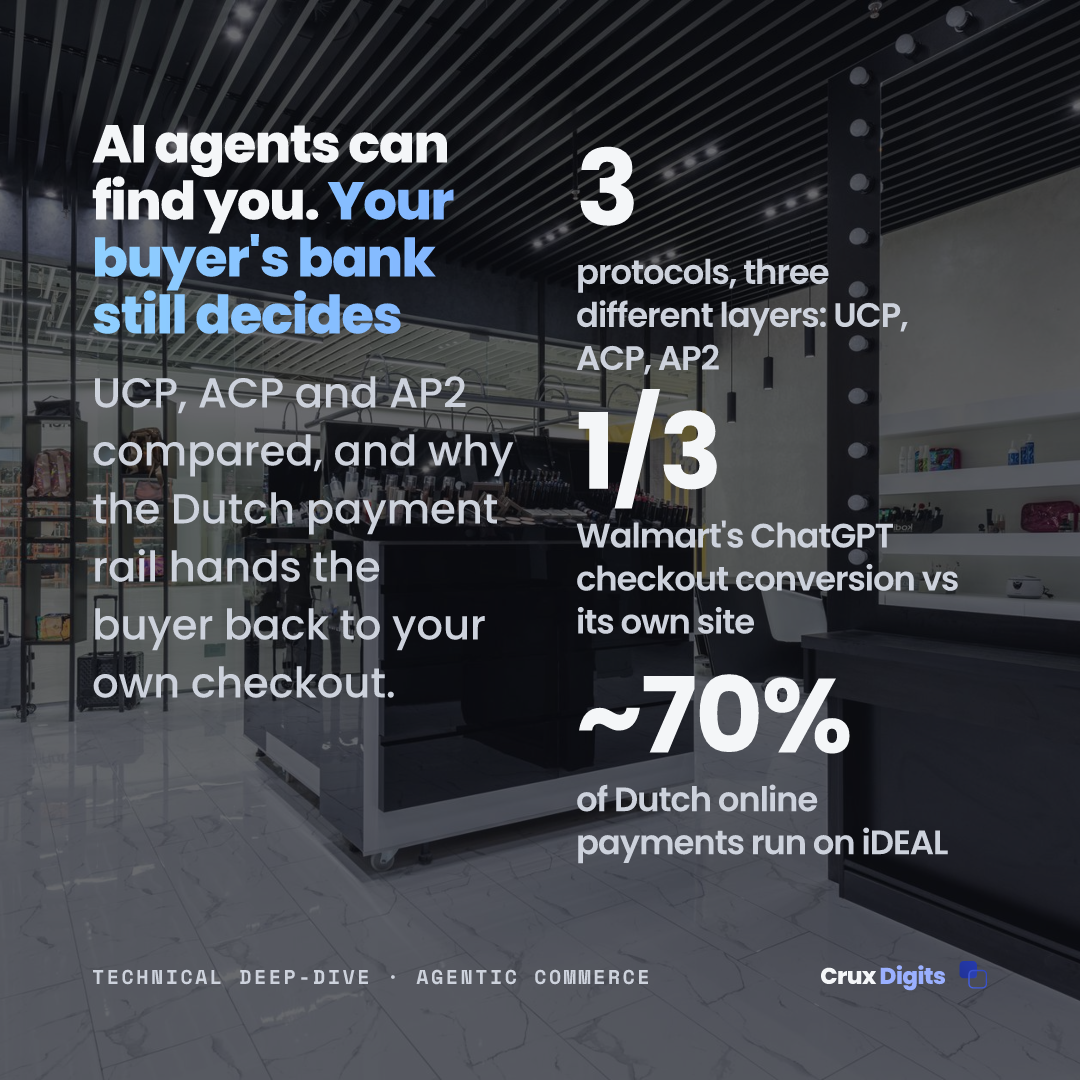
Three open protocols are marketed as rivals for letting AI agents buy things: UCP from Google and Shopify, ACP from OpenAI and Stripe, and AP2 from Google. They actually sit at different layers, so the real choice is not between them. For a Dutch merchant in August 2026 the practical answer is narrower than the announcements suggest: invest in the discovery layer, because on iDEAL the checkout will hand the buyer back to your own site.
What do UCP, ACP and AP2 each actually cover?
The three names get thrown around as competitors. Architecturally they occupy different floors of the same building, and reading them that way makes the decision much simpler.
UCP — the shopping session
The Universal Commerce Protocol was announced by Google and Shopify at NRF on 11 January 2026 and is published openly at ucp.dev. Shopify's Ilya Grigorik described the architecture as deliberately layered, the way TCP/IP is layered: a shopping service defining the core primitives (checkout session, line items, totals, status), then independently versioned capabilities — Checkout, Orders, Catalog — then extensions composed on top of those.
Two design decisions matter more than the rest. First, discovery is profile-based: a merchant publishes what it supports at /.well-known/ucp, the agent publishes its own profile, and the merchant computes the intersection per request. This is the negotiation HTTP already performs with Accept headers, applied to commerce. Second, namespacing is reverse-domain — dev.ucp.shopping.* belongs to the spec, com.yourvendor.* belongs to whoever owns the domain. A loyalty provider can define an extension without asking a committee. A March 2026 update added Cart, Catalog and Identity Linking.
ACP — the purchase API
The Agentic Commerce Protocol is narrower: it is the merchant-side contract for an agent-initiated purchase. OpenAI and Stripe released it under Apache 2.0 in September 2025 and maintain it in the open on GitHub under a Specification Enhancement Proposal process, with date-stamped stable cuts. The 2026-04-17 cut covers cart, feed, orders, authentication and MCP. If you already run an MCP server for internal tooling, that last item is the interesting one — the same transport your agents use to reach your systems can carry the commerce surface.
AP2 — the trust layer
The Agent Payments Protocol — a Google project, with Coinbase, the Ethereum Foundation and MetaMask among its launch partners — does not describe shopping at all. It describes authorisation. Its specification defines signed mandates carried as verifiable digital credentials: a Checkout Mandate covering what the buyer agreed to, and a Payment Mandate covering the payment itself. The point is a cryptographic, non-repudiable record of what the human actually authorised — exactly the artefact you want when a customer disputes a purchase their assistant made. AP2 is designed as an extension to A2A and MCP rather than a replacement for them.
One development matters more than the version number. On 28 April 2026 Google contributed AP2 to the FIDO Alliance, alongside Mastercard's Verifiable Intent framework, and the Alliance began work on interoperable standards for agentic commerce and agent authentication. Standardisation of the trust layer has moved out of a single vendor's hands and into the body that already owns passkeys — which is a good reason not to build against AP2 directly just yet.
The usable mental model: UCP is the session, ACP is the purchase API, AP2 is the signature on the mandate. You can implement one without the others, and most merchants will meet all three through their payment provider rather than directly.
Why did agent checkout stall in 2026?
Because the first large deployment did not convert, and the industry noticed.
Instant Checkout — the in-chat purchase flow OpenAI launched in September 2025 with Shopify, Etsy and Walmart — was wound down this spring. The Information reported it first and CNBC confirmed the details with the companies involved on 20 March 2026. The numbers behind the decision are the useful part. Daniel Danker, Walmart's EVP of AI Acceleration, Product and Design, told Wired that checkout conversion inside ChatGPT ran at roughly a third of Walmart's own site. Forrester principal analyst Emily Pfeiffer put Shopify participation at around thirty merchants as of February 2026 — out of millions.
The cause named in the reporting was not consumer reluctance. It was data quality. OpenAI was scraping retail sites for product information, so inventory, price and shipping were frequently wrong. Pfeiffer's summary — crawling and scraping cannot produce the breadth of product data commerce needs — is the sentence to remember, because it points directly at the work that is worth doing.
And the demand side split cleanly. A Semrush survey of more than a thousand US consumers found 22% had ever bought something inside an AI tool, while 50% had bought something after researching with one. That is a US sample and it should not be read as a Dutch number, but the shape of it matches what the merchants reported: discovery worked, checkout did not.
What breaks when the payment rail is iDEAL rather than a card?
Roughly seven in ten Dutch online payments run through iDEAL. Betaalvereniging Nederland puts it at 70% of Dutch e-commerce transactions; the European Payments Initiative's own announcement says approximately 72%. Treat it as a band rather than a precise share — either way, it dominates.
iDEAL is not a card. It is a bank redirect: the shopper is sent to their own bank's app or site and authenticates there. That authentication is the product, not friction to be engineered away, and there is no stored token an agent can present in its place. Card-shaped assumptions — tokenisation, a credential the agent holds and replays — do not map onto it.
This is not a flaw the protocols overlooked. UCP models it explicitly. Its checkout state machine has a first-class requires_escalation state carrying a continue_url: when the agent hits something it cannot complete — a regulatory constraint, a merchant policy, a capability it does not yet have — the buyer picks up exactly where the agent left off, and the Embedded Checkout Protocol makes that handoff feel native over a JSON-RPC 2.0 channel. UCP also refuses to hardcode payment methods. Each provider publishes its own handler specification and the two sides negotiate per transaction.
So the real question is not whether the protocol can express iDEAL. It is who publishes and maintains an iDEAL handler, and when — and there the timing in the Netherlands is genuinely awkward. iDEAL is mid-migration to Wero, the European Payments Initiative wallet developed with ABN AMRO, ING and Rabobank. The co-branded iDEAL | Wero logo has been in use since 29 January 2026, with merchants required to have implemented it by 31 March 2026, and the next migration phase connects all Dutch issuing banks to Wero in October 2026. Nobody sensibly invests in a stable agent payment handler for a rail that is being replaced underneath them.
Is the infrastructure available to Dutch merchants yet?
Not in a form a mid-sized Dutch merchant can switch on this quarter — though it is being built, and partly by Dutch hands.
Adyen, headquartered in Amsterdam, launched Adyen Agentic on 16 June 2026 with three layers: Agentic Feed for machine-readable catalogue and inventory, Agentic Cart for checkout and order orchestration, and Agentic Payments for authentication, tokenisation and fraud. It is positioned explicitly as a universal translator across UCP, AP2, ACP and Meta's AI checkout, so merchants integrate once rather than betting on a winner. At announcement it was in limited availability for enterprise merchants operating in the United States, with global expansion to follow.
On the European side, Nexi and Google Cloud signed a memorandum of understanding on 3 March 2026 to support UCP and AP2 across Europe, using UCP to orchestrate the shopping journey and AP2 as the trust layer. Real progress — and still a partnership announcement rather than a product your webshop can enable.
What should a Dutch merchant build in the next six months?
This is where the analysis becomes actionable. Our recommendation for merchants in the 20–50 FTE band and upward, in priority order:
- Fix the feed first. Structured, accurate, machine-readable product data — price, stock, delivery time, variants, return policy — published where agents can read it rather than scrape it. This is precisely the layer that failed at Walmart, every protocol depends on it, and it is the only investment here that is not a bet: it pays off in AI-assisted discovery whether UCP wins, ACP wins, or neither does. It also improves the Google Shopping and marketplace feeds you already maintain.
- Optimise the landing, not the agent. Assume the buyer arrives on your own site to pay, with intent already formed. Guest checkout, mobile, iDEAL first, no account wall. Traffic referred by an assistant is pre-qualified and unusually intolerant of friction.
- Do not build mandate handling yourself. AP2's mandates solve a real problem, but signing and verifying them belongs to your payment provider — and with standardisation now running through the FIDO Alliance, the shape of it will change again. Wait for Adyen, Mollie or Nexi to expose it, then consume it.
- Instrument the channel now. Tag and segment AI-referred sessions today so that in six months you have a baseline instead of an argument. You cannot judge whether agentic commerce arrived if you never measured the traffic it sent.
The broader lesson generalises past commerce. The protocol layer of the agent stack is moving fast and consolidating slowly, and the durable work is almost always in making your own data legible to a machine rather than in adopting whichever specification shipped most recently. That is the same conclusion we reach when connecting AI agents to existing systems in an ERP or a service desk: the integration standard is the easy part, the data underneath it is the project. If you are weighing what such a project involves, our guide to what an AI project costs sets out the realistic ranges.
Last updated: 18 August 2026. Protocol versions, governance and regional availability change monthly in this field — check the linked primary sources before acting on any specific date or version.
We build custom AI and LLM systems that run in production: a clickable MVP by the second call, fixed steps, and you own the code.
AI development agency in the Netherlands →