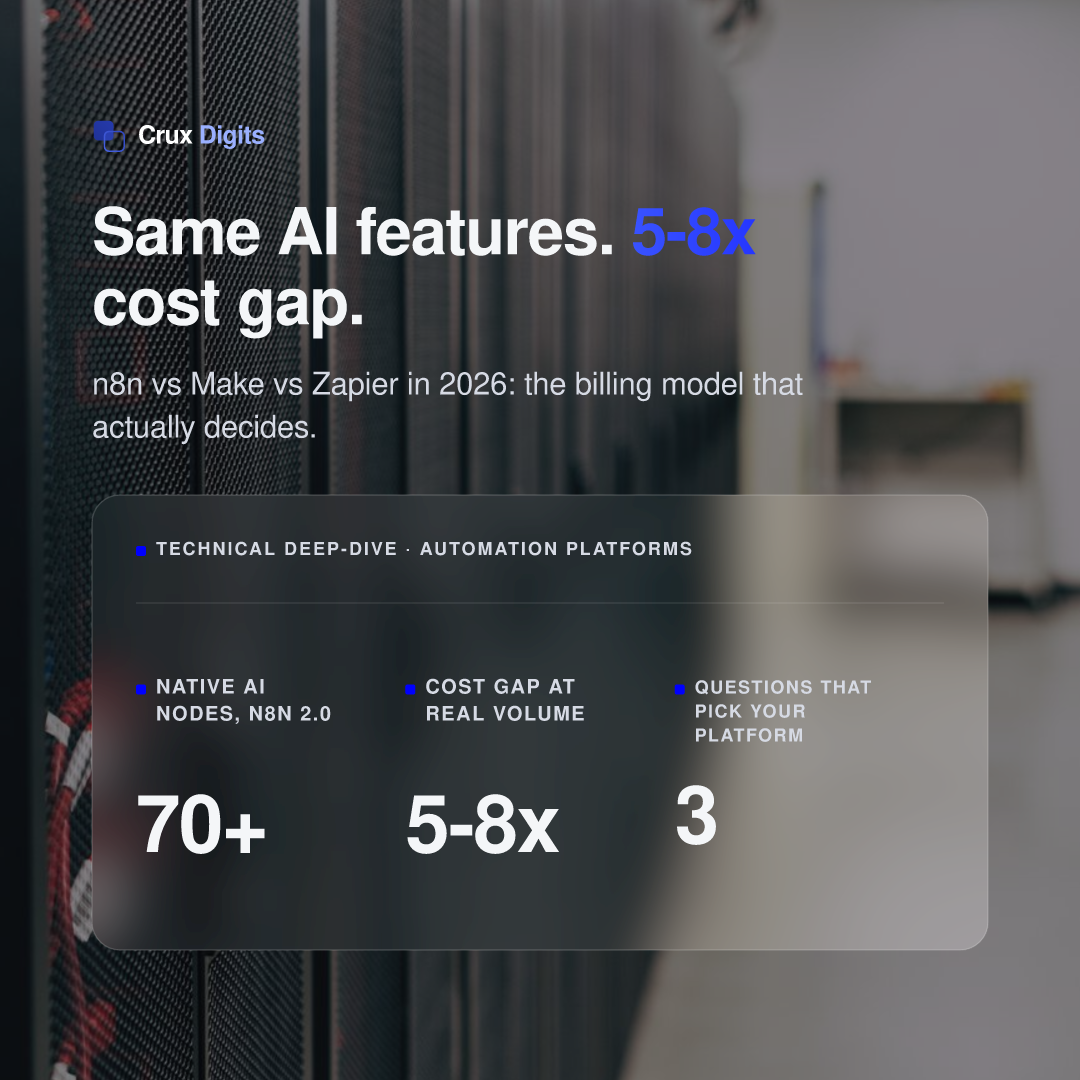
n8n, Make and Zapier all added AI agents in 2026, and the feature lists now look nearly identical, which is exactly why they're the wrong way to choose. The decision that actually matters is billing model (per-task, per-execution or per-operation), because at real SME automation volume the cost gap between platforms runs 5–8x, and it's the platform, not the AI features, that decides whether your monthly bill is €30 or €300.
What each platform actually shipped in 2026
Zapier reached general availability with AI Agents in 2025 and added a natural-language Copilot builder, then in February 2026 shipped 80+ ready-made free agents plus AI Guardrails, bring-your-own-model and persistent memory, on top of its 8,000–9,000-app directory. Make launched Maia in early 2026, an AI assistant that builds automation scenarios from a natural-language description, with its agent builder still marked beta. n8n shipped its 2.0 release in December 2025 with native LangChain support and more than 70 dedicated AI nodes: tool calling, persistent memory in Redis or Postgres, vector-database integrations for RAG, and human-in-the-loop approval steps built into the visual canvas. On paper, all three now let a non-developer wire an LLM to a workflow. The real differences show up once you look at what it costs to run that workflow at volume, and who is allowed to see the data flowing through it.
Is this an “AI agent builder” or a workflow tool?
All three now market themselves as an AI agent builder, and the phrase means almost nothing on its own. A workflow tool with an AI node bolted on runs the steps you drew, in the order you drew them, and calls a model at one of them. That is automation with AI in it, not an agent.
Three questions separate a genuine agent builder from a workflow tool wearing the label. Does it loop: can a step run again because the result was not good enough? Does it decide the next step itself, rather than following the branch you drew? And does it recover: when a call fails halfway, does the run resume, or does it die and leave the work half-done?
On those three, the honest answer for all three platforms is partly. Which is fine: most business processes want the drawn path and not a system inventing its own. Just buy it knowing which one you are getting.
The billing model is the decision, not the feature list
Zapier bills per task: every action inside a Zap counts separately. Make bills per operation: roughly one unit per step, simil15 to Zapier. n8n bills per workflow execution: a ten-step workflow that runs once counts as one execution, not ten. That difference compounds fast: a 10-step workflow run 10,000 times a month is 100,000 billable units on Zapier and 10,000 on n8n. Practitioner estimates put the resulting cost gap at 80–90% in n8n's favour at that kind of volume. Published entry pricing reflects the same shape: Zapier from roughly $20/month, Make from roughly $9/month, n8n from roughly $20/month or free if self-hosted, but at 100,000 monthly operations, Make reportedly stays under $100 while Zapier can push past $300. None of this makes n8n “the winner”; it makes the billing model the first number to model against your own workflow shape, not the last.
A worked example makes the billing-model gap concrete. Take a 25-person groothandel automating order confirmations: receive an order email, extract the line items, check stock in the ERP, draft a confirmation, and log it to a spreadsheet. That is five steps, running roughly 3,000 times a month at that order volume. On Zapier's per-task model, that's 15,000 billable tasks a month, comfortably into its higher-volume tiers. On Make's per-operation model it's a similar 15,000 operations, priced somewhat lower per unit. On n8n, the same workflow is 3,000 billable executions (one per order, regardless of how many steps run inside it), which is why practitioner benchmarks consistently show n8n pulling ahead as either step count or run frequency grows, while Zapier and Make stay more competitive for simple, low-step, low-frequency automations. The crossover point most teams report is somewhere around 5–10 steps combined with thousands of monthly runs; below that, the pricing gap rarely justifies the extra setup and maintenance n8n asks for.
MCP changed what “integration” means on all three
The Model Context Protocol didn't stay a developer curiosity in 2026. It reached all three platforms. n8n ships a native instance-level MCP server (public preview since April 2026) so Claude, ChatGPT or any MCP-compatible client can build and trigger workflows directly inside your n8n instance, plus an MCP Client node so any step, not just an AI agent, can call an external MCP server for tools or data. Zapier added MCP connectivity alongside its Copilot builder, letting Zapier-built agents expose actions as MCP tools to other AI systems. Make's MCP story is the least mature of the three so far. Practically, this means the old question, “does this platform integrate with tool X”, is being replaced by “does this platform speak MCP,” because an MCP-compatible workflow can pick up new tools without a bespoke connector at all. For a Dutch SME already committed to one platform, that's a reason to check MCP support before ripping out an existing automation stack, not a reason to switch.
Self-hosting and the AVG question
Zapier and Make are cloud-only: your workflow data, including anything pulled from klantdossiers, e-mails or ERP records, passes through their infrastructure, typically outside the EU unless you're on an enterprise data-residency plan. n8n can run the same way as a managed cloud service, or be self-hosted on your own EU server: the workflow engine, execution logs and any cached data then never leave infrastructure you control. For most SMEs automating marketing or scheduling this distinction barely matters. It matters a great deal the moment a workflow touches AVG-sensitive data: patient intake for a zorgorganisatie, klantdossiers for an accountantskantoor, or personnel data for HR automation. Self-hosting is not free: someone has to patch, monitor and back up the instance, so it's a trade against a few hundred euros a year in cloud fees, not a default choice, but it is the one structural advantage none of n8n's competitors currently offer.
A decision framework for a Dutch SME
- No technical team, need it running this week: Zapier's app directory and Copilot builder get a non-technical office manager to a working automation fastest, and the cost only becomes a problem past a few thousand tasks a month. Most single-department automations (facturen forwarden, leads naar een CRM) never get there.
- Visual builder, moderate complexity, cost-conscious at scale: Make's per-operation pricing and scenario builder suit a 20–50 FTE team automating several processes (offertes, facturen, klantenservice) without a developer on staff, provided volume stays in the low tens of thousands of operations a month.
- Technical capability in-house, high volume, or AVG-sensitive data: n8n's per-execution billing, native AI-agent nodes and self-hosting option make it the right default once a firm has someone who can maintain a server, or once monthly automation volume makes per-task billing genuinely expensive.
All three now connect reasonably well to Dutch back-office software: Exact Online, AFAS and e-Boekhouden all have first-party or community connectors on each platform, so the ERP integration question rarely decides it by itself; see our piece on connecting AI to Exact, AFAS and e-Boekhouden for the deeper integration patterns.
Where this fits in a bigger agent build
None of these platforms are the whole answer if you're building a genuine multi-step AI agent rather than automating a fixed workflow. That's the distinction we cover in AI Agents in Production: durable execution, retries and state management are still thin on all three compared with a purpose-built agent framework. Where n8n, Make and Zapier earn their keep is the 80% of automation that is genuinely a fixed sequence of steps with one or two AI-assisted decision points (draft a reply, extract fields from a document, classify a lead), not an open-ended agent reasoning over many tools. Treat “which automation platform” and “which agent framework” as two separate decisions; conflating them is the most common reason automation projects stall.
Switching platforms later is more disruptive than most comparison articles admit: workflows, credentials and error-handling logic are not portable between Zapier, Make and n8n, so a migration means rebuilding, not exporting. That's a reason to weight the decision toward where your volume and complexity will be in a year, not just where they are today, and it's also why starting a genuinely uncertain automation on whichever platform your team already knows is often the right call: the cost of a slightly suboptimal billing model for a few months is almost always smaller than the cost of rebuilding a dozen workflows from scratch once volume outgrows the wrong platform.
Where to start
Map your highest-volume manual process, count the steps, and estimate monthly runs before picking a platform: that single number decides more of the cost outcome than any feature comparison. See how we scope process automation for Dutch SMEs on our process automation page, and how we approach agent-grade builds on our AI agent development page.
AI automation for SMEs: the audit prices the saving and payback per process, then we build the first process as a Production-ready MVP.
AI automation for business →