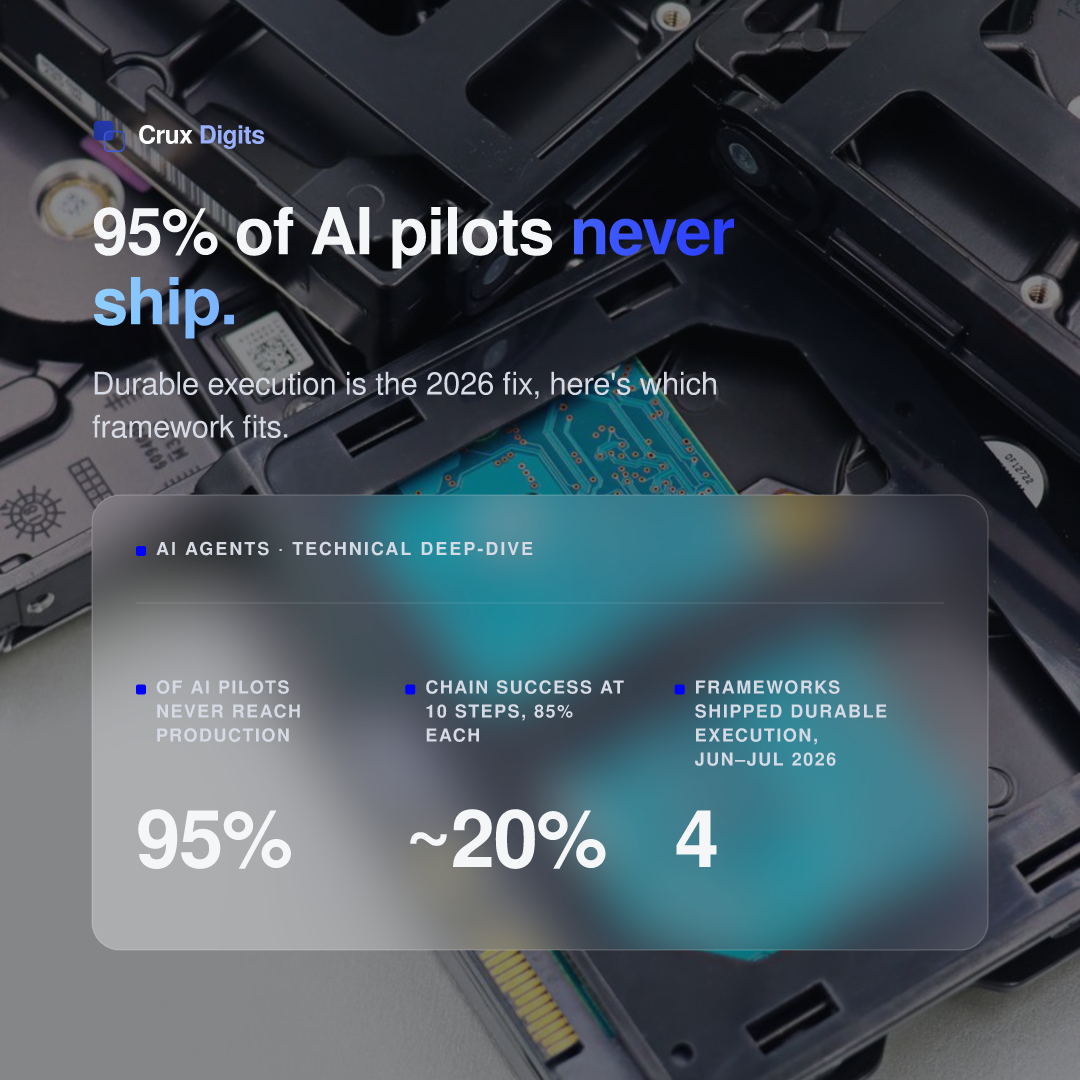
"AI agents in production" means an agent that survives a crashed process, a timed-out API call, or a task that runs six hours instead of six seconds — not a demo that works once, in a quiet room, on the happy path. That distinction matters more in mid-2026 than it did a year ago: four separate frameworks shipped stable, durable-execution primitives within six weeks of each other, and the reliability math explains why every one of them had to.
Why most agent pilots never reach production
MIT's NANDA initiative found that around 95% of enterprise generative-AI pilots fail to deliver measurable business impact, based on 300 deployments and interviews across 150 organisations. Going into 2026 that gap has shifted from “will this model work” to “will this agent survive contact with a real system.” The failure mode is rarely the model being wrong. It is the agent losing state: a tool call times out, a server restarts, an approval takes four hours instead of four seconds, and the whole run has to start over — or worse, silently repeats an action it already took.
This piece is about the infrastructure half of that failure rate — crashed processes, dropped state, timed-out tool calls. The non-technical half — scope, sponsorship, data readiness — is covered in our guide to why AI pilots fail.
The same MIT analysis found that buying from a specialised vendor or building through a partnership succeeded roughly 67% of the time, while purely internal builds succeeded about a third as often — not because internal teams write worse code, but because they rebuild the same durable-execution plumbing every vendor has already solved. That is the practical argument for treating the frameworks below as infrastructure to adopt, not something to reinvent per project.
The reliability math makes the underlying problem concrete. Say an agent chains five tool calls to handle one task — read an incoming email, look up the order in your ERP, check stock, draft a quote, send it — and each step succeeds 85% of the time on its own, a realistic figure for a well-tuned agent, not a sloppy one. The chain as a whole succeeds only 0.85⁵ ≈ 44% of the time. Add a second approval step and a follow-up action — ten steps total — and the same 85% per-step reliability compounds to 0.85¹⁰ ≈ 20%. Four runs out of five fail somewhere in the chain. No amount of prompt tuning fixes that; it is an infrastructure problem, and durable execution is the infrastructure answer.
What durable execution actually solves
Durable execution records every completed step of a workflow as an event log and replays that log on failure, resuming at the last completed step instead of the first one. Temporal, the durable-execution engine behind this pattern, raised a $300M Series D in February 2026 at a $5B valuation and shipped a Generally Available OpenAI Agents SDK integration in March 2026 — OpenAI, Replit and Lovable all build production agents on it. The point is not to add another vendor to your stack; it is to stop treating an LLM call as fire-and-forget. A durable agent can pause for hours waiting on human approval, survive a server restart mid-task, and retry only the step that failed — not the whole run.
Four frameworks, four bets — what shipped in June and July 2026
The last six weeks produced more production-grade agent tooling than the previous year, and each release bets on a different layer of the same problem.
- Pydantic AI v2 went stable on 23 June 2026 after seven betas, replacing its previous model with a single “capabilities” primitive — one composable unit bundling an agent's tools, hooks, instructions and model settings. Durable execution is moving into that same capability layer, letting a Python-first agent survive restarts and long human-in-the-loop pauses without a separate orchestration engine.
- LlamaIndex Workflows 1.0 went stable a day earlier, on 22 June 2026, as its own standalone package. It adds typed workflow state in both Python and TypeScript, resource injection for database clients, and OpenTelemetry-based observability — aimed squarely at multi-step document and research agents that need to be debuggable in production, not just demoable in a notebook.
- Claude Agent SDK gained hierarchical subagents on 10 June 2026 (Claude Code v2.1.172): a subagent can now spawn its own subagents, up to five levels deep, each running in an isolated context. Anthropic's own research found five levels covers nearly every practical engineering workflow — for a build team the payoff is context isolation and parallel subtasks without bloating the parent agent's prompt.
- n8n shipped a reliability-focused patch round on 7 July 2026 (v2.29.7), and its 2026 production guidance is explicit: run AI Agent workflows in queue mode with PostgreSQL and Redis, not the default single-process mode, specifically to avoid execution timeouts on long-running agent calls.
Between them, that is Python-native code (Pydantic AI, LlamaIndex), Anthropic-native orchestration (Claude Agent SDK) and low-code automation (n8n) — three different entry points into the same durable-execution shift, with LangGraph 1.0 and Temporal sitting underneath as the heavyweight option for teams that need full replay and audit trails.
Which layer actually fits a Dutch SME
Most SMEs never need Temporal directly, and that is the right call, not a compromise. A 20–50 FTE installation firm or accountancy practice automating quote generation or invoice matching against Exact Online, AFAS or e-Boekhouden gets most of the reliability benefit from n8n in queue mode with a Postgres-backed execution history and one clearly defined human-approval gate before anything is sent or booked — no separate orchestration engine required. A team with an in-house developer who wants code it owns, not a subscription to a workflow builder, is better served by Pydantic AI v2 or the Claude Agent SDK: both are Python- or code-first, both now ship durable-execution or context-isolation primitives natively, and both produce a codebase a developer can actually review. Temporal or LangGraph earns its added complexity only once an agent runs for hours or days, touches money or contracts directly, or needs a full replayable audit trail for compliance — which in practice means mid-market (250–500 FTE) territory more often than not.
Durable execution does not fix a wrong decision
None of this solves the other half of the reliability problem: an agent that reliably calls the wrong tool is still wrong, just more efficiently. Durable execution fixes infrastructure failures — crashes, timeouts, restarts, dropped state. It does nothing for a model that misreads a quote request or approves a refund it should have flagged. That half of the problem is still solved with evals scored at the tool-call level rather than only end-to-end, explicit guardrails on what an agent may do without approval, and — as below — a human in the loop on anything irreversible. Teams that treat a new durable-execution framework as a substitute for evals are trading one failure mode for another, not removing one.
A production-readiness checklist
Before calling any agent “done,” five questions separate a demo from something a business can run on:
- Does every tool call have a defined retry and backoff policy, or does a timeout just kill the run?
- Does every irreversible action — sending an email, booking an invoice, moving money — sit behind an explicit human-approval step before it commits?
- Is state stored outside the running process, so a crash resumes at the last completed step instead of step one?
- Can someone see, per run, exactly which step failed and why — structured logs or OpenTelemetry traces — rather than just “it broke”?
- Has the test plan covered what happens when a tool is unavailable, not only the happy path?
Answering no to more than one of these is a reliable sign the project is still a pilot, whatever the sales deck calls it.
Where MCP fits underneath this
This durable-execution wave sits directly on top of the protocol layer covered in our MCP 2026 spec piece: MCP's stateless core and Tasks extension let a server hand back a task handle instead of holding a session open — exactly the primitive a durable agent needs to survive a restart mid-tool-call. The frameworks above are, in effect, the client-side half of that same shift. If you are still deciding which layer of the 2026 stack — MCP, RAG, agents or A2A — your problem actually needs, that is covered in our stack breakdown, and agent memory — a related but separate failure mode — in our agent memory piece.
Where to start
Map one workflow — the one with the clearest, most repeatable steps and the highest cost when it silently fails — before picking a framework. If it is a chatbot flow or a WhatsApp or e-mail intake already running in n8n or Make, add queue mode, Postgres-backed history and one approval gate before reaching for anything heavier. If it is a multi-step agent your team is building from scratch, Pydantic AI v2 or the Claude Agent SDK are a more defensible 2026 default than a hand-rolled retry loop — and worth checking against the security side of the same shift in our agent security threat model. See how we scope agent builds on our AI agent development page, and read what separates a working system from a demo on our production AI, not demos guide.
We build custom AI and LLM systems that run in production: a clickable MVP by the second call, fixed steps, and you own the code.
AI development agency in the Netherlands →