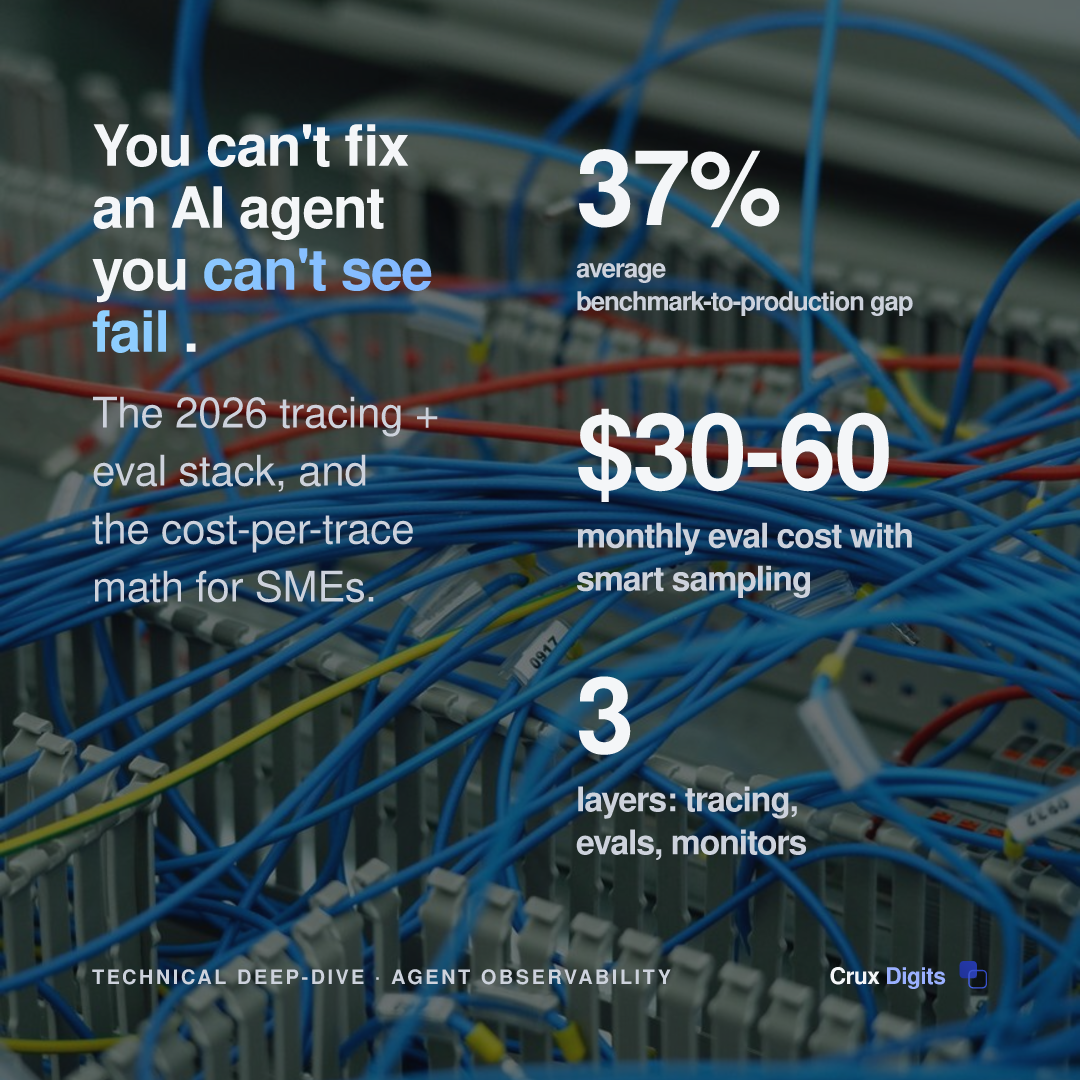
AI agent observability is the discipline of tracing every LLM call, tool invocation and retrieval step an autonomous agent makes, then scoring those steps for correctness, cost and safety before a user ever files a complaint. In 2026 it runs on three layers that most teams still bolt on separately: OpenTelemetry's GenAI tracing standard, an evaluation layer that scores what the traces show, and online monitors that catch drift once the agent is live. Skip any one layer and you have shipped an agent you cannot debug.
Why "it worked in the demo" stopped being good enough
A demo agent runs against three prepared inputs and a stable API. A production agent runs against a customer who mistypes an invoice number, a downstream system that times out, and a tool response shaped nothing like the fixture it was tested on. We covered the reliability side of that gap in AI Agents in Production — durable execution, retries, checkpointing. Observability is the other half: even a perfectly durable agent that never crashes can still be confidently, silently wrong, and durable execution will not tell you that. Only tracing and evaluation will.
Research comparing lab benchmark scores to real deployments in 2026 has repeatedly found a gap of roughly a third between the two — benchmarks use clean inputs, predictable tool responses and controlled environments, while production traffic does not. That gap is exactly what an observability stack is built to surface, continuously, instead of once at launch.
Three layers, not one tool
Tracing captures what happened: the exact prompt sent, the model's response, token counts, latency, and every tool call or retrieval step in between, structured as a hierarchical trace rather than an opaque request. Evaluation scores what happened, either offline against a curated dataset before you ship a change, or online against live traffic to catch regressions. Monitoring watches evaluation scores over time and alerts a human when a metric crosses a threshold. Most teams that skip observability entirely are missing layer one. Most teams that have "some logging" are missing layers two and three, which is where the actual failures get caught.
The standard layer: OpenTelemetry's GenAI semantic conventions
The part of this stack least likely to lock you into one vendor is the tracing standard itself. OpenTelemetry's GenAI Special Interest Group has been unifying attribute names for LLM calls, agent steps, vector-database queries, token usage and cost since April 2024, and by 2026 the OpenTelemetry GenAI semantic conventions cover four areas: LLM client spans, agent spans, events for prompt and completion content, and metrics. As of mid-2026 no part of the GenAI surface carries a formal Stable tag yet in the dedicated repository — client spans are the most mature and closest to graduating, while agent and framework spans remain explicitly experimental — so treat the whole convention as pre-1.0 and worth pinning a version for. An OTEL_SEMCONV_STABILITY_OPT_IN environment variable lets teams dual-emit legacy and new attribute names during the transition, so upgrading later does not mean a breaking rewrite.
The practical payoff is portability. Because each tool call, LLM invocation and retrieval step becomes a child span under the OTel convention, a trace you capture today will render correctly in whichever backend you choose next year — Datadog added native support in OTel v1.37, and Grafana's tracing stack ingests the same GenAI spans through its standard OTel pipeline. For a small technical team, that means the instrumentation work is not wasted if the observability vendor changes; only the destination changes.
Trajectory versus final answer: why agent evals are harder than they look
Evaluating a single LLM call is comparatively simple: did the answer match the expected one. Evaluating an agent means scoring the whole trajectory — did it call the right tool, in the right order, with the right arguments, and did it recover sensibly when a tool returned an error. Confident AI's 2026 guide to agent evaluation groups the useful metrics into tool-calling accuracy, planning quality, task completion and reasoning, with safety, latency and cost layered on top once the agent is live. A trace that ends in the correct final answer can still have taken four unnecessary tool calls to get there, burning budget and latency the final-answer metric never sees.
This is also where cost tracking stops being a finance question and becomes an engineering one: step and loop count is invisible in a trace's total cost line unless you attribute spend per span, which means a single misbehaving agent loop can multiply your token bill for weeks before anyone in finance notices the invoice moved.
The 2026 tool landscape
The tooling has matured enough that most SME-sized decisions come down to three or four names. Langfuse is open source and self-hostable, and treats a model call as a structured generation — model name, prompt, completion, tokens, latency, cost — rather than an opaque request, which is the right default for a Dutch team that wants traces, evals and prompt management in one connected workflow without a vendor contract. As of July 2026 its monitors also support boolean scores, so a team can alert in Slack or trigger a GitHub Action the moment a policy-check failure rate crosses a set threshold.
Arize and Confident AI's DeepEval lean toward evaluation-first workflows with a strong LLM-as-judge layer; Braintrust and Galileo — the latter now built on its Luna-2 foundation models — target teams that need an integrated simulation, evaluation and observability platform rather than assembling one from parts. None of these are free at real production volume, which is exactly why the next section matters more than the feature comparison.
The cost-per-trace math nobody shows you
Take a concrete, stated-assumption example: a Dutch SME running an invoice-processing agent handling 50,000 calls a month, averaging four spans per call — one LLM call plus three tool calls against the ERP, a validation service and email. Judging every trace against a single quality metric with an LLM-as-judge model costing roughly $0.002 per judged trace already comes to $100 a month. Running three metrics that actually matter in production — correctness, tool-call accuracy and a safety check — multiplies that to around $300 a month before storage, dashboards and the judge model's own token cost are added, which typically adds another 15 to 20 percent on top.
Almost no team needs to evaluate 100% of traffic to catch what matters. Sampling 10 to 20% of routine traffic, combined with evaluating every trace that carries a negative user signal, a tool error, or an unusually long trajectory, cuts that same workload to roughly $30 to $60 a month while still catching the failures that would otherwise reach a customer. The number that should worry a small team is not the eval bill — it is the token bill from an agent loop nobody is watching, which the same tracing layer is what catches first.
Frontier-lab watch: DeepMind's evaluation scientists just went to Anthropic
AlphaFold Nobel laureate John Jumper left Google DeepMind for Anthropic in June 2026 after nearly nine years, joining around 22 June; original AlphaFold co-authors Jonas Adler and Alexander Pritzel followed within days, reported to be joining around 24 June, with Adler moving into Anthropic's AI coding work and Pritzel into pretraining. The departures form part of a broader wave of researchers leaving Google for rivals through June and July 2026, including Noam Shazeer's move from Google to OpenAI.
The detail worth noticing for anyone building agent tooling is not the headcount, it is the discipline these three people built their careers on. AlphaFold won its Nobel not for a bigger model but for a rigorous, ground-truth-scored evaluation methodology that could prove a predicted protein structure was actually correct. Watching that specific kind of talent move toward a lab that has staked its identity on interpretability and careful evaluation is a signal worth reading literally: the next competitive edge in agentic AI is not a bigger model, it is who can prove their system is right, at scale, the same way AlphaFold had to prove it. That is precisely the muscle an observability and eval stack builds inside a business, not just inside a lab.
What to instrument first, in order
- Trace before you optimise anything. Wire up OpenTelemetry GenAI spans or a Langfuse SDK around your agent before touching prompts or frameworks — you cannot fix what you cannot see.
- Write three to five pass/fail criteria tied to a business outcome (correct invoice total, correct tool call, no unauthorised action), not a vague "sounds right" judgement call.
- Sample intelligently: eval 10 to 20% of routine traffic, but eval 100% of traces with negative feedback, a tool error, or a trajectory longer than expected.
- Set one online monitor with a Slack or webhook alert before go-live, not after the first customer complaint. This is the same discipline covered from the security angle in AI Agent Security and from the token-budget angle in Context Engineering.
- Treat the MCP and framework layer as the plumbing and observability as the meter — see MCP, RAG, AI Agents and A2A for how the pieces fit together.
None of this requires a large team. A Dutch SME with one or two agents in production, typically once you have moved past a single pilot into the 20-to-50-FTE range where a real process runs on the agent daily, gets most of the value from a self-hosted Langfuse instance and a short list of business-tied metrics; a managed platform earns its price once you are running enough agents, or hold enough compliance weight, that someone needs to own the evaluation pipeline as a full-time job. Crux Digits builds and instruments agent integrations with exactly this tracing-first approach, so the agent a client ships is one they can actually debug six months later.
This overview reflects the OpenTelemetry GenAI conventions and the Langfuse, Confident AI, Arize and Galileo feature sets as they stood at the end of July 2026. All four are moving quickly — check current docs before you commit to an architecture.