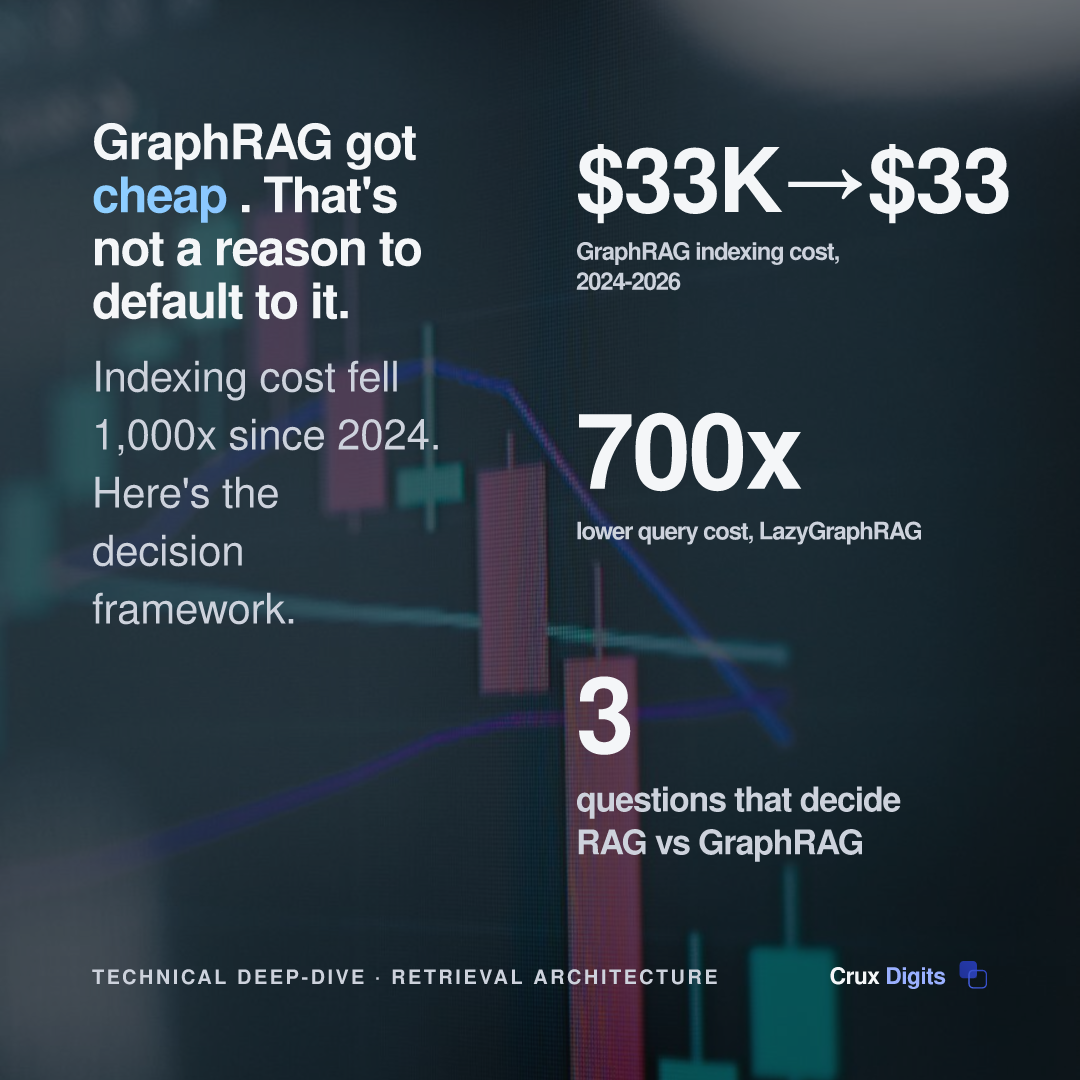
RAG vs GraphRAG comes down to one question: does your AI agent need to answer questions about specific facts or about the shape of your entire dataset? Vector RAG wins the first; GraphRAG wins the second. In 2026, GraphRAG's indexing cost collapsed from roughly $33,000 to near-vector-RAG parity — but that cost collapse doesn't mean every retrieval pipeline needs a knowledge graph bolted on.
What actually separates RAG from GraphRAG
Vector RAG chunks your documents, embeds them, and retrieves the chunks most semantically similar to a query — a form of best-first search. It excels at “who, what, when, where” questions where the answer sits inside one or two passages. GraphRAG instead extracts entities and relationships from your corpus at indexing time, clusters them into hierarchical communities, and has an LLM summarise each community. That structure is what lets it answer “what are the main themes” or “what are the implications of X across the dataset” — queries no single chunk can answer alone, because the answer is distributed across the whole corpus. Microsoft Research, which popularised the technique, calls this the local-versus-global distinction, and it is still the cleanest way to decide which architecture a given query needs.
The cost trap that no longer exists
Early GraphRAG deployments earned a reputation for being prohibitively expensive: indexing a single dataset with Microsoft's original pipeline could run to $33,000 in LLM calls, because every entity and relationship needed an LLM-generated summary before you could ask a single question. That figure is why most 2024–2025 “RAG vs GraphRAG” articles conclude GraphRAG is an enterprise-only luxury. It is stale advice. Microsoft's LazyGraphRAG, introduced in late 2024 and folded into Microsoft Discovery in 2025, defers LLM summarisation to query time: its indexing cost is defined as identical to plain vector RAG, and for comparable query cost it matches or beats full GraphRAG's global-search quality at more than 700 times lower query cost. Open-source alternatives moved just as fast — LightRAG (HKUDS, EMNLP 2025) uses a dual-layer graph-plus-vector index that updates incrementally instead of requiring a full re-index, at roughly the same indexing cost as embedding the text alone. Independent trackers now describe the drop as three orders of magnitude across the 2024–2026 window. Translated to SME scale: whatever a mid-sized contract archive would have cost to index under 2024-era GraphRAG, LazyGraphRAG or LightRAG index the same corpus for roughly what embedding it for vector RAG alone costs — the ratio holds regardless of corpus size, because LazyGraphRAG's indexing cost is defined relative to vector RAG, not as a fixed price. Cost is no longer the reason to avoid GraphRAG. It also isn't a reason to default to it.
Hybrid retrieval is still the production baseline
Before reaching for a knowledge graph, most teams should exhaust hybrid retrieval: combining sparse keyword search (BM25) with dense vector search and fusing the two ranked lists, typically with Reciprocal Rank Fusion. Practitioner benchmarks in 2026 consistently show hybrid retrieval beating either method alone by 15–30% on recall, with some enterprise pipelines reporting recall climbing from roughly 0.72 with BM25 alone to above 0.9 with a tuned hybrid-plus-reranker setup. For evaluation, the RAGAS framework's four-metric panel — faithfulness, answer relevancy, context precision, context recall — remains the reference point, now complemented in production by tools like DeepEval for CI/CD gating and Langfuse for tracing. If hybrid retrieval with a reranker clears your faithfulness and recall targets, you almost never need a graph on top. If your failures cluster around “the model can't see the whole picture” rather than “the model retrieved the wrong passage,” that is the signal to look at GraphRAG.
The decision framework
Three questions decide it, in order.
- Query shape: if most real user queries are lookup-style (“what is the deadline in contract X”), hybrid vector RAG wins on cost and simplicity. If a meaningful share are synthesis-style (“what are the risks across all our supplier contracts”, “summarise everything we know about client Y”), GraphRAG's multi-hop structure earns its cost.
- Corpus structure: contracts, compliance registers, incident reports and technical documentation are entity-and-relationship-dense — people, companies, clauses and obligations that reference each other. A flat FAQ knowledge base or a product catalogue mostly isn't; a graph adds indexing overhead with no retrieval gain.
- Change rate: LazyGraphRAG and LightRAG close some of this gap, but full GraphRAG's community summaries still need periodic re-indexing after significant corpus drift, while LightRAG's incremental updates and vector RAG's per-document embedding both tolerate daily-changing content better.
Score all three toward graph structure, and a knowledge-graph layer earns its keep. Score toward simple, fast-changing, lookup-heavy data — which describes most SME knowledge bases — and hybrid vector RAG is not just less expensive, it is more accurate for the questions actually being asked.
A worked example makes the trade-off concrete. Take a 30-person accountantskantoor with ten years of klantdossiers: engagement letters, correspondence, risk memos and annual accounts, each referencing clients, entities, fiscal years and specific risk flags. A lookup query — “what was the deadline in the Jansen BV engagement letter” — is answered perfectly by hybrid vector RAG: one document, one passage, done in milliseconds. A synthesis query — “across every client where we flagged going-concern risk in the last three years, which ones also changed accountant” — needs the graph, because the answer requires walking relationships between clients, risk flags and personnel changes that no single chunk contains. Most firms' actual query logs are dominated by the first type; the second type is real but rare. That ratio, more than any architecture diagram, should drive the build decision — and it's measurable from a week of query logs before you write a line of retrieval code.
Where retrieval fits in the 2026 agent stack
In 2026's agent architectures, RAG and GraphRAG are rarely called directly by an LLM — they sit behind a tool or an MCP server the agent calls when it needs grounded facts, the pattern we mapped out in MCP vs RAG vs AI Agents vs A2A: The 2026 Stack. That matters for the build decision: if you're already exposing a vector store as an MCP tool, swapping in a GraphRAG-backed tool is a retrieval-layer change, not an agent redesign — the agent's reasoning loop, memory and orchestration stay the same. It also means this decision can be revisited later without a rebuild: start with hybrid vector RAG behind the tool interface, and swap the implementation only if your evals later show synthesis-style queries failing.
What this means for a Dutch SME building an AI agent
Most Dutch SMEs evaluating retrieval for a customer-service or internal-knowledge agent do not need GraphRAG in 2026, and vendors pitching a knowledge graph as a default upgrade are usually solving a problem the buyer doesn't have. Where the calculation flips: an accountantskantoor building an agent over years of klantdossiers and correspondence, where “summarise every risk flag we've raised for this client since 2022” is a real, recurring query; an installatiebedrijf's compliance register connecting AI Act obligations to specific systems and suppliers; or a groothandel reconciling supplier contracts against changing ERP records, where the entities — leverancier, contract, artikel, voorwaarde — genuinely reference each other. That last case connects directly to the integration patterns we cover in How AI Connects to Exact Online, AFAS & e-Boekhouden — the retrieval layer sits on top of exactly the kind of interlinked, ERP-adjacent data GraphRAG is built for. For a straightforward WhatsApp-or-email support agent answering “what are your opening hours” and “where is my order,” hybrid vector RAG with a decent reranker remains the right, boring, inexpensive default — and boring is a feature when a 20–50 FTE team has to maintain it.
How to test it before you commit
Don't decide this on paper. Pull 20–30 real queries your users actually ask (or would ask), run them through a hybrid-plus-reranker baseline, and score faithfulness and context recall with RAGAS. Then run the synthesis-style subset — the “summarise across everything” questions — through a LazyGraphRAG or LightRAG pilot on the same corpus; both now index at roughly vector-RAG cost, so the pilot itself is inexpensive. If the graph pilot doesn't measurably beat the hybrid baseline on the queries it's supposed to win, the extra architecture and maintenance burden isn't worth it. This mirrors the durable-execution lesson from our piece on AI agents in production: build the simplest thing that clears your evaluation bar, and add complexity only where the evals prove you need it.
Where to start
If you're specifying retrieval for an AI agent this quarter, start with hybrid vector RAG and RAGAS evals as the default, and treat GraphRAG as an upgrade you test — not one you assume. See how we scope agent and retrieval architecture for Dutch SMEs on our AI agent development page, and how we take agents from pilot to durable production on our production AI page.
We build custom AI and LLM systems that run in production: a clickable MVP by the second call, fixed steps, and you own the code.
AI development agency in the Netherlands →