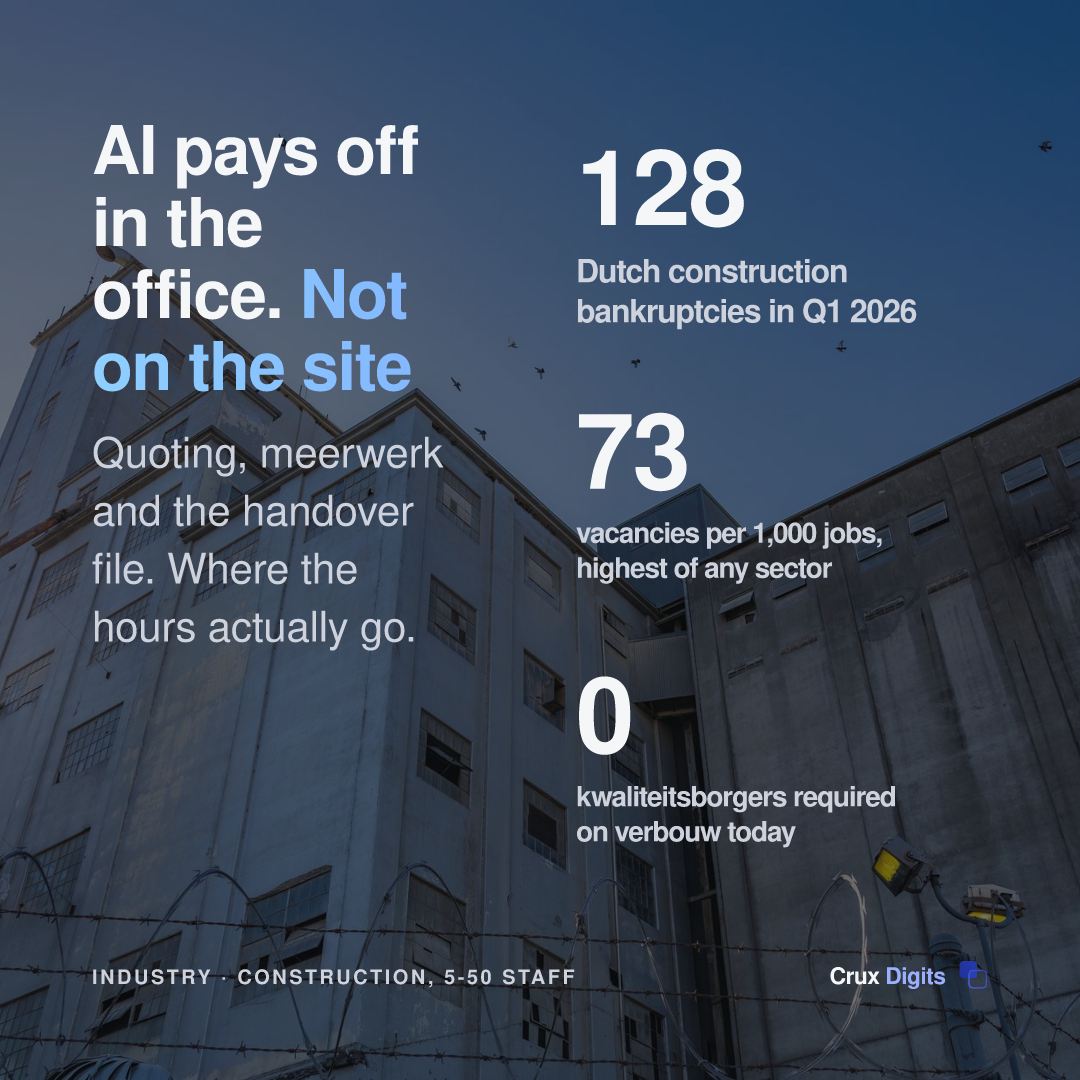
For a Dutch construction firm of five to fifty people, AI pays for itself in the office, not on the site. The work worth automating is the quoting, the meerwerk that never gets written down, the handover file assembled at the end, and the invoicing that follows — administrative work that already consumes evenings. Nothing here replaces a vakman. It replaces the paperwork that keeps one away from the job.
Why is this landing in Dutch construction right now?
Because margin has become the binding constraint. In the first quarter of 2026, 128 Dutch construction firms went bankrupt, and March alone saw 53 — a rise of more than 60 percent against March 2025. Firms are not short of work; they are short of margin and short of people to deliver it.
The labour picture explains the second half. Construction runs around 73 open vacancies per 1,000 jobs, still the highest vacancy rate of any Dutch sector against a national average of 42, and roughly 80 percent of construction entrepreneurs reported staffing shortages in CBS's conjunctuurenquête. In that situation, the return on automating administration is not a cost saving on paper. It is hours given back to people you cannot hire more of.
Where do the admin hours actually go in a 5-to-50 person contractor?
In most firms this size the pattern is consistent. Quoting and calculation absorb the largest single block, because every offer is assembled by hand from drawings, a bestek and last year's prices. Meerwerk — additional work agreed verbally on site — is the most expensive leak, because what is not recorded the same day is frequently never invoiced at all. Work preparation means turning drawings into material lists and sequences. Then the handover file has to be assembled at completion, and invoicing chases everything else.
The useful question is not which of these an AI could theoretically touch, but which one is costing you most right now. We wrote a general framework for that in Which Process to Automate First; in construction the answer is unusually often meerwerk, because it is the only one on the list where the automation does not save time so much as recover revenue that is currently walking off the site.
It is worth putting rough numbers on the meerwerk leak, with the assumptions stated so you can substitute your own. Take a contractor running fifteen people and forty projects a year. Assume two items of additional work per project are agreed verbally, that each averages 400 euros, and that a fifth of them never reach an invoice because nobody wrote them down the same day. That is sixteen unbilled items a year, or roughly 6,400 euros of work performed and not charged — against an automation that costs a fraction of it and needs no integration to run. Halve every assumption and it still clears its own cost. The reason this one is worth doing first is not that the technology is clever; it is that the money is already leaving and nobody has to be persuaded that it matters.
Does the Wkb actually require what the software vendors imply?
This is where a lot of construction software marketing quietly overstates the case, so it is worth being precise. The Wet kwaliteitsborging voor het bouwen applies to new-build in gevolgklasse 1. It does not currently apply to renovation. Kwaliteitsborging was due to become mandatory for verbouw from 1 July 2025, and that did not happen: in a letter of 10 December 2024, minister Mona Keijzer confirmed renovation will not fall under gevolgklasse 1 until there is a system that demonstrably fits renovation work. An evaluation of the kwaliteitsborging rules is due by 1 January 2027 at the latest.
The practical consequence matters if you are buying software. A contractor doing mostly verbouw and onderhoud is not under the kwaliteitsborging regime: no independent kwaliteitsborger, no bouwmelding, no gereedmelding. But do not read that as “no file at all”, because this is where both sides of the sales conversation tend to be sloppy. The Wkb's consumentendossier under article 7:757a BW applies to construction contracts concluded since 1 January 2024, verbouw included, unless the parties agree otherwise in writing. So the accurate position is narrower than the marketing claim and narrower than the dismissal: no kwaliteitsborger on your renovation work, but a default dossier duty toward your client that you can only contract away deliberately. Buy it because you want the file, not because you have been told you are about to need it. If you build new houses in gevolgklasse 1, the obligation is real and the Informatiepunt Leefomgeving guidance is the reference to work from.
What can AI genuinely do today for a bouwbedrijf — and what can't it?
It can read documents and produce drafts. Pulling quantities and specifications out of a bestek, drafting an offer from your own historical calculations, turning a voice note from the site into a structured meerwerk record with photographs attached, assembling a handover file from material already scattered across the project, and drafting the invoice that follows. All of these are document-in, document-out tasks with a human approving the result, which is the shape of automation that actually survives contact with a working business.
The quoting side deserves a caveat that the demos skip. Drafting an offer from historical calculations works well when your historical calculations are consistent and well structured, and badly when three people have priced work three different ways for a decade. The model reproduces whatever pattern it finds, including the bad habits. In practice the first weeks of a quoting automation are usually spent discovering how much variation exists in your own back catalogue, which is uncomfortable but valuable in itself.
It cannot price your risk. A calculation carries judgement about this client, this site, this subcontractor and how much trouble the ground is likely to cause — and that judgement is what separates a profitable job from a lesson. Treat AI output as a first draft prepared by a fast assistant who has read everything and understood the commercial stakes of none of it. The rule we apply everywhere holds especially here: AI drafts, people approve.
How does this connect to the software you already run?
It should sit on top, not replace. Most Dutch contractors of this size already run something for project administration — Bouw7, now part of Exact, is common in exactly this segment, alongside Admicom and the calculation packages. The integration route is the same one we described for connecting AI to Exact Online, AFAS and e-Boekhouden: the AI layer reads from and writes to the package through its API, and the package stays the system of record.
The related pattern from an adjacent trade is worth borrowing wholesale. Installation firms have been automating work orders on top of their existing ERP — voice capture on site, a human check, same-day invoicing — and the mechanics transfer directly to a bouwbedrijf's meerwerk problem. Invoice handling follows the same pattern once the project data is clean, which we covered separately in automating invoice processing.
What about Flemish contractors?
One thing to be clear about: the Wkb is a Dutch instrument and does not apply in Belgium. A Flemish KMO faces a different regulatory set, and any Dutch-language article promising a Wkb-shaped compliance benefit is describing the wrong country. The Belgian sector has its own pressure: Embuild counted a net loss of 1,402 construction and installation firms across Belgium in 2025, the first net decline in ten years. What does transfer is everything else in this piece — the quoting, the meerwerk capture, the handover documentation and the invoicing are the same administrative burden in Antwerp as in Utrecht, and the same document-in, document-out automation applies. Check the obligation locally; borrow the workflow freely.
Where should a small contractor start?
- Pick one process and measure it for two weeks before automating anything. If you cannot say how many hours quoting costs you, you cannot tell whether the automation worked.
- Start with meerwerk if anything gets agreed verbally on site. It is the shortest path from automation to recovered revenue, and it needs no integration to prove — a structured capture step and a same-day approval is enough.
- Keep a human approval on anything that reaches a client. A wrong quantity in an offer is far more expensive than the hour it saved.
- Only then look at integration with your project package, because that is where the effort and the cost concentrate.
The realistic horizon is weeks rather than quarters for a first working process, which we set out in how long an AI implementation takes, and the sensible first step is a conversation about which process is actually bleeding — not a platform decision. We work with Dutch SMEs on exactly this, and the first question is always the same: what does this cost you today, in hours you can name?
Sector figures and the Wkb position reflect published sources as of 31 July 2026. Kwaliteitsborging for verbouw remains under review — verify the current position before making a compliance decision.