Automating invoice processing means AI reads incoming invoices (PDF, email attachment or scan), extracts the line items, matches them against a purchase order or price list in your accounting package, and routes only the exceptions to a person. For a 20–50 FTE Dutch SME, that typically cuts per-invoice handling cost by 70–90% and turns a multi-day AP backlog into a same-day one, without replacing Exact Online, AFAS or e-Boekhouden.
What it actually costs today, and what AI changes
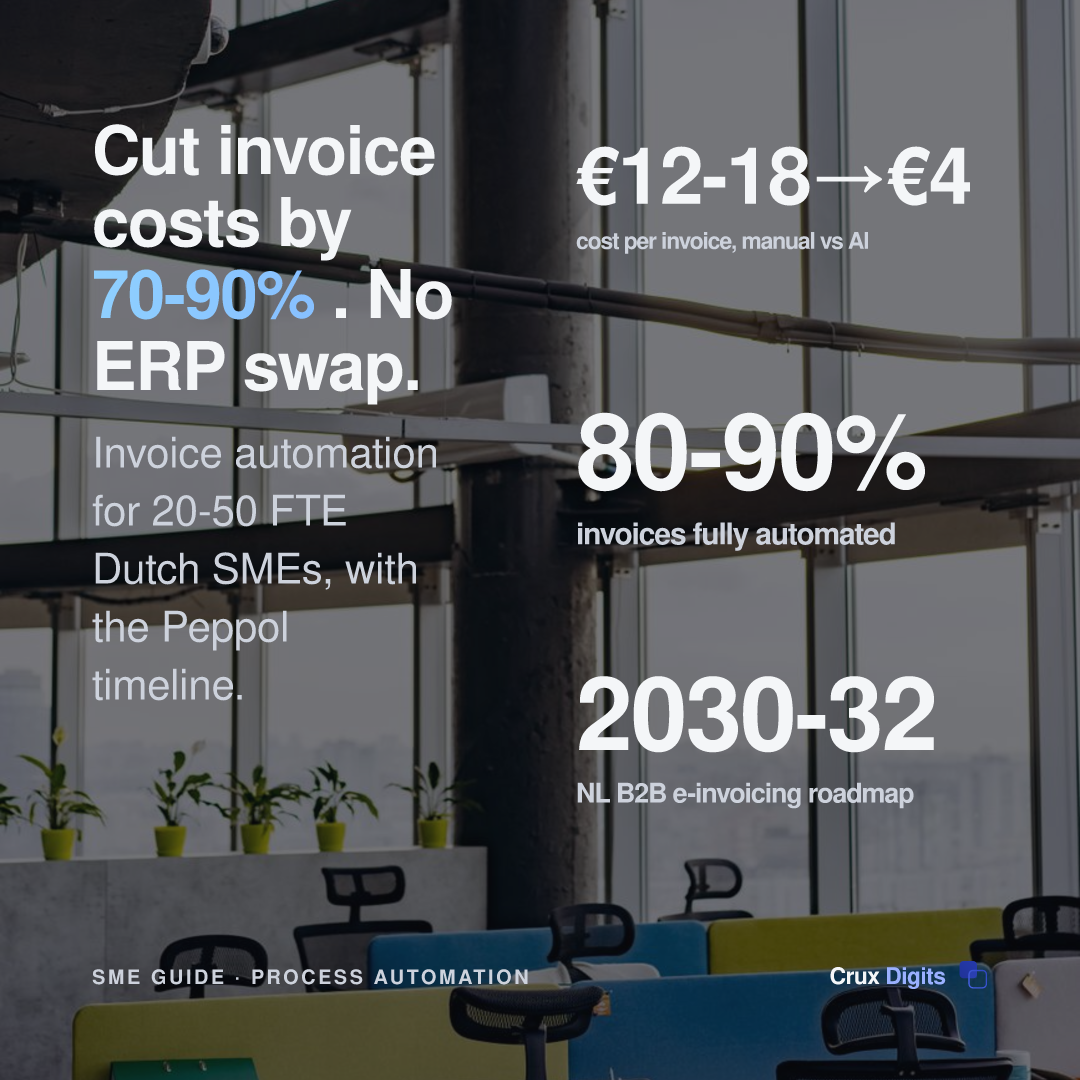
Industry benchmarking from Billentis and Ardent Partners puts fully manual invoice processing at roughly $25–35 per invoice globally, with organisations running mostly manual workflows reporting a wider $15–40 range once exception handling is included: 20–30% of manually processed invoices need some form of exception handling, and each exception adds cost well beyond the base figure. Semi-automated workflows land around $3–5 per invoice, and best-in-class AI-driven automation has pushed leaders below $1. Dutch AP-software vendors report a similar shape in euros: roughly €12–18 per invoice manually at around 8 minutes of handling time, versus €3–5 and about 2 minutes with AI-assisted extraction, with 80–90% of invoices processed fully automatically and the remainder, such as handwritten invoices, new suppliers and unusual formats, flagged for a person. For a firm processing 400 invoices a month, moving from €15 to €4 average cost saves roughly €4,400 a month, about €53,000 a year, in direct processing cost alone, before counting faster payment terms, fewer duplicate payments and fewer late-payment disputes.
The e-invoicing mandate that changes the underlying data
This is not just a productivity story. The Netherlands is mid-decision on mandatory B2B e-invoicing, and the direction matters for anyone automating invoices now. B2G e-invoicing is already mandatory for suppliers to Dutch central government. For B2B, there is no domestic mandate yet: a Dutch business can only be sent a structured e-invoice if it agrees to receive one, per the EU VAT Directive's buyer-consent rule. But that is likely temporary: under the EU's ViDA (VAT in the Digital Age) initiative, the Dutch Ministry of Finance submitted a third-party analysis to parliament in March 2026 recommending a decentralised, Peppol-based e-invoicing model with near real-time digital reporting, covering both cross-border and domestic B2B transactions. No legislation has passed; the roadmap points to phased implementation between 2030 and 2032, with the government's preferred direction expected this summer and draft legislation for consultation by the end of 2026. In practice the Netherlands already has one of Europe's highest voluntary Peppol adoption rates, because most Dutch ERP and accounting packages support the SI-UBL 2.0 format natively. The practical upshot for an SME automating invoices today: build the extraction and matching layer to consume structured Peppol/SI-UBL data where a supplier already sends it, and keep AI-based OCR extraction for the PDF and paper invoices that will keep arriving for years regardless of what a future mandate requires.
Faster processing also unlocks money most SMEs leave on the table: early-payment discounts. A supplier offering 2/10 net 30 terms (2% off if paid within 10 days instead of 30) is worth capturing only if invoices are matched and approved fast enough to act on it. On €500,000 of annual purchases where a firm currently pays on average day 25 because invoices sit in an inbox, capturing even half of the available early-payment discounts on offer is a low four-figure annual saving that manual processing structurally cannot reach, on top of the direct per-invoice cost reduction above.
The 2026 tool landscape, briefly
Three categories cover most Dutch SME needs. Native AP modules inside Exact Online, AFAS and similar packages have improved but still lean on basic OCR rather than AI-driven matching against purchase orders, worth testing before buying anything extra. Dedicated AP-automation platforms (the category Billentis and Ardent Partners benchmark) add AI extraction, three-way matching and exception routing on top of your existing ledger via API, and are where most of the cost reduction above actually comes from. Generic document-AI tools and workflow platforms (the n8n/Make/Zapier category we cover separately) can assemble a lighter version of the same pipeline for firms with fewer than roughly 100 invoices a month, at lower cost but with more manual tuning of the extraction and matching rules.
What the automated chain looks like
- Capture: invoices arrive by e-mail, a shared inbox, or a scan; the system reads either the structured Peppol/SI-UBL data if present, or extracts fields with AI-based OCR from a PDF or scan.
- Match: line items, VAT and totals are checked against a purchase order, price list or contract in your accounting package. Exact Online, AFAS and e-Boekhouden all expose an API a matching layer can query.
- Route exceptions: mismatches, new suppliers, and anything below a confidence threshold go to a person for approval. The rule that matters here is the same one that governs every AI-drafts, human-approves workflow: silent guessing on a payment amount is the failure mode that ends a pilot.
- Book and pay: approved invoices post directly to the ledger and enter the payment run, with the audit trail kept automatically: who approved what, and when.
Automated invoice processing versus OCR: where the line is
Most suppliers call reading a PDF automated invoice processing. It is not the same thing, and the difference decides whether anyone still touches the invoice. Three things have to happen, and only the first is OCR.
- Reading. Fields come off the document, or straight out of the Peppol or SI-UBL payload when the supplier sends structured data. Accuracy here is what demos show.
- Matching. The invoice is reconciled against the purchase order and the goods receipt, and the tolerance for a price or quantity difference is a rule you set, not a judgement someone makes per invoice.
- Booking. The invoice is posted in AFAS, Exact or your ERP against the right general ledger account and VAT code, and routed for approval by the mandate scheme you already use.
Stop after reading and you have moved the typing, not removed it: someone still opens every invoice to decide where it belongs. That is why a pilot measured on reading accuracy can look excellent while the finance team's workload is unchanged.
One number tells you which of the three you are being sold: the share of invoices posted without a human touching them, measured on your own invoice mix rather than a sample chosen by the supplier. Ask for it per supplier category, because a handful of high-volume senders sending structured data will flatter any average.
Where these projects fail
- Automating a messy approval process: if nobody agrees who approves what today, AI digitises the confusion. Fix the approval matrix first.
- No visible exception queue: if flagged invoices disappear into an inbox nobody checks, payments run late and trust in the system collapses fast.
- Treating it as an IT project, not an AP-team project: the people who will use it daily need to shape the exception rules from week one, not receive a finished system.
- Skipping VAT edge cases: reverse-charge invoices, intra-EU purchases and mixed VAT-rate line items are exactly where AI extraction makes confident-sounding mistakes; route anything with a non-standard VAT treatment to a person until the model has proven itself on your specific supplier mix over several months.
Who this pays off for right now
This is squarely a small-business (20–50 FTE) case: firms at this size typically have someone doing AP part-time alongside other finance work, process a few hundred invoices a month, and already run Exact Online, AFAS or e-Boekhouden, exactly the combination where a matching layer on top of the existing package pays back within months rather than replacing anything. Below roughly 100 invoices a month, the business case is thinner; a good digital-invoice inbox with basic OCR often covers it without a dedicated AI layer. For a 250–500 FTE organisation, the same logic applies but the project looks different: governance, multi-entity VAT rules and a formal change-management track around the AP team typically matter more than the extraction technology itself.
How to pilot it before committing
Run a one-month shadow test before switching anything on: feed a month of historical invoices through the candidate extraction and matching layer without letting it touch the ledger, and compare its output line by line against what your AP person actually booked. That single test surfaces the two numbers that decide whether the business case holds: the real straight-through rate for your specific supplier mix (not the vendor's marketing number) and the false-match rate on VAT and totals, which is the number that determines how tightly you need to gate exceptions before going live. Firms that skip this step and go straight to production are the ones most likely to end up back at 100% manual review within a month, because the exception rules were never tuned against real data.
Where to start
Start by counting: how many invoices a month, what share already arrive as structured data versus PDF, and how many exceptions your current process generates. That number tells you whether a lightweight OCR add-on or a full matching layer against your ERP is the right first step. See the integration patterns in our piece on connecting AI to Exact Online, AFAS and e-Boekhouden, how the same drafts-then-approves pattern plays out for a different back-office process in work-order automation for installation companies, and what a broader AI-implementation budget typically looks like on our AI implementation cost page.
AI automation for SMEs: the audit prices the saving and payback per process, then we build the first process as a Production-ready MVP.
AI automation for business →