A chatbot answers what someone asks. An AI agent decides what to do next and acts on it — looking something up, filling in a form, updating a system — without a person clicking "send" at every step. For a 20-50 FTE Dutch business already running a WhatsApp chatbot or a website assistant, the real question is not which label to buy, but which of your daily tasks genuinely need that extra autonomy — and which do not.
What actually separates a chatbot from an AI agent
Anthropic, the lab behind Claude and the Model Context Protocol, draws this line in its own engineering guidance: a workflow strings a language model and its tools together on a path a developer wrote in advance, while an agent lets the model decide, call by call, what happens next based on what came back from the previous step. A chatbot with a fixed decision tree — "if refund request, ask for the order number, then check status" — is a workflow, even if the conversation feels natural. Give the same system three tools (order lookup, refund initiation, escalation to a human) and let the model choose which one to call, in which order, based on what the customer actually says, and it has crossed into agent territory.
That distinction matters more than the marketing term attached to a product. Most software sold as an "AI agent" in the Netherlands right now is a workflow with a conversational front end — which is often exactly the right amount of AI for the task. The mistake is not buying a workflow. It is paying agent prices, and accepting agent-level testing overhead, for a job a workflow already does well.
What “agentic AI” actually means
The word agentic gets used as if it were a product category. It is not — it is a property, and it describes how much of a task a system carries on its own. A tool that answers is not agentic. A system that decides what to do next, acts, checks the result and adjusts is.
That is why the spectrum below matters more than the label. Asking whether something “is an AI agent” rarely has a clean answer; asking how much it does without a person in the loop always does.
It is a spectrum, not two boxes
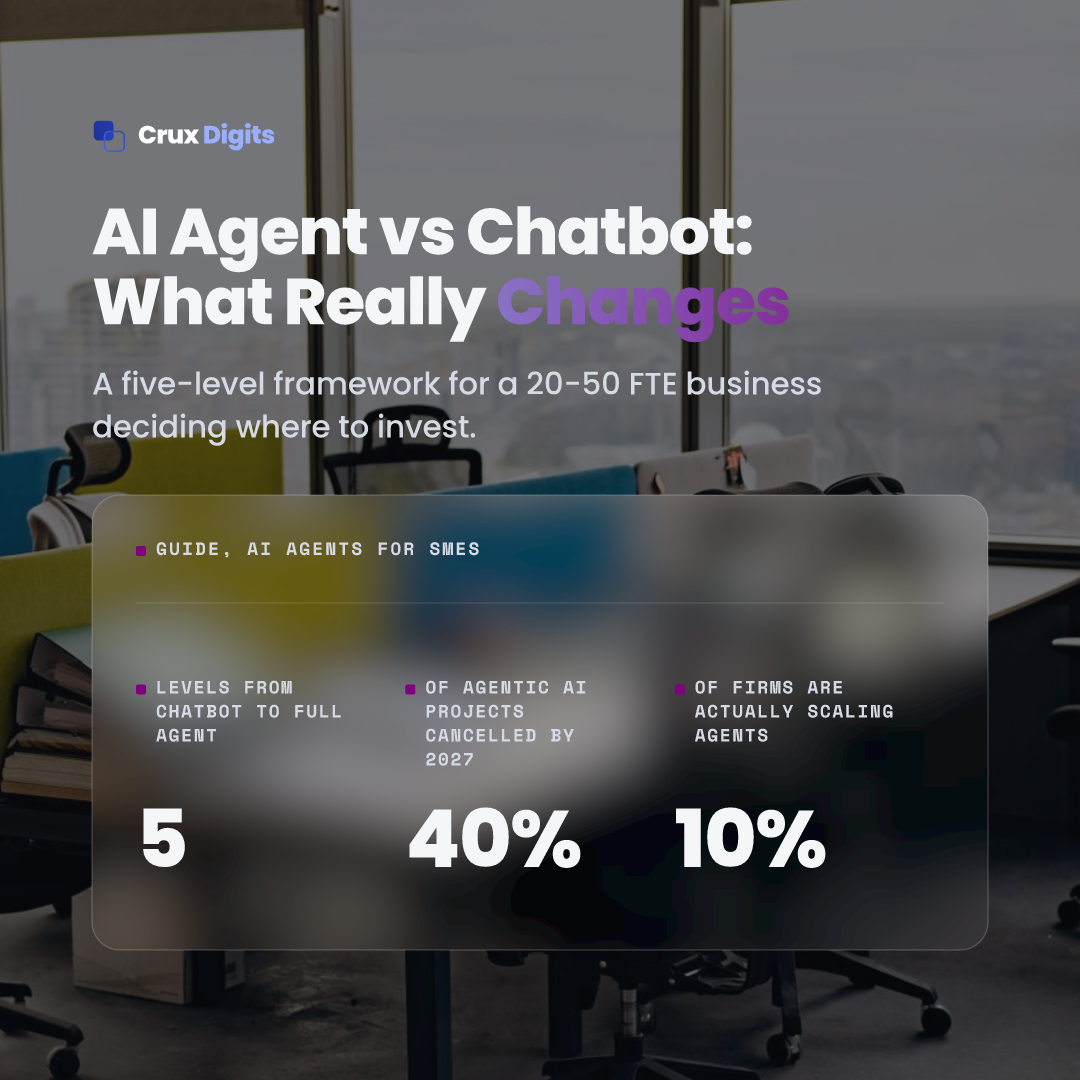
The boundary shifts with every tool you add, which is why treating "chatbot" and "agent" as two fixed products leads to the wrong purchase. A more useful way to place your own systems is a five-level ladder, built from what we see in Dutch SME deployments in 2026:
- Level 0 — static FAQ: keyword-matched answers, no model at all.
- Level 1 — LLM chatbot: answers questions from a knowledge base or website content, no tools, no memory of past actions.
- Level 2 — chatbot plus one tool: can look up an order or a stock level, but on a path the developer defined. Most Dutch WhatsApp customer-service bots sit here.
- Level 3 — multi-tool workflow: several tools wired on a fixed sequence, often an n8n or Make flow with an LLM step for classification or drafting.
- Level 4 — agent: the model chooses the tool sequence itself, retries on failure, and can chain systems it was not explicitly told to chain, inside guardrails a person set.
Level 4 is genuinely rare outside pilot projects, at any company size. That is not a reason to avoid it — it is a reason to be precise about which single process you are moving up the ladder, rather than replacing your whole customer-facing stack in one step.
A quick self-check: open the tool your chatbot already uses and count how many actions it can take per case without your approval. One action is level 2, three or four on a fixed sequence is level 3, and the moment the system itself chooses which action to use without you specifying the order, you already have a working agent — whatever the vendor calls it.
What the Model Context Protocol changes about that question
Historically, wiring a third or fourth tool into a chatbot meant a bespoke integration for each one, often rebuilt when you switched vendors. The Model Context Protocol (MCP) — the open standard Anthropic published and every major AI platform has since adopted — gives a tool a single, machine-readable description of what it does, so a model can discover and call it without custom glue code. We cover the mechanics in our MCP explainer for SMEs; the point that matters here is narrower: a well-built MCP server in front of Exact Online, AFAS or e-Boekhouden works the same way whether it is plugged into a level-2 chatbot today or a level-4 agent later. That is what makes starting small a genuine investment rather than a step you will throw away — see how we approach that specific koppeling in AI koppelen met Exact, AFAS en e-Boekhouden.
Four common tasks, four different answers
The same business rarely needs the same level of autonomy across every process. Four tasks we see most often at 20-50 FTE Dutch companies, and where each typically lands:
- Customer service on WhatsApp or the website: usually level 2 is enough — a chatbot that can look up an order, a delivery date or an invoice status. Reserve agent-level judgement for the minority of conversations that need a multi-step account change. We go deeper on the WhatsApp case specifically in our guide to AI customer service on WhatsApp.
- Invoice processing: typically stays a level-3 workflow on purpose — extract, match against the purchase order, flag the exception. Predictability matters more than autonomy when the output is a financial record; see the exception-counting business case in our invoice-automation piece.
- Quote follow-up and lead qualification: a genuinely good candidate for level-4 judgement — deciding whether, when and how to follow up varies enough by signal (industry, deal size, prior contact) that a fixed workflow either over- or under-reaches.
- Appointment scheduling across calendar, CRM and confirmation email: a clean agent use case — a small number of tools, low blast radius if it books the wrong slot, and an easy human-override path.
The rule underneath all four: push autonomy toward tasks where a wrong step is inexpensive and recoverable, and keep a fixed, auditable workflow wherever the output touches money, a signed commitment, or a decision about a person.
The numbers behind the hype
Two Gartner forecasts from 2025 sit in tension, and both are worth knowing before you commit a budget. The firm expects 40% of enterprise applications to embed task-specific AI agents by the end of 2026, up from under 5% in 2025 — real, fast movement. The same firm also expects more than 40% of agentic AI projects to be canceled by the end of 2027, citing escalating cost, unclear business outcomes and what it calls "agent washing" — vendors relabelling ordinary automation or chatbots as agentic. Of the thousands of vendors making that claim, Gartner counted roughly 130 with genuinely agentic capability.
McKinsey's most recent global AI survey lines up with that caution: no more than 10% of respondents report their organisation is scaling AI agents in any given business function, and roughly two-thirds have not yet begun scaling AI across the enterprise at all. The practical reading for a Dutch SME: budget and test for the step from pilot to production, not just for the demo — the demo is the low-cost part.
"Agent washing" is not just a Gartner talking point — it changes how you should read a Dutch vendor's pitch deck this year. If a supplier cannot explain, in plain terms, which of the five levels above their product actually operates at, and why, that is the question to ask before the contract, not after the invoice. A level-2 chatbot sold at agent pricing is the most common version of this we see in procurement conversations.
What this means for a 20-50 FTE business
At this size you typically have one real automation project running — a chatbot, a workflow, or both — and are deciding whether to extend it. Three practical guidelines:
- Start at level 2 or 3, not level 4. Wire one or two tools into what you already have, on your existing Exact Online, AFAS or e-Boekhouden stack, before considering full model-driven autonomy.
- Keep a human-approval step on anything financial or contractual. Autonomy is worth paying for on low-stakes, reversible tasks first — appointment scheduling before payment handling.
- Only move a process to level 4 once its level-3 version is running cleanly. You need to know exactly where the fixed workflow breaks before you hand the model the freedom to route around it.
A quick note on budget before that conversation: an agent costs more to build and test than the chatbot it extends, mainly in edge-case testing and per-task token use. If you want a ballpark before scoping anything, see what a chatbot typically costs as the starting comparison point.
If you are mapping which of your own processes fits where on this ladder, that scoping conversation is the first thing we do with a new client — see how we approach agent projects on our AI agent development page.
We build custom AI and LLM systems that run in production: a clickable MVP by the second call, fixed steps, and you own the code.
AI development agency in the Netherlands →