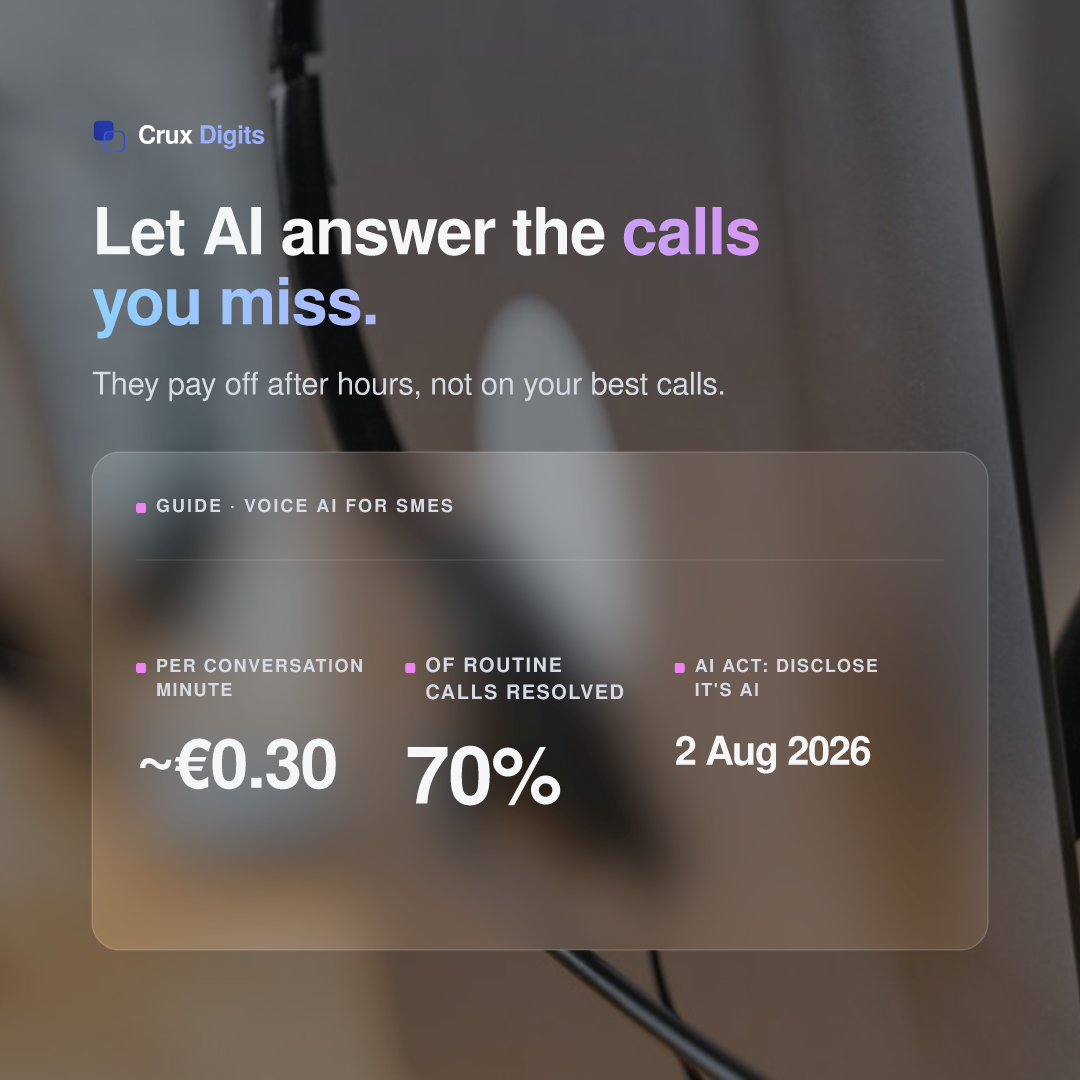
Yes — an AI voice agent can answer your business phone, hold a natural conversation, and book an appointment, and it is good enough to put in front of customers in 2026. It earns its place on a specific slice of calls, though, not all of them. Here is the honest version for a Dutch SME of 1 to 50 staff: what these agents do, what they cost, whether they speak Dutch, and the one legal line you cannot skip.
What an AI voice agent actually is (and why 2026 is different)
An AI voice agent answers a phone call, understands natural speech, decides what to do, and speaks back — no keypad menus, no “press 1 for sales”. The leap in 2026 is speech-to-speech models. Instead of chaining speech-to-text, then a language model, then text-to-speech (which added delay and stripped the tone out of a voice), a single model now hears audio and speaks audio directly.
OpenAI’s gpt-realtime, generally available since August 2025 and updated on 6 July 2026 with configurable reasoning and tool use, is the clearest example. It can call your tools mid-conversation to check availability or create a booking, switch language mid-sentence, and connect straight to the public phone network over SIP. The result sounds far less like a robot and far more like a competent front-desk colleague. For a small business that means a call answered on the first ring at 2pm and at 2am, no queue, and the same repetitive questions — “are you open Saturday?”, “can I move my appointment?” — handled without tying up a person.
The 2026 voice stack: the tools behind the agent
You do not build this from scratch. A handful of platforms now cover the whole loop: listening, reasoning, speaking, and connecting to your phone number. The model layer is OpenAI Realtime (gpt-realtime, with a less expensive mini tier), Google’s Gemini Live API (Gemini 2.5 Flash native audio, 30 voices across 24 languages), and ElevenLabs, whose voices are widely regarded as the most natural. The orchestration layer — platforms such as Vapi and Retell — wires the model to telephony, your CRM, and a fallback to a human.
The number that matters most is latency: the pause before the agent replies. Natural human turn-taking happens at 200 to 300 milliseconds; under roughly 700ms a call still feels conversational; past about 900ms callers start talking over the agent and disengage. Tuned setups on Vapi and Retell land around 500 to 620ms today, which is why the good ones no longer feel like an old phone menu. For a Dutch SME the practical takeaway is that this is a configuration job for a specialist, not a research project for you.
Does it actually speak good Dutch?
This is the question every Dutch owner asks, and the honest answer is: better than you expect, but test it yourself. English voice quality is excellent across the board. Dutch is a smaller training language, so quality varies by provider and by voice. ElevenLabs’ Dutch voices handle natural intonation and are a common choice for NL deployments, and its low-latency Flash model covers Dutch among 32 languages. OpenAI’s gpt-realtime switches languages mid-sentence and reads phone numbers and postcodes back more reliably than its predecessor — useful when a caller spells out a street name.
Two Dutch-specific things still trip agents up: proper nouns — street and town names like “Nieuwegein” or “’s-Hertogenbosch” — and code-switching to English mid-call. Flemish is a further variant to check if you serve Belgium. The rule of thumb: shortlist two providers, call each one with your actual accents, opening hours and product names, and just listen. A ten-minute test tells you more than any vendor demo.
What does a voice agent cost, and when does it pay off?
Usage-based pricing is now low-cost enough that cost is rarely the blocker. OpenAI’s realtime audio runs about $0.30 (roughly €0.28) per minute of conversation on the flagship model, and the mini tier released in July 2026 is roughly a third of that; platform and telephony fees sit on top. As a planning figure, a small always-on deployment lands somewhere around €250 to €450 per month all-in — but treat that as a starting range and get a real quote for your volume. For the full picture we keep a dedicated page on what a chatbot costs.
The payback is not where most vendors point. Against one skilled agent on the calls a human handles best, a bot is neither less expensive nor better. The money is in the calls you currently miss. Industry benchmarks suggest around 70% of routine inbound calls can be handled without a human at all — the repeat questions, bookings and status checks that fill the phone day. Meanwhile Dutch SMEs report that roughly a quarter of inbound calls go unanswered at peak times and after hours, while a full-time service hire costs €45,000 to €55,000 a year all-in. A worked example, assumptions stated: 600 calls a month, about 150 of them missed, at roughly 3 minutes each, is around 450 agent-minutes — on the order of €135 in model cost plus platform fees. If recovering even one booking a week clears that, the maths works. Write down your own numbers and be honest about them; that discipline is the whole game.
Voice, WhatsApp or email: which channel should you automate first?
Voice is not automatically the first thing to automate. A simple rule for a 1-to-50-person business: automate the channel where you lose the most, and match the channel to the customer’s urgency. Voice wins when calls are time-sensitive and go unanswered — bookings, “are you open?”, overflow and after-hours. WhatsApp wins for quick, asynchronous questions where a customer happily waits a minute for a reply and inbound replies are effectively free. Email wins for detailed, non-urgent requests that need a paper trail.
In practice most SMEs get the best first result by automating whichever channel produces the most repetitive, low-judgement contacts — and for a lot of trade, care and local-service businesses, that is the phone. If you are unsure, start with the channel where a missed message directly loses a sale. You do not have to pick only one forever, but you should pick one to start.
The AI Act rule you cannot skip: tell callers it is AI
One legal line applies to every voice agent in the EU. Under Article 50 of the EU AI Act, from 2 August 2026 you must inform people that they are dealing with an AI system, clearly and at the latest at the first interaction. For a phone line that means the agent opens by saying it is an automated assistant — one sentence, before anything else. Reported fines for transparency breaches run up to €15 million or 3% of global turnover, but the practical point is simpler: callers dislike being fooled, and a clear “Hi, I’m the AI assistant for [company] — how can I help?” actually raises trust. We keep the SME view of these duties on our AI Act checklist.
Where voice agents oversell — and how to start safely
Three honest cautions. First, edge cases: an agent that is brilliant on routine calls can confidently give a wrong answer on an unusual one, so cap what it is allowed to promise and hand off cleanly when it is unsure. Second, the handoff itself: a warm transfer with context beats dumping the caller back into a queue, so design it before you launch. Third, do not automate a broken process — if your booking rules are a mess, the agent will just read the mess back faster.
The safe way in for a small business is narrow and monitored. Put the agent on one job — after-hours bookings, or the three questions you answer fifty times a week — keep every call transcribed and reviewed for the first weeks, and expand only what works. That is how a voice agent becomes a dependable AI agent in your business rather than a gamble. If you would like a second opinion on where to start, scoping that first job is exactly what we help Dutch SMEs do.
The technology crossed the “good enough for customers” line in 2026. For a Dutch SME the winning move is not replacing your team — it is giving every caller an answer, including the ones who currently hear a voicemail beep.
We build custom AI and LLM systems that run in production: a clickable MVP by the second call, fixed steps, and you own the code.
AI development agency in the Netherlands →