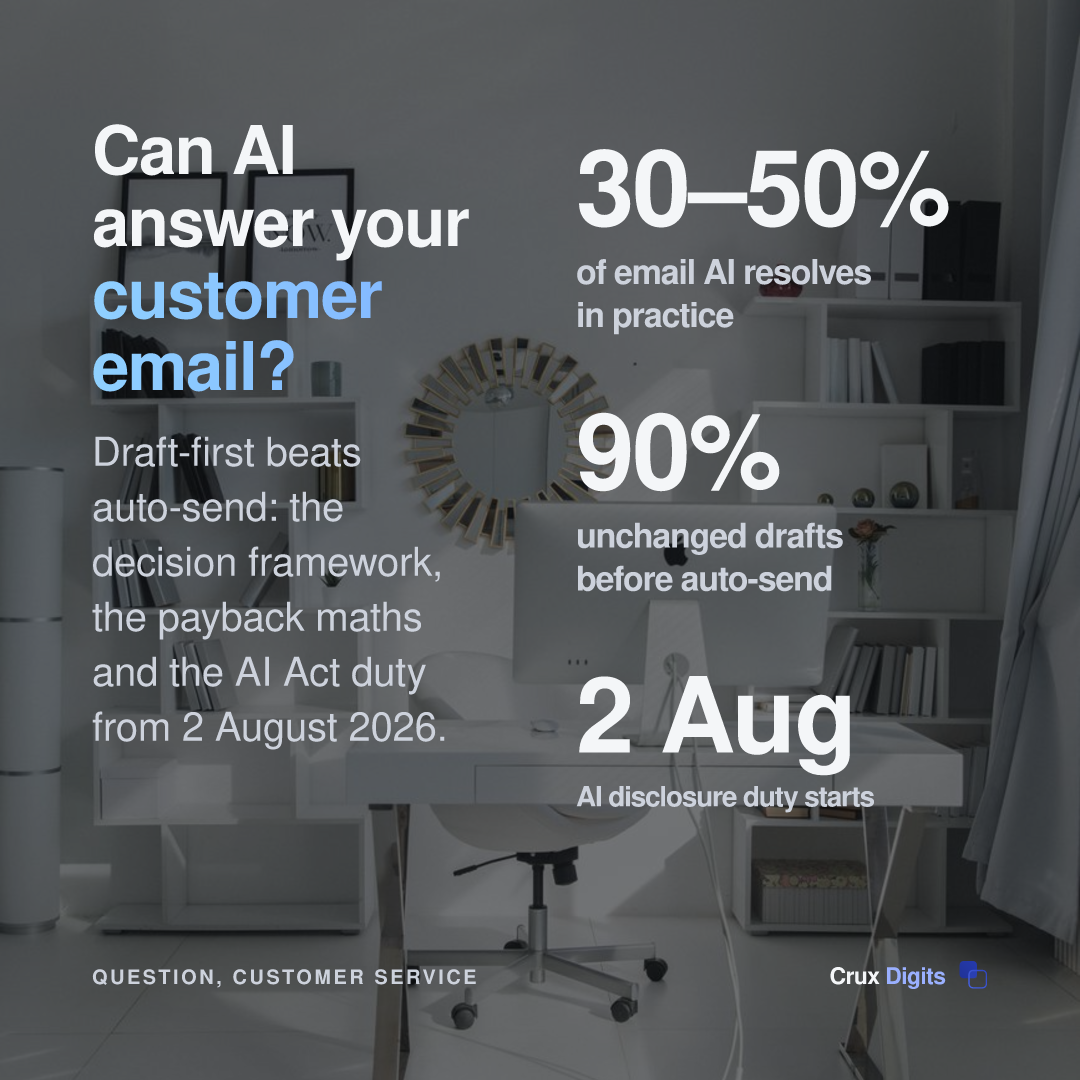
Yes — AI can answer a large share of your customer service email in 2026, but not all of it should go out without a human look. AI email agents reliably read, classify and draft replies for most routine questions, and well-tuned systems resolve roughly half of incoming volume autonomously. The safe pattern for an SME is draft-first: AI writes every reply, a person sends the risky ones, and only proven categories graduate to auto-send. From 2 August 2026, fully automatic AI replies also carry a disclosure duty under the EU AI Act — a deadline the Digital Omnibus did not move.
What AI can actually do with customer email in 2026
Modern email AI does four jobs. It classifies incoming mail (invoice question, return, complaint, quote request) and routes it to the right person. It retrieves the facts behind the answer from your knowledge base, CRM or order system. It drafts a reply in your tone of voice. And for a growing set of categories it resolves the whole thread end-to-end. The step change of 2025–2026 is that agents work in multiple steps: they no longer just answer, they look up the order, check the return policy and prepare the credit note before writing a word.
For SMEs the tooling comes in two flavours. The SaaS route: the Dutch platform Trengo ships an AI HelpMate that drafts and answers email and chat in 26 languages from your own knowledge base, while Zendesk AI and Intercom Fin do the same at global scale — Fin is priced at $0.99 per resolved conversation. The build-it route: workflow tools like n8n ship a ready-made Gmail AI auto-responder template that deliberately creates drafts instead of sending, with Outlook variants — you stay in charge of the send button. We compared the workflow engines in n8n vs Make vs Zapier.
Be careful with headline numbers. Intercom publishes a resolution rate around 65% across Fin customers, with out-of-the-box figures nearer 51% that climb toward 86% after months of tuning; independent comparisons put typical real-world autonomous resolution at 30–50%. Both can be true. Resolution rate depends on how standard your questions are and how good your documentation is — not on which model the vendor licenses.
Auto-send or draft-first: a decision framework
The costly mistake is treating automation as one decision for all email. Split your inbox into three risk tiers and decide per tier.
Tier 1 — safe to auto-send, with an AI disclosure: questions answered straight from system data with no judgment involved. Order status and track & trace, opening hours, appointment confirmations, and documented FAQ answers where the AI can cite a knowledge-base source and clears a confidence threshold.
Tier 2 — draft-first: anything touching money or judgment. Refunds, invoice disputes, cancellations, complaints, contract questions. The AI writes the reply in seconds; a person checks it and clicks send.
Tier 3 — human only: legal threats, privacy and data requests, emotionally charged messages, and your biggest accounts. AI may summarise the thread and suggest points; it does not get to draft the relationship away.
Then make graduation measurable. Run everything draft-first for two to four weeks and track the unedited-send rate per category. A category earns auto-send only when roughly 90% of its drafts go out unchanged — and it keeps that status only as long as weekly spot checks stay clean. Always keep a visible escape route to a human being.
The caution is not theoretical. Generative systems still fabricate: they promise refunds that do not exist or invent policy, as Air Canada learned when a Canadian tribunal held it liable for a bereavement discount its chatbot made up. Whatever your AI sends, your company sent. We explain the mechanism in what is AI hallucination.
What answering email costs — and what AI saves
Dutch contact-centre benchmarks put the cost of handling one customer email at roughly €3–8 internally, against €7–15 for a phone call; specialised outsourcers quote €0.80–2.50 per e-mail. Email is inexpensive per contact and expensive in aggregate, because nobody counts the hours.
A worked example with explicit assumptions: a company receiving 40 customer emails per working day, 60% of them routine, at 6 minutes average handling time and €38 per hour fully loaded staff cost, spends about 2.4 hours or €91 per day on routine mail — roughly €1,900 per month. Draft-first automation cuts routine handling to about 1.5 minutes of review-and-send, saving around €1,430 per month, or €17,000 per year. Different volumes scale the outcome linearly — which is exactly why you write the assumptions down first.
Against that saving: SaaS AI inboxes run €100–500 per month, so at this volume they pay back within weeks. A custom email agent integrated with your CRM or ERP is quoted in the Dutch market at €8,000–35,000 to build plus €200–800 per month in model costs — worth it when the agent must take actions inside systems rather than just write. Below roughly 15 customer emails a day, SaaS is almost always the answer. A baseline measurement tells you which side of that line you are on, and what a chatbot costs covers the chat side of the same decision.
The Article 50 disclosure duty was not postponed
In May and June 2026 the EU agreed the Digital Omnibus, which postpones the AI Act's high-risk obligations to December 2027 and August 2028. Many teams read that as “the AI Act is delayed.” For customer-facing AI it is not: Article 50's transparency duties — the requirement that people are told they are dealing with AI — were left untouched and apply from 2 August 2026.
For email automation the legal line runs along the same split as the risk framework. An AI reply sent without human involvement is direct interaction with an AI system: the customer must be told at the first interaction that the reply is machine-generated — a clear sentence in the reply itself does the job, while burying it in your terms and conditions does not, per the European Commission's draft guidance of May 2026. A human-reviewed, human-sent AI draft is in our reading ordinary assisted writing: the person who clicks send takes responsibility, as with any template or ghost-written text. The supporting Code of Practice on AI-generated content is still being finalised, so revisit this once the final text lands — but draft-first is also the compliance-light route today.
Penalties for transparency violations reach €15 million or 3% of worldwide turnover. And separate from the AI Act, customer email is full of personal data, so the GDPR basics apply: an EU processing agreement with your AI vendor and no training on customer data without a legal basis — see training AI on company data under GDPR. The wider timeline, including the AI-literacy duty that has applied since February 2025, is in our AI Act checklist for SMEs.
How to start without breaking anything
Start with a one-week baseline: count emails per category and minutes per email. That number is what every later claim gets measured against. Pick the lightest tool that fits — a SaaS inbox if your questions are standard, n8n or a custom agent when the answer lives inside your ERP. Switch on draft-first for everything, add the AI disclosure line to the categories you intend to automate, and let the unedited-send rate decide what graduates. Plan for maintenance from day one: knowledge bases age, and an email agent is never “done.” If you want an outside eye on which part of your inbox qualifies, that assessment is exactly what an AI scan is for — and the broader automation picture lives on our AI automation page.
AI automation for SMEs: the audit prices the saving and payback per process, then we build the first process as a Production-ready MVP.
AI automation for business →