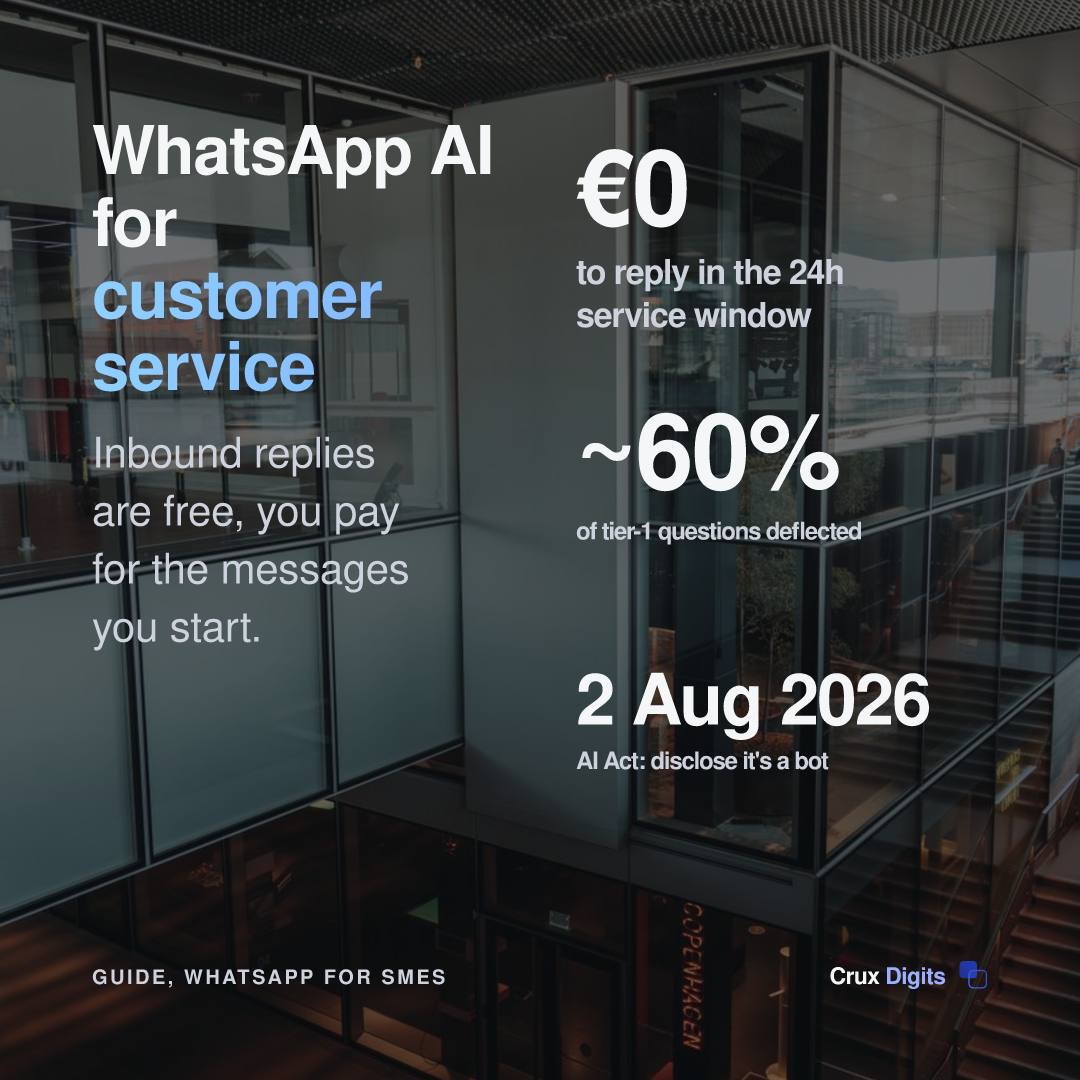
Putting AI on WhatsApp for customer service means connecting an AI agent to the WhatsApp Business Platform so it answers questions in the app your customers already use — check an order, explain a product, book a slot — and hands off to a person when it should. Here is the part most guides skip: answering inbound questions is the low-cost part — replies inside Meta's 24-hour service window are free, so on Meta's side an AI support agent costs almost nothing; the real bill comes from the messages you start.
You can't just plug ChatGPT into WhatsApp
The consumer app and the free WhatsApp Business app won't let an AI agent read and reply for you. You need the WhatsApp Business Platform (the Cloud API), which you reach through a Business Solution Provider — Twilio, 360dialog, Sinch or the Dutch-rooted Bird (formerly MessageBird). On top of that sits your AI: a language model with retrieval over your FAQs, product data and order status, plus a rule for when to hand off to a human. Tools like n8n or Make can wire the agent to the API without heavy custom code, which is why a first version is a matter of weeks, not months.
What happens in a single conversation
A good WhatsApp agent runs a tight loop on every message. It works out the intent — order status, opening hours, a complaint, a sales question — retrieves the facts it needs from your FAQ, product catalogue and, crucially, the live order or CRM record, and drafts an answer grounded in that data instead of inventing one. When it can act, it calls the right API: send a track-and-trace link, book a slot, log a ticket. When its confidence is low, money is involved, or the customer is upset, it hands to a colleague with the conversation summarised. Two design decisions make or break it: ground every factual answer in a system of record rather than the model's memory, and be strict about when the agent must step back. Get those two right and the rest is tuning.
What it actually costs — the model no one explains
Meta rebuilt its pricing in July 2025: you now pay per delivered template message, in four categories — marketing, utility, authentication and service. For a customer-service use case, one detail changes the whole business case:
- Inbound replies are free. When a customer messages you, a 24-hour service window opens, and every reply you send inside it costs nothing on Meta's side — and it resets each time they write again. An AI agent answering support questions therefore runs essentially free of Meta fees.
- Ads that click to WhatsApp open a 72-hour free window, so lead conversations from a campaign are unbilled for three days.
- You pay for messages you start. Marketing and utility templates are billed per message by country — a Dutch marketing template runs roughly €0.08–€0.12, utility far less. Proactive blasts, not support replies, are where the meter runs.
On top of Meta sit two more costs: a provider/platform subscription and your AI build. Off-the-shelf chatbot tools run in the tens to low hundreds of euros a month; a custom agent is a project — weigh it against what a chatbot costs to build. Practitioner take: the economics reward using WhatsApp AI for support and order questions, and being deliberate about proactive marketing.
A worked example of the economics
A quick sense of the numbers, with the assumptions stated. Say a webshop handles 1,500 customer messages a month, almost all inbound — a customer asks, you answer inside the service window. On Meta's side those replies are free; your cost is the platform subscription and the build. If the agent resolves 60% without a human, about 900 conversations, and each would have taken a colleague five minutes, that is roughly 75 hours a month handed back to spend on the harder 40%. The proactive side is where money goes out: a 2,000-contact marketing template at about €0.10 is roughly €200 a send, so treat broadcasts as a paid channel with their own return, kept separate from the free support agent. The point is not the exact figures — it is that support and marketing have opposite cost shapes, and lumping them together is how WhatsApp budgets go wrong.
Where it pays off — by company size
- Micro, 1–10 people: an off-the-shelf WhatsApp chatbot that deflects tier-1 FAQs — opening hours, order status, returns — is usually enough, with no integration project.
- Small, 20–50 people: the sweet spot. Connect the agent to your CRM, webshop or order system so it answers from live data and hands off to a colleague on anything it is unsure of. For most companies this is their first real AI agent.
- Mid-market, 250–500: the agent becomes one channel in a wider service operation — routing, analytics and governance matter more than the bot itself, and the WhatsApp number sits alongside email and phone under one policy.
Where it works and where it doesn't
AI on WhatsApp is strong at high-volume, repetitive tier-1 questions that have a clear answer in your data: where is my order, are you open, how do I return this, what does this product do. It is weak — and should hand off — on anything ambiguous, emotional or high-stakes: disputes, refunds above a threshold, legal or medical questions, or a plainly frustrated customer. Design out the two classic failures: hallucinated facts (force the agent to quote the order system, never guess) and the language trap (Dutch customers switch between Dutch, English and dialect mid-chat, so test for it). Keep a human reachable in one tap — a bot that traps people is worse than no bot at all.
The rules: AVG and the AI Act's 'tell them it's a bot'
Two obligations apply. Under the EU AI Act's Article 50 transparency duty (in force from 2 August 2026) you must make clear the customer is talking to AI, not a person — a single line at the start of the chat does it. Under the AVG/GDPR you need a data-processing agreement (verwerkersovereenkomst) with your WhatsApp platform, EU data hosting, and opt-in before you send proactive messages. Pick a provider that hosts in the EU and signs the AVG agreement, and you have covered most of it.
Choosing a provider without getting locked in
The provider you pick matters as much as the model. Four things to check: EU data hosting and a signed AVG processing agreement; transparent pricing, because some providers add a per-message markup on top of Meta's own rates — ask exactly what you pay above Meta; whether AI is built in or you bring your own model and prompts, since bringing your own keeps you portable; and ready-made connectors to the systems you actually run — your webshop, CRM or order tool — so the agent answers from live data instead of a static export. Two more practical filters: does it genuinely handle Dutch, because many tools are English-first and stumble on tone and spelling, and is there a real support line and an uptime SLA — a WhatsApp outage on a busy day is a customer-service outage. One lock-in test settles the rest: can you take your WhatsApp number, your templates and your chat history with you if you leave? If the answer is no, keep looking.
Four steps to launch one
- Scope tight: pick the five to ten questions that make up most of your inbound volume; don't try to answer everything on day one.
- Ground it: connect the FAQ, product data and order or CRM system so answers come from your data, and set the confidence line for handoff.
- Get on the Business Platform: via a provider that hosts in the EU and signs the AVG agreement, then verify your business and number.
- Add disclosure and handoff: the Article 50 line, a visible route to a human, and a weekly habit of reading real transcripts to fix the gaps.
Industry figures suggest a well-scoped bot deflects around 60% of tier-1 questions; treat vendor savings claims (often 30–50% of support cost) as a ceiling, not a promise. To map this to your own stack, that is exactly what our AI automation work and our AI consultants for the mkb do.
Software built around your process and data, with AI where it changes the outcome. Something working every week, and the code is yours.
Custom software development in the Netherlands →