Agentic AI is software that can carry out a multi-step task on your behalf — reading an email, looking something up in your system, drafting a reply, and updating a record — rather than just answering a question like a chatbot. For a Dutch SME, the value is real but narrow: it pays off on a few high-volume, rule-heavy admin workflows where a human stays in control of anything that matters. The sensible way to start is one small, well-scoped agent on a single workflow, not a company-wide rollout.
What "agentic AI" actually means for a smaller company
You have probably used a chatbot. You type a question, it types an answer, and that is the end of it — the system does nothing in your business. Agentic AI is the next step up. An AI agent is given a goal and a set of tools, and it works through the steps itself: it can read an incoming order, check stock in your system, decide whether to reorder, draft the supplier email, and log what it did. It strings actions together instead of just producing text.
The word "agentic" simply means the software can act, not only talk. The model still does the language part — understanding the email, writing the reply — but it sits inside a loop that lets it call your tools (your inbox, your CRM, a database, a calculator) and react to what comes back. If you want the plain-language version of the building blocks, we wrote one in what are AI agents.
For an SME this matters because most of your repetitive work is not a single question — it is a little chain of steps. Someone reads a request, finds the right record, copies a few fields, sends a confirmation, and updates a spreadsheet. That chain is exactly what an agent is built to handle. The point is not a robot that runs your company. The point is a narrow assistant that takes one boring chain off a person's desk.
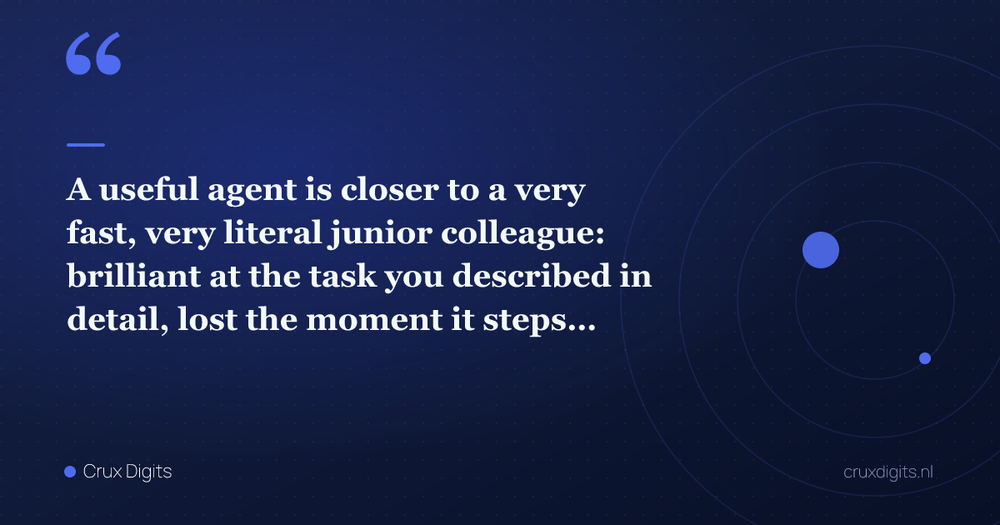
It helps to be clear about what an agent is not. It is not artificial general intelligence, it is not a system that learns your whole business on its own, and it is not something you switch on and walk away from. A useful agent is closer to a very fast, very literal junior colleague: brilliant at the task you have described in detail, lost the moment it steps outside that description. Your job — and ours, when we build one — is to draw that boundary clearly and keep the agent inside it.
Why this matters now, not in five years
Two things changed. The models got reliable enough at following instructions and using tools that you can trust them with structured, repeatable work — under supervision. And the connectors to everyday business systems (email, Microsoft 365, accounting tools, your own database) became easy enough that you no longer need a research team to wire an agent into the software you already use.
The practical difference from the chatbot era is that the work happens inside your process instead of in a chat window. Instead of an employee asking a tool for help and then doing the task by hand, the agent does the task and the employee reviews it. That is a different economic proposition — it removes minutes per item across thousands of items, which is where SME time and money actually leak.
There is also a competitive reason not to wait. The first agent is the hardest one — it is where you learn how to scope a workflow, where you build the habit of reviewing the agent's output, and where your team gets comfortable working alongside one. Companies that have done that once move much faster on the second and third. For a Dutch SME competing against larger firms with bigger admin teams, a few well-chosen agents are a quiet way to do more without hiring.
It is worth being honest about the hype, though. Agentic AI is genuinely useful for a specific shape of work. It is not a reason to rethink your whole company, and a vendor who tells you it is should make you cautious. The companies getting value are picking one workflow and doing it well, not buying a platform and hoping. Steady beats spectacular here, and the slower, scoped path is also the less expensive one.
Where agentic AI realistically pays off for an SME
It is almost always the same short list: high-volume, rule-heavy admin and operations work where the inputs are messy but the decision is fairly mechanical. These are the workflows worth looking at first:
- Order and invoice processing — reading incoming documents, extracting the fields, matching them to a record, flagging the exceptions for a human.
- Customer and supplier email triage — classifying inbound messages, drafting first-line replies, routing the rest to the right person.
- Quote and proposal drafting — pulling the right product, price, and terms into a first draft a salesperson then checks and sends.
- Data entry and reconciliation — moving information between systems that do not talk to each other, the way a person copies between two screens today.
- Scheduling and follow-ups — booking, confirming, and chasing appointments or overdue items.
Notice what these have in common: they happen many times a day, they follow a recognisable pattern, and a mistake is recoverable because a human is still in the loop. That is the sweet spot. If you want to see how this differs from older rule-based automation, AI agents vs RPA covers when each one fits. And if your bottleneck is broader process automation rather than a single agent, our AI automation work may be the better fit.
Where it does not pay off yet: open-ended judgement calls, anything with serious legal or safety consequences decided without review, and one-off tasks that happen rarely. If a workflow runs twice a month, the time you save will never repay the effort to build the agent. Volume is what makes the maths work.
A simple test before you commit to anything: could you write the rules of the workflow down on a single page, so clearly that a new hire could follow them on their first day? If yes, an agent can probably do it. If the answer is "it depends, you have to use your judgement," that is a sign the work needs a person — or that the agent should only ever draft, never decide. The clearest, most boring workflows are the best candidates, which is the opposite of where most people expect AI to shine.
A realistic starting point: one narrow agent, human in control
The mistake we see most often is scope. A company decides to "do agentic AI," lists fifteen workflows, builds a committee, and stalls before anything ships. Six months later there is a strategy document and no working software. The starting point that actually works is the opposite: pick one workflow, scope it tightly, and keep a person in control of every decision that has a consequence.
Concretely, a good first agent does one job — say, triaging the support inbox — and is allowed to draft, not to send. It proposes; a human approves. That single design choice removes most of the risk while you learn how reliable the agent is on your real data. Once you trust it on a class of cases, you let it act automatically on the easy ones and keep humans on the rest. This is the same disciplined approach as any sensible pilot; how to run an AI pilot walks through the steps.
Pick the workflow on three criteria. Is the volume high enough that small savings add up? Is the pattern clear enough to describe in a page of instructions? And is a mistake low-cost to catch and undo? A workflow that scores well on all three is a good first agent. One that fails any of them is a project for later, not for now.
There is a cultural point hiding in here too. The first agent works best when the team that does the work today is involved in describing it, rather than having automation dropped on them. The person who triages the inbox knows the edge cases, the awkward customers, and the exceptions that never made it into any procedure document. Capturing that knowledge is half the build. It also means the people whose work changes are part of the decision, which is how you avoid the quiet resistance that kills so many automation projects in smaller firms.
The risks for an SME — and how to manage them
Agentic AI has real failure modes, and they are worse for a small company because you have less margin to absorb a bad week. Three are worth naming plainly.
Over-automation. The temptation is to let the agent do everything because it usually works. "Usually" is the problem. An agent that is right 95% of the time and acts without review is wrong, unsupervised, several times a day. Keep approval gates on anything that touches money, contracts, or a customer relationship until you have evidence it earns the trust.
Reliability. Language models can produce confident, wrong answers — a habit usually called hallucination. The fix is not to hope; it is to design around it: ground the agent in your real data, constrain what it is allowed to do, and log every action so you can audit and roll back. We go deeper on the grounding part in RAG vs fine-tuning, and on keeping agents stable once live in AI agents in production.
Data. An agent reads your systems, so it inherits your data-protection obligations. For a Dutch SME that means GDPR is in play from day one: know what the agent can see, where the data goes, and whether your provider processes it inside the EU. Give the agent access only to the data the task needs, not a master key to everything. This is a solvable problem, but it is a design requirement, not an afterthought.
The honest summary is that the risks are manageable precisely when you start small — a narrow agent with a human gate is also the safest agent. Every one of these risks gets harder to control as scope grows and easier to control when the agent does one well-understood job. That is the deeper reason the "start with one workflow" advice keeps coming back: it is not just faster to ship, it is genuinely safer.
The EU AI Act angle, in one paragraph
Most SME agents — inbox triage, invoice matching, quote drafting — sit in the EU AI Act's lower-risk tiers, where the main obligations are transparency (people should know when they are dealing with AI) rather than heavy conformity work. The Act is phasing in through 2026 and 2027, so the practical move now is simply to keep a record of where you use AI and why, not to panic. If any agent ever touches a higher-risk area, the requirements step up — and that is exactly the kind of thing to check before you build. We cover the SME-specific detail in EU AI Act compliance in the Netherlands.
How Crux Digits starts small without a big-bang commitment
We are a boutique AI consultancy based in Nieuwegein, in the province of Utrecht, and we work the way an SME actually buys: in fixed-scope projects with a price you know up front, not open-ended hourly engagements or a dedicated team you have to keep busy.
There are three steps and you can stop after any of them. An AI Audit & Strategy (EUR 2,500, fixed) looks at your workflows and tells you honestly where an agent pays off and where it does not. A Proof of Concept (EUR 20,000, fixed) builds one real agent on one real workflow with your data, so you see it working before you commit further — this is the no-big-bang step that lets you judge the idea on evidence, not a slide deck. Production Launch (from EUR 50,000) only happens once the PoC has proven its worth.
If you would rather talk to a person first, our AI consultant for the MKB page is written for exactly this audience, and the broader AI agent development in the Netherlands and AI consulting pages explain how we build. There is also subsidy worth knowing about for Dutch SMEs — see AI subsidie voor het MKB.
If any of this sounds like a workflow on your own desk, a short, no-obligation consultation is the easiest way to find out whether an agent is worth building. We will tell you plainly if it is not — and if it is, you will know what it costs before you decide. Have a look at our pricing or just get in touch.
We build custom AI and LLM systems that run in production: a clickable MVP by the second call, fixed steps, and you own the code.
AI development agency in the Netherlands →