RAG vs fine-tuning is one of the most common decisions teams face when adapting a language model to their business, and the two are often presented as rivals when they answer different questions. In short: retrieval-augmented generation (RAG) gives a model access to your information at the moment it answers, while fine-tuning changes how the model behaves by training it on examples. This guide explains what each does, when each wins, and why the most robust systems frequently use both.
What RAG actually is
Retrieval-augmented generation keeps your knowledge outside the model. When a question comes in, the system searches a store of your documents, retrieves the most relevant passages, and places them into the prompt so the model answers from that supplied context rather than from memory alone. The model itself is unchanged; you are feeding it the right material at the right moment.
Because the knowledge lives in a separate store, you can update it the instant your information changes — add a document, remove an outdated policy, correct a price — and the next answer reflects it. RAG also lets the system cite where an answer came from, which matters enormously when users need to trust or verify the output. The trade-off is that the quality of the answer depends heavily on the quality of retrieval, which in turn depends on how well your data is structured and indexed. This is why serious RAG work usually leans on solid data engineering underneath.
What fine-tuning actually is
Fine-tuning takes a base model and trains it further on your own examples, adjusting the model's weights so it internalises a pattern. You are not adding facts so much as shaping behaviour: a consistent tone, a strict output format, a particular way of handling a class of inputs. After fine-tuning, that behaviour is baked in and the model produces it without being reminded in every prompt.
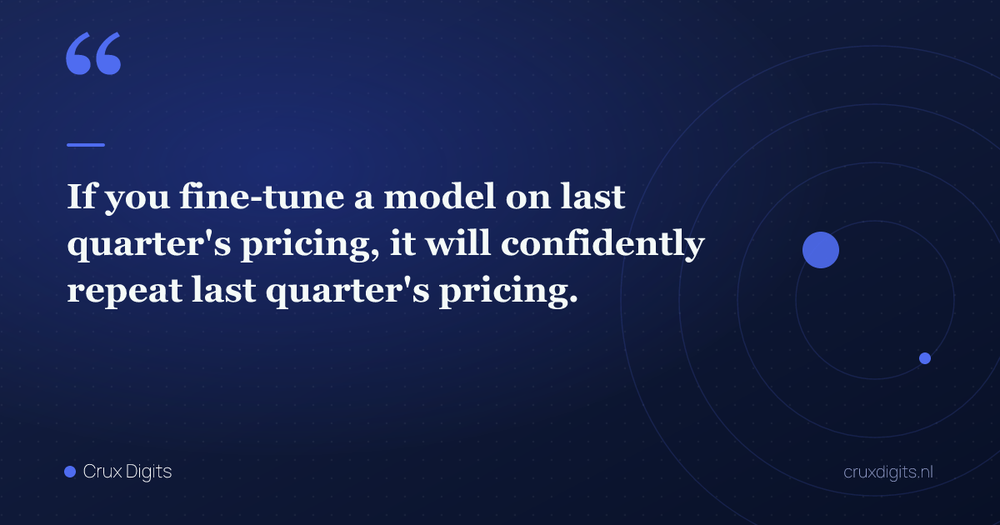
The cost structure is different from RAG. Fine-tuning requires a curated set of high-quality examples, a training run, and a retraining whenever the desired behaviour changes. Crucially, fine-tuning is poor at teaching facts that change, because anything you train in is frozen until you retrain. If you fine-tune a model on last quarter's pricing, it will confidently repeat last quarter's pricing. This single property settles a lot of RAG vs fine-tuning debates on its own.
When RAG wins
Choose RAG, or lead with it, when these conditions hold:
- Your data is fresh or changing. Documentation, policies, prices, inventory, support articles — anything that updates regularly belongs in a retrieval store, not baked into weights.
- You need citations. If users must see the source behind an answer, RAG can point at the exact passage it used. Fine-tuning cannot.
- You want lower upfront cost and faster iteration. There is no training run to manage; you improve the system by improving the data and the retrieval, which is usually quicker and less expensive.
- Accuracy on your specific facts matters most. Grounding the model in retrieved text reduces the tendency to invent plausible-sounding but wrong answers about your domain.
For most business knowledge problems — internal helpdesks, document Q&A, customer support assistants — RAG is the sensible default. It is also the backbone of most AI agents that need to act on current company information.
When fine-tuning helps
Reach for fine-tuning when the problem is about how the model behaves rather than what it knows:
- Strict output format. If you need consistent, structured output every single time — a specific JSON shape, a fixed classification scheme — fine-tuning can make that behaviour reliable in a way that prompting alone struggles to match at scale.
- Consistent style or domain language. A particular tone of voice, register, or specialist phrasing the model should adopt by default.
- A narrow, stable task done at high volume. When the same well-defined task runs constantly and the desired behaviour does not change often, fine-tuning can improve consistency and sometimes let you use a smaller, less expensive model for the job.
Note the word stable. Fine-tuning rewards tasks whose behaviour you can pin down and whose definition does not shift weekly. If the requirement keeps moving, the retraining cost erodes the benefit. Choosing and applying the right base model for this is part of machine learning work proper.
The common pattern: do both
In practice, the strongest systems rarely pick one. They fine-tune for behaviour and use RAG for knowledge. A fine-tuned model gives you reliable format, tone and task handling; a retrieval layer feeds it current, citable facts at answer time. The two are complementary because they solve different problems — one shapes the model, the other supplies the context.
A typical arrangement looks like this: RAG handles everything that changes and everything that must be cited, while a light touch of fine-tuning enforces the output contract and house style so you are not repeating elaborate instructions in every prompt. You often start with RAG alone, because it is less expensive and faster to validate, and add fine-tuning only once you have evidence that a behavioural problem persists that prompting cannot fix. Layering these well is a core part of a maintainable production AI stack, and it connects to broader LLM optimisation decisions such as model choice and cost control.
An honest note on the limits
Neither technique is a silver bullet. RAG can retrieve the wrong passage, or none at all, and then the answer suffers no matter how capable the model is — retrieval quality is the ceiling. Fine-tuning can overfit to your examples, drift from the base model's broader competence, and quietly go stale as your world changes. Both need evaluation: a way to check, on real cases, whether answers are actually correct and useful, not just fluent. Without that measurement you cannot tell which approach is helping, which is the same discipline we stress for AI in production generally.
A simple way to decide
- Start by asking: is my problem about knowledge (what the model knows) or behaviour (how it acts)?
- If knowledge — especially fresh, changing, or citable knowledge — start with RAG.
- If behaviour — strict format, consistent style, a narrow stable task — consider fine-tuning.
- If both, as is common, lead with RAG and add fine-tuning once a behavioural gap is proven.
- Whichever you choose, build the evaluation first, so you can tell whether it is working.
Where to start
If you are weighing RAG vs fine-tuning for a real use case, the least expensive way to get clarity is to test it on your own data rather than argue about it in the abstract. A short audit can establish whether your data is ready for retrieval and where fine-tuning might add value; a proof of concept lets you see real answers on real cases. You can review our transparent pricing — an audit from around €2,500, a proof of concept from around €20,000, and production work from €50,000 — or book a free consultation to talk through which approach fits your problem. The right answer is usually decided by your data, not by the trend.
We build custom AI and LLM systems that run in production: a clickable MVP by the second call, fixed steps, and you own the code.
AI development agency in the Netherlands →