To build an AI agent you give a language model a clear goal, a set of tools it can call (APIs, databases, functions), memory to hold context, and a loop that lets it plan, act, observe the result, and try again until the goal is met. Around that you add guardrails and human approval points so it stays safe and predictable. The hard part is not the first demo — it is making the agent reliable, measurable, and affordable in production.
First, what counts as an "agent"?
An AI agent is a system that uses a language model to decide what to do next, takes an action in the real world (calling a tool or an API), looks at what happened, and repeats — instead of just returning one block of text. The model is the reasoning engine; the tools are its hands. If you only send a prompt and get a paragraph back, that is a chatbot, not an agent.
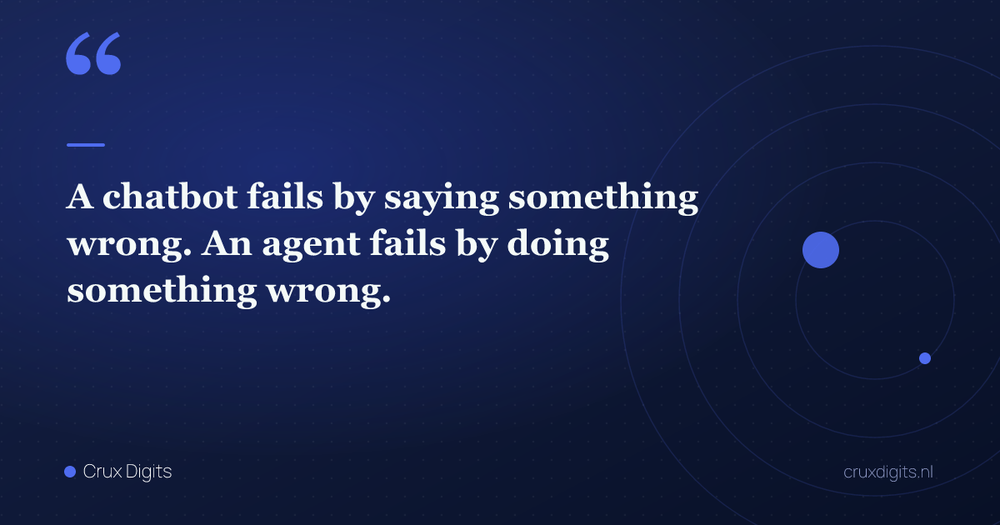
The distinction matters because it changes how you design and test the thing. A chatbot fails by saying something wrong. An agent fails by *doing* something wrong — sending the email, updating the record, refunding the order. That raises the stakes on guardrails and evaluation, which is the theme running through the rest of this guide.
If you want the conceptual grounding before the build details, start with what AI agents are and how they differ from rule-based RPA. The short version: RPA follows a fixed script; an agent reasons about an open-ended goal. This guide assumes you already want the agent version and asks how to build it well.
The core architecture: five moving parts
Almost every useful agent is made of the same five components. You can build them with any framework or none at all — the parts matter more than the library.
- The LLM brain. A model (GPT-4-class, Claude, Gemini, or an open-weight model like Llama) that interprets the goal and decides the next step. This is where reasoning, planning, and natural-language understanding live.
- Tools / function-calling. The actions the agent is allowed to take — a search API, a database query, a calculator, a calendar booking, an internal function. You expose each tool with a name, a description, and a typed schema; the model picks one and fills in the arguments.
- Memory and state. Short-term context (the current conversation and intermediate results) plus longer-term memory (past interactions, retrieved documents, user preferences). Retrieval-augmented generation often sits here — see RAG vs fine-tuning for which approach fits.
- The planning / execution loop. The control flow that runs *think → act → observe → repeat* until the goal is reached or a stop condition fires. This loop is the heart of "agentic" behaviour.
- Guardrails. The rules and checks that keep the agent inside safe limits — input validation, output filtering, permission boundaries on tools, spend caps, and human approval gates.
Get these five right and you have an agent. The remaining work is making each one trustworthy enough to run unattended, which is harder than wiring them together.
Step 1: Define the goal and a success metric
Before any code, write down what "done" looks like in one sentence a non-engineer would understand — "resolve a customer refund request end to end" or "draft a first-pass proposal from a client brief." A vague goal produces a vague agent that wanders.
Then attach a measurable success metric. Not "the agent should be helpful," but "resolves the request correctly in 90% of cases without escalation" or "produces a draft the consultant accepts with minor edits." You will use this number to decide whether the agent is good enough to ship, and to catch regressions later. Teams that skip this step end up arguing about vibes instead of evidence.
Scope tightly. A narrow agent that does one job reliably beats a broad one that does ten jobs unpredictably. You can always widen the scope once the narrow version earns trust. The same discipline you'd bring to scoping any AI proof of concept applies here: pick the one workflow where success is obvious and the value is real, prove it there, and resist the urge to boil the ocean on day one.
Step 2: Pick the tools and APIs it can call
List the concrete actions the agent needs to reach its goal, then expose each as a tool with a clear name, a plain-language description, and a typed input schema. The quality of these descriptions matters more than people expect — the model chooses tools by reading them, so a fuzzy description leads to the wrong call.
Two rules save a lot of pain. First, give the agent the *fewest* tools that get the job done; every extra tool is another way to go wrong and another thing to test. Second, treat write actions (anything that changes data or money) differently from read actions — those are the ones that need approval gates, which we cover below.
This is also where integration reality bites. The agent is only as capable as the systems it can reach, so plan for authentication, rate limits, and error handling on every API. Solid data engineering underneath an agent is usually what separates a demo from something that survives contact with real systems.
Step 3: Design the prompt and policy
The system prompt is the agent's job description and rulebook. It should state the role, the goal, the constraints ("never issue a refund over EUR 200 without approval"), the tone, and how to behave when it is unsure — ideally "ask or escalate" rather than guess. This is policy, not decoration; it is where most of an agent's reliability is won or lost.
Spell out the reasoning style you want. Asking the model to plan its steps before acting, and to check its own output against the goal, measurably reduces silly mistakes. Be explicit about failure behaviour too: what should it do when a tool returns an error, when data is missing, or when the request is out of scope?
Keep the prompt versioned, like code. You will iterate on it dozens of times, and you want to know exactly which version produced which behaviour when something changes.
Step 4: Add memory, then guardrails and approval points
Decide what the agent needs to remember. For many tasks, the current conversation plus a few retrieved documents is enough. For others — a support agent that should recognise a returning customer — you need persistent memory and a retrieval layer over your own data. Don't add long-term memory you don't need; it adds cost and a surface for stale or wrong context to creep in.
Now the part that makes an agent safe to run unattended.
- Permission boundaries. Restrict which tools can run automatically and which require sign-off. Read-only actions can usually run free; irreversible or costly ones should not.
- Human-in-the-loop gates. Insert approval steps at the high-stakes moments — before sending external communication, moving money, or deleting data. A well-placed "confirm before acting" turns a scary autonomous system into a trustworthy assistant.
- Input and output validation. Sanitise what goes in (prompt-injection is a real attack) and check what comes out before it reaches a customer or a database.
- Spend and loop limits. Cap the number of steps and the token spend per task so a confused agent can't loop forever or run up a bill.
For regulated work in the EU, these controls are not optional — see EU AI Act compliance in the Netherlands for which obligations apply to higher-risk systems and the timeline you are working against.
Step 5: Evaluate before you trust it
An agent that demos well in five hand-picked cases will surprise you in production. Build an evaluation set early: a collection of realistic inputs with known-good outcomes that you can re-run after every change. This is the single most valuable habit in agent development and the one most teams skip, because writing test cases is less exciting than watching a fresh demo succeed.
Measure against the success metric you defined in step one. Track not just whether the agent reached the right answer, but how — did it call the right tools, in a sensible order, without burning excess steps? For open-ended outputs you can use an LLM as a grader against a rubric, complemented by human review on a sample. The goal is a number you trust enough to gate releases on.
Treat evaluation as continuous, not a one-time gate. Models change, your data changes, and edge cases arrive that you never imagined. A regression suite you run on every prompt change is what keeps quality from quietly drifting.
Frameworks and approaches, at a high level
You do not need a framework to build an agent — a loop, an LLM API with function-calling, and a few tools is a complete agent. Frameworks help with orchestration, memory, and observability once things grow, but each adds its own concepts and lock-in, so don't reach for one on day one.
At a high level the options cluster into a few camps. Orchestration libraries such as LangChain or LlamaIndex give you ready-made tool, memory, and retrieval abstractions. Graph-style frameworks like LangGraph model the agent as explicit states and transitions, which helps when control flow gets complex. Multi-agent frameworks (CrewAI, AutoGen and similar) let several specialised agents collaborate. And the model providers' own SDKs increasingly ship native tool-calling and agent primitives that cover a lot of cases with less abstraction.
Pick based on your team and your problem, not hype. A common, sensible path: prototype with the raw provider SDK to understand the behaviour, then adopt a framework only when orchestration or observability genuinely hurts. The architecture — the five parts above — outlives whichever library you choose, and the framework market moves fast enough that betting your design on one specific tool is a risk in itself. Whatever you pick, keep your tool definitions, prompts, and evaluation set framework-agnostic so you can swap the orchestration layer later without rewriting the agent's actual behaviour.
The hard parts (and why most agents stall here)
Building a working demo is a weekend. Building one you'd let touch real customers and real money is the actual job, and it is where most projects underestimate the effort. Four problems show up every time.
- Reliability. LLMs are non-deterministic; the same input can produce different actions. You manage this with constrained tool schemas, validation, retries, and tight evaluation — not by hoping.
- Hallucination. The model can invent facts or call a tool with made-up arguments. Grounding answers in retrieved data and verifying outputs against sources keeps this in check.
- Cost. Every reasoning step is tokens, and agents that loop can get expensive fast. You control it with step limits, smaller models for simple sub-tasks, caching, and trimming context.
- Production monitoring. Once live, you need logging, tracing of every tool call, alerting on failures, and a way to review what the agent actually did. An agent you can't observe is an agent you can't trust.
This last point deserves its own attention; we go deep on it in running AI agents in production. The gap between a promising pilot and a dependable system is almost entirely monitoring, evaluation, and operational discipline.
Build vs buy — and when to call a partner
Buy the commodity, build the differentiator. If an off-the-shelf tool already does the job — a customer-support or scheduling assistant that fits your workflow — buying is faster and less expensive, and you skip the maintenance burden. Build when the agent touches your proprietary data, your specific processes, or a capability that gives you an edge competitors can't simply purchase.
Be honest about the maintenance tail, too. An agent is not a project you ship and forget; it needs evaluation, monitoring, and tuning as models and data move. That ongoing cost belongs in the build-vs-buy decision from the start, not as a surprise six months in.
If you do build and want to skip the expensive lessons, this is where a focused partner earns its fee. At Crux Digits we run AI agent development in the Netherlands as fixed-scope projects with transparent pricing — a EUR 2,500 AI Audit & Strategy to decide whether an agent is even the right tool, a fixed-price proof of concept to prove the value on your data, and a production launch only once the evaluation numbers justify it. You can see the full pricing up front; there are no dedicated-team or open-ended retainers.
If you're weighing whether an agent fits your process at all, that first conversation is free — book a consultation and we'll tell you honestly whether to build, buy, or wait.
We build custom AI and LLM systems that run in production: a clickable MVP by the second call, fixed steps, and you own the code.
AI development agency in the Netherlands →