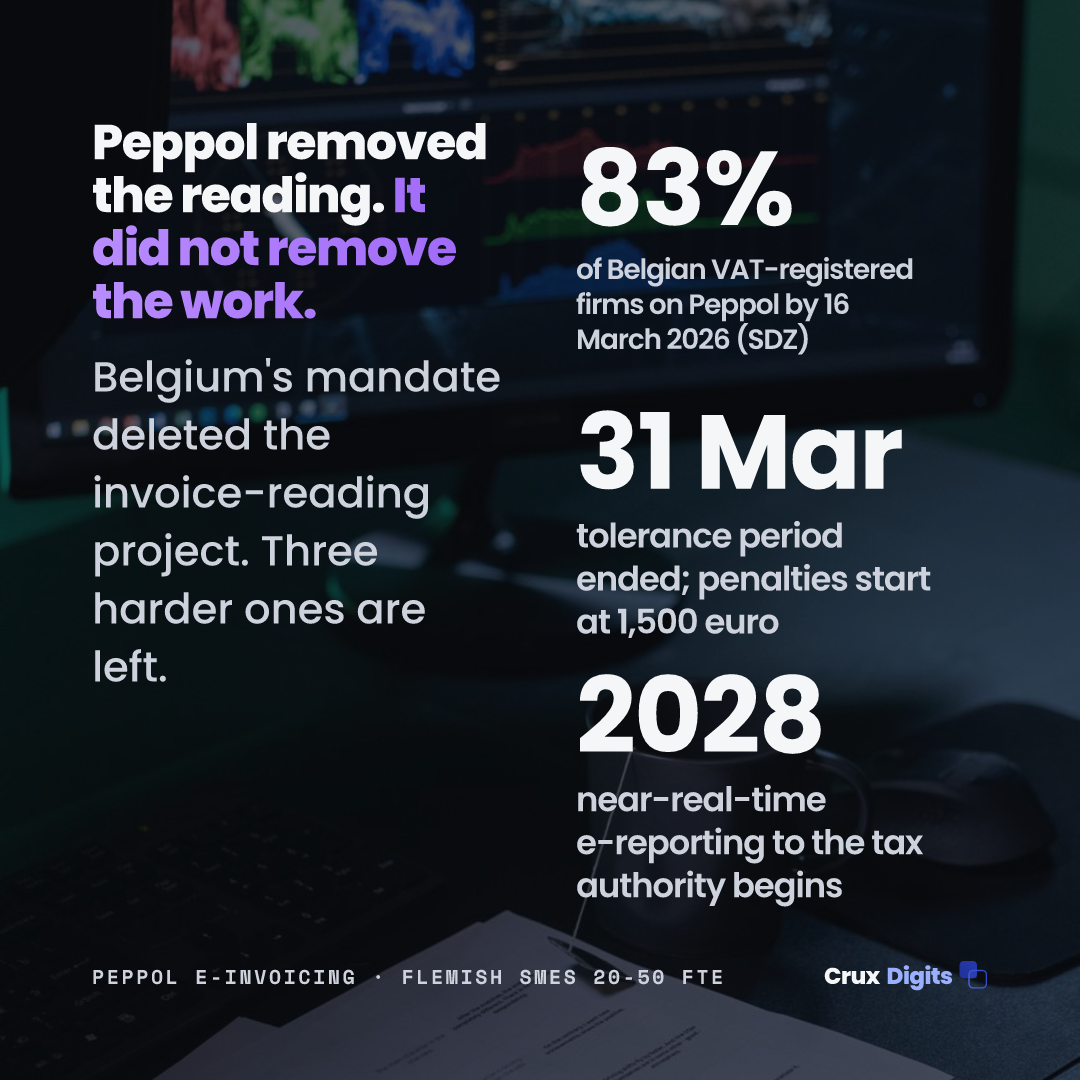
Belgium's B2B e-invoicing mandate has been live since 1 January 2026, and the general tolerance period ended on 31 March. For a Flemish SME of twenty to fifty people, the interesting consequence is not compliance. It is that the invoice automation project you scoped in 2025 no longer matches the problem in front of you. Peppol removed the reading. It did not remove the work, and it quietly added two problems that nobody put on the project plan: a supplier base that now runs at two speeds, and a delivery receipt that looks like an acceptance and is not.
What did the mandate actually change?
Since 1 January 2026, every Belgian VAT-registered business must send and receive structured electronic invoices for domestic B2B transactions. The Belgian government's e-invoicing portal is explicit about what that excludes: a PDF sent by email is not a structured invoice, because a PDF carries no machine-readable invoice data. The working format is Peppol BIS Billing 3.0, a Core Invoice Usage Specification of the European standard EN 16931, exchanged as UBL 2.1 XML over the Peppol network. Belgian participants are normally registered under their Crossroads Bank for Enterprises number, identifier scheme 0208.
The run-up was slower than the finish. In early December 2025 the FOD Financiën put compliant businesses at roughly 515,000 of the 1,178,000 in scope, about 43 percent. By 29 December, PeppolCheck.be counted 940,354 Peppol registrations, around 78 percent of the 1,202,139 VAT-registered enterprises in its denominator. By 16 March 2026 the SDZ Federatie reported 995,819 connected businesses, around 83 percent. The two series count slightly different things, so the exact jump is arguable, but the direction is not: several hundred thousand Belgian businesses connected in the closing weeks of December, which tells you something about how SMEs treat a deadline.
Flanders started ahead, and that reason is worth naming because it is specific to this country. Belgian suppliers to the public sector have been sending e-invoices through the Mercurius platform for years, phased in by contract value from November 2022 and extended in March 2024 to new contracts from €3,000. Any Flemish firm that invoices a municipality, a school group or a care institution was already on Peppol before the B2B mandate existed. That is why the December gap between Flanders on one side and Wallonia and Brussels on the other was as visible as it was. By March it had closed: SDZ reported large parts of Wallonia at the same 83 percent as Flanders. The head start bought time, not a lasting lead, which is the argument for spending 2026 on what comes after the connection rather than on the connection itself. A Dutch reader has no equivalent here: the Netherlands still has no domestic B2B mandate, and Peppol there remains B2G plus voluntary adoption.
The penalties come from the Royal Decree of 8 July 2025 and run at €1,500 for a first infringement, €3,000 for a second and €5,000 from the third, with a three-month interval before a new infringement counts as the next one, and no warning required first. Enforcement has been gradual rather than immediate, but the general tolerance has been over since 31 March, so this is now an ordinary compliance risk.
Why the invoice AI project you scoped in 2025 is the wrong project
Here is the part almost nobody writes down. The standard invoice automation project for a company this size was, until last year, an extraction project: supplier invoices arrive as PDFs, OCR or a language model reads them, a human checks the fields, the result is posted. Every vendor demo you sat through in 2025 was a demo of that, and its entire value came from the input being unstructured.
For domestic B2B in Belgium, that input is now gone by law. A Peppol BIS invoice arrives with the VAT number, the invoice date, the line items, the VAT breakdown and the payment terms already in named fields. There is nothing to interpret. Spending a budget on reading invoices that arrive pre-read is the most expensive way to automate nothing, and it is exactly what a supplier will sell you if you go into the conversation with last year's brief.
What the mandate did not touch is everything that happens after the data lands. Does this invoice correspond to a purchase order or a delivery that actually happened? Is the general ledger account right for this supplier and this cost type? Who approves it, and what happens when that person is on leave? Is the price the one that was agreed? Those are matching, coding and judgement problems, and structured data makes them easier to attack but does not solve them. If you are rewriting the brief, our note on where purchase-to-pay automation actually breaks covers the same ground in more detail.
Where does the residual manual work sit now?
In three places, and the split is worth measuring before you buy anything.
Master data. The most common processing failure after the mandate is not a technical one. It is a supplier whose VAT number, payment terms or article codes in your system do not match what arrives in the XML, so an invoice that is perfectly valid still lands in an exception queue. Peppol enforces the presence of fields, not the correctness of your own reference data. Cleaning that up is unglamorous and it is the single highest-return week of work available to most companies right now.
The receiving side. A large share of Belgian SMEs solved sending and left receiving for later, because sending is what a customer complains about. The obligation covers both directions, and a business that cannot receive a structured invoice is not compliant even if every invoice it issues is perfect. Being registered on the network is step one, not the finish line.
The suppliers who are not in scope. This is the design problem nobody priced. A foreign supplier without a fixed establishment in Belgium is not obliged to invoice you through Peppol, even when it holds a Belgian VAT number. A Dutch software vendor, a German component maker, a French subcontractor: all of them may keep sending PDFs, entirely lawfully. So accounts payable now runs two pipelines, a structured one that flows and an unstructured one that does not.
How should you handle the two-speed supplier inbox?
Count first. Take last quarter's supplier invoices, split them into domestic Belgian and everything else, and look at the second pile as a share of both volume and value. In most Flemish SMEs of this size the foreign residue is a minority of the invoices and a disproportionate share of the handling time, because it still needs a human.
That count decides the answer. If the residue is small and stable, the honest recommendation is to leave it manual and spend the budget on matching and approval instead. If it is large, or growing because you buy more software and services abroad, extraction is still worth automating, but only for that pile, scoped as a narrow tool rather than as the invoice project. Either way, the target is a single queue where structured and unstructured invoices reach the same shape before a human sees anything, which is an integration question more than an AI one. In Belgium most connections run through a handful of access points, CodaBox, Billit and Storecove among the largest, so the practical question is usually what your existing package supports, whether that is Odoo, WinBooks, Octopus, Adsolut or Exact Online. That is the work our process automation and system integration pages describe, and the integration mechanics are in our guide to connecting AI to Exact Online, AFAS and e-Boekhouden.
Does a Peppol receipt mean the customer accepted the invoice?
No, and this is where accounts receivable automation quietly goes wrong. OpenPeppol published version 1.1.0 of the Message Level Status specification on 7 July 2026, days after an operational guideline for service providers and a phase-out plan for the older Message Level Response. MLS is exchanged between the two Peppol service providers and answers one question: was the document processed and forwarded, temporarily undeliverable, or failed.
It says nothing about whether your customer agrees with the invoice, has posted it, or intends to pay it. Business acceptance travels on a separate document, the Peppol Invoice Response, which carries statuses such as accepted, conditionally accepted, under query or rejected. Belgium uses the standard Peppol exchange model here rather than a French-style national invoice lifecycle, which means the business-level status is available but not imposed on anyone.
The practical failure mode: a service provider reports a green delivery status, an integration writes that back to the ERP as "accepted", and the dunning workflow starts counting days on an invoice the customer disputed on day two. Nobody chases it, because the system says it is fine. When you evaluate a provider, do not ask whether it supports Peppol. Ask whether it distinguishes technical delivery from business acceptance, whether it can act on an Invoice Response, and whether it keeps status messages as audit evidence, which connects directly to the four-eyes and audit-trail design any finance automation needs anyway.
What should you build before 2028?
Belgium is not finished. From 1 January 2028, near-real-time e-reporting of invoice data to the tax administration is scheduled, built on the same Peppol infrastructure in a five-corner arrangement. Reporting is also why the Belgian Peppol Authority role is set to move from FOD BOSA to FOD Financiën in 2027, a transfer both administrations have announced: the expertise required becomes fiscal rather than purely technical. Further out, the EU's VAT in the Digital Age package, adopted on 11 March 2025, brings digital reporting and e-invoicing for intra-Community transactions from 1 July 2030, the date VLAIO also cites.
The design consequence is simple and it is the reason to do the boring work now. Once invoice data is reported to the tax administration close to real time, errors stop being an internal annoyance you fix at month-end and start being something you have already reported. Data has to be right where it is created, not patched downstream. A company that spent 2026 cleaning master data and building proper exception handling has already done most of 2028. A company that bought the minimum viable Peppol connection will run the project twice.
On funding, be careful with the framing. VLAIO points to an increased cost deduction of 120 percent for invoicing subscriptions and related advice for income years 2024 to 2027, and the basic rate of the investment deduction raised to 20 percent, which it lists among the e-invoicing incentives. These are federal fiscal measures with their own conditions rather than a grant you apply for, and eligibility is a question for your accountant, not for us. Our overview of Vlaio support for Flemish SMEs sets out what does and does not still exist in 2026.
A rule for the next twelve months
Four steps, in this order. One, verify you can receive and post a structured invoice without anyone retyping anything, because that is where the remaining non-compliance sits. Two, spend a week on supplier master data, which is what turns valid invoices into exceptions. Three, count the non-Peppol residue and decide deliberately whether to automate it or leave it alone. Four, separate technical delivery from business acceptance in whatever you build, before the dunning process teaches you the difference.
None of that requires AI, and saying so is the point. The mandate was a data-format change, and the right response to a data-format change is plumbing. Machine learning earns its place afterwards, in the parts that still need judgement: coding an unfamiliar cost, spotting a price that drifted from the agreement, predicting which invoices will be disputed. That second project works far better on clean structured data than it ever did on scanned paper. Our overview of AI applications for Flemish SMEs covers where it usually pays off.
If matching and approval are where your hours go, custom software development for Flemish SMEs shows what we build around Odoo, Exact Online, WinBooks and Octopus.
Last updated 3 September 2026.
Software built around your process and data, connected to Odoo, Teamleader, Exact Online or WinBooks. A fixed price per step, and you own the code.
Software development in Belgium →