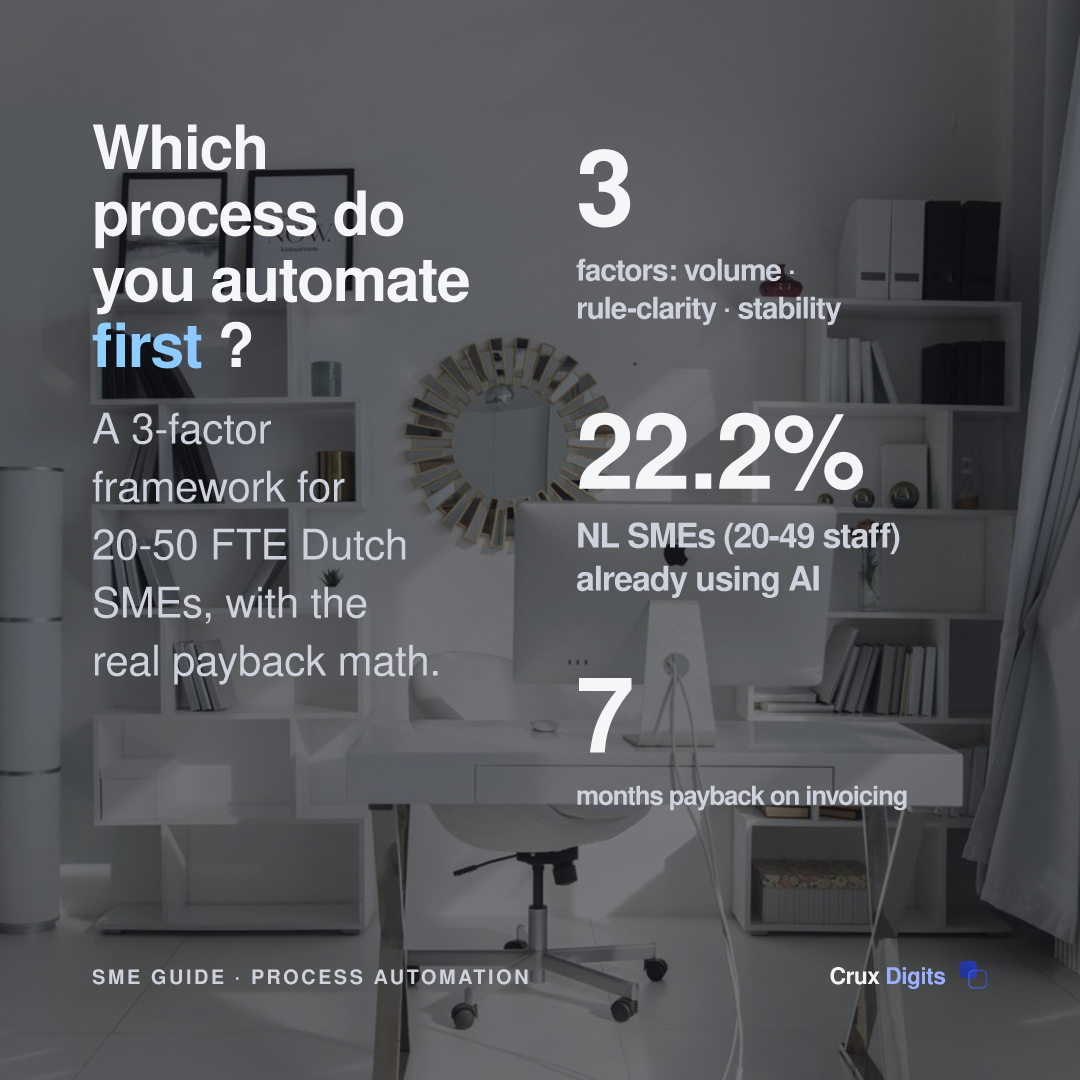
The process to automate first is whichever one scores highest on three factors: how often it runs, how consistent the rules are, and how stable it will stay over the next year. For a Dutch business with 20 to 50 people, that combination almost always points to invoicing, standard customer replies, or quote generation — not the judgment-heavy work most owners assume AI should tackle first.
Why the wrong first process kills the whole initiative
Somewhere between 60 and 88 percent of AI pilots never reach production, depending on how you count the failure-rate research. Ask why, and the honest answer is rarely "the model didn't work." It is a missing production plan, a process nobody defined clearly, or — most controllably — a first project picked for the wrong reasons: it was annoying, a manager liked the demo, or a vendor was pushing it. Patterns from Dutch SME pilots show the same thing at smaller scale: the projects that stall are the ones where nobody scored the candidate process before building.
We have written before about why automation plans stall at the follow-through stage, not the planning stage. This piece is about the decision one step earlier: which process to put on the table in the first place. Get that choice right and follow-through gets easier, because the win is obvious early. Get it wrong and no amount of discipline saves the project.
The 3-factor priority framework: volume, rule-clarity, stability
Score every candidate process on three questions. First, volume: does this happen daily or weekly, or a handful of times a quarter? A task that runs 500 times a month pays back faster and gives the AI far more examples to learn from than one that runs ten times. Second, rule-clarity: does the task follow a consistent, describable pattern, or does it depend on judgment, negotiation and context that changes every time? Third, stability: will this process still look the same in twelve months, or is it about to be redesigned — a new ERP, a reorganised team, a planned website relaunch?
Plot volume against rule-clarity and four groups appear:
- High volume, clear rules — automate first. Invoice processing, standard email replies, quote generation from fixed price lists, appointment scheduling. This is where AI pays back in months, not years.
- High volume, judgment-heavy — augment, don't automate. Complex complaints, sales conversations, anything that needs reading the customer. Give staff an AI draft or summary; do not let it decide alone.
- Low volume, clear rules — automate later. Annual filings, rare compliance reports. The rules are simple but the task happens too rarely to justify building anything bespoke, unless a single error is very costly.
- Low volume, judgment-heavy — leave it alone. Strategic decisions, one-off negotiations, hiring calls. Not an AI project at all, at least not yet.
Stability is the veto that overrides the other two. A process that scores well on volume and rule-clarity but is about to change — because you are switching bookkeeping software or restructuring the sales team — is a bad first bet regardless. You would be automating something you are about to throw away.
Where Dutch SMEs' AI already lands first — and why that's informative
The adoption data backs the framework rather than contradicts it. Among Dutch companies with 20 to 49 employees, 22.2 percent already use some form of AI (CBS, 2024), and across all AI-using businesses, marketing and sales account for 36 percent of use cases and administrative processes and management tasks another 30 percent — the two most rule-heavy, high-volume corners of a typical company. Fresh 2026 CBS data on Dutch micro-businesses shows the same pattern one size class down: companies with 5 to 9 staff that use AI generate 21.5 percent of their group's revenue, against 17 percent for 3-to-4-person firms and 10.8 percent for 2-person firms — AI concentrates where there is enough repeatable volume to make it worth building.
The lesson isn't "copy what everyone else does." It's that the market has already converged on the same answer the framework gives: administrative, back-office and standard customer-facing tasks win the volume-times-rule-clarity test more often than anything in sales strategy or product decisions. 84 percent of Dutch SMEs plan to increase AI investment over the next three years — the highest of any European SME market — which makes picking the right first process, rather than the flashiest one, worth the extra hour of scoring.
The payback math, worked out
Here is the calculation we would run for a 20-to-50-FTE wholesale or services business with invoice processing as its top-scoring candidate. Every assumption is visible so you can swap in your own numbers.
- Volume: 500 supplier and customer invoices a month — typical for a business this size with a handful of major accounts and a long tail of smaller ones.
- Manual time: benchmarks put manual invoice handling at roughly 12.5 minutes per invoice — checking, matching to a purchase order, keying into the bookkeeping system. That is 104 hours a month.
- AI-assisted time: with extraction and matching handled automatically and a person reviewing exceptions, realistic throughput lands around 2 to 3 minutes per invoice — call it 21 hours a month.
- Hours freed: roughly 83 hours a month. At a loaded administrative cost of €32/hour (a reasonable planning assumption for Dutch back-office work, not a universal figure), that is about €2,650 a month, or €32,000 a year.
Crux Digits publishes its own proof-of-concept pricing at around €20,000 for a working, integrated use case. Against €32,000 a year in freed capacity, that is a payback of roughly seven to eight months — before counting fewer keying errors, which industry data puts at 1 to 4 percent of manually entered fields, each one costing far more to fix once it reaches a supplier dispute or a VAT return than at entry. Halve the invoice volume to 250 a month and the payback stretches to over a year — which is exactly why volume is the first factor in the framework, not an afterthought.
For a specific look at what that looks like end to end — matching, coding, exception handling — see our guide to automating invoice processing, and if your books run on Exact Online, AFAS or e-Boekhouden, how the AI layer connects to each without replacing them.
What not to automate first
Resist the pull toward the most visible problem. Sales negotiation, first-line strategic decisions, and anything where two customers with the identical request would fairly get different answers, are augmentation candidates, not automation candidates: let AI draft a reply or summarise a case, and keep a person deciding. The economics only work when volume is high and the rules are genuinely consistent — force it onto judgment-heavy work and you will spend the pilot budget building guardrails instead of value.
Scoring three common SME processes
To make the framework concrete, here is how three processes typical of a 20-to-50-FTE business score against it.
- Invoice processing — Volume: high. Rule-clarity: high. Stability: high, unless an ERP switch is already planned. Automate first, as the worked example above shows.
- Standard customer-service replies (opening hours, order status, simple how-to questions) — Volume: high. Rule-clarity: high for the standard slice, low for genuine complaints. Stability: high. Automate the standard slice; route anything emotional or unusual to a person.
- Quote or proposal generation from a fixed price list or catalogue — Volume: medium to high. Rule-clarity: high, if your price list is genuinely fixed. Stability: medium, since price lists change but the process doesn't. A strong second candidate once your top pick is running.
Test before you commit: the two-to-four-week filter
Before signing anything, run a scoped trial on your top-scoring process: measure the current baseline (time per unit, error rate, cost) for two weeks, run the AI-assisted version on a slice of real volume for two to four weeks, and agree in advance what "working" looks like — for invoice processing, that might be 70 percent of invoices needing no manual correction. If the pilot can't show that on a small slice, it won't show it at scale either, and you will have spent weeks, not months, finding out. An AI readiness scan is a fast way to get an outside view on where your best candidate actually sits on the three factors before you build anything.
For a 20-to-50-person Dutch business, this is usually the first real step into process automation — not a full digital transformation, one scored process at a time, feeding your existing accounting and CRM stack rather than replacing it. See how we approach AI-driven process automation for businesses at this stage.