Flemish SMEs (kmo’s) can get support for AI projects mainly through two routes in 2026: the kmo-portefeuille for AI training (30% support for small companies, 20% for medium-sized ones, capped at €7,500 per year), and Vlaio’s innovation instruments for genuine AI development work. The rules changed on 1 February 2026 — most consultancy (advies) support was abolished, with cybersecurity advice as the main exception — so guides written in 2025 will mislead you. Here is the current picture, with the caveats that funding pages usually leave out.
What changed on 1 February 2026
Until this year, the kmo-portefeuille funded two service types: training (opleiding) and advice (advies). Since 1 February 2026, the advice pillar has essentially gone: only cybersecurity-related advice still qualifies. An AI adoption or digitalisation advice trajectory that would have been co-funded in January is no longer eligible. Training survived — which quietly makes structured AI training the most fundable way for a Flemish SME to start with AI.
Route 1: kmo-portefeuille for AI training
- What qualifies: AI training delivered by a registered service provider (geregistreerde dienstverlener) under the digitalisation theme — learning what AI is, how it applies to your business, and how to work with it responsibly.
- How much: 30% support for small enterprises, 20% for medium-sized, up to €7,500 support per year. Cybersecurity and energy-efficiency services get elevated rates (45%/35%) — plain AI training does not.
- The catch: the provider must be registered for the kmo-portefeuille; an invoice from an unregistered foreign or Dutch provider gets you nothing. Check registration before you book, not after.
Route 2: Vlaio innovation support for real AI development
For companies building something — an AI application, a novel process — Vlaio maintains AI-specific innovation support within its development-project instruments. These are heavier: applications are assessed on innovation content and business case, percentages and ceilings vary per instrument and per call, and buying an off-the-shelf tool does not qualify. Realistic reading: these fit a kmo investing serious effort in AI that goes beyond what the market already sells, and the application itself takes weeks of preparation.
How Flanders compares with the Netherlands
Working on both sides of the border, the contrast is instructive. The Netherlands funds AI learning mainly through the SLIM scheme (annual application rounds, project-based) and R&D through WBSO (a wage-cost reduction for your own developers — it never pays a consultant’s invoice). Flanders funds continuously through the kmo-portefeuille (no application rounds — you claim per purchased service) but at lower ceilings, and its advice route just closed while the Dutch equivalent never existed in that form. Net effect for an AI-curious kmo: Flanders rewards starting with training now; substantial development support requires the full Vlaio innovation route on either side of the border. For the Dutch picture, see our AI subsidy guide for Dutch SMEs.
Honest caveats before you budget
- Support percentages, ceilings and eligible themes change — often on 1 January or 1 February. Verify on the Vlaio pages the week you apply, not from a blog (including this one).
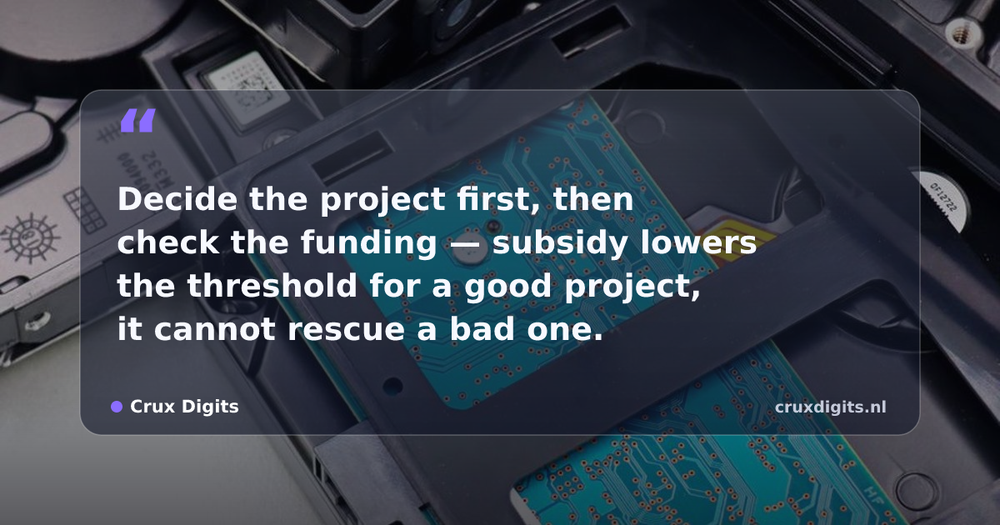
- Subsidy can lower the threshold for a well-chosen project; it cannot rescue a badly chosen one. Decide the project first, then check funding — never the reverse.
- Nothing here is a promised grant: eligibility depends on your size, sector, registration status and the state of the budget pot in a given year.
A worked example: budgeting a €10,000 AI training programme
Say a small Flemish installation or accountancy firm books a structured AI training programme of €10,000 (excl. VAT) from a registered provider: process-mapping workshops plus hands-on training for office staff. As a small enterprise, the kmo-portefeuille contributes 30% — €3,000 — leaving €7,000 own cost, and uses €3,000 of the €7,500 annual ceiling, so room remains for, say, a cybersecurity course later in the year. The mechanics matter: you apply digitally before or shortly after the service starts, pay your own share into the portefeuille, the government adds its share, and the provider is paid from the portefeuille — the discipline is administrative, not intellectual. What the subsidy does not change: whether those training days translate into an automation shortlist. That depends entirely on how concrete the programme is about your processes.
Common mistakes we see Flemish kmo’s make
- Booking first, checking registration second. The provider must be registered for the specific pillar (training) at the moment of application — an otherwise excellent Dutch or international trainer without registration costs you the full 30%.
- Treating the ceiling as a target. €7,500 of support per year is a cap, not a goal; a €4,000 well-scoped training beats a €25,000 generic programme booked "because the subsidy makes it inexpensive".
- Confusing training with implementation. The portefeuille funds learning. The moment a provider is configuring your systems, that is implementation work — budget it separately and judge it on payback, not on subsidy.
- Missing the calendar. Theme rules shift on fixed dates (the advice pillar died on 1 February 2026). If a service is borderline, book on the right side of the date.
Don’t forget the EU layer: EDIHs and test-before-invest
Beyond Flemish instruments, the EU co-funds European Digital Innovation Hubs — regional one-stop shops that offer SMEs subsidised or free "test before invest" services, including AI feasibility testing, alongside training and funding guidance. Flanders has its own EDIH presence, and for a kmo unsure whether a use case is technically real, a hub assessment can be a zero-cost sanity check before any paid trajectory. Quality and focus vary per hub, and capacity is finite — but it is the most underused free resource in the Flemish AI funding landscape.
The AI Act makes funded training doubly relevant
One more reason the training route matters in 2026: Article 4 of the EU AI Act — in force since February 2025 — requires organisations that use AI systems to ensure adequate AI literacy among the staff working with them. This applies to Belgian and Dutch companies alike, and it converts AI training from a nice-to-have into part of your compliance baseline. A Flemish kmo that uses the kmo-portefeuille to fund AI literacy training is, in effect, getting co-funding for something the AI Act expects it to do anyway. That is a rare alignment of subsidy and obligation — worth using while both the duty and the funding pillar exist in their current form.
A sensible sequence for a Flemish kmo
Start with a focused AI training for the people who own the processes (fundable, fast, low-risk), use it to shortlist one or two automation candidates, and only then consider whether the build qualifies for innovation support. If you want a practical sparring partner on the project-selection step, that is exactly what we do — see our AI consulting approach for SMEs or our AI implementation services. We work in Dutch on both sides of the border.
Want the whole picture for a Flemish SME, including fixed prices and the Belgian rules that shape an AI project? See our page on AI consultancy for Flemish SMEs.
WBSO, MIT and SLIM explained with worked examples — plus a free subsidy check for your situation.
Read the subsidy guide →