AI for hospitality: guest questions, bookings and reviews, answered day and night
A hotel, restaurant or travel company lets AI answer recurring guest questions on website chat, WhatsApp and Instagram, confirm bookings and summarise reviews. When the answer must come from the PMS or reservation system, custom work is needed.
The same questions arrive every evening while the dining room is full and the front desk is on its own.
AI pays off in hospitality in three places: answering guest questions on every channel, handling bookings and no-shows, and reading reviews. There are two routes. SimplyBoost, our own product, answers questions on website chat, WhatsApp and Instagram from your own website, PDFs and FAQ, books in Google Calendar and hands over to email, from €39 a month and live within days. When the answer has to come from the PMS or the reservation system (is a room free, what is on my bill, move my table), Crux Digits builds that as custom work at a fixed price, alongside your ICT partner, with your front desk or host as the check. What the AI never does is guess about allergens or let a guest believe they are talking to a person.
Three fixed facts
What is settled before the AI starts
- 14 allergensAllergen information dutyEvery food business must be able to inform guests about fourteen allergens (Regulation (EU) 1169/2011); orally is allowed if a visible notice says guests can ask.
- 2 Aug 2026AI Act, Article 50Since 2 August 2026 a guest must know they are talking to an AI. One sentence in the opening message is enough.
- 4 to 6 weeksProduction-ready MVP, fixed priceMeasured on a test set from your own guest questions and bookings: share handled without intervention, and every handover.
Sources: NVWA on allergens; AI Act, Article 50; our pricing.
From enquiry to review
What the AI does, step by step
Five moments in a hospitality day where the same questions and the same actions recur, and what changes when an assistant catches them.
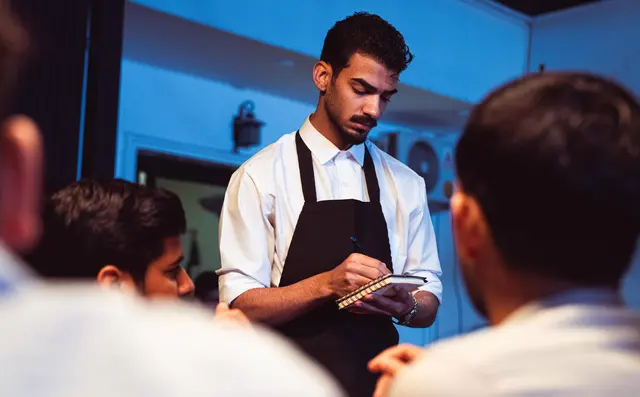
The enquiry arrives
Through the website, WhatsApp or Instagram a guest asks for a table or a room. The assistant answers in the guest's language and records the request.

Questions before arrival
Check-in time, parking, a cot, late arrival: answered from your own information, with a handover to the front desk as soon as something is out of the ordinary.
Allergens and the menu
What the kitchen has recorded per dish is the only thing the assistant says about allergens. Doubt goes to a team member.
The PMS as the source
A specific booking, the bill or a room change comes from Mews, Opera or Stayntouch. That is custom work, with the front desk as the check.

After the visit
Reviews on Google and Tripadvisor are summarised and get a draft reply. The owner reads and posts.
AI in hospitality: six tasks where the difference sits
| Task | What the AI does | What the team keeps |
|---|---|---|
| Answering guest questions | Answers opening hours, parking, check-in time, pets, allergens and directions on website chat, WhatsApp and Instagram, from your own information and in the guest's language. | Takes over any conversation that is out of the ordinary or sensitive; the handover carries the conversation with it. |
| Bookings and no-shows | Records a table or appointment in Google Calendar, sends the confirmation and the reminder, and on a cancellation asks whether another time suits. | Sets the no-show policy, the deposit and who gets priority on a full night. |
| Allergens and the menu | States per dish what the kitchen has recorded about the fourteen allergens, and nothing more. | Maintains the allergen list and answers every question of doubt in person. |
| Reviews | Summarises Google and Tripadvisor reviews each week, flags what recurs and drafts a reply in your own tone. | Reads, adjusts and posts. |
| Staff scheduling | Prepares a draft rota from the bookings and the rules from the Dutch hospitality collective agreement you have recorded. | Decides the rota and assigns the shifts. |
| Group and travel enquiries | Summarises an enquiry for a group, a package or a trip, checks it for completeness and prepares the draft reply. | Sets price and availability and sends the quote. |
SimplyBoost or custom work: which route fits which question
Most guest questions are about things already on your website or in your house rules: breakfast times, parking, the latest check-in, whether the dog can come, which dishes are vegetarian. That is what SimplyBoost, our own product, is made for: trained on your website, PDFs and FAQ, it answers those questions on website chat, WhatsApp and Instagram, books a table or appointment in Google Calendar and hands a conversation it cannot finish over to email, with the whole conversation attached. From €39 a month, live within days, no per-seat fees.
Custom work starts where the answer has to come from a system that is yours alone. Is a room free from Friday to Sunday: that lives in the PMS (Mews, Opera, Stayntouch) and runs through the channel manager. What is on the bill for room 12: that lives in the PMS and the POS (Lightspeed, unTill). Move my table from seven to half past eight: that lives in Formitable, Resengo or TheFork. There Crux Digits builds an assistant that reads from those systems, lets the front desk confirm where that belongs and only writes when the integration allows it. How to make the choice is set out on custom chatbot development.
An example of such a request. A family hotel on the coast gets the same questions through WhatsApp every evening in season: can I check in late, is there parking, do you have a cot, can I add a room. The front desk is alone at that hour and the phone is ringing too. The solution asked for: answer the first three from the hotel's own information, the fourth with availability from the PMS and a confirmation by the front desk, and hand over every conversation that is out of the ordinary with the transcript. That is a bounded project with a measurable outcome: share of conversations handled without intervention, and the waiting time at the desk.
What you get
Three building blocks, each with a team member as the fallback
 AI customer service
Guest questions on every channel
Opening hours, parking, allergens, breakfast times and directions: answered on website chat, WhatsApp and Instagram, from your own information.
 Custom chatbot development
Booking and confirming
A table or appointment in Google Calendar through SimplyBoost; availability from Mews, Formitable or Resengo through custom work.
 Private AI assistant
Reviews and guest data
Google and Tripadvisor reviews summarised each week, with a draft reply in your own tone and the subject that keeps coming back.
Connecting to the PMS, reservation system and POS: Mews, Formitable, Lightspeed
AI does not replace your PMS, reservation system or POS; it reads from them and delivers to them. Mews, Opera and Stayntouch have APIs that expose availability, a booking and the folio; the channel manager (SiteMinder or a comparable system) keeps the rooms in sync across Booking.com, Expedia and your own site, and it carries on doing that. Formitable, Resengo and TheFork manage the tables; Lightspeed and unTill the till. An AI assistant should read from those systems and write into them only where the system allows it and a team member has confirmed: a change to a booking, a note on a guest, a reservation in the right time slot.
The direct booking is the commercial argument: a guest who gets their question answered on your own website or WhatsApp and books there costs no OTA commission. What such an assistant costs and where the break-even between product and custom work lies is on what a chatbot costs.
The software a Dutch hospitality business already uses, and where the AI connects
We do not build a new package and we ask nobody to switch. The AI connects to the software already running in Dutch hotels, restaurants and travel companies, and delivers in the format that system imports.
| Where | What hotels, restaurants and travel companies use | What the AI delivers to it |
|---|---|---|
| PMS | Mews, Opera, Stayntouch | Availability, a specific booking and the folio read out; changes only after confirmation by the front desk |
| Channel manager and OTAs | SiteMinder, Booking.com, Expedia | Direct questions and bookings on your own channels, so fewer guests book through an OTA |
| Restaurant reservations | Formitable, Resengo, TheFork | Table recorded or moved in the right time slot, confirmation and reminder |
| POS | Lightspeed, unTill | Bill and revenue per part of the day read out for rota and purchasing |
| Guest contact | WhatsApp Business, Instagram, website chat, Google Business Profile | Answers from your own information, in the guest's language, with a handover to a team member |
| Reviews | Google, Tripadvisor | Weekly summary, recurring subjects, draft reply in your own tone |
| Staff and administration | Rotas in L1NDA or Excel, the Dutch hospitality collective agreement, Exact Online or e-Boekhouden, the guest register and tourist tax return to the municipality | Draft rota from the bookings; guest register and tax return drafted from the PMS |
Allergens, the AI Act and the GDPR: what the assistant may and may not say
On allergens the rule is strict and the room for an AI is small. Under Regulation (EU) 1169/2011 every food business must be able to inform guests about fourteen allergens; the Dutch food authority NVWA allows this to be done orally, provided a visible notice says guests can ask and the information is available in writing or digitally for staff and inspectors. An assistant may therefore only state what the kitchen has recorded per dish, with the date of that list, and infer nothing from a recipe. Every question outside that goes to a team member. That is how we build it, and that is how it is written into the test set.
Since 2 August 2026 Article 50 of the AI Act applies: a guest must know they are talking to an AI. One sentence in the opening message is enough; pretending is the part that costs. An assistant that answers questions and records bookings does not fall in the high-risk categories; the Article 4 literacy duty does apply to the team that works with it, weekend staff included. Our free check shows in three minutes where your team stands. Guest data falls under the GDPR: a name, a phone number and a booking are personal data, so the retention period for conversations is set before the assistant goes live, and the guest register and the tourist tax stay what they were, only prepared from the PMS instead of retyped.
How we work, and what it costs
If the answers are on your website and in your house rules, start with SimplyBoost: from €39 a month, live within days, no project. We say so plainly, even when you come to us for custom work.
If the assistant has to read from the PMS, the reservation system or the POS, we start with an AI audit of €2,500: one to two weeks in which we look at your guest questions, systems and integrations, write down the rules (what the assistant may say, what goes to the front desk) and build a test set from real conversations. Then a production-ready MVP of €20,000 in four to six weeks, measured on that test set, and production from €50,000 with integrations, monitoring and handover. Model usage and hosting come on top; all prices excluding VAT and fixed in advance. See pricing.
We work alongside your ICT partner or your PMS vendor and take over no management of your network, POS or wifi. What you get is the AI layer: code, prompts, test set and documentation, handed over to your company. If you want us to keep watching it afterwards, managed AI support covers systems we built.
More on AI in hotels, restaurants and travel
Frequently asked questions
What does an AI assistant cost for a hotel or restaurant?
Can the assistant book a table or a room?
May an AI inform guests about allergens?
Do guests have to know they are talking to an AI?
Does it work for German and English guests too?
Does this replace our front desk or our reservation system?
Send us the questions your guests ask most. We will show you what the assistant does with them.
Tell us which PMS, reservation system and POS you use and through which channels guests reach you. Within one working day you will hear whether SimplyBoost is enough or custom work is needed.
Book a call