AI in Dutch vehicle repair is currently built for chains and insurers, not for the independent garage. ABS Autoherstel, Fixico and insurer-linked platforms run AI-based damage estimation and planning across dozens of locations. For a 3–20 person garage or schadeherstelbedrijf, the realistic entry points are smaller: WhatsApp-based photo intake, appointment automation and automatic status updates — not a computer-vision damage engine.
This is written for that specific size band — roughly 3 to 20 people, independent or Bovag-affiliated, running your own front desk and planning rather than a franchise head office doing it for you — not for the dealer groups and repair chains the trade press usually covers.
Why AI is suddenly urgent in the repair bay
Staff shortage is the backdrop for almost every automation decision in the sector right now. 64% of Dutch businesses report a shortage of suitable staff, and for the first time, automation — including AI — has overtaken “making the job more attractive” as the most-used response: 29.7% of companies now lean on automation, up from 24.7% a year earlier, according to CBS figures published in June 2026. Bovag’s own ondernemersmonitor confirms the same pressure from the inside: personnel costs and regulatory burden remain the two biggest pain points for its member businesses — more than 8,000 mobility entrepreneurs, the majority of them independent garages, tyre specialists and damage repair companies.
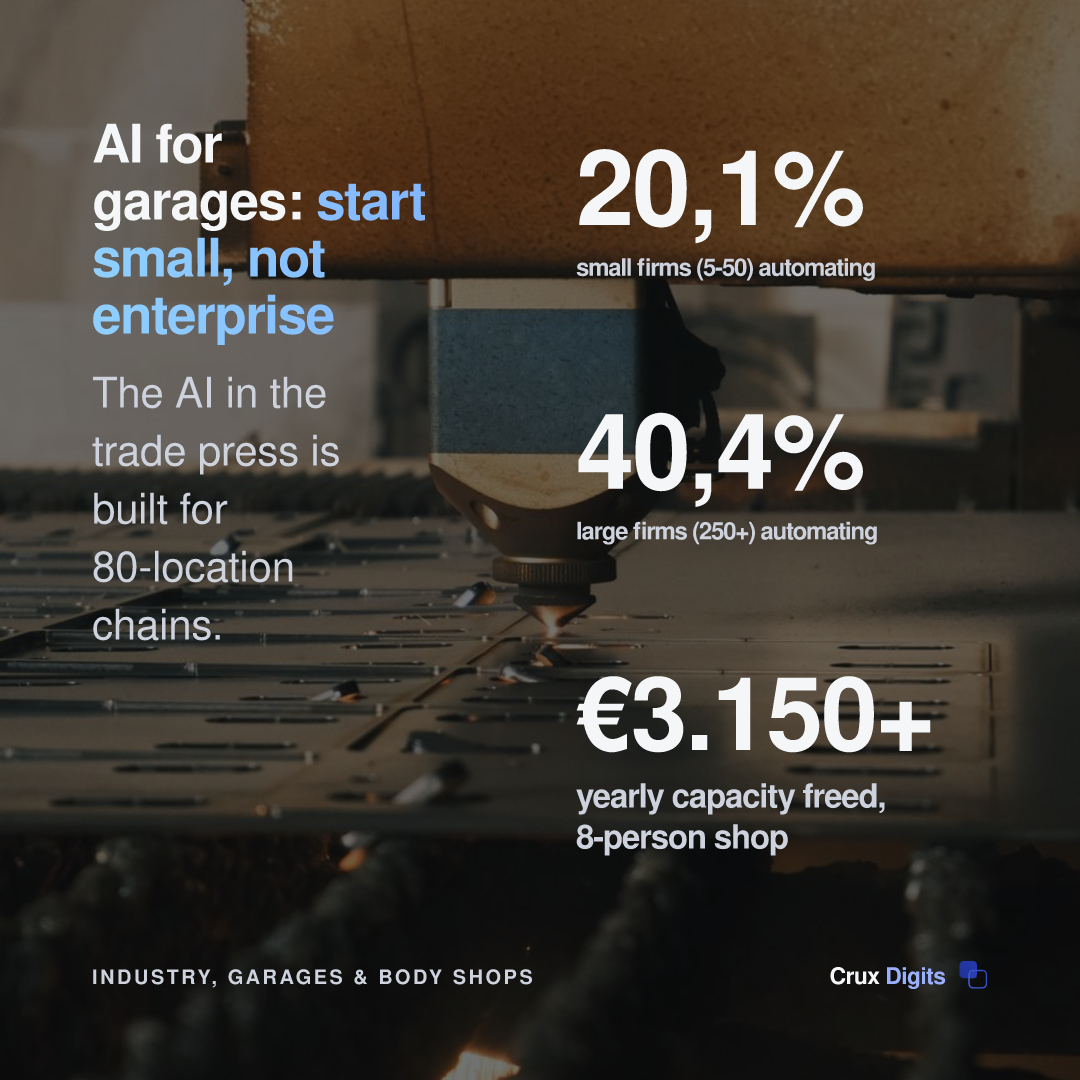
But the CBS data also shows a gap that matters for this article: 40.4% of large companies (250+ staff) now automate, against only 20.1% of small companies (5–50 staff). Small firms are the only size class where hiring perks, not automation, are still the primary response — and they are twice as likely to report that a staff shortage is actively limiting production. The AI tools making headlines in the automotive trade press are aimed squarely at the 40.4% end of that split.
What the current AI wave in repair actually looks like
Look at what is actually being deployed today and the pattern is consistent: it is built for scale. At ABS Autoherstel, an 80-location damage-repair chain, an internally built chatbot called Herbie now answers front-office questions about client agreements in seconds — work that used to take 20–30 minutes per file across handbooks and spreadsheets. In parallel, a pilot with Solera called Intelligent Estimate analyses damage photos on five locations and proposes a repair calculation, which a schademanager still approves or corrects; AI-driven planning reshuffles technician schedules automatically when someone calls in sick.
The same pattern shows up in the insurer-facing layer: Fixico and Inspektlabs combine a repair-network platform with AI-based digital damage assessment, and vendors such as Fasttrack (Wedat) sell photo-based calculation engines into the sector. All of it assumes a dedicated schademanager role, an IT budget, and volume: a five-location pilot, a network platform, a calculation tool licensed per branch. None of it is written for the owner-operator who answers the phone, plans the bay and does the calculation themselves.
What is realistic for a 3–20 person independent shop
Scale the same idea down and three things are genuinely within reach this year, without a chain-level IT budget:
- Photo intake before the car arrives: a WhatsApp Business number where customers send damage photos and a short description. A language model drafts a triage summary — likely repair type, roughly how long the bay is occupied — for a human to check before the appointment is confirmed. It replaces guesswork on the phone, not the calculation software.
- Appointment and reminder automation: on top of whatever planning tool or paper agenda you already use, an automation layer sends confirmations, reminders and rebooking requests, and flags double-bookings before they happen.
- Automatic status updates: the single most requested feature from customers of small garages is “when is my car ready” — a short WhatsApp or SMS update at defined milestones removes most of that call volume from the front desk.
- Quote follow-up: a scheduled nudge on unanswered repair quotes, which in most small shops currently happens only when someone remembers to chase it.
The payback math, worked out
Take an 8-person independent garage with one person effectively running the front desk. Assume, conservatively, 45 minutes a day lost to status-update phone calls and appointment phone-tag — a figure well below what most owners report anecdotally. That is roughly 180 hours a year at 240 working days.
- Freed capacity: if WhatsApp status updates and appointment automation remove half of that — the realistic share, since some calls always need a person — that is 90 hours a year. At a loaded front-desk cost of roughly €35/hour, that is about €3,150 a year, which either goes back into billable bay time or reduces overtime.
- Fewer missed follow-ups: even converting one extra quote a week through automated follow-up, at an average ticket of €450, is roughly €23,000 a year in additional revenue — the single biggest line in this calculation, and the easiest to test first because it needs no new software beyond a scheduling rule.
Against that: a WhatsApp Business API connection and a simple automation layer typically run €50–€150 a month for a shop this size, plus a few days of setup. The honest conclusion, in line with what CBS’s own small-business figures suggest: below roughly 5 employees the case is thin — start with WhatsApp status updates alone; the fuller automation layer earns its keep from about 8 people up, once phone interruptions are genuinely costing bay time.
Where AI still falls short at small-shop scale
Photo-based damage estimation — the headline feature in every chain-scale story above — is not yet a realistic buy for a single independent shop. The Solera and Fasttrack-class tools are trained and priced against a calculation database (Audatex-style parts and labour pricing) that a chain licenses centrally; a five-location pilot exists precisely because the system needs volume and correction data to stay accurate. Buying that tier as a solo shop means paying enterprise pricing for a system tuned on someone else’s repair mix, with no schademanager on staff to review its output at the pace the vendor assumes.
Fraud-pattern detection, similarly, is built for insurers looking across thousands of claims — it has no equivalent use case at single-shop scale. The practical rule: automate communication and scheduling first; treat AI-based damage calculation as something to revisit once your shop is part of a franchise, buying group or insurer network that licenses it centrally, not as a standalone purchase.
The tool landscape for small shops in 2026
The building blocks are ordinary and already used well beyond automotive: the WhatsApp Business Platform for customer messaging, and a no-code automation layer such as n8n or Make to connect WhatsApp, a calendar and a language model without custom software development. Your existing calculation software (Audatex, GT Estimate or similar) and planning tool stay exactly as they are — the AI layer sits on the communication side, drafting and routing, never issuing a final quote or calculation on its own.
A realistic first build takes one to two weeks: connect the WhatsApp number, draft the triage and status-update templates, add the human-approval step, and test it on real repair jobs for a month before switching off the phone-based process it replaces. That is a materially smaller project than anything described in the chain-scale examples above, and it is the right size for an 8-person shop’s budget and attention.
Common mistakes to avoid
- Buying capability you don’t need: a chain-scale calculation platform is the wrong first purchase for a solo shop — start with intake and communication.
- Removing the human check: every AI-drafted triage summary or quote needs a person to confirm it before it reaches the customer — exactly the rule ABS Autoherstel applies at chain scale.
- Rolling it out on the busiest technician: pilot with the person most sceptical of a new WhatsApp flow, not the most enthusiastic — if it survives them, it will stick with customers too.
- Automating a messy intake process: if photo requests today are inconsistent, AI drafts inconsistent triage. Fix what a complete intake needs first.
Privacy, customer photos and the AI Act
Vehicle and customer photos sent over WhatsApp are personal data under the GDPR, so route them through a processor agreement with whatever platform handles the automation, and avoid storing raw images longer than the repair file needs. Because the EU AI Act’s Article 4 literacy duty already applies to any business using AI tools with staff, make sure whoever operates the WhatsApp/automation layer understands what the model can and cannot reliably do — a one-page internal note is enough for a shop this size. Damage-triage drafting is not a high-risk use case under the Act, but it does need a human in the loop before anything reaches a customer, which is also simply good practice.
Where to start
Start with the one call type that eats the most front-desk time — usually status updates — and automate only that for a few weeks before adding intake or follow-ups. A free AI readiness scan takes about a minute and tells you where your shop actually stands before you commit to anything. See how we scope a first project as an AI consultant for Dutch SMEs, or read the comparable calculation for a related trade in our piece on work-order automation for installation companies.
For the build side, our AI automation service covers exactly this kind of WhatsApp-plus-workflow project; general project cost ranges are on our AI project cost page, and the AI Act checklist for SMEs covers the literacy duty in more detail.
We build custom AI and LLM systems that run in production: a clickable MVP by the second call, fixed steps, and you own the code.
AI development agency in the Netherlands →