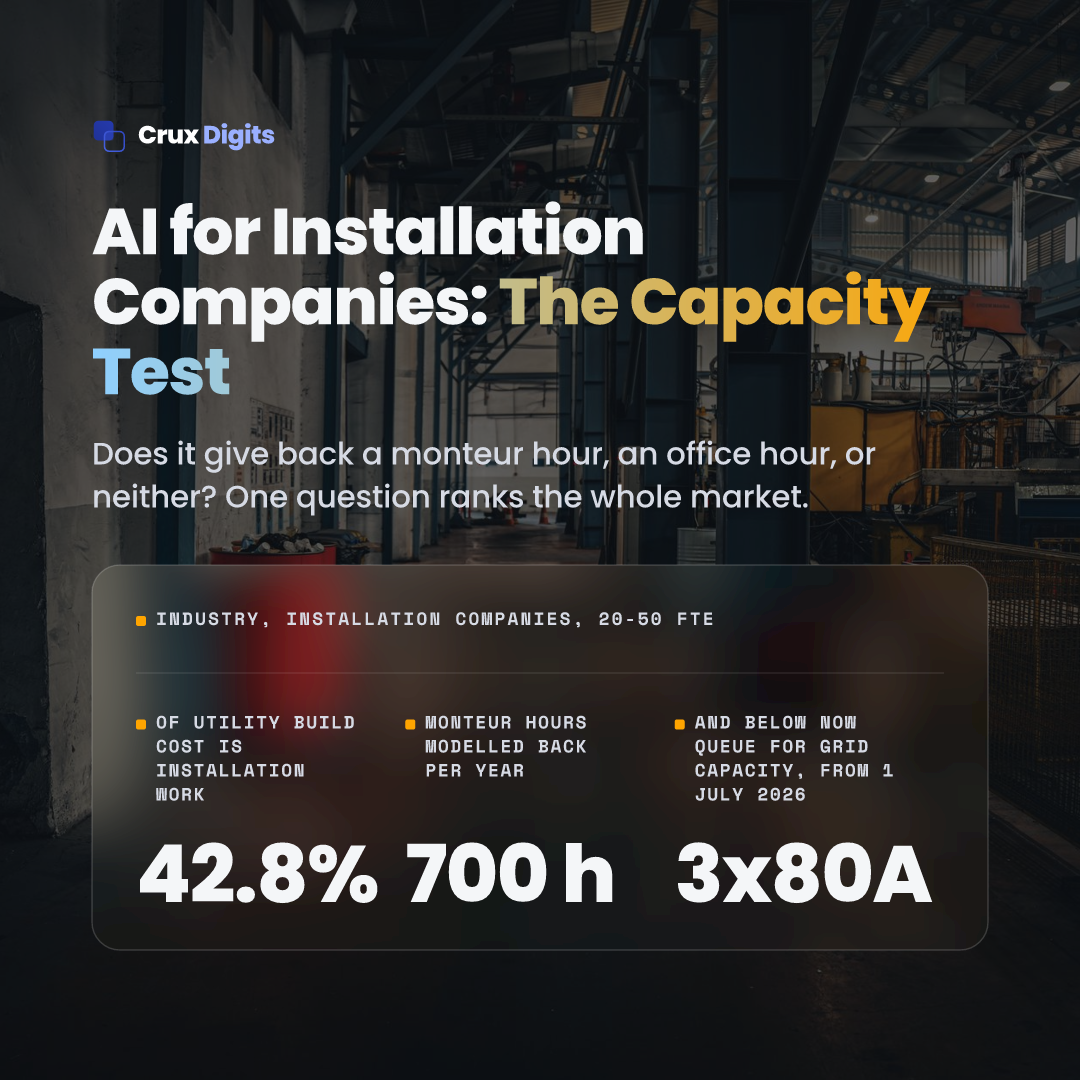
For a Dutch installation company of 20 to 50 people, the useful AI question in 2026 is not which admin task to automate first. It is which automation converts an office hour into a monteur hour on site. Techniek Nederland's June 2026 sector outlook is blunt about why: demand keeps growing, but available execution capacity — not demand — increasingly decides whether a project happens at all.
Why does capacity, not demand, decide your year?
The numbers are not gloomy. In the Economische vooruitzichten 2027 en verder report Bouwkennis produced for Techniek Nederland, published 25 June 2026, production volume in the installation sector grows 2.1% in 2026, 0.4% in 2027 and 1.7% in 2028. Infrastructure grows 13.1% this year. Utility construction shrinks 2.4%, largely offset by sustainability and renovation work.
What matters more is the composition. The installatiequote — the share of installation technology in the total build cost — climbed to an average 42.8% in utility construction and 19.5% in housing. Buildings now depend on heat pumps, ventilation, charging points, storage and smart energy control working together. Techniek Nederland describes the resulting shift plainly: the installer moves from uitvoerder to systeemintegrator.
And the ceiling is labour, not order books. Techniek Nederland's own framing is that personnel shortages, netcongestie and complex regulation increasingly obstruct execution. Wij Techniek's Arbeidsmarktontwikkelingen 2024 report put it in harder terms for 2024: nearly a third of installation firms had shortages severe enough that they turned work away. That figure is 2024 data and should be read as such — but nothing in the 2026 outlook suggests the direction reversed.
This has a direct consequence for how you evaluate an AI project. If your constraint is billable execution capacity, an automation that lowers cost without raising executable volume is optimising a variable that is not binding. It will look good in a business case and change nothing about your revenue.
What is the monteur-hour test?
Before you evaluate any AI proposal — a supplier's, a consultant's, ours — ask one question about it: does this give back an hour of monteur time on site, an hour of office time, or neither? That single question sorts the entire market into three tiers.
- Tier 1 — it returns a monteur hour. This is capacity, and in a firm turning work away, capacity is revenue. Value it at your contribution margin per billable hour.
- Tier 2 — it returns an office hour. Real, bankable, and bounded by what you pay for that hour. It only becomes capacity if the office is genuinely your bottleneck.
- Tier 3 — it returns neither, but demos well. Website chatbots, marketing copy, meeting summaries. Not worthless; not a capacity strategy.
There is one honest complication. Werkvoorbereiders are themselves scarce — Wij Techniek names work preparers alongside monteurs as the roles in highest demand. So werkvoorbereiding hours are Tier 1 in disguise: freeing a work preparer releases jobs onto the schedule, which releases monteur hours downstream. Invoicing hours do not do that. Treat the two differently even though both happen at a desk.
Which AI use cases actually give back a monteur hour?
The largest and least glamorous one is first-time fix. Field-service benchmark reporting, which is not installation-sector-specific but is the closest published comparison, puts the average first-time-fix rate at 80%, best-in-class organisations at 88% and laggards at 63%, and estimates that a visit which fails the first time takes roughly 1.6 further dispatches to close. See PTC's summary of the metric for the standard definition. Each avoidable second visit is travel, diagnosis and admin billed to nobody.
What moves that number is not a chatbot. It is retrieval: making the manuals, schematics, installed-base history and two years of your own werkbonnen searchable at the moment the service call is taken, so the intake produces the right diagnosis hypothesis and the right parts on the van. That is a retrieval-augmented system over your own documents, and it is a different build from a customer-facing bot.
Three more sit in the same tier. Voice capture on site, which turns a spoken note into a structured werkbon before the monteur leaves the address — we covered the full work-order chain separately. Remote triage of inbound service calls, which avoids some truck rolls entirely. And planning support, with an honest caveat: in a country with short drive times, route optimisation returns less than vendors imply. The win is not sending the van twice, not shaving four minutes off the drive.
What did the grid queue change on 1 July 2026?
This is the part most AI-for-installers content has not caught up with. The ACM's societal prioritisation framework has applied to large-consumer connection requests since 1 January 2026. From 1 July 2026 it also governs kleinverbruik connections up to 3x80 amperes, and the capacity that grid operators used to reserve for small connections is no longer set aside. Netbeheer Nederland describes the new working method; the ACM's own publication sets out the three priority categories — congestion relievers, safety and acute care, and societal basic needs such as housing, schools and heat initiatives. Techniek Nederland has published what the framework means specifically for installers.
For a 20-50 FTE installer, that changes intake, not marketing. Whether a job can proceed now partly depends on an answer from a grid operator you do not control, in a region you do not choose. Your intake has to ask questions it never asked: does this need a heavier connection at all, can it be solved inside the existing one, does the customer's storage or flexibility make them a congestion reliever, and where in the queue does that put them.
That is a classification-and-retrieval job — matching a customer's situation against published operator rules and your own precedent — which is exactly what a language model working over your own intake notes is good at, and exactly what a generic assistant is bad at. Be clear about what it buys you: no AI system gets you grid capacity. It stops you scheduling a monteur against a job that cannot legally proceed for eight months, and lets you resell that slot to one that can. If grid constraints are a recurring theme for your customers, our page on netcongestie in de industrie goes deeper on the technical side.
What does the payback math look like?
Numbers first, assumptions stated, so you can substitute your own. Take a 30-person firm with 20 monteurs at roughly 1,500 productive hours a year — 30,000 monteur hours. Market surveys put zzp installer rates around €60 per hour in 2026; an employing firm's charge-out sits in a comparable band, so call it €65 with a labour contribution margin near 35%, or roughly €23 of contribution per additional billable hour. These are illustrative figures, not a quote.
Now the intervention. Say 4,000 service visits a year, first-time fix at 78%, lifted to 85%. That is 280 failed visits avoided. Charge each avoided failure conservatively at 2.5 monteur hours of travel, re-diagnosis and admin: 700 monteur hours returned, worth roughly €16,000 in contribution — before counting the work you can now accept instead of refusing, which in a capacity-constrained firm is the larger half of the number.
Set that against a retrieval layer over manuals and werkbonnen, integrated into the system your planner already uses. That is a project in the tens of thousands, not the hundreds; our page on wat een AI-project kost gives the fixed-price bands. The point of the arithmetic is not the total. It is the sensitivity: almost all of the value sits in whether the saved hours land on monteurs. Run the same math on an invoicing automation and the number is a tenth of the size.
How does this connect to Syntess, Acto or Exact?
You do not replace the ERP, and any proposal that starts there should be treated with suspicion. Syntess Atrium and Acto are the systems of record for calculation, werkvoorbereiding, planning, field service and finance in a large share of Dutch installation firms; smaller firms often run Exact Online or Bouw7 alongside a field-service app. The AI layer reads from those systems and writes back into them. We have written separately about connecting AI to Exact, AFAS and e-Boekhouden, and the same principle holds here.
The rule worth enforcing in any supplier conversation: whatever gets built must deliver its output into the screen your planner already opens every morning. An AI answer that lives in its own tab is an answer nobody reads by week three. Newer Dutch entrants aimed at this sector — Ajeto, for instance, which focuses on intake enrichment and site surveys for installers — are worth a look, but the first question is always what they write back into your ERP, not what their demo shows.
Where do vendors oversell, and where should you start?
Three places, consistently. Autonomous planning, pitched as an AI that builds your schedule: a real installation schedule is constrained by certifications, van contents, customer windows and material lead times, and a model blind to those constraints produces a plan your planner overrides by 9am. Calculation from drawings, pitched as instant quoting: useful as a first draft, but the liability for a wrong calculation stays with you, so it needs a check step and the check step eats the saving on complex work. And the website chatbot sold as 'AI for installers', which is squarely Tier 3.
A sensible first move for a 20-50 FTE firm: pick one service segment — heat pump service is the usual candidate, given volume and complexity — and measure your actual first-time-fix rate for eight weeks before building anything. Then build retrieval over the manuals and the last two years of werkbonnen for that segment only. Narrow scope is what makes the result measurable. Our note on which process to automate first walks through the selection logic, and AI in de bouw covers the adjacent contractor case.
Two housekeeping points. The EU AI Act's obligations for a firm using AI internally are lighter than the headlines suggest, but not zero — we set out what actually applies in our AI Act checklist for the mkb. And on funding: schemes change and nothing is guaranteed, so decide the project on its own merits first and check AI-subsidies voor het mkb afterwards. If you want a second opinion on which of your processes passes the monteur-hour test, that is the conversation we have with Dutch SMEs most weeks.
A consultant tells you where AI pays off; Crux Digits also builds it. A fixed price per step, one named expert, from Utrecht.
AI consultancy in the Netherlands →