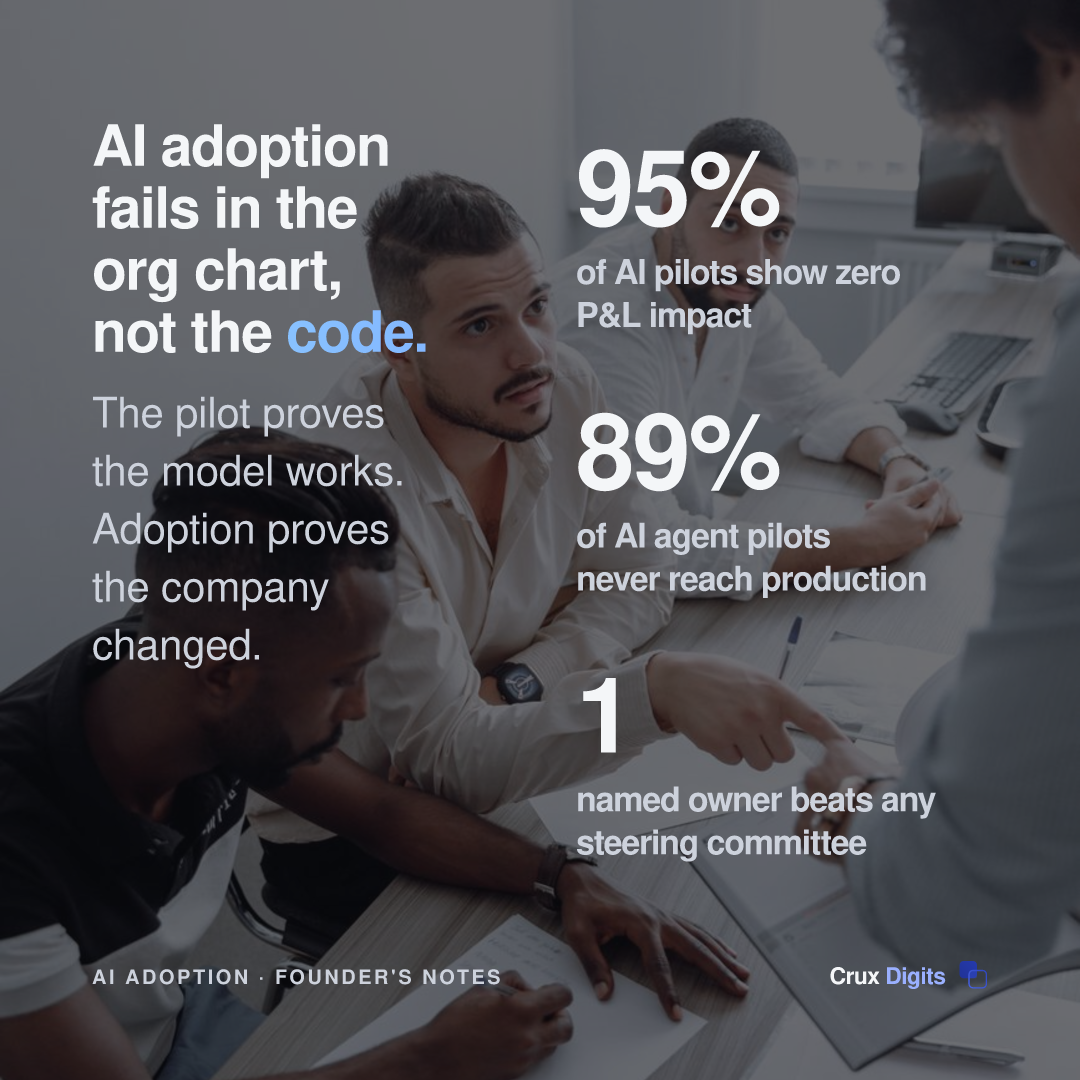
Ask me why an AI pilot dies and I won't blame the model. In four years of running an AI consultancy, I have never once watched a project fail because the technology didn't work — I have watched plenty fail because nobody redesigned a single job around it.
The Stat Nobody Puts in the Slide Deck
Every AI vendor pitch this year opens with a benchmark. Almost none of them open with the number that actually predicts what happens to your project: research from MIT this year found that 95% of enterprise generative AI pilots deliver no measurable P&L impact, and separate industry data on agentic AI puts the number of pilots that never reach production at close to 89%. Both studies land on the same root cause, and it isn't model quality. It's what researchers are now calling, a little dryly, a "learning gap" — the inability of a company to fold a new tool into its actual workflows, its actual org chart, its actual Tuesday morning. I'd call it something less dry: nobody changed anyone's job, so nobody's behaviour changed either.
I bring this up first because it inverts the order most SMEs approach AI in. The instinct is to worry about the model — is it accurate enough, is it the right vendor, is it GDPR-compliant, is it going to hallucinate in front of a customer. Those are real questions and worth asking. But they are rarely the reason a promising pilot quietly stops being mentioned in the Monday meeting three months later. The reason is almost always more boring than a model problem, and more fixable, which is the good news buried in an otherwise sobering set of numbers.
What "The Pilot Worked" Actually Means
Here is a pattern I see constantly: a pilot runs for six weeks, the demo is genuinely good, the numbers on the slide are genuinely real, and everyone in the room nods. Then nothing happens. Not because anyone decided to kill it — usually nobody decides anything. The tool just quietly stops being the thing people reach for, and eight months later someone asks whatever happened with that AI project, and the honest answer is that it's still technically running, on a server, being used by nobody.
"The pilot worked" is a sentence about the model. It says the system produced correct outputs on a representative sample of your data. It says nothing at all about whether a human being's actual job changed as a result — whether their manager now expects the output to be faster, whether their own performance review reflects the new way of working, whether the five minutes they used to spend on the old method are now genuinely available for something else. A pilot can be a complete technical success and a complete adoption failure at the same time, and in my experience that combination is closer to the median outcome than the exception.
This is also, not coincidentally, exactly where I've written before about what clients usually expect versus what actually happens once a project moves past the demo stage — the gap between "it works" and "it stuck" is the single most underestimated part of any AI engagement, ours included.
The Kind of Change Management a Twenty-Person Company Actually Needs
Say "change management" to the owner of a twenty-person business and you'll usually get a slightly pained look, because the phrase comes wrapped in enterprise baggage — steering committees, culture workshops, a slide with eight circles and arrows between them. None of that is what I mean, and none of it is what a company that size needs. What a twenty-person company actually needs is smaller, less expensive, and far less glamorous than the word suggests: someone has to physically change how a specific task gets done, on a specific day, and someone senior enough has to notice and expect it going forward.
That's the entire mechanism, reduced to its two moving parts. The task changes, and someone in authority starts expecting the new version. Everything people usually mean by "change management" — training sessions, internal comms, workshops — is in service of those two things and worthless without them. I have seen a beautifully produced internal training video accomplish nothing, and I've seen one sentence from an owner in a Monday stand-up — "from now on, quotes go out through the new system, full stop" — accomplish everything the training video was supposed to. The difference wasn't production value. It was authority attached to expectation.
This is the part of an AI project that has nothing to do with AI, and it's also the part most technically-minded teams are worst at, because it isn't a technical problem and doesn't respond to technical fixes. You cannot patch your way to adoption. You can only decide, out loud, that the old way no longer exists, and then actually mean it when someone tries to go back to it in week three.
Three Signs a Rollout Is About to Stall
I've learned to watch for the same three tells before a rollout quietly dies, and by the time all three are present the project is usually already lost, even if the technology is fine.
- Nobody's job description actually changed. If the new tool was bolted onto someone's existing role as an optional extra rather than replacing a specific step they used to do manually, it will lose to habit within a month. People don't adopt tools; they abandon steps. If no step got removed, nothing got adopted.
- The tool is optional in practice, even if it's mandatory on paper. The real test isn't the rollout memo — it's what happens the first time someone is in a hurry and the new way is even slightly slower or less familiar than the old one. If falling back to the spreadsheet is still possible without anyone noticing, it will happen, repeatedly, until it's the default again.
- Nobody above the user has to look at the output. Adoption sticks when a manager, a client, or a colleague downstream expects to see the new version and would notice its absence. The moment the output of an AI tool disappears into a void where no one checks it, usage becomes theoretical rather than actual, licence renewed, dashboard quietly empty.
Every one of these is a management decision, not an engineering one, which is exactly why I'd rather sit in the room where the process gets redesigned than just hand over a working model and wish the client luck.
Who Owns Adoption After We Leave
This is the uncomfortable question I ask myself before I'll take a project on: if we disappeared the day after go-live, would this survive contact with a normal Tuesday? If the honest answer is no, the problem usually isn't in the code — it's that nobody inside the company has been given clear ownership of making the new way the only way. I've written before about how I can usually tell within the first half hour whether a project is going to work, and one of the strongest early signals is whether a client can already name the person on their side who will own this once we're gone. If they can't name that person in the first call, I raise it before we sign anything, because building the system is the easy half of the job.
This is also why I'd rather ship something rough that a real owner will actually push into daily use than something polished that impresses a room and then quietly dies. I've made the case before for a working MVP over a polished slide deck, and adoption is the reason: a rough tool with a determined internal owner beats a beautiful one with nobody accountable for whether people actually use it, every single time I've watched the two compete.
The 2026 Twist: Less expensive Pilots, Same Adoption Gap
Something genuinely changed in the last year that makes this problem worse rather than better, and it's worth naming directly. Agentic AI and the Model Context Protocol went from research-lab jargon to shipping infrastructure faster than almost anyone predicted — building a working demo that connects to your actual data now takes days, sometimes hours, where it used to take months. That's a real gain. But it means the bottleneck has moved entirely from "can we build this" to "will anyone actually change how they work because of it," and that second question got no easier just because the first one got dramatically less expensive to answer.
I'd go further: low-cost pilots make the adoption problem worse in one specific way. When a demo is expensive and slow to produce, a company is forced to think hard before committing to it, which accidentally does some of the change-management thinking up front. When a demo can be spun up in an afternoon, it's tempting to skip that thinking entirely and just see if it's impressive — which is exactly how you end up with the pattern from my earlier post on the gap between a demo and a production system: a genuinely good demo, running forever, changing nothing.
What Actually Works
The research on this is more specific than "communicate more," and worth taking seriously because it matches what I see in practice. Companies that treat AI adoption seriously report allocating something in the range of twenty to thirty percent of an AI initiative's budget to training, internal communication and workflow redesign — not as an afterthought line item, but as a planned part of the project from day one. Compare that to the wider finding that only around a third of companies have anything resembling a structured change programme in place at all, despite most of them running technical training sessions. Training people to click the right buttons is not the same thing as changing what their job requires of them, and conflating the two is one of the most common and most avoidable mistakes I see.
In practice, this means the AI implementation step plan for any rollout I'm involved in — the real AI change management plan for an SME, not the model spec — now includes, from the very first proposal, an explicit answer to three questions that have nothing to do with the model: which specific task disappears the day this goes live, who is the named person expected to notice if people quietly go back to the old way, and what changes in a performance conversation as a result. If a client can't yet answer those three, that's not a reason to walk away — it's usually the actual first project, before the technical one even starts.
Who Actually Owns This Inside the Company
One question I ask in almost every scoping call now, and one I'd encourage any owner to ask themselves before signing anything: whose job gets easier if this works, and whose job gets harder? Adoption tends to stall silently when the two answers point at different people. If the person doing the daily work sees only a new tool to learn with no reduction in effort, and the benefit accrues mainly to a manager's dashboard three levels up, you have built something people will comply with while resenting, not something they will actually reach for. The rollouts that stick are the ones where the person doing the task is also the person who benefits most obviously and most immediately — faster invoices out the door for the person who used to chase them, fewer repeated phone calls for the person who used to field them, not just a tidier report for someone who never touched the original process.
This is also why "who owns it" needs a name, not a department. "IT will manage it" and "operations is responsible" are both answers that sound like ownership and function like nobody being accountable. The projects I've watched survive a year past go-live all had one identifiable person whose actual job included noticing, weekly, whether the new way was still being used — not a steering committee, one person with enough standing to ask "why did this invoice go out the old way again" and get a straight answer.
Where to Start
If you're looking at an AI pilot that technically works but hasn't actually changed how anyone spends their Tuesday, the fix is rarely a better model. Start by naming the one task that should disappear and the one person who will notice if it doesn't. We've laid out realistic budget ranges — including the change-management side most quotes leave out — on our page on what an AI project actually costs, and if you're earlier than that and still deciding whether this is a project worth starting at all, that's the conversation we have first, before any proposal, at Crux Digits.