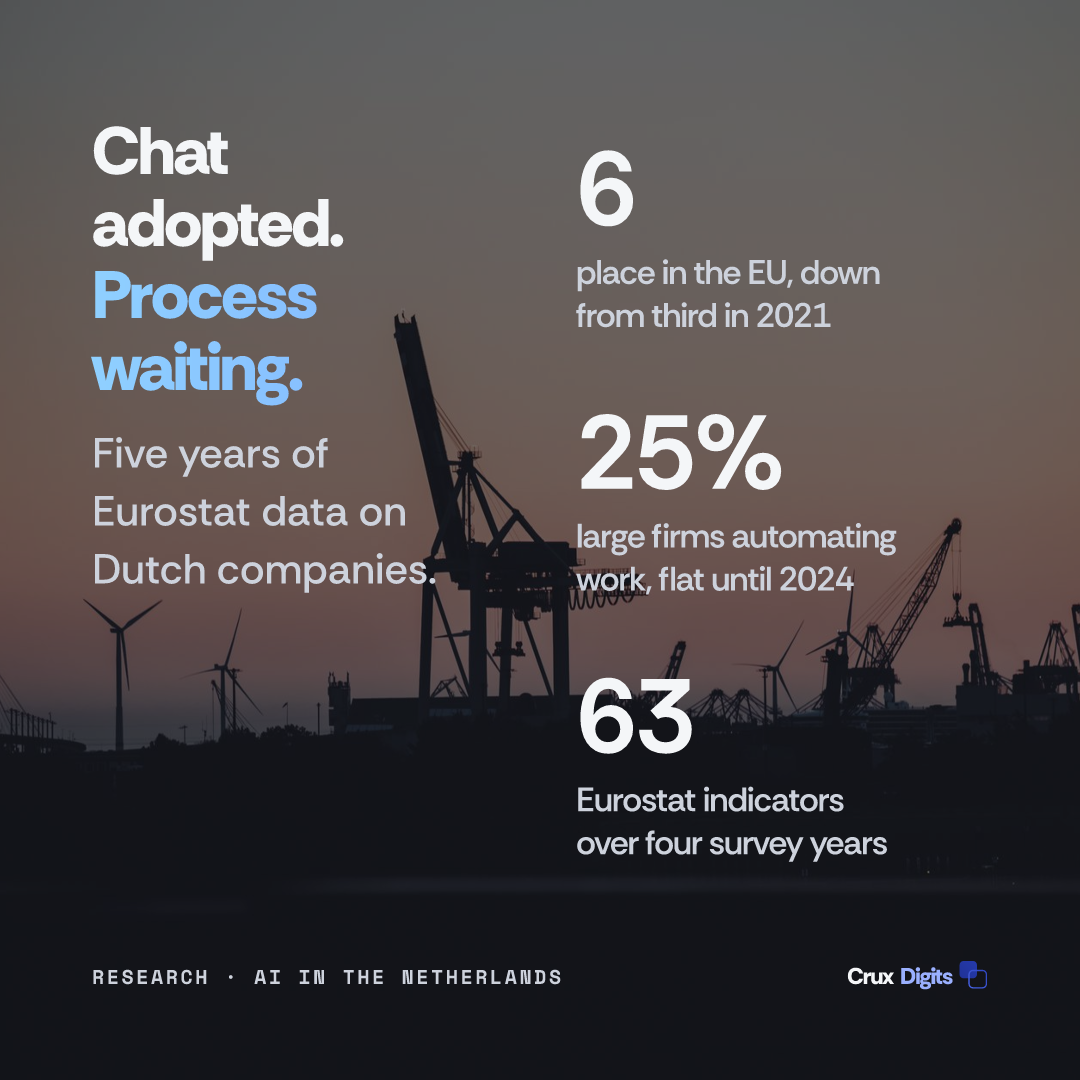
In 2025, 33.2% of Dutch companies with ten or more staff used at least one AI technology, up from 13.1% in 2021. Among companies with 250 or more staff it was 67.6%. Both figures are far above the EU average. Yet the Netherlands fell from third to sixth place in the EU over those years, and the kind of AI that changes a process, as opposed to a document, hardly moved in Dutch large firms between 2021 and 2024.
That second sentence is the reason for this study. The headline number is quoted everywhere. What sits underneath it is not, so we pulled the full Eurostat survey series for the Netherlands, Belgium and the EU, four survey years and 63 indicators, and worked out the changes, the ranks and the gaps ourselves. It is written for the IT manager, CIO or information manager at an organisation of 250 to 5,000 people who has to explain where the organisation stands.
How was this study built?
The source is Eurostat's annual survey on ICT use in enterprises, tables isoc_eb_ai (by size) and isoc_eb_ain2 (by sector), last updated on 15 June 2026. CBS collects the Dutch part. We pulled the data on 5 October 2026.
- Years: 2021, 2023, 2024 and 2025. The AI questions were not asked in 2022.
- Who is counted: companies with ten or more persons employed, in manufacturing, energy, construction, trade, transport, hospitality, ICT, real estate, professional and administrative services. The financial sector, healthcare, education and government are not in the survey.
- What is counted: a company uses AI if it uses at least one of seven technologies, from text mining to machines that move autonomously. One licence counts the same as a rebuilt process.
- Our own work: the changes in percentage points, the EU ranks across 27 member states, and the shares of AI users. Eurostat flags a break in the Dutch 2025 series for the overall figure and for small firms, so compare those two with 2024 with some caution.
How many Dutch companies use AI, and how does that rank in the EU?
Use went from 13.1% in 2021 to 14.1% in 2023, 23.1% in 2024 and 33.2% in 2025. The EU average in 2025 was 19.9%. So the Netherlands is two thirds above the average, and it still lost ground: third of 27 in 2021, sixth in 2025, behind Denmark (42.0%), Finland (37.8%), Sweden (35.0%), Belgium (34.5%) and Luxembourg (33.6%).
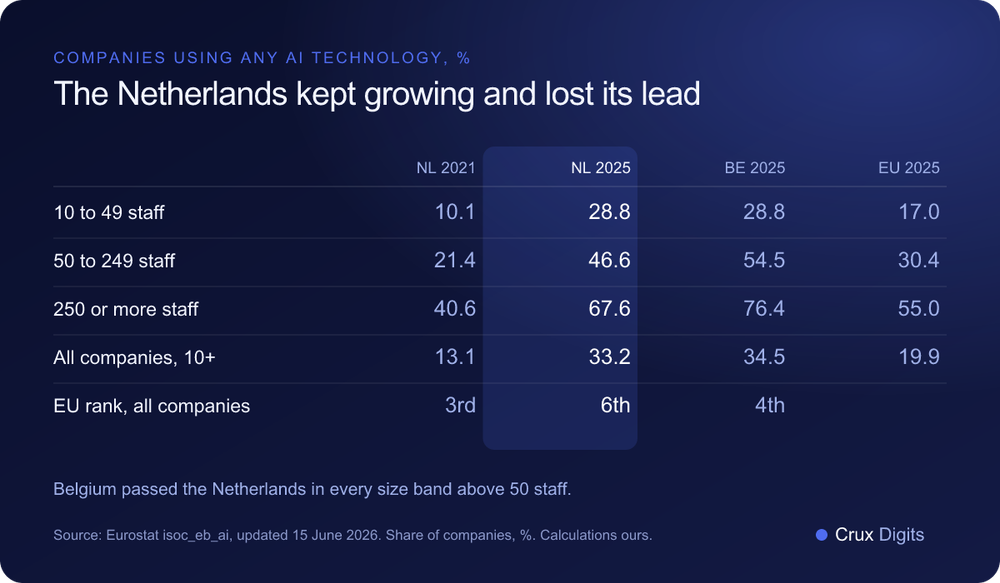
Size explains most of the differences inside the country:
- 10 to 49 staff: 10.1% in 2021, 28.8% in 2025.
- 50 to 249 staff: 21.4% in 2021, 46.6% in 2025.
- 250 or more staff: 40.6% in 2021, 67.6% in 2025.
For the small-firm picture and the mkb figures we keep a separate page, the state of AI in the Dutch mkb. This study follows the larger organisations.
Where did the Netherlands lose its lead?
Not among small firms. Dutch and Belgian companies with 10 to 49 staff are level at 28.8%. The lead was lost in exactly the size band where the budgets and the IT departments are.
In 2021 Dutch mid-sized firms (50 to 249 staff) were 4.5 points ahead of Belgian ones, 21.4% against 16.9%. In 2025 they were 7.9 points behind, 46.6% against 54.5%. Among firms of 250 or more the two countries started level, 40.6% and 41.4%. By 2025 Belgium was at 76.4% and the Netherlands at 67.6%. In the EU ranking for large firms the Netherlands went from fourth to seventh. Belgium is second, behind Finland.
Which AI did Dutch large firms adopt?
This is the finding we did not expect. Split the 250+ figure by technology and two very different lines appear.
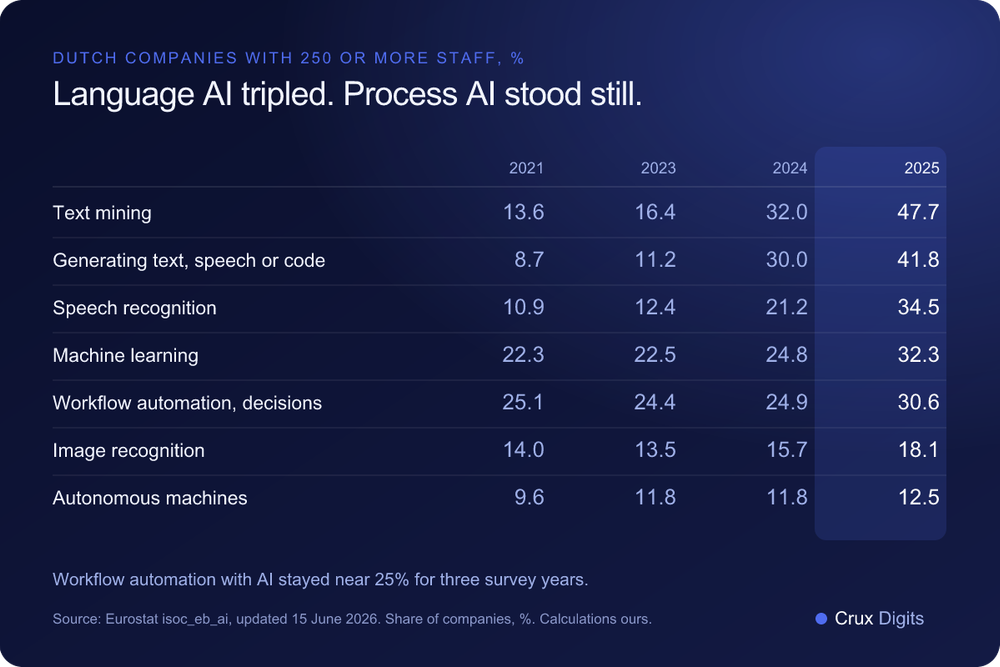
Language AI, which reads and writes documents, went up steeply:
- Text mining: 13.6% in 2021, 47.7% in 2025.
- Generating text, speech or code: 8.7% in 2021, 41.8% in 2025.
- Speech recognition: 10.9% in 2021, 34.5% in 2025.
AI that sits inside a process went almost nowhere:
- Automating workflows or assisting decisions: 25.1% in 2021, 24.4% in 2023, 24.9% in 2024, 30.6% in 2025.
- Machine learning for data analysis: 22.3% in 2021, 32.3% in 2025.
- Image recognition: 14.0% in 2021, 18.1% in 2025.
- Machines that move on autonomous decisions: 9.6% in 2021, 12.5% in 2025.
For three survey years the share of large Dutch firms using AI to automate a workflow did not change, while the headline went from 40.6% to 54.1%. Belgian large firms doubled the same indicator over the same period, from 22.6% to 45.0%. The Dutch adoption story of these years is, to a large extent, the arrival of a general assistant on the desktop. That is useful. It is also a different thing from a process that runs differently, and it is why adoption statistics and operational results so often fail to line up. We wrote about the organisational side of that in AI adoption fails in the organisation, not the code.
Which Dutch sectors lead, and which lag?
Share of companies with ten or more staff using AI in 2025:
- Information and communication: 70.0%.
- Professional, scientific and technical services: 55.0%.
- Electricity and gas supply: 54.6%.
- Pharmaceuticals: 48.9%.
- Machinery: 40.1%.
- Chemicals: 37.4%.
- Wholesale: 34.5%.
- Manufacturing as a whole: 28.6%.
- Retail: 27.4%.
- Food and beverages: 22.6%.
- Construction: 21.3%, from 4.7% in 2023.
- Transport and storage: 19.6%.
- Hospitality: 16.0%.
Two things stand out. Construction more than quadrupled in two years, from a very low base. And transport and storage, in the country with Europe's largest port, gained the least of any major sector: 8.1 points in four years, from 11.5% to 19.6%. Belgium's transport sector is at 22.4%.
The purpose data says the same. The share of all Dutch companies using AI for logistics was 2.7% in 2021 and 2.1% in 2025. Among large firms it was 9.3% and 11.9%. For comparison, large firms using AI for business administration went from 15.2% in 2023 to 36.6% in 2025.
Do Dutch companies build AI or buy it?
They buy it, and more each year. Among large Dutch firms that use AI, 72.2% use ready-made commercial software, up from 54.1% in 2021. The share that had AI developed or modified by an external provider fell from 54.2% to 44.7%, and the share that had it developed by their own employees fell from 36.0% to 30.8%.
Read together with the technology split, this is consistent: most new users arrived through a product somebody else built. Building or adapting AI for one's own process became a smaller part of the whole, even as the whole grew. For the IT organisation this shifts the work from development to supplier management, and it makes the question of who answers when the supplier's model changes more pressing. We covered that in who owns an AI incident.
What holds back the companies that do not use AI?
Of large Dutch firms, 12.8% say they considered AI and do not use it. Eurostat asks those firms why. Their answers in 2025, with 2021 for comparison:
- Lack of relevant expertise: 73.0% (71.4% in 2021).
- Concerns about data protection and privacy: 61.4% (16.0% in 2021).
- Lack of clarity about legal consequences: 50.0% (15.1% in 2021).
- Difficulties with the availability or quality of data: 42.2% (39.8% in 2021).
- Incompatibility with existing equipment, software or systems: 32.9% (45.4% in 2021).
- Costs seem too high: 24.9% (40.9% in 2021).
Cost dropped from the second reason to the last of these six. Privacy and legal uncertainty roughly quadrupled and tripled. Expertise stayed on top throughout. The picture is of organisations that can afford it, are less worried about fitting it into their systems, and are now stopped by not knowing how and not knowing whether they may.
What does this mean if you run IT at a Dutch organisation?
Three practical readings.
- Do not benchmark on the headline. Being among the 67.6% says only that someone has an assistant licence. The harder and more useful question is whether you are among the 30.6% that automate a workflow with AI, and for which process.
- Expect the gap to show up in tenders. Belgian and Nordic competitors of the same size are further along with operational AI. In sectors where Dutch firms compete across the border, logistics first, that will be visible in price and lead time before it is visible in a statistic.
- Treat the two growing barriers as work, not as a verdict. Privacy and legal uncertainty are answerable per process, with a DPIA, a classification under the AI Act and a change process that fits AI. We described one in AI change management.
Crux Digits builds AI into existing processes, as the AI partner next to an organisation's ICT partner or internal IT team. This study is not an argument for hiring anyone. A general assistant for every employee is a licence decision you can take yourself. The 30.6% line is where a specialist earns a place, and that is the work we do.
What are the limits of this data?
- It is a survey of what companies say they use, not a measurement of how much or how well.
- Finance, healthcare, education and government are outside the survey, so nothing here describes a bank, a hospital or a municipality.
- Use is binary. One pilot and a company-wide system count the same.
- The 2025 Dutch figures for the total and for small firms carry a break-in-series flag. The large-firm and mid-sized figures do not.
- Some sector figures rest on small samples and jump between years. We left out the cells that looked unstable.
The short version
- 33.2% of Dutch companies with ten or more staff used AI in 2025, against 13.1% in 2021 and an EU average of 19.9%.
- The Netherlands fell from third to sixth in the EU, and from fourth to seventh for firms of 250 or more.
- Large Dutch firms: 67.6% use AI, but workflow automation with AI stayed near 25% for three years and stood at 30.6% in 2025.
- Transport and storage gained the least of any major sector. AI for logistics is used by 2.1% of all companies.
- Among firms that considered AI and stayed out, cost fell away as a reason and privacy and legal uncertainty took its place.
A consultant tells you where AI pays off; Crux Digits also builds it. A fixed price per step, one named expert, from Utrecht.
AI consultancy in the Netherlands →