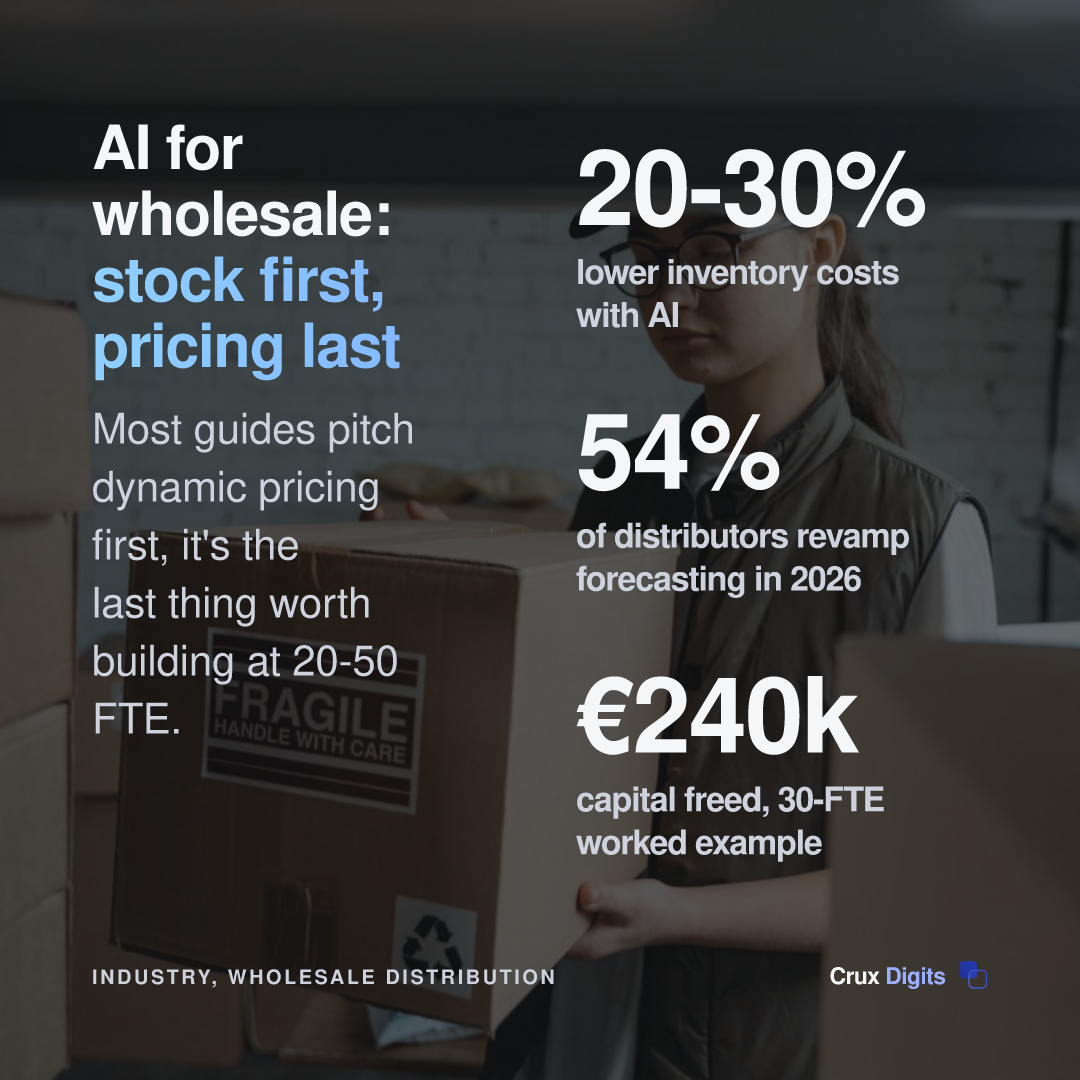
For a Dutch wholesale distributor with 20-50 employees, AI earns its keep in one place before any other: demand forecasting and stock levels. Sector research puts AI-driven forecasting at 20-30% lower inventory costs and materially fewer stockouts than the spreadsheet-and-gut-feel forecasting most wholesalers still run — before pricing automation or customer-service AI are worth touching at all.
Where AI actually moves the needle for a wholesaler
Three areas dominate real deployments in wholesale and B2B distribution: demand forecasting and stock optimisation, order intake and processing, and pricing. Forecasting AI combines sales history, seasonality, supplier lead times and, where available, external signals such as weather or construction permits to recommend purchase quantities per SKU, instead of a buyer eyeballing last year's numbers in a spreadsheet. Order AI reads incoming orders from email, phone transcripts, EDI and WhatsApp, checks stock and customer-specific pricing, and pushes a confirmed order into the ERP without manual retyping. Pricing AI recalculates the optimal price per customer per product from margin, volume agreements and competitor signals. All three now run on general-purpose AI models rather than the narrow, expensive optimisation software that used to require enterprise scale to justify — which is why the entry cost has fallen sharply for firms far smaller than the large distributors most case studies are written for.
What AI forecasting actually delivers, with the caveat most guides skip
Phocas Software's first annual Inventory Trends in Wholesale Distribution report, based on a global survey of over 100 distributors published in March 2026, found that 54% plan to adopt a new demand-forecasting approach in 2026 — but only 11% currently rate their forecasting as very accurate, and 70% already manage more than 5,000 SKUs. McKinsey's research on AI in distribution operations ties AI-driven forecasting to inventory reductions of 20-30% and holding-cost cuts of up to 50%, alongside logistics cost cuts of 5-20% and procurement savings of 5-15%. The caveat those figures skip: accuracy gains that size assume clean, structured historical sales and purchasing data feeding the model — six months of guessed reorder points in a spreadsheet will not produce an 8-15% forecast error rate, it will produce the same 35-45% error most traditional forecasting already runs at, just with an AI label on it.
A worked example makes the size question concrete. Take a technical or electro-technical wholesaler with 30 FTE, roughly 6,000 active SKUs and €8 million in annual turnover — a fairly typical profile for the 20-50 FTE band. Assume an average inventory value of €1.2 million tied up in stock. Even the low end of the 20-30% inventory-reduction range frees up close to €240,000 in working capital, money that otherwise sits on shelves instead of funding the next purchase run. Sector estimates put lost orders from stockouts at 5-10% of potential demand; recovering half of that on an €8 million turnover base, at a typical wholesale contribution margin, is worth pursuing on its own even before the working-capital gain is counted. None of this requires replacing the ERP — it requires six to twelve months of clean sales history feeding a forecasting layer that sits on top of it.
The e-invoicing shift that will force cleaner data anyway
This is the timely part most "AI for wholesale" guides skip entirely: the EU's VAT in the Digital Age (ViDA) package, adopted in March 2025, already lets member states mandate e-invoicing domestically, and requires structured, machine-readable e-invoices for cross-border B2B transactions from 1 July 2030, with fully aligned domestic reporting by 2035. Belgium made Peppol e-invoicing mandatory for all domestic B2B transactions from 1 January 2026; Poland and Greece follow later in 2026 and France in September 2026. The Netherlands has not set a domestic B2B mandate yet — Peppol is only compulsory today for invoices sent to the national government — but the direction is set, and Dutch wholesalers trading into Belgium or France already need structured invoice data now, not eventually.
The connection nobody makes: the same structured order and invoice data that e-invoicing will eventually require is precisely the clean historical data an AI forecasting model needs to hit that 8-15% error range instead of 35-45%. A wholesaler that treats "get invoice data e-invoicing-ready" and "build an AI forecasting layer" as two separate projects pays twice for the same data clean-up. Build them on the same foundation and the forecasting project gets materially less expensive, because the expensive part — structured, matched, machine-readable sales and purchasing data — was going to be mandatory anyway. We cover the mechanics of automating that document layer in our piece on automating invoice processing with AI.
Order intake before pricing — sequencing for a 20-50 FTE wholesaler
Order intake is usually the louder daily pain. Orders arrive by email, phone, WhatsApp and the occasional EDI feed; someone retypes them into the ERP, checks stock and customer pricing by hand, and mistakes in article numbers or quantities surface as credit notes weeks later. AI order intake reads the incoming message regardless of channel, extracts customer, SKU, quantity and requested date, checks it against stock and the customer's price agreement, and routes only genuinely ambiguous orders — an unclear product reference, a customer over their credit limit — to a person. That is the same capture-match-flag-exceptions pattern that works for freight documents and work orders elsewhere in Dutch SME automation, applied to a purchase order instead.
Pricing AI is where most vendor pitches lead with the biggest number and the least honesty about data requirements. Recalculating optimal price per customer per product needs enough order history and price-response data to model elasticity reliably — typically more transaction volume than a 20-50 FTE wholesaler with a few thousand active customers accumulates within a useful timeframe. Building it before forecasting and order intake are solid usually means automating guesswork with more confidence, not less risk. Our recommendation for this size band: get demand forecasting and order intake right first — both compound the same clean-data investment — and revisit dynamic pricing once a full sales cycle of AI-clean order data exists to train it on.
A caution before connecting AI to Exact Online or AFAS
AFAS updated its own guidance in June 2026 with a warning worth taking seriously: as of that publication, no AI integration with AFAS is officially certified, and the company explicitly warns against "MCP-server" or "AI-agent" tools that present themselves as an "AFAS solution" without certification — these can alter data in ways that are not always reversible, and AFAS can give no guarantee about what happens with data behind an uncertified integration. The practical translation for a wholesaler connecting an AI order or forecasting tool to Exact Online or AFAS: check whether the specific integration is certified by the platform, scope API tokens to only what the tool needs, give tokens a limited lifetime, and treat any vendor's claim of being "built for AFAS" or "built for Exact" with the same scrutiny you'd give a claim about a banking integration. We go deeper on the connection patterns themselves in our guide to connecting AI to Exact Online, AFAS and e-Boekhouden. This sits alongside the EU AI Act's Article 4 literacy duty, already in force, and the wider obligations phasing in through August 2026 — none of which classify ordinary stock, order or pricing AI as high-risk, but all of which expect staff to understand what the tool they're using actually does.
Where these projects go wrong
- Treating AI as an ERP replacement instead of a layer on it: Exact Online and AFAS already handle stock, invoicing and customer records reasonably well; the AI project that succeeds adds forecasting and order-reading intelligence on top via API — the same integrate-don't-replace pattern that applies to legacy ERP more broadly.
- Skipping the data clean-up: six months of guessed reorder points will not train an accurate model; budget the clean-up as part of the project, not as a delay to it.
- Going straight to dynamic pricing: without enough transaction history to model elasticity, an AI price recommendation is a confident-sounding guess wearing a spreadsheet.
- No human checkpoint on the purchase order: an AI system that auto-generates purchase orders without a buyer's final sign-off turns a forecasting error into an inventory write-off; keep a person approving the order, not just monitoring it after the fact.
Who this pays off for right now
This fits small and mid-sized Dutch wholesalers (roughly 20-50 FTE) particularly well: forecasting still runs on spreadsheets and a buyer's gut feel, orders arrive across email, phone and WhatsApp with no single intake channel, and margins are thin enough that a 20% cut in inventory holding cost shows up directly on the balance sheet. Below about 10-15 FTE, a good off-the-shelf stock and order tool usually delivers more value than a custom AI layer — the transaction volume needed to train a useful forecasting model rarely exists yet. Above roughly 250 FTE, the conversation shifts from "which process to automate first" to governance, change management and pilot-to-production rollout across multiple warehouses or business units — a different scale of project we cover on our applied AI & ML page for mid-sized businesses.
Where to start
Start with whichever pain is loudest. If a buyer is still reordering by gut feel and stockouts are costing sales, pilot demand forecasting on your top 200-300 SKUs by revenue for one full purchasing cycle before rolling out further. If order intake is the daily fire drill, pilot AI order reading on your highest-volume customer or channel first, and measure straight-through-processing rate against your current manual baseline, not a vendor's projected percentage. Wholesale and logistics sit close together in the Netherlands — Nieuwegein's own Plettenburg and Het Klooster business parks carry a meaningful concentration of wholesale and distribution firms — and much of what applies to route and warehouse automation on our logistics industry page carries over directly. See how we scope a first AI project for Dutch SMEs on our AI consultant page, and what a typical project costs on our AI implementation cost page.