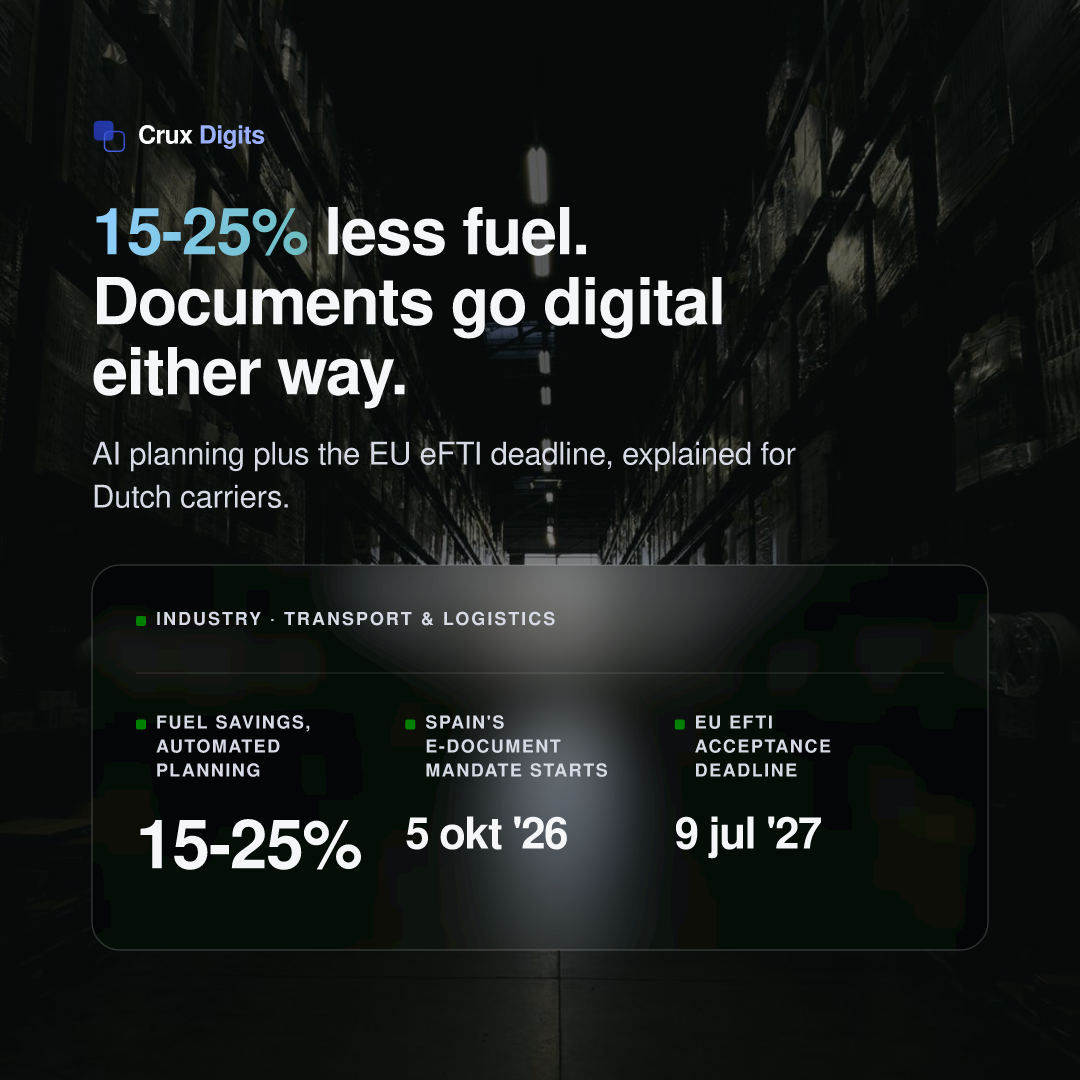
For a Dutch transport or logistics firm, AI earns its keep in two places: route and load planning, and freight-document processing. Automated planning typically saves 15-25% on fuel and lifts vehicle utilisation 20-30%, while a parallel EU deadline is about to force every carrier's paperwork into digital form regardless of whether they touch AI at all. Getting the sequencing right — plan first or digitise documents first — depends mostly on fleet size.
What AI actually does for a transport company
Two categories cover almost every real deployment. Planning AI combines ride and load data, vehicle telematics, driver hours, traffic and weather to build and continuously re-optimise routes and loads — the same class of system used to catch a delay and re-route before a planner would notice. Document AI reads freight paperwork — consignment notes, proof-of-delivery, customs and ADR documents — extracts the relevant fields, and matches them against the booking and invoice. Both categories now run on general-purpose AI models rather than the narrow, expensive optimisation software that dominated this space a decade ago, which is why the cost of entry has fallen sharply for firms far smaller than the 3PLs that first adopted it.
What automated planning actually saves
Dutch sector estimates put automated route and load planning at 15-25% fuel savings and 20-30% higher vehicle utilisation, because the system re-optimises in real time against traffic and delay data instead of running a plan built once each morning. Planners themselves reportedly save 30-45 minutes a day once routine re-planning is automated, and a mid-sized logistics operation is estimated to save €8,000-15,000 a month in operational cost once planning, fuel and utilisation gains are combined — though that figure assumes a fleet large enough (roughly 20+ vehicles) for the percentage gains to translate into real euros; a 5-truck firm sees the same percentages on a much smaller base.
The eFTI deadline that changes freight paperwork for everyone
This is the timely part most AI-for-logistics content skips: the EU's eFTI Regulation requires national authorities to accept freight documentation in electronic form via certified platforms from 9 July 2027, and Member States are expected to have their national connecting systems ready by mid-2026. Spain will make its electronic control document mandatory for all road transport in or through the country from 5 October 2026 — the first EU member state to force the issue. The Netherlands is not starting from zero: it is one of the earliest and most complete adopters of the eCMR protocol, largely through TransFollow, a Dutch-founded platform now standard for electronic consignment notes and digital proof-of-delivery in the country, and the Benelux eCMR pilot has been extended through July 2027 to keep pace with the wider EU rollout. For a Dutch carrier, the practical read is: the paper CMR is not disappearing overnight — most experts still expect a fully paperless transition closer to 2029 — but every trip into Spain from October 2026, and every EU trip from mid-2027 onward, increasingly assumes electronic documentation exists somewhere in the chain. Building document AI now on top of an eCMR-ready base, rather than on scanned paper, is the version of this project that won't need rebuilding in two years.
A worked example makes the fleet-size trade-off concrete. Take a 15-truck regional carrier running mostly domestic and Benelux routes. A planner currently rebuilds tomorrow's routes each evening and re-plans by phone whenever a delay hits — call it 90 minutes of daily replanning across the fleet. Automated planning claiming even the low end of the 30-45 minutes/day/planner figure recovers roughly 300 hours a year, and the 15-25% fuel saving on a fleet spending, say, €25,000 a month on diesel is €3,750-6,250 a month — €45,000-75,000 a year — before touching documents at all. That gap is usually large enough on its own to justify a planning pilot regardless of what happens on the document side, which is why the two projects are worth sequencing rather than bundling into one procurement.
Piloting before you commit
Run the planning pilot on your busiest 3-5 routes for a month before rolling out fleet-wide, and measure two numbers against your current manual plan: actual fuel burned and actual on-time delivery rate, not the vendor's projected percentages. For document AI, shadow-test extraction against a month of already-processed consignment notes and proof-of-delivery records, and check the error rate specifically on damage notes and quantity discrepancies — those are the fields where a missed flag costs real money in disputes, unlike a minor formatting error elsewhere on the document.
Where document AI fits in the chain
- Capture: a consignment note, proof-of-delivery or customs form arrives as an eCMR record, a photo from a driver's phone, or a scanned paper document; AI extracts the shipment reference, quantities, condition notes and signatures regardless of format.
- Match: extracted data is checked against the original booking and the planned route — a mismatch between what was loaded and what was booked is exactly the kind of discrepancy that otherwise surfaces as a billing dispute weeks later.
- Flag exceptions: damage notes, refused goods, missing signatures and customs discrepancies route to a person immediately rather than sitting in a folder until month-end reconciliation.
Invoice: confirmed deliveries generate invoice lines the same day, which is where most of the realistic cash-flow benefit — faster billing, fewer disputes — actually shows up, the same pattern we found in work-order automation for installation companies.
Where these projects go wrong
- Planning software that ignores driver reality: a route optimiser that doesn't know a specific driver always takes longer at a specific loading dock gets ignored within a week. Feed it real completion data, not just distances.
- Digitising documents without an eCMR-ready base: OCR on scanned paper is a stopgap; if the regulatory direction is electronic-first, build the extraction layer to consume structured eCMR data where it already exists rather than photographing paper forever.
- No exception path for damage and disputes: an AI system that silently accepts a proof-of-delivery photo showing damaged goods, without flagging it, creates a liability problem, not a time saving.
- Treating AI as a replacement for the TMS instead of a layer on it: most transport management systems already handle dispatch, invoicing and basic tracking reasonably well; the AI project that succeeds adds planning intelligence and document extraction on top via API — the same integrate, don't replace pattern that applies to legacy ERP more broadly.
Who this pays off for right now
This fits small transport firms and owner-operators (roughly 5-50 vehicles) particularly well: a planner or the owner is still doing route adjustments by phone and gut feel, paperwork is a mix of paper CMRs and photos on WhatsApp, and margins are thin enough that a 15-25% fuel saving is immediately visible on the bottom line. Below about 5 vehicles, a single owner-operator usually gets more value from a good planning app alone than from a custom AI layer. Above roughly 50-100 vehicles, the conversation shifts toward integrating AI into an existing TMS (transport management system) rather than building planning from scratch — a different, larger project with its own governance requirements.
Where to start
Start with whichever pain is louder: if planners are firefighting rescheduling by phone, pilot route optimisation on your busiest routes first; if disputes and late invoicing dominate, pilot document capture and matching on your highest-volume customer first. Both are separate, sequenced projects, not one AI rollout. See how we approach similar drafts-then-approves automation in our piece on connecting AI to Exact Online, AFAS and e-Boekhouden, see our broader work on route and warehouse automation on our AI for logistics page, and how we scope process automation for Dutch SMEs on our process automation page. None of this requires waiting for the EU deadlines to bite: the planning savings are available today regardless of what happens with eFTI, and firms that start building document workflows around eCMR data now, rather than around scanned paper, are the ones who won't be re-platforming under time pressure in 2027.