For a Dutch accountancy or administratiekantoor, the fastest AI wins are the repetitive, high-volume tasks — document capture, transaction coding, VAT checks and bank reconciliation — the work your bookkeeping package already assists with under human sign-off. Start there, not with an autonomous month-end close. The new NBA/NOREA guideline is blunt about why: for its members, AI may never be a black box, and human judgment stays the basis of public trust.
That gap — between using AI and using it well — is the real 2026 story for accounting firms. What follows is a practitioner's map: which tasks to automate first, what the fresh Dutch guidance actually demands, how it lands on the stack you already run (Exact, Yuki, Twinfield, e-Boekhouden, Visionplanner), and where 'agentic accounting' is still ahead of what you can safely sign. It is written for the small and midsize firm — roughly 5 to 50 people — not the Big Four.
78% already use AI — so why does it feel stuck?
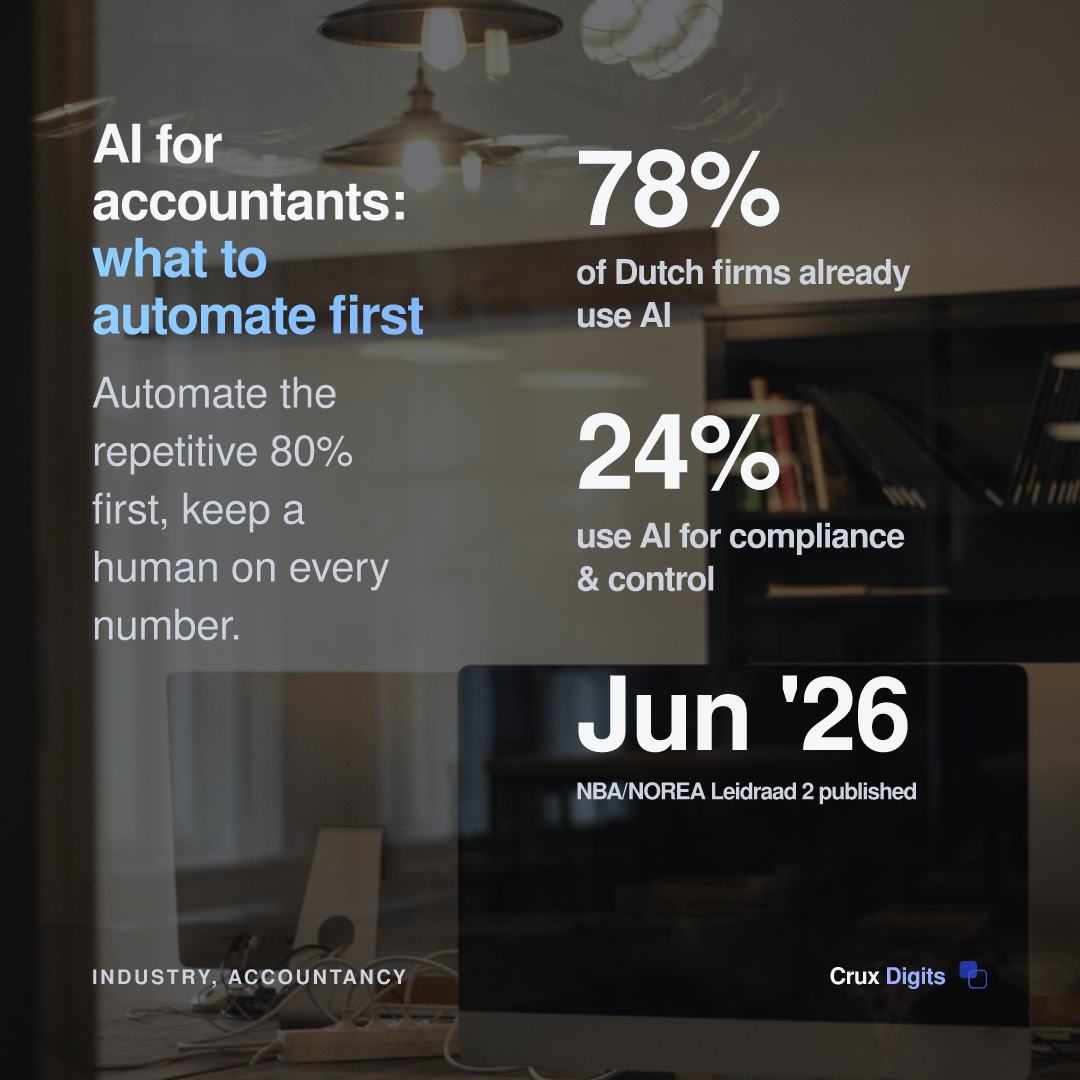
In the June 2026 Exact MKB Barometer, a survey of around 1,700 Dutch entrepreneurs and firms, 78% of accountancy offices said they already use AI. Yet 49% admit they don't know how to get the most out of it. Adoption is not the same as application.
Look at where the effort goes. Text and communication (37%) and analysis and advice (32%) lead, while fewer than a quarter — 24% — use AI for compliance and control, the part of the job with the highest stakes and the biggest recurring time sink. Meanwhile 68% call automation a priority and 71% say they have the budget. The bottleneck is not money or willingness; it is knowing which task to point AI at, and how to keep the result defensible.
The firms' own top challenges point the same way: keeping up with laws and regulation (43%), meeting the proactive-advisor role clients now expect (36%), and cutting manual admin work (36%). Sequenced properly, AI chips away at all three.
One survey finding doubles as a to-do: 18% of firms still do not help clients with e-invoicing, and only 36% actively explain its benefits. That matters more than it looks, because structured e-invoice data is exactly what makes the AI below accurate — clean, machine-readable input beats a cleverer model every time. With EU e-invoicing rules tightening, moving clients off PDF and paper is the highest-leverage preparation step most firms are quietly skipping.
Which accountancy tasks to automate first
One test sets the order: automate work that is high-volume, rule-shaped and easy to verify before work that is judgement-heavy or hard to check. That means starting at the bottom of the ledger and moving up:
- Tier 1 — automate now: document capture (OCR of invoices, receipts, bank statements), coding to the right grootboekrekening and VAT code, duplicate detection, and bank-to-invoice matching. High volume, clear right answers, one-glance review.
- Tier 2 — automate with guardrails: drafting client emails and management summaries, first-pass VAT-return checks, cross-reference checks in annual-account review, and anomaly flags for fraud. AI drafts or flags; a person decides.
- Tier 3 — assist, don't automate: tax planning, going-concern judgement, the final audit opinion, and advisory conversations. Here AI is a research aide, never the signer.
Most small firms are inverting this — reaching for a general chatbot to write advice (Tier 3) before automating the coding grind (Tier 1) that actually eats their week. Fix the sequence and the time comes back where it hurts most.
What 'Leidraad 2: AI Toegepast' actually requires
On 1 June 2026, NBA Accounttech and NOREA published Leidraad 2: AI Toegepast, the applied successor to 2024's Leidraad: AI in Control. It is not law, but for NBA and NOREA members it sets the professional bar — and it is refreshingly concrete.
Two demands matter most. First, no black box: you must be able to reproduce and explain how an AI-assisted figure came about, backed by ethical frameworks — reproducibility over 'the model said so'. Second, human judgment stays the basis of public trust: validation by a professional is not optional garnish, it is the control. The guideline pairs this with dozens of worked cases spanning journalising, contract review, fraud detection and ESG reporting.
In practice, reproducibility is a workflow, not a feature. Keep the source document, the suggested booking and the name of whoever approved it linked in one place, so any figure can be walked back on request. Tools that log this for you are worth more than tools with a flashier model, because the log is what turns 'the AI did it' into a defensible position when a client, a peer reviewer or the Belastingdienst asks.
It sits alongside the EU AI Act, in force since February 2025; for most bookkeeping AI that means the 'limited' or 'minimal' risk tier — a transparency duty at most, not a high-risk regime, while the Article 4 AI-literacy duty applies across the board. Our AI Act checklist for SMEs walks through it. The practical consequence is a filter for tool choice: a system that can show its working — which document, which rule, which prior booking drove a suggestion — fits the guideline. A confident number with no audit trail does not.
Mapping AI to your Dutch stack
You almost certainly do not need a new platform. The AI to switch on first is probably already inside the software you run:
- e-Boekhouden.nl: 'Scan & Herken' OCR, smart categorisation suggesting the grootboekrekening and VAT code, duplicate and outlier detection, and automatic bank-statement matching — the micro and zzp workhorse.
- Yuki: auto-posts transactions to the correct ledger account with built-in invoice recognition and classification — strong for firms running many small-client administrations.
- Exact Online and Twinfield: built-in invoice recognition and classification inside the packages your larger SME clients already use.
- Visionplanner: its March 2026 'Prepared by Client' module adds an AI assistant that analyses and automatically validates requested documents — squarely a Tier-2, review-first tool.
- AFAS and Microsoft Copilot: features many firms already pay for; the win is turning what you own into a routine, not buying more. Check where each vendor stores data and favour EU residency to keep AVG/GDPR simple.
The real work is rarely the model; it is the plumbing and the checks. Getting these tools to talk to each other cleanly — and adding the review step the guideline demands — is a process-automation job, not a science project. That connective layer over your existing Dutch stack (see our AI automation for the Dutch stack) is where a small firm gets leverage without a rip-and-replace.
The realistic payback — with honest assumptions
Vendors quote dramatic numbers; here is a transparent, conservative estimate you can adjust. e-Boekhouden puts manual document handling at 2–3 minutes each and AI-assisted handling at 10–15 seconds. Take a 15-person firm with three bookkeepers processing roughly 1,800 documents a month between them.
Assume a net saving of two minutes per document after a human review step — deliberately below the raw gap. That is about 60 hours a month of capacity returned across the team. Even halving it for imperfect adoption and rework leaves roughly 30 hours, against AI add-ons that typically run €15–50 per user per month. The payback is measured in weeks. Note what this is: capacity freed for review and advisory work, not automatic profit — and it only holds if the review discipline holds. For a worked example of one Tier-1 task end to end, see how firms automate accounts payable with AI.
Where 'agentic accounting' helps — and where it doesn't yet
2026 is being sold as the year of 'agentic accounting' — autonomous agents running month-end close, accounts payable and reconciliation end to end. The direction is real, and for narrow, well-bounded tasks the agents genuinely work. But agentic AI for Dutch SMEs earns its keep in the same order as everything above: bounded, verifiable steps first.
An agent that reconciles a bank feed and stops for approval on exceptions fits the guideline. An agent that closes the books and files without a reproducible trail does not — not because the technology can't, but because you cannot yet stand behind the number the way your professional duty requires. The honest 2026 position: let agents run the plumbing, keep humans on the judgement, and widen autonomy only as the audit trail proves itself.
The firms pulling ahead are not the ones with the flashiest chatbot; they automated the boring 80% first, kept a human on every number, and turned the reclaimed hours into advice clients will pay for. If you want a second opinion on where to start on your own stack, that is the conversation we have with Dutch SMEs every week. Last updated 13 July 2026.
AI automation for SMEs: the audit prices the saving and payback per process, then we build the first process as a Production-ready MVP.
AI automation for business →