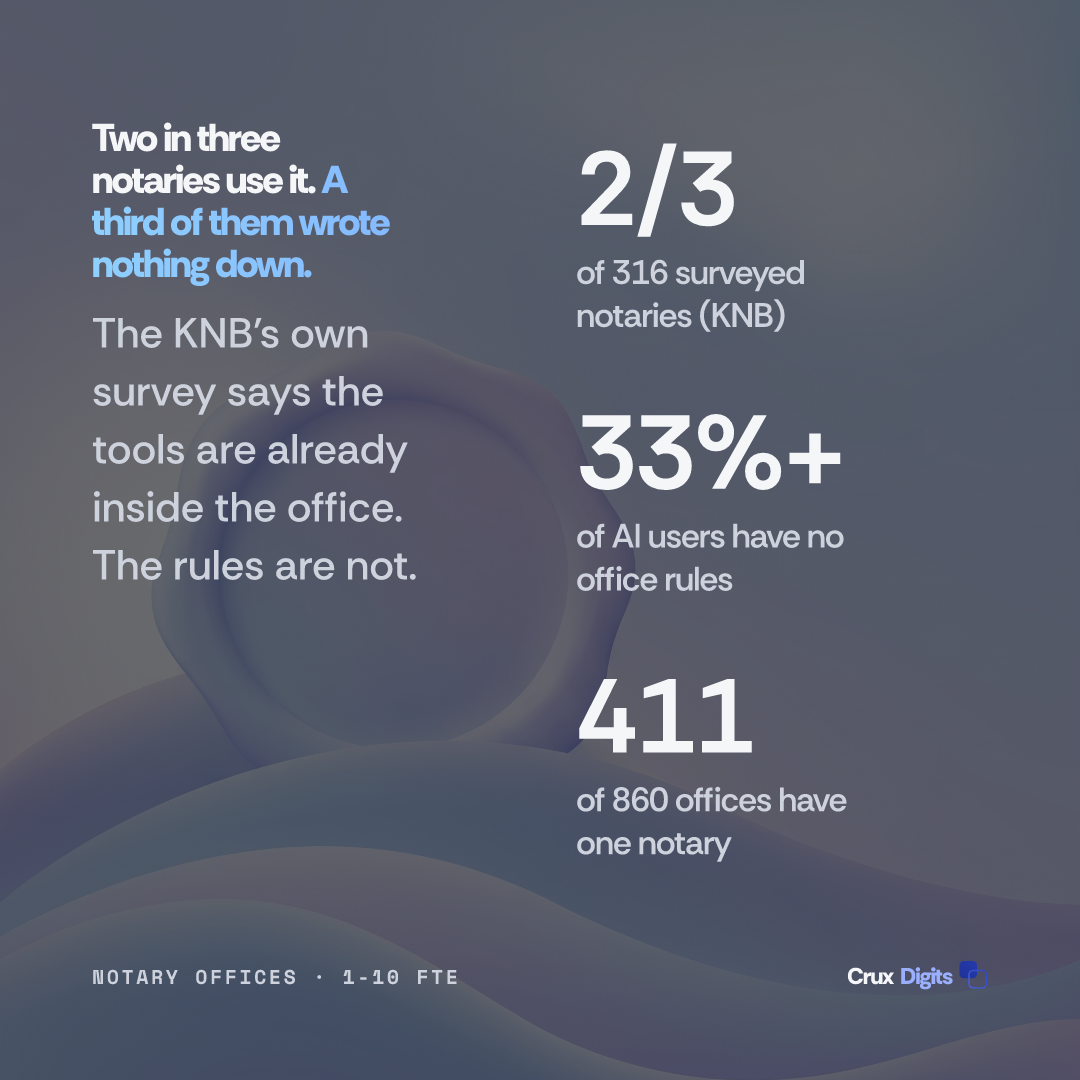
Two in three notaries in the KNB's own survey now use AI at work, and more than a third of those users say their office has no formal rules for it. That gap, not the technology, is the first thing worth fixing. After that, one test decides the rest: automate the work a register can check, and leave the work only a notary can judge. The deed itself sits firmly in the second group, and so does most of what the vendor blogs promise.
What does the KNB survey actually say about AI in notary offices?
On 16 July 2026 the KNB published an enquête among 316 (kandidaat-)notarissen and toegevoegd notarissen. Two in three respondents use AI in their work. Of those users, 82 percent reach for it several times a week. The named tools sit oddly next to each other: ChatGPT and Microsoft Copilot alongside legal-specific products such as Zeno Law, DonnaJames, Legora and GeniAL. Uses run from looking up wet- en regelgeving to summarising, and for a smaller share to risk and compliance checks.
Then the number that matters. More than 33 percent of AI users report that their office has no formal rules for AI at all. Hold that against the two-in-three adoption figure and at least one respondent in five is using AI inside a Wwft-supervised practice with no written rules for it. The survey does not cross-tabulate frequency against governance, so the share who are frequent users without rules cannot be derived from the published results; given that 82 percent of users are weekly users, it is unlikely to be small.
The tension is in the same dataset. The most-cited barrier to further digitalisation is security concerns, named by 177 respondents, ahead of wet- en regelgeving at 171 and lack of time and capacity at 155. Security is also what non-users name first, at about half of them, with uncertainty about how to start second. One word covers two problems: one group wants assurance before it begins, the other is already running and wants a rule to run under. Meanwhile 88 percent say they know where notarial data is stored and who can reach it, and 72 percent of that group still want more grip on it. A quarter are seriously worried about dependence on American technology.
That is not an adoption problem. It is a documentation problem. The tools are already in the building.
Why can a notary office not simply automate the akte?
Because the law has not moved. Since 1 January 2024 a BV can be incorporated by fully digital deed, and the first two were passed at eKo Notaris in Zwijndrecht and Aqte Notarissen in Bergen op Zoom. That is one aktesoort. In June 2026 the KNB launched five digital services for hybrid dienstverlening: online advice through a Dutch video platform, remote digital identification, digital notarial verification, remote signing of onderhandse stukken, and a digital dossier environment built to the Archiefwet. In the same announcement it said the missing piece is legislation enabling digital deeds, and called on the ministry of Justitie en Veiligheid to start that change. The WODC report Staat van het Notariaat deel II (2026) points the same direction.
So while the marketing describes AI writing your standaardakten, the leveringsakte and the hypotheekakte still require a passeren with the notary present. That matters less than it sounds, because the deed was never where the hours went. Model deeds have been half-generated inside the kantoorsysteem for years. What nobody has touched is everything that must be true before a passeerafspraak can even be set.
There is a harder reason too. Article 21 of the Wet op het notarisambt gives the notary a ministerieplicht, and in its second paragraph an obligation to refuse where the requested work is unlawful or clearly has an unlawful purpose. That refusal is the personal judgement of an officer of the state. There is no model for it, no register behind it and no evaluation set that says whether a machine got it right.
The register test: which notarial work is safe to automate?
Here is the rule we apply, and it replaces the usual advice to automate the repetitive tasks: automate work whose output can be checked against an authoritative register, and do not automate work whose output can only be checked against a notary's judgement.
Repetition is a bad guide in this sector. The Wwft cliëntenonderzoek is highly repetitive and is precisely the place where an unexamined machine decision becomes a supervisory conversation. What matters instead is whether an error is findable. A register gives you ground truth on every case, so you can measure the error rate continuously, in production, without reading every output. A judgement call has no ground truth, so the only quality control is a human reading everything, which removes exactly the saving you were buying.
The registers a Dutch notary office already queries, and which therefore give a checkable answer:
- Kadaster for the openbare registers, eigendom, hypothecaire inschrijvingen and erfdienstbaarheden. Registration itself runs through KIK, Ketenintegratie Inschrijving Kadaster, which is free to use and charges a tariff per registered deed. For automation purposes the point is that a KIK submission is machine-readable and the response is a definitive pass or fail.
- Handelsregister at the KvK for bestuurders, vertegenwoordigingsbevoegdheid and statutaire gegevens.
- The CDR, the Centraal Digitaal Repertorium, a KNB initiative running since 2014, through which every office files its deeds electronically instead of couriering paper originals to the Belastingdienst at its own cost. It also gave the KNB its first real view of how many deeds pass and in which fields.
- The BRP, the Curatele- en bewindregister, the Centraal Testamentenregister and the Centraal Insolventieregister.
Work that passes the test: pulling parties, kadastrale aanduiding and koopsom out of a koopovereenkomst and reconciling them against Kadaster and Handelsregister; matching a bank's hypotheekopdracht to the dossier; flagging a missing volmacht, absent huwelijkse voorwaarden or an expired identity document; drafting the concept nota van afrekening; noticing that a parcel has a voorlopige kadastrale grens. In each case the machine proposes and a register disposes.
Work that fails the test: the Wwft risk classification and the decision to file an ongebruikelijke transactie; judging whether a client is under pressure from a family member; wilsbekwaamheid; and the Article 21 refusal. Not because a model is bad at these, but because you cannot find out whether it is good at them.
What does this mean for a one-notary office?
Scale decides the answer here more than in most sectors. The KNB's January 2026 factsheet on leden en kantoren counts 860 notariskantoren, with separate vestigingen counted individually, of which 411 are eenmanskantoren with a single notary. Across 1,181 notarissen, 2,126 kandidaat-notarissen and 263 toegevoegd notarissen, that is roughly four members per office, before the klerken, notarieel medewerkers and secretaresses who do most of the dossier work and whom the factsheet does not count. Nearly half of all offices run on one notary. The average kantoor is a small business; the eenmanskantoor end of it is a micro-business, and that end is who this is written for.
So the sequencing that works at a 250-person firm does not apply. There is no governance board, no pilot committee and no data engineer. What a one- or two-notary office can realistically do in a fortnight:
- Write the rules down. One page: which tools are approved, what may never be pasted into a general tool, who decides on a new tool, and what has to be recorded. You are not starting from a blank sheet. The KNB already publishes the AI-weegschaal, an afwegingskader in three parts with scenarios and assessment questions, plus a short list of questions to put to any vendor, and an online AI-basistraining for the notariaat opens on 12 October 2026. This is the highest-value hour on the list, because it closes the gap the survey itself found.
- Pick one register-checkable task and only one. Dossier intake reconciled against Kadaster and KvK is the usual winner.
- Measure it against the register for four weeks before trusting it. Because the answer is checkable, this costs attention rather than money.
- Leave the deed, the Wwft judgement and the client conversation alone.
A calculation, with the assumptions written out so you can replace them with your own. Say an office passes 40 deeds a month and the intake check per dossier, retrieving and reconciling the koopovereenkomst, the Kadaster extract, the KvK extract and the identity documents, takes 35 minutes of a medewerker's time. That is roughly 23 hours a month. If a well-scoped intake assistant removes half of the retrieve-and-reconcile work while a person still confirms every field against the register, the office frees around 12 hours a month. That is not a transformation. It is about a day and a half that currently goes into copying numbers between screens, and for an office of that size that is an honest number to plan against. Ours is a worked example, not a benchmark: run it on your own deed count and your own minutes before you believe it.
How does the AI Act apply to a notariskantoor in 2026?
Article 4, the AI literacy duty, has applied since 2 February 2025 to any organisation deploying AI, a notary office included. The Digital Omnibus softened the wording so that providers and deployers must support the development of AI literacy among staff rather than guarantee a level, and supervision of the literacy rules has sat with the national market surveillance authorities since 2 August 2026. The high-risk obligations moved out to 2 December 2027 for Annex III systems and 2 August 2028 for Annex I. The practical obligation this year is therefore modest and specific: know what you are using, train the people using it, write it down. Our AI Act checklist for Dutch SMEs walks through the same duties for a small firm.
The transparency rules in Article 50 have applied since 2 August 2026 and bear on generated content. The profession's own magazine was ahead of that. The May 2026 cover interview with Lex van der Code, a fictional digitaris, carries the credit Tekst: Mistral-Le Chat/Heleen Boex on the page itself. A beroepsorganisatie labelling its AI-generated content before the article bites is a better standard than most of the sector's marketing manages. We have written separately about what Article 50 labelling means in a working stack.
Where should a notary office ignore the general AI advice?
Two places where the standard guidance misleads a notariskantoor.
First, put your knowledge base into a retrieval system and ask it questions. Most notarial knowledge is not in your own documents. It sits in the KNB modellen and in wet- en regelgeving that changes underneath you. A retrieval system pointed at your own protocol will answer confidently from last year's model. If you build retrieval, point it at the dossier, not at the law.
Second, start with a client-facing chatbot. In a profession where the first conversation is where pressure on a client gets noticed, moving intake behind a bot removes the observation the institution exists to make. Use remote identification and a digital dossier environment, both of which the KNB now offers on Dutch infrastructure, and keep the conversation. The same logic decided what we recommended for accountancy firms and for insurance advice offices: automate the file, protect the meeting.
What to do this month
Write the one-page AI rules, name one register-checkable task, and measure it for four weeks. If it helps to have someone go through the dossier with you rather than sell you a tool, that is the conversation we have with Dutch SMEs every week, and it sits behind our wider work on AI in legal practice. Last updated: 14 September 2026.