Article 50 of the EU AI Act has applied since 2 August 2026. It splits the work in two: the provider of the generative system owes machine-readable marking, and you, the deployer, owe a label a human can see. The Commission is explicit that the second duty is not satisfied by the first. That separation is the whole engineering problem, because the machine-readable layer rarely survives your own publishing chain.
What does Article 50 require, and of whom?
Read Article 50 as two stacked obligations on two different parties. Providers of generative systems must make sure outputs are marked in a machine-readable format and detectable as artificially generated, and must tell people when they are talking to an AI system. Deployers must disclose deepfakes, must inform people exposed to emotion recognition or biometric categorisation, and must label AI-generated text published to inform the public on matters of public interest.
The dates matter more than most summaries admit. Article 50 applied from 2 August 2026. A grace period exists, but it is narrow: per the Commission's own Article 50 FAQ, it covers only AI systems placed on the market before 2 August 2026, only the marking and detection duty in Article 50(2), and only providers, who must comply from 2 December 2026. Deployer duties got no grace period at all. Content generated before 2 August 2026 does not have to be labelled retroactively, though the Commission encourages it where feasible.
The same FAQ carries the sentence that should govern your architecture. Writing about deepfake disclosure, the Commission states that deployers cannot simply rely on the machine-readable marking embedded in the content by the provider to fulfil their own disclosure obligation. Disclosure has to be perceivable without special tools. A manifest inside a JPEG is not that.
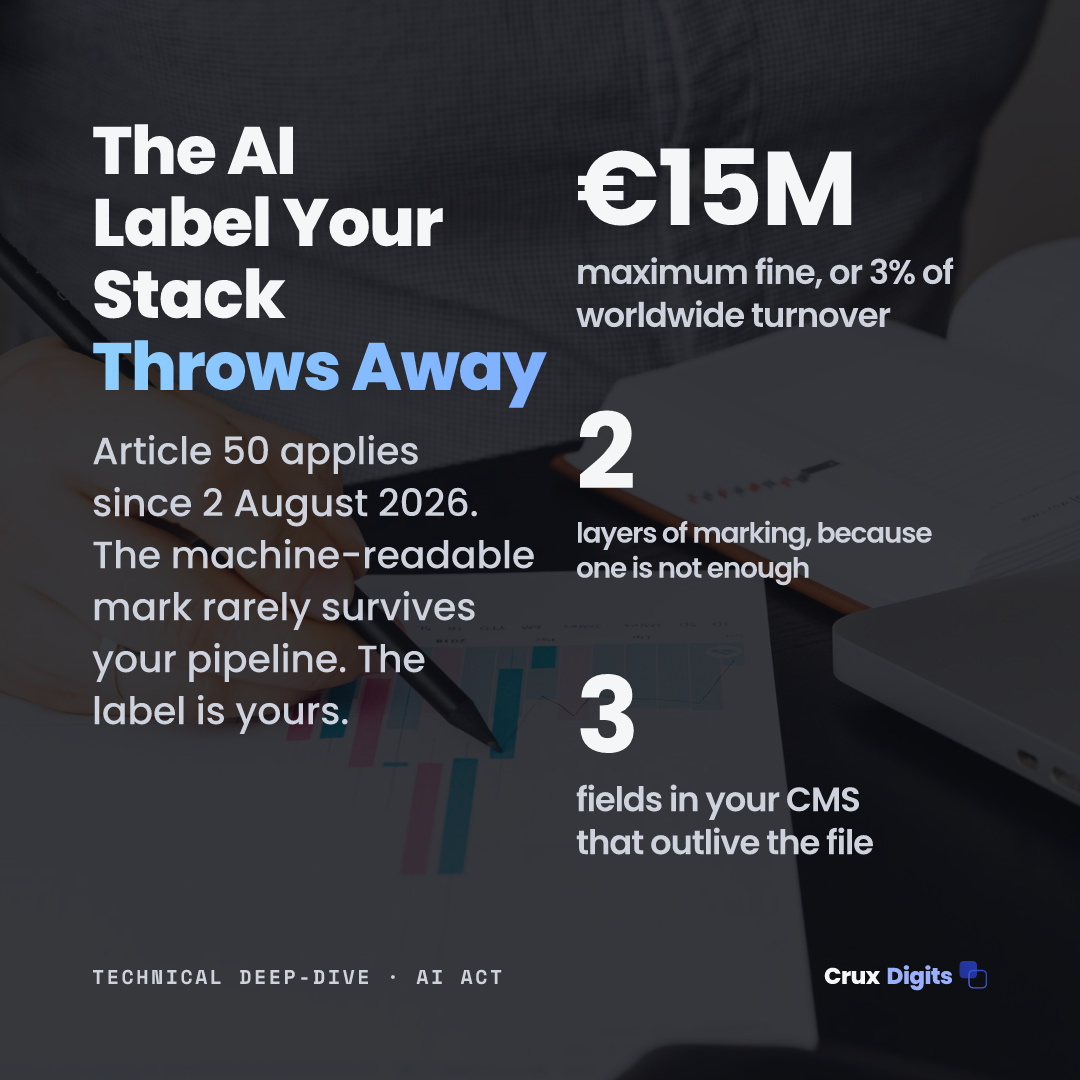
Enforcement sits mainly with national market surveillance authorities, and fines can reach EUR 15 million or 3% of worldwide annual turnover, with proportionality available for SMEs and small mid-caps. Note that number. The EUR 7.5 million and 1% tier that circulates in some write-ups is Article 99(5), the penalty for supplying incorrect information to an authority, not for breaching Article 50. Note the other half of Article 99 as well: for an undertaking the fine is whichever of the two figures is higher, but Article 99(6) makes it whichever is lower for an SME. For a firm of thirty people the operative number is 3% of turnover, not EUR 15 million.
Why does machine-readable marking not survive your publishing chain?
The dominant marking technique is C2PA Content Credentials: a signed manifest carried with the asset, bound to the bytes by a cryptographic hash. That hard binding is the strength and the weakness. Change the bytes with any tool that does not understand the standard and the binding no longer holds. Your CMS resizing a hero image to WebP does that. So does a PDF export, a screenshot, a paste into a deck, and most social upload pipelines, which re-encode on the way in.
This is not a critic's complaint. It is the reason the standard's own ecosystem built a second layer. The Content Authenticity Initiative documents Durable Content Credentials precisely because, in its words, platforms that host media assets might remove C2PA manifest data. The workaround is soft bindings: invisible watermarks actively inserted into the content, and content fingerprints passively computed from it, either of which can be used to find a copy of the manifest again in a database after the file itself has lost it.
The Code of Practice on Transparency of AI-generated Content reaches the same conclusion from the regulatory side. It recognises that under the current state of the art no single marking technique meets the Act's demands of effectiveness, interoperability, robustness and reliability at once, and therefore asks signatories to use at least two layers of machine-readable marking where necessary, combining metadata, watermarks or other measures.
There is also a trust layer that quietly moved. The C2PA Conformance Program and the official C2PA Trust List launched in mid-2025, and the Interim Trust List was frozen on 1 January 2026: no new entries, no updates. Content signed while an interim certificate was valid stays valid against the legacy trust model, but nothing new joins. If your imaging or generation tooling still signs against an interim certificate tied to the 1.x specification series, verifiers will increasingly present it as legacy rather than as current provenance.
The architectural conclusion is unglamorous and firm. Treat the embedded manifest as best effort in transit. Never treat it as your record of what happened.
What does the Code of Practice actually change for a deployer?
The final Code was published on 10 June 2026, and the Commission and the AI Board have confirmed it is an adequate voluntary tool for demonstrating compliance. By the end of July 2026 roughly 190 companies and organisations had signed. It has two sections: one for providers on marking and detection, one for deployers on labelling deepfakes and public-interest text.
Signing is not compliance. The obligation is in the regulation either way. What signing buys is evidentiary standing that travels across member states, so you are not arguing the adequacy of your own bespoke approach with each market surveillance authority separately. Firms that comply by other means may simply face more requests for information, because there is less transparency about how they do it.
For a company of 20 to 50 people with an in-house marketing or communications function, the deployer section is the part worth reading. It is short, it is written for people who publish rather than for people who build models, and it points at the published EU icons for labelling AI-generated content, which spares you an internal debate about wording.
When does an SME accidentally become a provider?

Most Dutch SMEs are deployers and stay deployers. You cross into provider territory when you place a system on the market or put it into service under your own name or trademark, or when you substantially modify one. In practice there are three common routes: white-labelling a chatbot for your customers, shipping an AI assistant inside your own product, and fine-tuning a model and offering the result as a service under your brand.
If you cross that line, Article 50(1) and 50(2) become yours. Your chatbot has to announce itself at the first interaction, unless that is obvious anyway, and your generated outputs need machine-readable marking. This is also the only realistic way the 2 December 2026 date becomes an SME deadline rather than a vendor's problem: it applies to providers of systems already on the market before 2 August 2026.
It is worth being blunt about the trade. Reselling an AI assistant under your own brand looks like a margin decision. It is also a regulatory one, and the marking obligation is not something you can subcontract back to the model vendor by contract alone.
How do you build labelling into the publishing chain?
Here is the pattern we would implement, in the order we would implement it. It assumes an ordinary stack: a generation tool, a CMS, and a set of channels.
1. Record provenance in your system, not in the file
At generation time, write the facts to the content record: which model and version produced it, whether a human reviewed the substance, who that was, and when. Four facts, three fields on a CMS entry once the reviewer and the date share one. The file will lose its manifest somewhere between your image pipeline and a reader's browser. Your database will not.
2. Make the label a template decision
If the record says generated and not reviewed, the template renders the disclosure. Do not leave it to an editor to remember on a Friday afternoon. A rule that lives in a template survives staff turnover; a rule that lives in a habit does not.
3. Decide the public-interest test once, in writing
The Commission guidelines list the domains: politics and democratic processes, public administration and services, justice and law enforcement, fundamental rights, public security, public health, environmental protection, consumer safety, and economic, financial, political, scientific or cultural developments that may be a relevant subject of public debate. Your product page is not that. Your explainer on new subsidy rules or on a health claim probably is. Write the boundary down once and apply it, rather than relitigating it per article.
4. Write down what counts as human review
The exemption for reviewed text is real and it is the least expensive route to compliance for most published copy. But the bar is substantive. A spell check is not review. The guidance describes deliberate examination of the substance by someone with relevant knowledge and professional judgement, with a named person holding editorial responsibility. Name that person in your process document.
5. Stop stripping metadata by default
Most image pipelines discard metadata as a size optimisation. Change the default so manifests are carried where the tooling supports it, and accept the loss where it does not. Then verify the way a reader would: download your own published image from the live page and check whether the credential is still attached. Checking the export you uploaded proves nothing.
Who enforces this in the Netherlands?
National supervision is still being organised. The draft Dutch implementing act designates the Rijksinspectie Digitale Infrastructuur and the Autoriteit Persoonsgegevens as coordinating supervisors, working alongside sectoral inspectorates including the Inspectie Leefomgeving en Transport, the Inspectie Gezondheidszorg en Jeugd, the NVWA and the Nederlandse Arbeidsinspectie. Under that draft the RDI becomes the single point of contact for business and facilitates the regulatory sandboxes, which are aimed particularly at the mkb.
The Dutch implementing act went to public consultation on 20 April 2026. That timing is a common source of confusion: the AI Act is a regulation, so it applies directly regardless of when the national implementing act arrives. The absence of a Dutch law is not a waiting room.
A realistic expectation for a 30-person firm in Utrecht: nobody is auditing your LinkedIn feed this quarter. The first enforcement will land on larger systems and on platforms, and it will set what clear and distinguishable means in practice. What you want by then is not a perfect provenance chain. It is a defensible record of which content was generated, which was reviewed, and by whom, and a template that renders a label when the record says it should.
If you want a broader compliance picture first, our AI Act guidance for SMEs covers the wider obligations, and the AI Act checklist is a faster starting point than the regulation. If AI already writes a meaningful share of your published copy, the same three fields also belong in your AI marketing workflow, and the privacy questions that usually arrive with them are covered in our post on AI and the GDPR. The rules you write down here belong in the same document as your AI policy.
A consultant tells you where AI pays off; Crux Digits also builds it. A fixed price per step, one named expert, from Utrecht.
AI consultancy in the Netherlands →