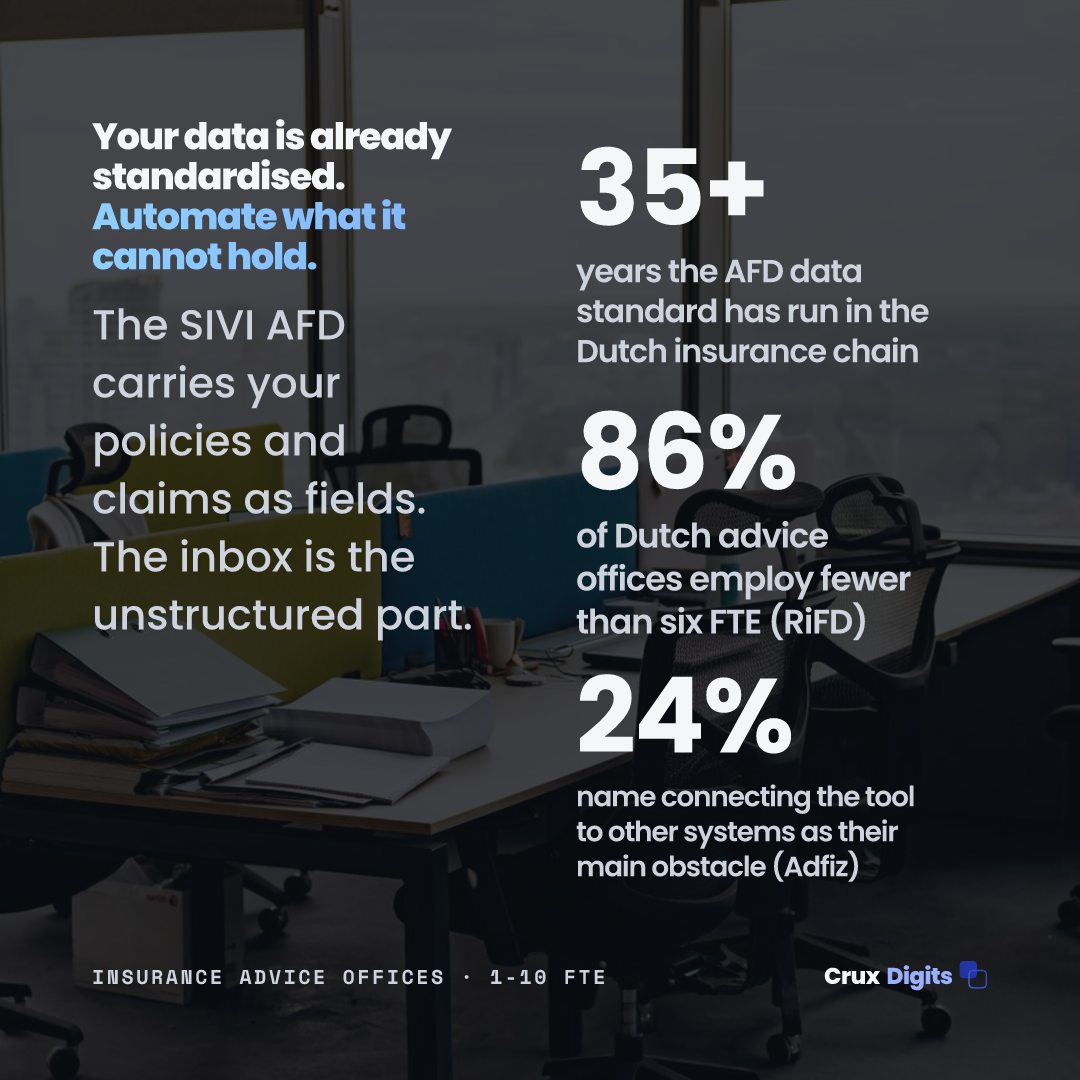
Most Dutch insurance advice offices do not have a data problem. They have had a machine-readable industry data standard since the late 1980s: the SIVI All Finance Datacatalogus, which carries policies, mutations and claims between adviser, insurer and gevolmachtigd agent. That changes what AI is worth buying. The useful work is not extracting data. It is classifying the free text the AFD was never built to hold.
Why does an assurantiekantoor already have structured data?
The AFD (All Finance Datacatalogus) grew out of ADN message traffic at the end of the 1980s and is now more than 35 years old. It describes entities such as a verzekeringnemer, a dekking or a claim, each with attributes, formats and controlled code lists. The current AFD 1.0 release is dated 1 September 2026 and the AFD 2.0 release 1 August 2026, so this is not a legacy artefact anyone is quietly abandoning. It is actively maintained, monthly, on request from the chain.
AFD 1.0 is the XML and EDIFACT generation from the mid-1990s. AFD 2.0, introduced with SIVI AFS in 2020, cuts the model back to roughly thirty entities such as coverage, object, party and document, each subdivided into entityTypes, and moves to JSON. The types insuredPerson and regularDriver, for instance, both sit under the party entity. SIVI also publishes AFDshort, an intermediate form that keeps AFD 2.0 structure and JSON but uses AFD 1.0 label names, so a system built around flat labels like PP_NUMMER or OB_MERK can move to modern transport before it changes its semantics.
For a four-person office running ANVA, CCS or Faster Forward, none of that is a project you undertake. Your software supplier deals with it. What matters is the consequence: the policy number, the birth date, the vehicle make, the branchecode and the premium already arrive as fields. Nobody needs a large language model to read them.
Where is the real unstructured work in an advice office?
It is in three places, and none of them is the polisadministratie. First, the inbox: a client emails that she has moved, sold the caravan and wants to know whether the new boiler is covered, all in one message, and someone has to open it, decide which dossier it belongs to and what has to happen. Second, the schademelding, where the human describes what happened in ordinary Dutch and someone else has to turn that into a claim record. Third, the polisvoorwaarden themselves: dozens of PDFs per insurer, revised yearly, that an adviser reads to answer one question about one clause.
This is exactly where the Adfiz Nieuwjaarspeiling lands. AI use among advice offices rose from 43 to 69 percent in a single year, with larger offices at 84 percent against 63 percent for smaller ones. The three biggest digitalisation obstacles the members named were finding the right application for AI (36 percent), selecting the most suitable tool (30 percent) and connecting that tool to other systems (24 percent). Adfiz released those figures from its Nieuwjaarspeiling ahead of Advies in Cijfers 2026-2027.
That third obstacle has a published answer that almost nobody writing about AI for advisers mentions. SIVI ships AFD mappings and a mapping API: AFD 2.0 to AFDshort, AFD 2.0 to AFD 1.0, AFD 1.0 to AFD 2.0, and HDN to AFD 2.0, with VNAB in development. If your integration question is "how do I get this tool to speak the same language as the rest of the chain", the answer is a standard, not a bespoke build. Our note on what an API koppeling actually involves walks through the same reasoning for other sectors.
Which AI tasks does the AFD codelist already define for you?
This is the part worth stealing. The AFD publishes controlled code lists: AFD Schadeclassificatie (release 46E), AFD Documentsoort (45C), ADN Branchecode (46I), plus lists for things like fuel type and body style. A code list is a closed set of allowed answers. That means "read this claim description and pick the right schadeclassificatie" is a bounded classification task with a published answer key, not an open-ended generation task.
The practical consequence for a small office is that you can measure it. Take three hundred historical claims where a human already assigned the code, run the classifier over them, and count how often it agrees. You now have an accuracy number you can defend to an insurer or an auditor. Compare that with "the AI drafts our advice reports", where nobody can tell you what correct looks like. Bounded tasks with published code lists are the ones a four-person office should automate first, because they are the ones a four-person office can verify.
SIVI is also unusually honest about where its own standard is ambiguous. Under a programme it calls Eenduidiger AFD it publishes the known problems: the code list for carrosserie has overlapping meanings for Autobusje, Bestelauto and Bestelauto/VAN, and there is documented drift between the attributes verzekerde som and verzekerde loonsom. Read that backlog as a map of where not to automate. Where the standard itself cannot decide, a model will produce a confident answer and you will have no way to tell it is wrong. See our work on insurance operations for how we scope that boundary.
What does the arithmetic look like for a four-person office?
Assumptions first, because they are yours to change, and because none of these numbers came from a client engagement. The Dutch market is micro offices, one to ten FTE. RiFD counted 6,870 advice firms with an AFM registration at the end of 2025, more than 1,400 of them under a collective licence, and more than 90 percent active in only one or two municipalities. Adfiz Advies in Cijfers 2025-2026 puts 86 percent of offices under six FTE, with close to 60 percent at nought to one FTE, both figures attributed to RiFD.
So take an office of four. Say sixty inbound emails a day need a dossier and a next action, and that opening, reading, classifying and filing each one costs ninety seconds of someone's attention. That is ninety minutes a day, seven and a half hours a week, roughly 360 hours a year over 48 working weeks. At a loaded internal cost of 55 euros an hour, routing the inbox costs about 19,800 euros a year before anyone has given any advice.
If a classifier files seventy percent cleanly and flags the rest for a human, the recoverable share is roughly 250 hours, or near 14,000 euros a year. The model calls behind that are tens of euros a month at 2026 prices, not thousands. What decides the case is the build and the running of it, not the tokens. Put your own figure in from our page on what an AI project costs, and be suspicious of any proposal whose integration phase is longer than the payback period.
What do the AFM and the AI Act actually require of you?
The AFM said in its Agenda 2026, published on 19 January 2026, that it is building broader AI supervision. Its wording is a specification in disguise, so it is worth quoting exactly: the AFM "asks institutions to map their AI applications, strengthen model risk management and data quality, record decision-making logic, and actively report incidents". For an office of four that is not a compliance department. It is a one-page register: which tool, on which process, who checks the output, what happens when it is wrong. Our guide to writing an AI policy covers the same ground.
On the AI Act, be precise about what applies to you. Annex III classifies AI used for risk assessment and pricing of natural persons in life and health insurance as high risk. That is underwriting and pricing. An adviser classifying incoming email or summarising a dossier is not doing that. The Article 4 AI literacy duty does apply to you, and the transparency duty means a chatbot on your site must tell visitors they are talking to a machine. The Digital Omnibus would move several high-risk obligations later, but those dates only apply if it is formally adopted, so plan against current law. Our AI Act checklist for SMEs sets out the sequence.
On personal data, the sector has already built its own answer. Adfiz published version 1.2 of its Handboek AI in de praktijk on 15 July 2026, prompted by the launch of the Adfiz Pseudonimisator, a tool that replaces names, BSNs, IBANs, addresses and contact details with coded fields and does the processing entirely locally. The same version gives prompt injection its own section, which is the right instinct: an agent with access to your mailbox will eventually be sent an email containing instructions meant for it rather than for you.
Where do you start on Monday?
In order. Ask your polisadministratie supplier which AFD release you are on and whether their roadmap is AFD 2.0 or AFDshort, because that determines what any integration has to speak. Pick one bounded task with a published code list, most likely schadeclassificatie or documentsoort, and score a model against three hundred historical records before you buy anything. Write the one-page register the AFM is asking for. Pseudonymise before anything leaves the building. And leave advice generation alone until the boring classification work is measurably right, because that is the part where being confidently wrong costs you a Kifid file rather than an afternoon.
The AI audit & strategy: in one to two weeks, a ranked list of use cases with a return per opportunity, and a plan you own.
AI audit & strategy →