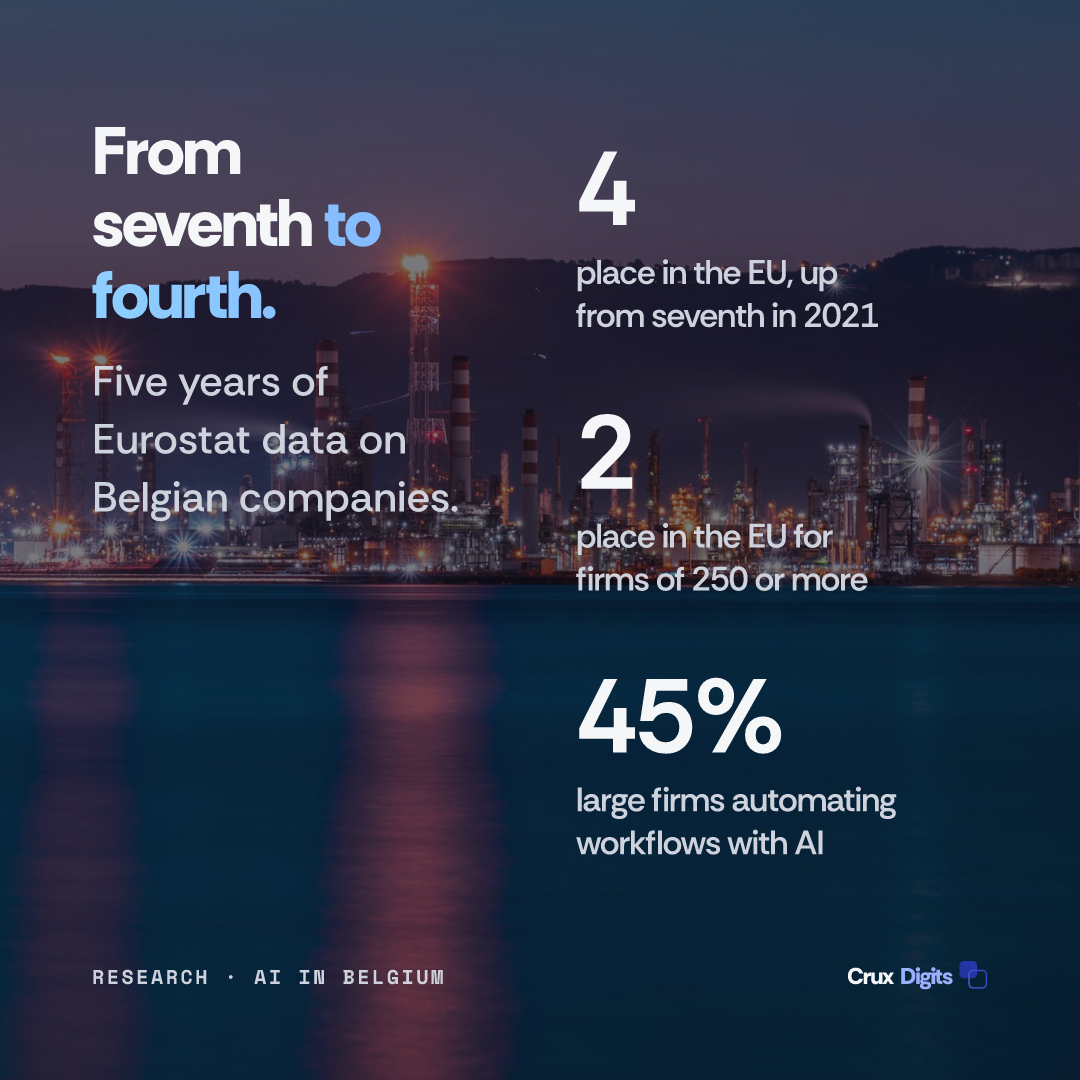
In 2025, 34.5% of Belgian companies with ten or more staff used at least one AI technology, against 10.3% in 2021. That took Belgium from seventh to fourth place in the EU, past the Netherlands. Among companies with 250 or more staff the figure is 76.4%, second in the EU behind Finland. Of the six leading countries, only Sweden gained more points over those four years.
We pulled the full Eurostat survey series for Belgium, the Netherlands and the EU, four survey years and 63 indicators, and worked out the changes, ranks and gaps ourselves. This is written for the IT manager, CIO or security officer at a Belgian organisation of 250 to 5,000 people, and for anyone who assumed Belgium follows its northern neighbour on technology. On AI, the data says the opposite.
How was this study built?
The source is Eurostat's annual survey on ICT use in enterprises, tables isoc_eb_ai (by size) and isoc_eb_ain2 (by sector), last updated on 15 June 2026. Statbel collects the Belgian part. We pulled the data on 5 October 2026.
- Years: 2021, 2023, 2024 and 2025. The AI questions were not asked in 2022.
- Who is counted: companies with ten or more persons employed, in manufacturing, energy, construction, trade, transport, hospitality, ICT, real estate, professional and administrative services. Finance, healthcare, education and government are not in the survey.
- What is counted: a company uses AI if it uses at least one of seven technologies. One licence counts the same as a rebuilt process.
- Our own work: the changes in percentage points, the EU ranks across 27 member states, and the comparison with the Netherlands.
- What is missing: the figures are national. The survey gives no split between Flanders, Wallonia and Brussels, and several Belgian sub-sector cells are not published. We say so where it matters.
How fast did AI use grow in Belgian companies?
From 10.3% in 2021 to 13.8% in 2023, 24.7% in 2024 and 34.5% in 2025. The EU average in 2025 was 19.9%. Only Denmark (42.0%), Finland (37.8%) and Sweden (35.0%) are ahead.
By size the Belgian numbers are stronger still:
- 10 to 49 staff: 8.0% in 2021, 28.8% in 2025. Level with the Netherlands.
- 50 to 249 staff: 16.9% in 2021, 54.5% in 2025. Second in the EU, behind Denmark.
- 250 or more staff: 41.4% in 2021, 76.4% in 2025. Second in the EU, behind Finland at 79.4%.
More than half of Belgian mid-sized companies now use AI. In the Netherlands that is 46.6%, and in the EU as a whole 30.4%.
Where did Belgium overtake the Netherlands?
In the larger companies, and decisively. In 2021 Dutch mid-sized firms were 4.5 points ahead of Belgian ones. In 2025 Belgian mid-sized firms were 7.9 points ahead. Among firms of 250 or more the two countries started level, at 41.4% and 40.6%. Four years later Belgium led by 8.8 points.
The more telling difference is in what the AI does. Among Belgian firms of 250 or more:
- Automating workflows or assisting decisions: 22.6% in 2021, 45.0% in 2025. The Netherlands: 25.1% and 30.6%.
- Machine learning for data analysis: 25.1% in 2021, 42.9% in 2025. The Netherlands: 32.3% in 2025.
- Image recognition: 16.5% in 2021, 31.3% in 2025. The Netherlands: 18.1%.
- Machines that move on autonomous decisions: 13.0% in 2021, 18.1% in 2025. The Netherlands: 12.5%.
Language AI grew in both countries. In Belgium the operational kinds grew with it. Large Belgian firms doubled their use of AI in workflows while the same line in the Netherlands stayed flat for three years. We set out the Dutch side in the companion study on the Netherlands.
Which Belgian sectors lead?
Share of companies with ten or more staff using AI in 2025, with the EU average for the same sector:
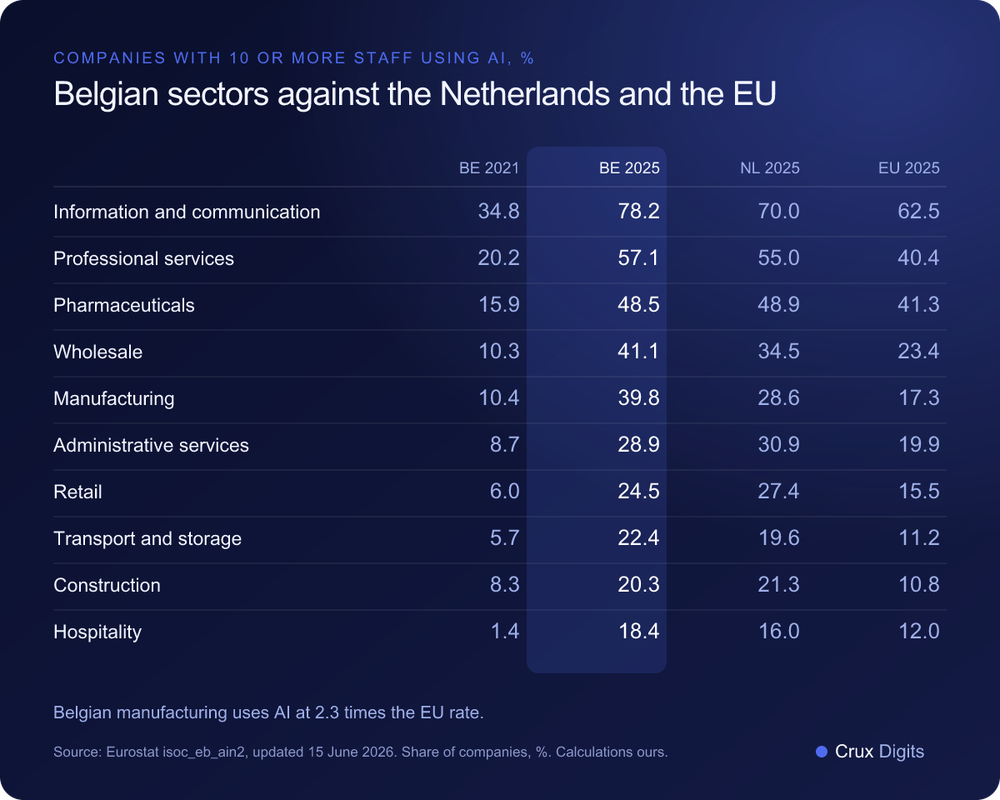
- Information and communication: 78.2% (EU 62.5%).
- Professional, scientific and technical services: 57.1% (EU 40.4%).
- Pharmaceuticals: 48.5% (EU 41.3%).
- Wholesale: 41.1% (EU 23.4%).
- Manufacturing as a whole: 39.8% (EU 17.3%).
- Administrative and support services: 28.9% (EU 19.9%).
- Retail: 24.5% (EU 15.5%).
- Transport and storage: 22.4% (EU 11.2%).
- Construction: 20.3% (EU 10.8%).
- Hospitality: 18.4% (EU 12.0%).
Manufacturing is the figure to remember. Belgian manufacturers use AI at 2.3 times the EU rate and 11 points above Dutch manufacturers (28.6%). In 2021 Belgian manufacturing stood at 10.4%. For a country whose industry is concentrated in chemicals, pharma, food and metal, that is the centre of the economy moving, not the edge.
One caution. Transport and storage reached 23.0% in 2024 and stood at 22.4% in 2025, so that sector stopped growing. And for several Belgian sub-sectors, including food, chemicals and machinery, the 2025 cells are not published, so we cannot say which branches of manufacturing carry the 39.8%.
What do Belgian companies use AI for?
Among firms of 250 or more in 2025, with the Netherlands and the EU for comparison:
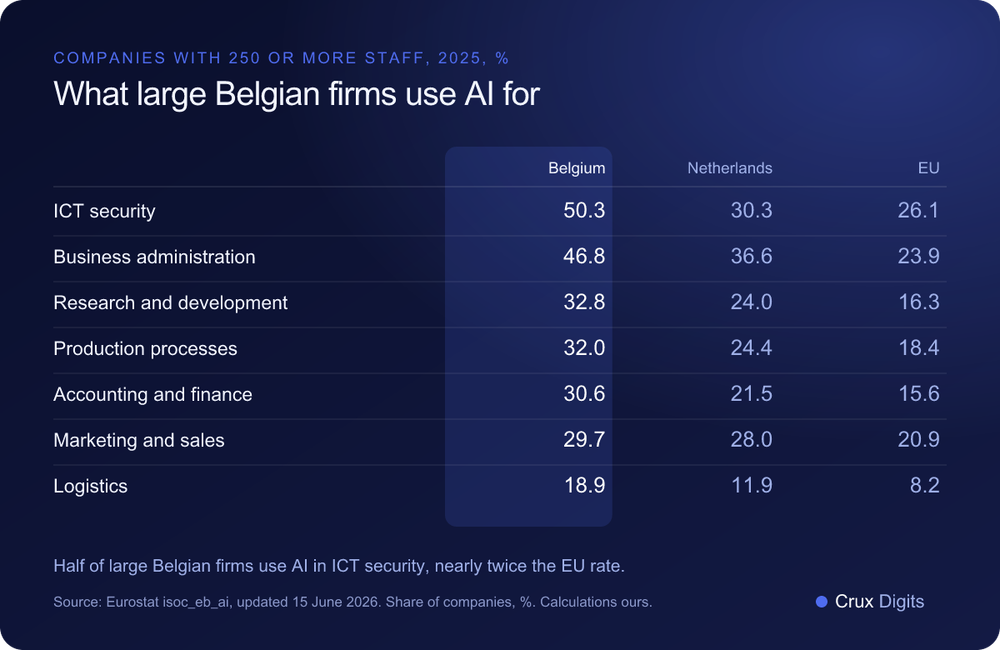
- ICT security: 50.3% (Netherlands 30.3%, EU 26.1%).
- Business administration and management: 46.8% (Netherlands 36.6%, EU 23.9%).
- Research, development and innovation: 32.8% (Netherlands 24.0%, EU 16.3%).
- Production processes: 32.0% (Netherlands 24.4%, EU 18.4%).
- Accounting, controlling and finance: 30.6% (Netherlands 21.5%, EU 15.6%).
- Marketing and sales: 29.7% (Netherlands 28.0%, EU 20.9%).
- Logistics: 18.9% (Netherlands 11.9%, EU 8.2%).
Half of large Belgian firms use AI in ICT security, nearly twice the EU rate. That lines up with a country that has pushed its own cybersecurity framework hard, a link we explored in NIS2, CyFun and your AI supplier. Finance is the other Belgian speciality: across all company sizes, 10.8% use AI for accounting and finance, against 4.6% in the EU.
Marketing is the one purpose where Belgium is not clearly ahead. Belgian adoption leans towards the back office and the plant.
Do Belgian companies build AI or buy it?
Both, and more of each than the Dutch. Among large Belgian firms that use AI in 2025:
- 81.0% use ready-made commercial software (Netherlands 72.2%).
- 54.6% had AI developed or modified by an external provider (Netherlands 44.7%).
- 47.7% modified commercial software with their own staff (Netherlands 42.9%).
- 39.0% had AI developed by their own employees (Netherlands 30.8%).
The share working with an external provider barely changed in Belgium since 2021, from 56.7% to 54.6%, while it fell by almost ten points in the Netherlands. Belgian large firms kept building and adapting while they also bought. That is the most likely reason the operational indicators moved.
What holds back the Belgian companies that do not use AI?
Here the Belgian picture is less comfortable. Of large Belgian firms, 8.7% considered AI and do not use it. Their reasons in 2025:
- Lack of relevant expertise: 82.2% (66.3% in 2021).
- Difficulties with the availability or quality of data: 60.1%.
- Concerns about data protection and privacy: 57.3% (29.6% in 2021).
- Incompatibility with existing equipment, software or systems: 54.0%.
- Lack of clarity about legal consequences: 52.7% (28.9% in 2021).
- Costs seem too high: 51.3%.
Compare cost with the Netherlands, where 24.9% of the same group name it. In Belgium it is twice that. And across all company sizes, unclear legal consequences is named by 57.9% of Belgian firms that stayed out, up from 29.4% in 2021 and well above the Dutch 37.9%.
So Belgium has both the faster adopters and the more firmly stuck remainder. The firms that moved, moved far. The ones that did not are stopped by expertise, data, cost and law at once.
What does this mean if you run IT at a Belgian organisation?
- If you are among the adopters, your peers are no longer a reason to go slowly. With three in four large firms using AI and nearly half automating workflows with it, the question from your board will be about depth, not about whether.
- If you are not, the survey says you are probably facing four barriers at the same time. Take them in order: expertise first, because it decides how expensive the other three are. Data quality second, per process, not for the whole company.
- Take the legal question seriously and make it small. Lack of legal clarity nearly doubled as a reason in four years. It is answerable per use case, with a classification under the AI Act and a check with your DPO. The dates that apply are in the AI Act in 2026 for Flemish companies.
Crux Digits builds AI into existing processes for organisations in the Netherlands and Flanders, as the AI partner next to the organisation's ICT partner or internal IT team. This study is not a pitch. If your company is in the 76.4%, you may need nobody. If a specific process is where you are stuck, that is the work we do in Belgium.
What are the limits of this data?
- It is a survey of what companies say they use, not a measurement of how much or how well.
- Finance, healthcare, education and government are outside the survey.
- The figures are national. Nothing here separates Flanders from Wallonia or Brussels.
- Several Belgian sector cells for 2025 are not published, and one that is, electricity and gas supply at 90.5%, rests on so few companies that we left it out of the comparison.
- Use is binary. One pilot and a company-wide system count the same.
The short version
- 34.5% of Belgian companies with ten or more staff used AI in 2025, against 10.3% in 2021. Belgium went from seventh to fourth in the EU.
- Large firms: 76.4%, second in the EU. Mid-sized firms: 54.5%, also second.
- Belgium overtook the Netherlands in every size band above 50 staff, and in operational AI most of all: 45.0% of large firms automate workflows with AI, against 30.6% in the Netherlands.
- Manufacturing stands at 39.8%, 2.3 times the EU rate. Half of large firms use AI for ICT security.
- Among firms that stayed out, cost is named twice as often as in the Netherlands, and legal uncertainty nearly doubled since 2021.
A consultant tells you where AI pays off; Crux Digits also builds it. A fixed price per step, one named expert, and the Belgian rules and funding built in.
AI consultant in Belgium →