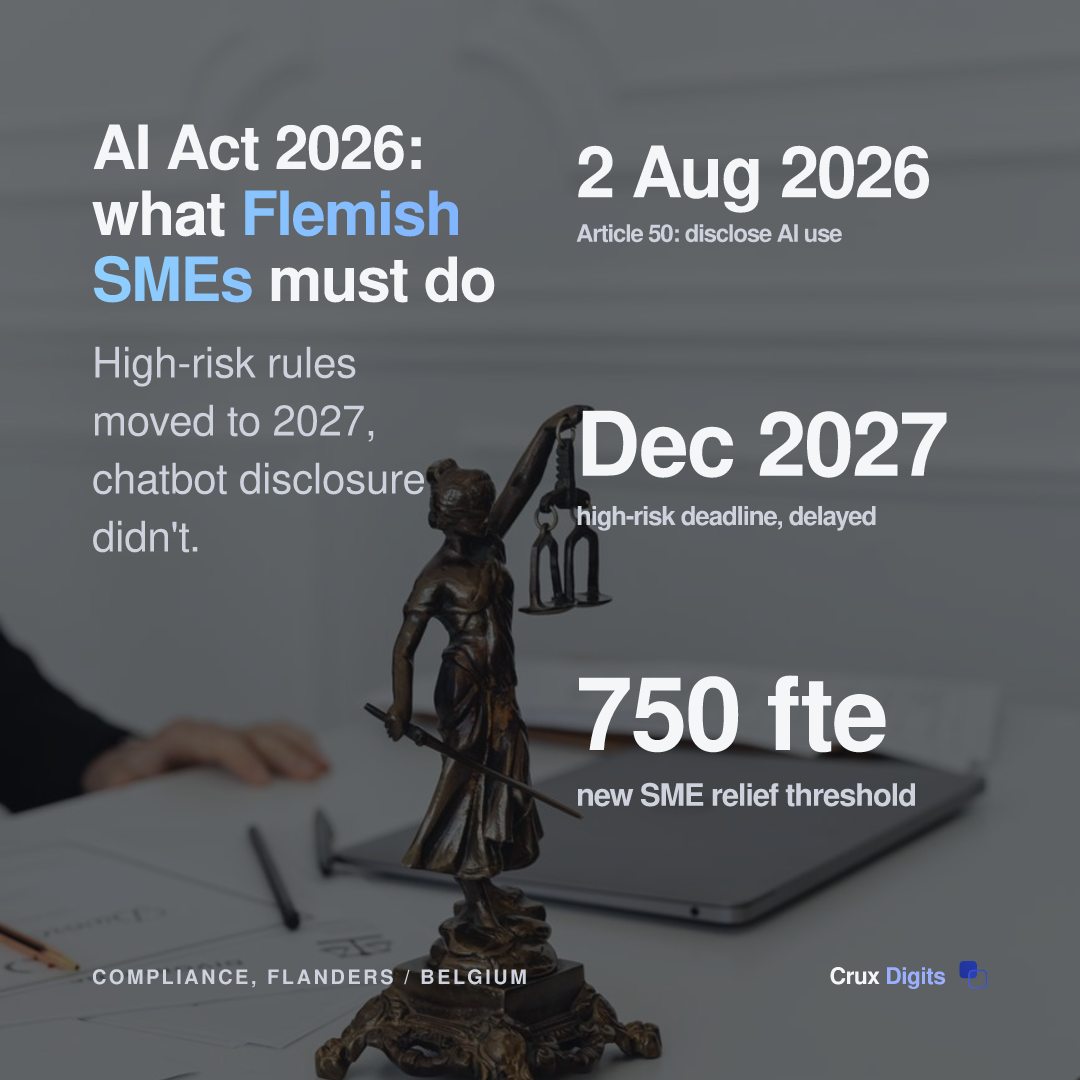
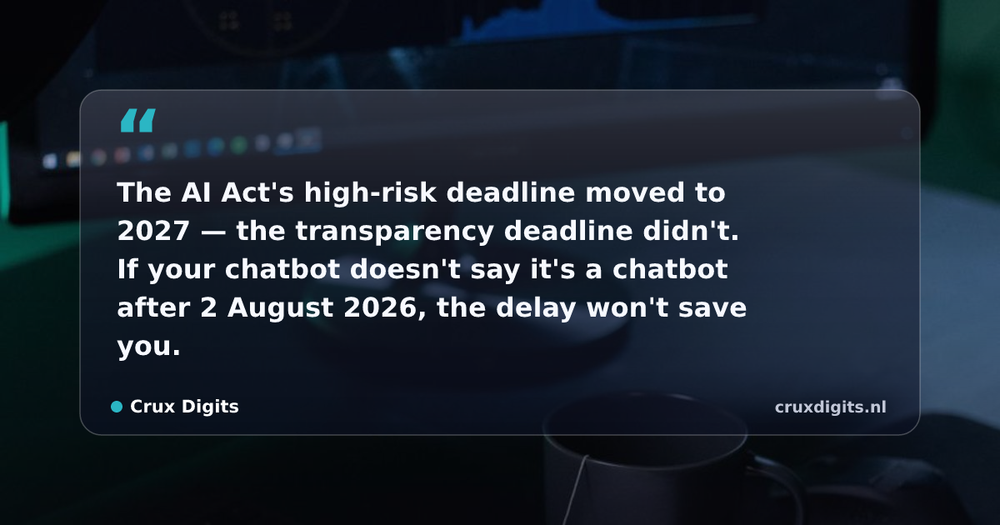
The EU AI Act's high-risk rules were delayed on 29 June 2026 — standalone systems (Annex III) now have until 2 December 2027, and AI embedded in regulated products (Annex I) until 2 August 2028. But the transparency duties in Article 50 were not delayed: from 2 August 2026, any AI chatbot, AI-written public text or AI-generated image a Flemish SME uses must say so.
What actually changes on 2 August 2026
The AI Act entered into force on 1 August 2024 and rolls out in phases. The ban on unacceptable AI practices and the Article 4 AI-literacy duty applied from February 2025. Rules for general-purpose AI models (Articles 51–55) applied from August 2025 and are untouched by the delay — enforcement of those is centralising at the EU AI Office. Now the third phase lands: from 2 August 2026, the Article 50 transparency obligations apply across the EU, including Belgium.
- AI chatbots must clearly state that the user is talking to an AI system.
- Emotion-recognition systems must inform people that they are being analysed by AI.
- AI-generated content must carry a recognisable label.
- Deepfakes — synthetic video or audio that imitates a real person — must be disclosed as AI-generated; purely fictional or clearly unrealistic content, such as an animated dog giving a speech, is exempt.
- AI-generated text published for public information — news articles, annual reports, scientific publications, government social posts — must state it was produced with AI.
This lands squarely on the AI tools most Flemish SMEs already run. If you use a WhatsApp or website chatbot for customer service — a setup we've written about before — a one-line disclosure in the opening message is now a legal requirement, not a nice-to-have.
The high-risk deadline that moved — and what didn't
In November 2025 the European Commission proposed the Digital Omnibus on AI, including a 'stop the clock' mechanism for the parts of the Act industry said it could not meet in time. Parliament and Council reached a provisional political agreement on 7 May 2026; Parliament formally endorsed it on 16 June 2026; and the Council of the EU gave its final green light on 29 June 2026. The text still needs to be published in the Official Journal and enters into force three days after — a formality, but not yet done as we publish this.
Here is what the final deal actually postpones, and what it leaves alone:
- Standalone high-risk AI systems (Annex III — recruitment scoring, biometric identification, credit scoring, exam grading and similar): pushed from 2 August 2026 to 2 December 2027.
- High-risk AI embedded in regulated products (Annex I — medical devices, machinery): pushed to 2 August 2028.
- National regulatory sandboxes must now be operational by August 2027.
- Prohibited practices and the Article 4 literacy duty: in force since February 2025, unchanged.
- General-purpose AI model rules: in force since August 2025, unchanged.
- Article 50 transparency duties: apply from 2 August 2026 as originally planned.
- Watermarking of AI-generated content from existing systems: moved earlier, to 2 December 2026.
- A new ban on non-consensual, intimate AI-generated imagery: takes effect 2 December 2026.
- SME relief widened to 'small mid-caps' — companies up to 750 employees now qualify for simplified obligations, a threshold that covers essentially every Flemish SME and most mid-market firms.
The AI-literacy duty itself was softened in wording — from an obligation to *ensure* a level of literacy to one to *support the development of* it, with responsibility now shared between companies and public authorities — but supervision of Article 4 still begins on 2 August 2026, per the European Commission's own literacy FAQ. It was not deferred.
What this means if you run a Flemish SME
Strip away the legal language and three questions decide what you actually need to do before August:
Does a customer or visitor see or talk to your AI? A chatbot, an AI voice agent, AI-written marketing copy, AI-generated images — Article 50 applies to you from 2 August 2026, delay or no delay. This is most micro and small Flemish businesses running a WhatsApp bot or a website assistant.
Does your AI make or materially influence a decision about a person? Hiring, credit, insurance pricing, exam grading, biometric ID — you're likely looking at Annex III high-risk obligations, and you now have until December 2027 instead of August 2026. That's real breathing room, but starting a self-assessment this year — our guide walks through how — is still the sane move, not a requirement you can ignore until 2027.
Is your AI use purely internal? Summarising documents, drafting internal emails, RAG over your own files, coding assistance — this mostly sits outside Annex III and Annex I altogether. Your main ongoing obligation is Article 4 AI literacy for the staff who use these tools, which has applied since February 2025 regardless of the Omnibus.
For a micro business (1–10 FTE) — the zzp'er or eenmanszaak running a WhatsApp bot on top of an e-Boekhouden-style admin stack — the practical move is small: one disclosure sentence in the chatbot's opening message, and a one-page note showing you did it. For a small business (20–50 FTE) layering AI onto Exact Online or AFAS workflows — quote and invoice automation, a first AI customer-service agent — the same disclosure rule applies, but it's worth pairing it with a short written AI inventory: which tools, what they touch, who owns it. That inventory costs an afternoon now and saves a scramble later if a competitor complaint or an audit ever triggers scrutiny.
Belgium's enforcement reality: BIPT, FOD Economie, and what to actually expect
Belgium designated the Belgian Institute for Postal Services and Telecommunications (BIPT) as its lead AI Act market surveillance authority through the January 2025 federal government agreement, with FOD Economie coordinating implementation across sectors. Belgium missed the original 2 August 2025 deadline for full institutional designation, and — like most EU member states — sector-by-sector notifying-authority procedures are still being finalised more than a year later.
The honest read for a Flemish KMO: enforcement capacity is still being built. The realistic near-term picture is complaint-driven, large-company-first enforcement, not proactive sweeps of small chatbot deployments. That does not make the obligations optional — Belgian employers' organisations Voka and VBO-FEB are both telling members to prepare now, not wait for a first enforcement case to set the tone.
A short checklist before 2 August 2026
Before the transparency duties land, a Flemish SME with a customer-facing AI tool should be able to tick these off:
- Add a one-line AI disclosure to any chatbot's opening message or a website AI assistant's first response.
- Label AI-generated marketing images, social posts or written content that goes out under your name.
- Write down which AI tools your team uses and for what — a spreadsheet is enough at this size.
- Run a five-minute self-check on whether any tool touches hiring, credit or biometric decisions — if yes, start the Annex III self-assessment even though the deadline moved.
- Note who in the business owns AI Act follow-up, even if that's just you.
Our AI Act checklist for SMEs walks through this in more detail if you want a structured version to work from, and our 10-step compliance checklist covers the broader process.
Where Vlaio funding fits in
None of the above requires new software spend for most micro and small businesses. Where training budget helps is getting the team up to speed on AI-literacy expectations — the kmo-portefeuille still covers a share of training (opleiding) costs after the February 2026 reform, though the advies category was scrapped. We've written the full, hedged breakdown of what's still fundable separately; treat any subsidy figure as indicative until Vlaio confirms your specific application, and see our subsidy guide for the equivalent Dutch-market mechanisms.
Our practitioner read: treat 2 August 2026 as the 'are we disclosing AI honestly' deadline, and December 2027 as the 'get the high-risk paperwork in order, don't panic' deadline. Most compliance vendors will sell urgency on both dates equally this summer — the actual urgency isn't equal, and knowing the difference is worth more than any tool.
When you move from disclosure to building, our page on AI consultancy for Flemish SMEs sets out the fixed prices and how the BIPT, CAO no. 39 and Peppol fit into a project.
*Last updated: 16 July 2026, based on the Council's final agreement of 29 June 2026.*
Our AI Act Check (€950 fixed) gives you your risk classification, obligations and a concrete to-do list within one week — including what you can safely ignore.
See the AI Act Check →A consultant tells you where AI pays off; Crux Digits also builds it. A fixed price per step, one named expert, and the Belgian rules and funding built in.
AI consultant in Belgium →