Anthropic released Claude Opus 5 on 24 July 2026, and the pitch is refreshingly simple for a company that usually talks in careful, safety-first language: a model that gets close to its most powerful system, Claude Fable 5, at half the price. It's available today across every Anthropic platform, and it's already the default model on Claude Max and the strongest one on Claude Pro. If you use Claude for anything more demanding than quick questions, this is the release that actually changes your day-to-day.
Where Opus 5 fits in Anthropic's lineup
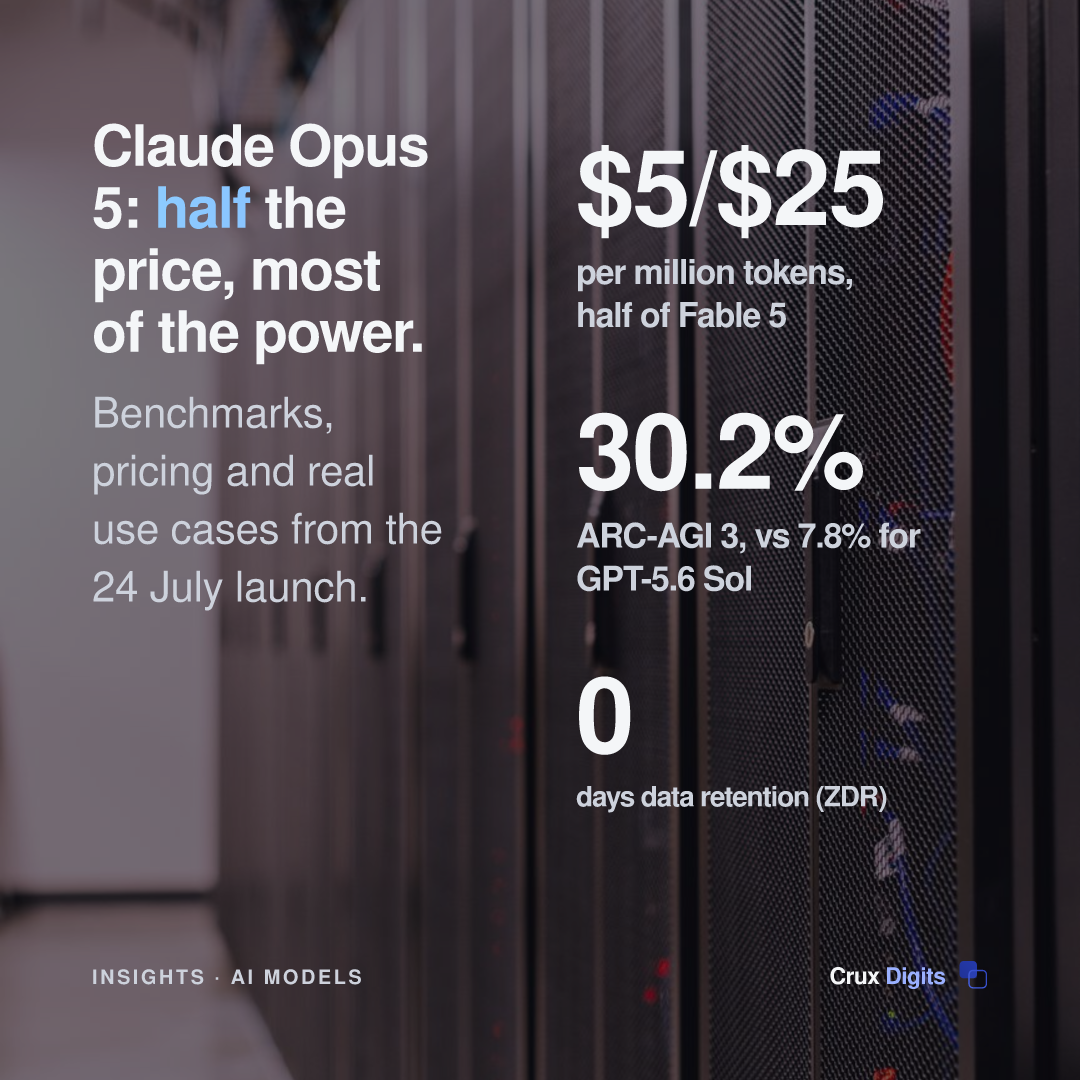
Opus 5 is the fourth Claude model Anthropic has shipped in under two months, following Mythos 5, Fable 5 and Sonnet 5 in June. That pace alone is worth noting: no other AI lab has matched it in 2026. The pricing now forms a clean ladder: Sonnet 5 costs $2 per million input tokens and $10 per million output tokens for everyday work, Opus 5 sits at $5 and $25 for complex, semi-autonomous tasks, and Fable 5 tops out at $10 and $50 for the hardest problems where cost isn't the deciding factor. That's the same price Anthropic charged for Opus 4.8: Opus 5 is a straight upgrade at no extra cost, not a new, pricier tier. Anthropic itself frames the trade-off honestly: Opus 5 is built for daily professional use, while Fable 5 remains the better choice for the very longest, most open-ended autonomous runs.
The coding and reasoning benchmarks, with the actual numbers
Most model launches lean on vague superlatives. Anthropic and independent outlets both published hard numbers this time, so let's look at them directly. On Frontier-Bench v0.1, a demanding coding-and-agentic evaluation, Opus 5 scored 43.3%, against Opus 4.8's 18.7% and Fable 5's 33.7%, meaning Opus 5 didn't just beat its predecessor, it beat Anthropic's own top-tier model too. On CursorBench 3.2, tested inside the Cursor coding editor, Opus 5 at maximum effort landed within half a percentage point of Fable 5's best score, while costing roughly half as much per task, and it beat every other model at a given cost across high, extra-high and max effort settings. It's not a clean sweep, though: on DeepSWE, a well-regarded agentic-coding benchmark, Opus 5 scored 68.8% against GPT-5.6 Sol's 72.7%, a rare case where OpenAI's newest model still leads.
On reasoning and novel problem-solving, the gap is more dramatic. On ARC-AGI 3, a test built specifically to resist memorisation, Opus 5 scored 30.2%, roughly four times GPT-5.6 Sol's 7.8%, and twenty times Opus 4.8's own 1.5%. Anthropic reports similarly strong results on GDPval-AA v2 (professional knowledge work), HLE (Humanity's Last Exam, a notoriously hard general-knowledge benchmark) and DeepSearchQA, describing Opus 5 as its best and most cost-efficient model yet on that whole cluster of evaluations.
Where you'll actually meet Opus 5. Practically speaking, most people won't pick a model by name at all. Opus 5 is now the model behind Claude Pro's most capable tier and the default for Claude Max subscribers, and it's what powers Claude Code and Claude Cowork whenever a task is complex enough to need it: multi-file refactors, long research runs, agent workflows that touch several tools in sequence. Developers calling the API directly select it by name (claude-opus-5 in Anthropic's model catalogue) and can dial the effort setting per request. A Fast variant is also available, running at roughly 2.5 times the speed for double the per-token price, useful for latency-sensitive product features where a slightly higher bill is worth a snappier response.
It's worth sitting with the pricing ladder for a moment, because it says something about where Anthropic thinks the market is heading. Six weeks ago, choosing a Claude model meant picking between "fast and low-cost" and "slow and capable," with a large gap between them. Now there are three deliberately spaced tiers (Sonnet 5, Opus 5, Fable 5) and the middle one no longer feels like a compromise. Quartz's coverage of the launch put it plainly: Anthropic is betting that most paying customers, especially businesses running agents at volume, care more about the cost-per-successful-task than about topping a leaderboard, and Opus 5 is built to win on exactly that metric.
Where it gets genuinely useful: agentic and business-task benchmarks
The benchmark that best predicts what Opus 5 will feel like in daily use is probably Zapier's AutomationBench, which measures whether a model can carry a real business task from start to finish rather than just start it convincingly. Here Opus 5's pass rate runs about 1.5 times the next-closest model at matching cost, and even at its least expensive effort setting it beats every competitor's best result. Zapier's own CEO, Wade Foster, described handing the model a raw account-health spreadsheet and asking it to run a full churn-prevention sequence: flag at-risk accounts, alert the right internal owner, summarise everything for the retention team. Previous models didn't pass this test at all; Opus 5 hit 100%, without using more tokens than earlier Claude models needed to fail at it.
On computer-use tasks (literally operating a screen, clicking buttons, filling in forms), Opus 5 tops OSWorld 2.0 at every price point, and matches Fable 5's best-ever result while using roughly a third of the budget. That combination of "as good, dramatically less expensive" is really the theme of this whole release, and it's the exact category of task most teams already run through no-code automation tools, the kind we compared in our n8n versus Make versus Zapier breakdown, rather than a raw API call.
Science: a genuine step up, not just a coding story
It's easy to assume a model release like this is purely about writing code faster, but Anthropic's life-sciences results suggest something broader. Opus 5 improved on Opus 4.8 across every single one of Anthropic's internal life-sciences evaluations, spanning structural biology, organic chemistry and bioinformatics. The biggest jump, over 10 percentage points, came on organic chemistry tasks like inferring a molecule's structure from raw spectroscopy data. It also gained close to 8 percentage points on predicting how mutations in a protein's sequence change its function, a task that matters directly for drug discovery.
The effort dial: a genuinely useful cost control
One detail that will matter more than it sounds: Opus 5 ships with an adjustable effort setting (low, medium, high, extra-high and max) that lets you trade intelligence for speed and cost on the fly, rather than switching models entirely. This isn't new to Anthropic, but Opus 5 extends the range and, according to early users, needs noticeably less back-and-forth prompting to get a task right the first time. Harvey, the legal-AI company, is a good illustration: its head of applied research, Niko Grupen, reported that Opus 5 matched Opus 4.8's maximum-reasoning output quality while using 26% fewer tokens on average: the same answer, delivered for meaningfully less money.
Alignment, and an honest gap on cybersecurity
Anthropic's pre-deployment behavioural audit puts Opus 5 at a misaligned-behaviour score of 2.3, the lowest (best) of any recent Claude model, ahead of Opus 4.8, Sonnet 5 and even Fable 5. The company reports the fewest instances of deceptive behaviour and the strongest resistance to being manipulated into misuse of any model it has released.
Cybersecurity is the one area where Anthropic is candid about a gap, and it's an interesting one because it's deliberate. Opus 5, like Opus 4.8 before it, was intentionally not trained on offensive cyber tasks. Even so, general capability gains carried over: on OSS-Fuzz, Anthropic's test for finding and exploiting real software vulnerabilities, Opus 5 found bugs 79.4% of the time, almost matching Mythos 5's 80% (Mythos 5 is a version of Fable 5 with extra safeguards removed, restricted to a small number of vetted cyberdefence organisations). But turning those findings into working exploits is a different story: Opus 5 succeeded on only 4 of the challenges where Mythos 5 cleared 13. Anthropic has also tuned Opus 5's safety classifiers to intervene roughly 85% less often than Fable 5's. Flagged requests fall back automatically to Opus 4.8 rather than simply refusing.
None of this means Opus 5 is unrestricted. Anthropic still runs every request through its usual safety classifiers, and the company is explicit that the lower intervention rate reflects better-calibrated detection, not a looser policy: genuinely risky requests are still caught, just with far fewer false positives on ordinary technical or security-adjacent work that used to get needlessly flagged.
A quieter but important detail: no 30-day data retention
For enterprise buyers, this might matter as much as any benchmark. Fable 5 comes with a 30-day data-retention requirement, because Anthropic needs to retain prompts and outputs to run its safety classifiers on that model. Opus 5 doesn't carry that requirement: it's available under zero data retention, the same as Opus 4.8. For any organisation whose contracts, regulators or clients require ZDR for source code or confidential material, that removes a procurement blocker Fable 5 simply couldn't clear, regardless of how good it scored on a benchmark.
The use cases that actually stood out
Benchmarks tell you how a model performs on a fixed test. What's more interesting is what happens when real teams point it at messy, open-ended work. A few examples from Anthropic's early-access customers stand out because they're specific rather than generic praise.
The blind 3D reconstruction. On one Frontier-Bench task, Opus 5 was shown a drawing of a machine part and asked to rebuild it as a 3D FreeCAD model, but deliberately given no way to directly view the image. Rather than fail, it wrote its own computer-vision pipeline to extract the geometry from the raw pixel data, then reconstructed the part correctly, repeatedly. No competing model given the same constraints solved it in five attempts.
The exchange feed nobody else could build. An engineer at a trading firm asked Opus 5 to build a market-data feed for a brand-new exchange in a single session. Previous models couldn't complete the task at all, even with detailed plans supplied up front. With no live feed available to test against, Opus 5 built its own test harness to verify its code was parsing the exchange's data correctly before calling the job done.
The bug fix that found the real cause. Given a genuine bug in a popular open-source package manager, Opus 5 traced it to its actual root cause and fixed an edge case that the community's own published patch had missed. A competing model, given the same bug, patched only the visible symptom and reported the issue resolved. That is the same instinct for tracing a problem to its source, rather than the nearest symptom, that shows up in how these models handle retrieval architecture; see our RAG versus GraphRAG comparison for a deeper look at that trade-off.
A weekend as chief of staff. One engineer, Cristian Rivera, gave Opus 5 a chief-of-staff role over his development environments for a weekend: it built its own monitoring, drove each machine directly, and only pulled him in for genuine judgment calls. That is a small but telling example of the "agency and thoroughness" Anthropic says defines this model.
Beyond these standout stories, the pattern repeats across industries with real numbers attached: Box found Opus 5 outperforms Opus 4.8 by 8% overall on enterprise document analysis, with an 11% gain on data-analysis workflows and 17% on due diligence, the kind of work technology, healthcare and public-sector customers run daily. Lovable's co-founder Fabian Hedin called it the biggest leap in the Opus family since version 4.5, up 22% over Opus 4.7 on their hardest agentic coding tasks with far less run-to-run variance, consistency that matters when millions of people are building apps on the platform. A genomics company's CEO described Opus 5 behaving "more like a careful scientist than any model we've run," reaching for the correct statistical tests and cross-checking its own results independently across long multi-step analyses. And on legal work, contract-review teams reported first-turn redline quality nearly double that of Opus 4.8, with faster passes through NDAs at equal or better accuracy.
It's also worth being honest about what these benchmarks don't tell you. A pass rate on Frontier-Bench or ARC-AGI 3 says nothing about how a model handles your specific codebase, your company's writing style, or a support ticket that's really a billing dispute wearing a technical-question costume. The customer accounts above are more useful precisely because they're about a specific task, with a specific before-and-after: a churn workflow that used to fail outright now completing at 100%, a legal-redline pass that used to take two turns of back-and-forth now landing clean on the first try. That's the kind of signal worth weighing more heavily than any single leaderboard number, and it's also why Anthropic leaned so hard on named customers and quantified deltas in its own announcement rather than benchmark tables alone.
How it stacks up against GPT-5.6
The comparison Anthropic really cares about isn't Opus 5 versus its own older models. It's Opus 5 versus OpenAI's GPT-5.6 Sol, released earlier this month (we covered that launch and how it stacked up against Fable 5 in detail). The results are genuinely mixed rather than a clean win either way. Opus 5 crushes Sol on ARC-AGI 3 (30.2% versus 7.8%) and leads comfortably on several agentic and computer-use benchmarks. Sol, in turn, edges ahead on DeepSWE (72.7% versus 68.8%), a benchmark specifically built around agentic coding workflows. Techzine's own read on it is a fair one: for most day-to-day coding work, the choice between the two increasingly comes down to personal preference and existing workflow rather than a clear capability gap. If you're mapping out the wider field (Gemini, DeepSeek, Qwen and the rest), our broader look at where the open-source and closed-source landscape stands is a useful companion read. Google's Gemini 3.5 Pro, meanwhile, is reportedly delayed, leaving Anthropic and OpenAI to trade blows at the frontier for now.
There's a wrinkle in that comparison worth flagging, though: Google's Gemini 3.5 Pro was widely expected to ship alongside or shortly after Opus 5, and MacRumors' report on the launch notes it has slipped without an official new date, which leaves the frontier effectively a two-way race between Anthropic and OpenAI for at least the next few weeks. Anyone benchmarking their own workload against Opus 5 right now should treat the comparison as provisional: a third serious contender re-entering the field tends to reshuffle where the price-to-capability sweet spot actually sits.
The bottom line
Opus 5 isn't the most powerful model Anthropic makes. That's still Fable 5, and Anthropic says so plainly. What it is, is the model most people and most businesses will actually use, because it closes most of the intelligence gap to the flagship while cutting the price in half, dropping Fable 5's data-retention requirement, and adding a genuinely useful effort dial for controlling cost. For a mid-sized team weighing whether to route serious agentic work (document processing, coding agents, research assistants) through Claude, Opus 5 is now the sensible default rather than a compromise; it's the kind of decision worth working through with an experienced AI consulting partner rather than guessing from a benchmark table. The honest caveats are real too: it remains behind Mythos 5 on offensive cybersecurity by design, and it's not the model Anthropic recommends for the very longest autonomous runs. For everything in between, which is most of what businesses actually need an AI model to do, this is currently Anthropic's best value on the table.
We build custom AI and LLM systems that run in production: a clickable MVP by the second call, fixed steps, and you own the code.
AI development agency in the Netherlands →