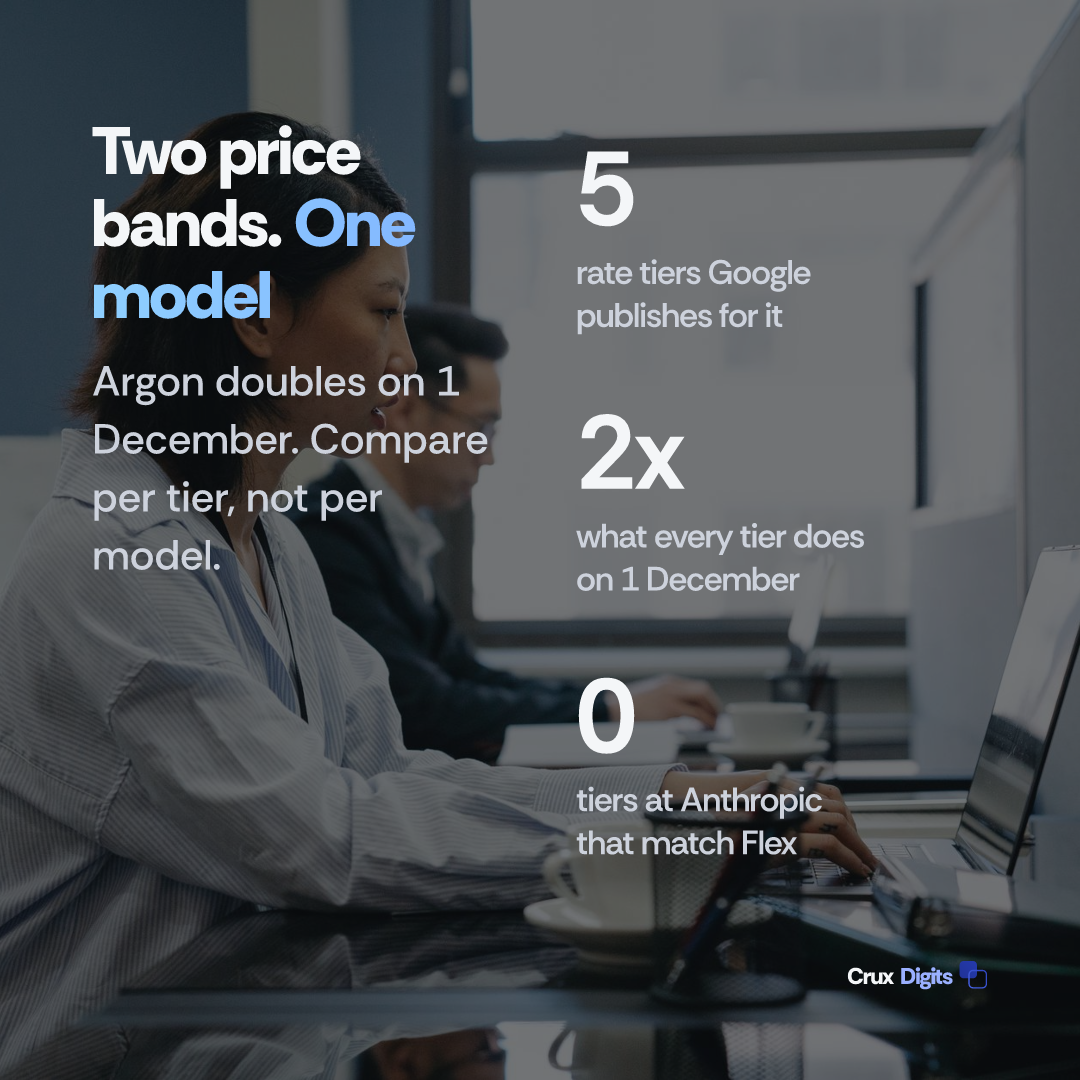
Google made Gemini 4 Argon generally available on 13 October 2026 at an introductory rate that runs until 30 November. On 1 December every Argon rate doubles. The model does not change; its price band does, from where Anthropic lists Claude Sonnet 5.5 to where it lists Claude Opus 5.5. The question a budget actually needs answered is which of Google's four open rate tiers you are costing, because Anthropic publishes two and a premium mode.
This is written for the person who has to put a number in a 2027 budget line: the IT manager, informatiemanager, IT director or architect at a Dutch organisation of 250 to 5,000 FTE, who is being asked to approve a model choice on a price that expires in six weeks.
What changes on 1 December 2026?
Argon is Google's flagship multimodal model. It was unveiled on 30 September 2026 through the Fairwind Program, with access limited to approved cybersecurity defenders, and reached general availability on 13 October. On the Gemini API pricing page the standard rate is $2 per million input tokens and $10 per million output through 30 November 2026, then $4 and $20. Cached input moves from $0.10 to $0.20. Output prices include thinking tokens.
That the December standard rate lands exactly on Claude Opus 5.5's list price, and the introductory one exactly on Claude Sonnet 5.5's, has already been written. A comparison updated on 14 October set out both, batch row included. We are not claiming the observation, and that same comparison already carries the Priority row and the implicit-versus-explicit caching contrast. A comparison published on 15 October has since set Google's 1.8 times premium multiple beside Anthropic's 2 times as well. What we have not found assembled anywhere is the Flex rung set against Anthropic's ladder, which is where the tier decision actually sits.
How do Argon's tiers line up against Claude's?
Google publishes five rate tiers for Argon, four of them open to anyone. The fifth, Contributor, is an invite-only private preview priced like Batch, and it is the one tier whose traffic Google says it uses to improve its products, which belongs in your processing register rather than in a footnote. Anthropic publishes two tiers for Opus 5.5 plus a premium mode. Per million tokens, input and output, verified against both vendors' own pages this week:
- Standard. Argon $2/$10 now, $4/$20 from 1 December. Opus 5.5 is $4/$20 and Sonnet 5.5 is $2/$10, both unchanged.
- Batch. Argon $1/$5 now, $2/$10 from 1 December. Opus 5.5 batch is $2/$10 and Sonnet 5.5 batch is $1/$5. From December, Argon's batch rate equals both Opus 5.5's batch rate and Sonnet 5.5's standard rate.
- Flex. Argon $1/$5 now, $2/$10 from 1 December. Anthropic publishes no equivalent, so a workload that tolerates variable latency has a rung on one vendor's ladder and nothing to compare it to on the other's.
- Priority. Argon $3.60/$18 now, $7.20/$36 from 1 December. Anthropic's nearest thing is fast mode at $8/$40, which is not the same product. Note the multiples: Google's premium tier is 1.8 times its own standard rate, Anthropic's is 2 times its own.
- Cached input. Argon is $0.10 then $0.20 on Standard, $0.05 then $0.10 on Batch and Flex, and $0.18 then $0.36 on Priority. Opus 5.5 cache reads are $0.20 and Sonnet 5.5 cache reads $0.10.
Read down that list rather than across one row. Argon is not simply half of Opus 5.5 until December and level after. It occupies Sonnet 5.5's entire price band on every comparable tier, then Opus 5.5's entire band, and it carries two rungs that have no Anthropic counterpart at all. A procurement comparison that quotes one standard rate against another is comparing a quarter of the pricing surface.
Why can you not engineer the cached rate on Argon?
Because Argon supports implicit caching only. Explicit context caching is not supported for this model, which Google's pricing page states directly. The 95 percent discount on cached input is therefore something the platform gives you when prefixes happen to repeat, not something you provision and rely on.
Anthropic works the other way round. You pay to write a cache, $5 per million tokens for a five-minute lifetime and $8 for an hour on Opus 5.5, and then read it at $0.20. That is a cost you incur deliberately and a hit rate you control. So the cached-rate row above is the one line of the table that is not like for like: one vendor sells you a cache, the other hands you one when it happens.
It matters most for the workload shape a mid-market team usually pilots first, which is retrieval over a long stable system prompt. On Claude you can engineer that prompt into a cache and know what the hit rate will be. On Argon you write the prompt, observe what the implicit cache does, and budget the undiscounted rate until the logs tell you otherwise.
Do the independent benchmarks agree with Google's?
Not uniformly, and the disagreement runs in a direction worth noticing.
On Google's own published comparisons Argon leads: DeepSWE v1.1 at 77.9 percent against 74.2 for Opus 5.5 and 74.1 for GPT-6 Astra; the Harvey legal benchmark at 19.6 against 3.8 and 5.4; Zapier AutomationBench at 51.3 against 42.5 and 41.4; the Vals Index at launch at 68.9 against 67.0 for Opus 5.5. These are agentic and tool-use benchmarks, and the margins on two of them are large.
On the independent index the ordering changes. Artificial Analysis frames the release as Google rejoining the top three labs. Reading its index numbers, The Decoder puts Argon (High) at 53, level with GPT-6 Astra (max) and Claude Fable 5.1, behind Claude Opus 5.5 at 58 and Claude Sonnet 5.5 at 56. We are not going to assign it a placing, because the published accounts count the ties differently; the scores are the part that holds. The Vals Index has moved since: its 19 October standings put Claude Sonnet 5.5 first at 70.85 and Claude Opus 5.5 second at 70.18, with Argon third at 69.24.
Then the benchmark worth looking at twice. Google published Terminal-Bench 4.0 in its own evaluation methodology report at 57.4 percent for Argon against 66.4 for Opus 5.5, 58.2 for GPT-6 Astra and 57.9 for Claude Fable 5.1, which puts Argon last of four in its own vendor's chart. Artificial Analysis ran the same benchmark and got 57 for Argon, 59 for GPT-6 Astra, 60 for Opus 5.5 and 64 for Sonnet 5.5: Argon last again. The useful detail is which number moves. Argon scores about 57 on both runs. Opus 5.5 scores 66.4 on Google's chart, the same 66.4 Anthropic publishes for it, and 60 on Artificial Analysis's. The disagreement is about the opponent, not about Argon, which is a reason to run the benchmark on your own stack rather than read a gap off anyone's slide.
What does a realistic Dutch pilot actually cost?
Here is the arithmetic with the assumptions stated, so you can replace them with your own. Take a document-handling workload of the kind an organisation in this band actually pilots: 2,000 documents a month at 8,000 input and 1,500 output tokens each, so 16 million input and 3 million output tokens.
- On the standard tier: $32 input plus $30 output, so $62 a month now, and $124 from December.
- On batch, which is what this workload really is: $16 plus $15, so $31 a month now and $62 from December. An overnight document run has no reason to be priced as interactive.
Notice which lever is bigger. Moving that workload to the correct tier saves as much as the December increase costs, and it keeps saving afterwards. Teams that quote the standard rate for a batchable job are paying a latency premium they are not using. The tier decision is worth more attention than the date, and almost all of the coverage is about the date.
Change the shape and the increase lands harder. An agentic workload that writes rather than reads, say 500 runs a month at 20,000 input and 8,000 output tokens, is 10 million input and 4 million output: $20 plus $40, so $60 now and $120 from December. That one is genuinely interactive, so the batch rung is not available to it, and output is where the doubling hurts.
All of these are small numbers, and saying so is more useful than dramatising them. In a mid-market AI project the model bill is rarely the budget risk; integration, data work and the people running it are. The reason to do this arithmetic is not the total, it is that a proposal quoting a November rate for a 2027 budget is understating a recurring line by half.
Where does the data sit, and whose obligation is it?
This is the question your security officer asks first and the benchmark coverage never answers. General availability through the Gemini API and Google AI Studio is not the same as availability in a European region, and an API endpoint is not a residency guarantee, so read Google Cloud's locations documentation for the regions your own project is served from. Establish where inference runs before the pilot rather than after, and keep the answer with the model, not in someone's memory.
There is a register to update while you are there. Under the AI Act a general-purpose model you call through an API carries the provider's obligations, while the system you build on top of it carries yours as deployer, and the Article 4 literacy duty has applied since 2 February 2025. The AI Act risk checker will tell you in a few minutes whether what you are building lands in a class you have to care about.
One billing consequence hides in the long-decode protocol. Google's model documentation describes input, thinking and output sharing a single window of 1,048,576 tokens, with a default response cap of 65,536 tokens; going beyond it needs background execution and a raised limit, after which the model generates in hops of up to 64K tokens that the caller joins back together. Thinking tokens count inside that output budget and bill at the output rate. A background long-decode job therefore bills its own reasoning at $10 per million now and $20 from December.
What we would put in the 2027 budget line
- Date every quote. Any Argon figure in a proposal or a supplier estimate is a November number unless it says otherwise. Ask which rate it assumes and which tier.
- Choose the tier before the model. Half the workloads a mid-market team pilots are batchable and priced as though they are not. That decision is available today and survives the price change.
- Run the evaluation before 30 November. Six weeks of discounted interactive access is a real window for an honest comparison on your own data, which is the only comparison that settles an agentic-versus-index argument. Choosing a model per workload has the method.
- Keep the switch portable. Parity on list price from 1 December removes the price reason to pick either vendor, which makes staying model-independent the less expensive position rather than the purist one.
Crux Digits builds and runs AI systems alongside the ICT partner or internal IT team you already have. We do not run your service desk, your infrastructure or your supplier contracts. Where we are useful is this kind of decision: which model and which tier for a given workload, what the data path does, and what replacing it would cost in a year. Our work with mid-sized organisations is set out under applied AI for mid-sized business, and how an implementation runs here under AI implementation in the Netherlands.
Last updated: 21 October 2026. Prices verified against Google's and Anthropic's own pricing pages on that date.
We build custom AI and LLM systems that run in production: a clickable MVP by the second call, fixed steps, and you own the code.
AI development agency in the Netherlands →