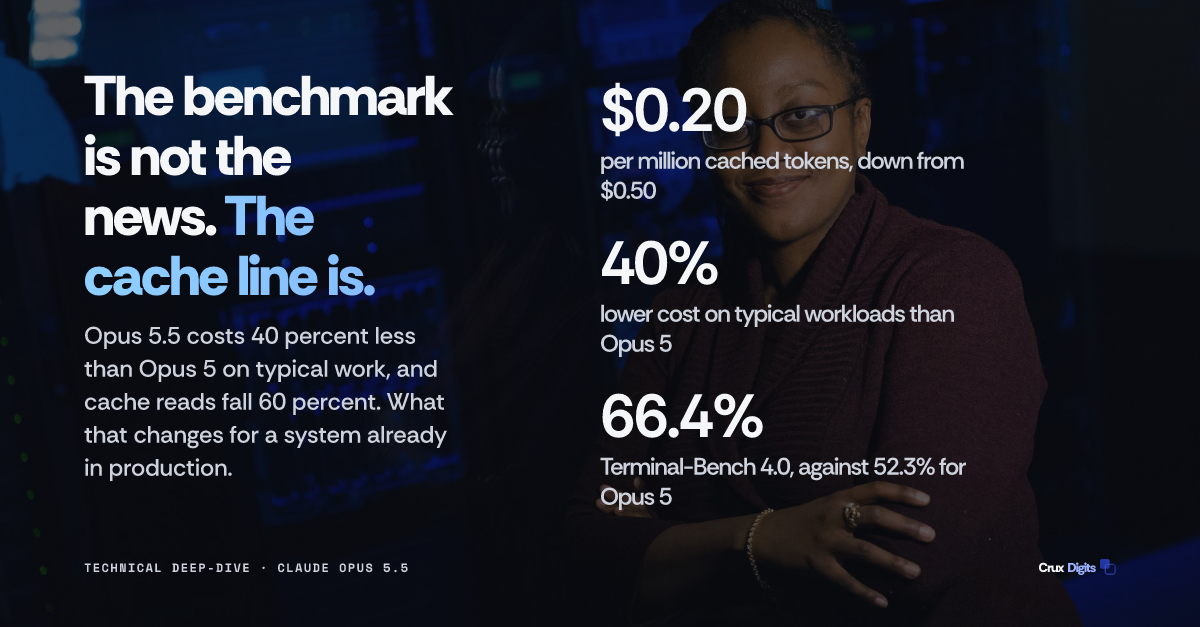
Anthropic released Claude Opus 5.5 on 22 September 2026. Most of the coverage led with benchmark scores. For a company that already runs AI in production, the benchmark table is the least interesting part of the announcement. The price list is the news.
What was announced
Opus 5.5 is the first model in the Claude 5.5 family. Anthropic positions it as performing at the level of Claude Fable 5.1 on most work while costing 40% less to run than Opus 5 at default settings. Sonnet 5.5 and Haiku 5.5 are announced for the following weeks.
The published per-million-token prices, set against Opus 5: input tokens $4 against $5, output tokens $20 against $25, cache writes $5 against $6.25, and cache reads $0.20 against $0.50. Output generation is more than 30% faster. A fast mode is available at $8 per million input and $40 per million output tokens. All of these are Anthropic figures, published with the model.
The price is the news, and the cache line is the reason
Input is 20% less expensive and output is 20% less expensive, but cache reads are 60% less expensive. That single line is what moves a production bill, because in agentic and retrieval workloads cache reads are the majority of what you pay for. Every tool call replays the context. Every step of an agent re-reads the same system prompt, the same schema, the same retrieved documents.
A retrieval assistant over your own documents is mostly cache reads. An agent that plans, calls a tool, reads the result and plans again is mostly cache reads. If that is the shape of your workload, the headline 40% understates what happens to your invoice, and the saving arrives without touching a line of your code.
There is a second effect that is easy to miss. Anthropic reports that the model uses fewer tokens per task, not only that tokens are less expensive. In one of their examples an early tester audited and fixed a 200,000-line codebase in under three hours, against more than 20 hours and 2.5 times the tokens on Opus 5. Price per token and tokens per task compound, which is where the 40% comes from.
What the benchmarks do and do not say
On the published numbers, Opus 5.5 leads agentic coding (Terminal-Bench 4.0 at 66.4%, against 55.8% for Fable 5.1 and 52.3% for Opus 5), knowledge work (GDPval-AA v2.1 at 1846, against 1735 and 1708) and computer use (OSWorld 2.0 at 81.8% partial). On Terminal-Bench-Science it scores 58.7% where GPT-6 Astra scores 64.6%, so the lead is not uniform.
The more useful sentence in the announcement is the caveat. Anthropic states plainly that at these capability levels benchmark margins have become a less reliable guide to real-world differences, and that in their own use the gap between Opus 5.5 and Fable 5.1 is narrower than the scores suggest. A vendor writing down the limits of its own scoreboard is worth more than the scoreboard.
Treat the table as a reason to run your own test, not as a result. The only benchmark that decides anything for your business is the one built from your own cases, with your own documents, scored by the people who will live with the output.
What changes if you already run AI in production
Five things are worth doing in the week after any frontier release, and none of them is a rewrite.
First, check that you pinned a model version. If your code names a model family rather than a version, your behaviour can change under you when a provider shifts a default. Pinning is how you decide when to move, rather than finding out from a support ticket.
Second, re-run your own acceptance set before you switch anything. If you do not have one, that is the finding. A set of fifty to two hundred real cases with the answers you expect is the least expensive insurance in applied AI, and it turns a model release from a rumour into a measurement.
Third, measure tokens per task, not the price per token. A model that costs less per token and takes more steps can be more expensive in practice. The reverse is also true, and it is the direction Anthropic is claiming here.
Fourth, look at what a change does to your paper trail. If your system falls under the EU AI Act, the model is part of the technical documentation you keep, and swapping it is a change you record rather than a silent upgrade. Article 50 transparency duties apply from 2 August 2026, and high-risk Annex III duties from 2 December 2027 under the Digital Omnibus timetable.
Fifth, decide on evidence. Switch when your own set says the new model is at least as good and the cost per task is lower. Stay when it does not. Both answers are fine, and neither needs a rewrite of the system around the model.
What a model upgrade does not fix
A faster, less expensive model does not clean your data, does not document your process, and does not decide which exception a person should still handle. In the projects we see, those three things decide whether a system reaches daily use, and they are unaffected by a release.
The pattern holds in the other direction too. If an assistant gives an unreliable answer because the source document is out of date, a better model will give you a more fluent unreliable answer. Retrieval quality, ownership of the content and a clear handover to a person are what move that number, and they are work you do once rather than every release.
The short version
Opus 5.5 is a real step up on agentic work and a real drop in running cost, with the largest saving in the line most people never look at. If you run something in production, pin your version, re-run your own set, measure tokens per task and record the change. If you do not run anything yet, a model release is not the reason to start; a process that costs you a measurable amount of time is.
Figures in this article are Anthropic’s own, published on 22 September 2026 with the Opus 5.5 announcement, and the benchmark results are the vendor’s reported numbers rather than our measurements.
We build custom AI and LLM systems that run in production: a clickable MVP by the second call, fixed steps, and you own the code.
AI development agency in the Netherlands →