Anthropic released Claude Fable 5.1 on 1 September 2026 and called it, together with Mythos 5.1, its most advanced model for coding and knowledge work. The list price did not move. One line on the bill did, and it changes the maths for exactly one kind of workload. This post sets out what actually shipped, what it costs per task rather than per token, how the effort dial works, what breaks if you are already on Fable 5, and what a Dutch or Belgian company should do with it this month. Every number below comes from Anthropic's announcement, the official pricing page or a named independent source, and where sources disagree we say so.
What Anthropic shipped on 1 September
Fable 5.1 is available today on claude.ai, in Claude Code, through the Claude API as claude-fable-5-1, and on Amazon Bedrock, Google Cloud Vertex AI and Microsoft Foundry. AWS confirmed general availability the same day. It is offered to Pro, Max, Team and Enterprise plans.
The detail most coverage skipped is that Fable 5.1 and Mythos 5.1 are the same model with different safeguard levels. Mythos 5.1 keeps its full cyber and biology capability and is restricted to vetted US organisations through Anthropic's trusted-access programmes. On Terminal-Bench 4.0 the two score 55.8 percent and 60.9 percent, and Anthropic attributes the gap to tasks where the earlier, less precise cyber safeguards intervened. If you are outside those programmes, Fable 5.1 is the model you get, and the numbers that matter to you are the Fable ones.
Fable 5 itself moves to legacy status. According to ClaudeFast's migration notes it will not be retired before 9 June 2027, so there is no forced deadline, only a reason to plan.
The price did not change. The cache did.
Input stays at $10 per million tokens and output at $50 per million. Batch processing halves both to $5 and $25. US-only inference carries a 1.1x multiplier. The full 1M-token context window is billed at the standard rate, so a 900,000-token request costs the same per token as a 9,000-token one. All of that is unchanged from Fable 5.
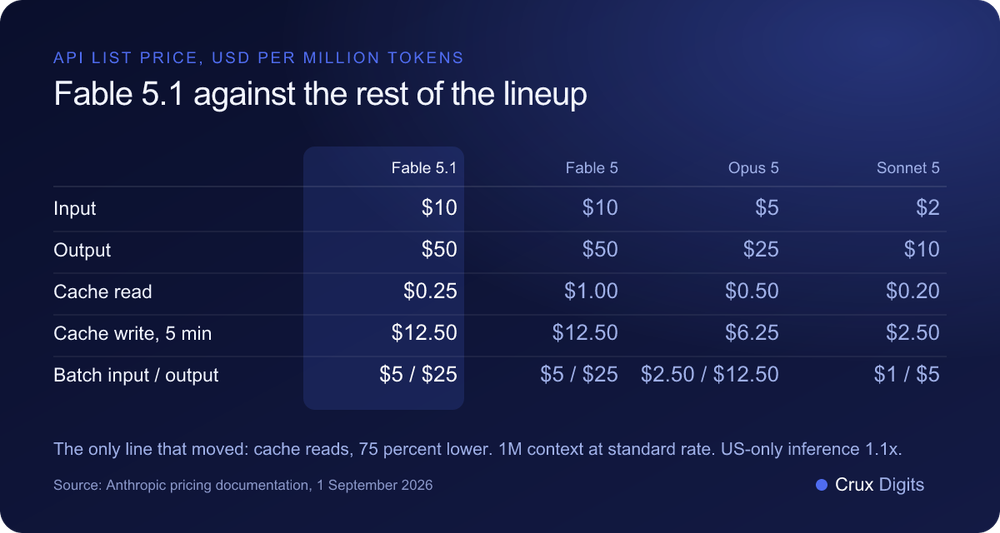
The one line that moved is cache reads: from $1.00 to $0.25 per million tokens, a 75 percent cut. Anthropic's pricing page states it as a 0.025x multiplier on the input price, against the 0.1x every other Claude model uses. Cache writes stay at $12.50 for five minutes and $20 for one hour.
From that single change Anthropic derives its headline claims: about 25 percent lower cost for typical workloads and up to about 45 percent for highly agentic work. Those are not rate cuts. They are measurements of August usage, and ClaudeFast reports the underlying figures: cache reads were roughly 40 percent of a typical workload's bill and 65 percent of an agentic one. So the saving is real, but it is a saving on re-reading context you have already paid to write. A short, single-turn call with no cached prefix saves nothing at all. That is the sentence to remember before anyone in your company quotes the 45 percent.
One more line item that is easy to miss on the pricing page: Claude 4.7 and later models, Fable included, use a newer tokenizer that produces roughly 30 percent more tokens for the same text. It is not new with 5.1, but if you are comparing against a bill from a Sonnet 4.6-era system, part of the difference is the tokenizer, not the model.
The cost story the headline leaves out
Artificial Analysis did pre-release evaluation for Anthropic and published a different cut of the same data. At max effort Fable 5.1 scores 66 on their Intelligence Index, the highest they have measured, ahead of Opus 5 at 63. But it does so by using roughly 1.7 times as many output tokens as Fable 5, which makes it about 20 percent more expensive per task than Fable 5 at max effort despite the lower cache price. Their per-task figures are $3.76 for Fable 5.1 at max against $2.34 for Opus 5, and $2.72 at extra-high effort where it scores 65. The Decoder reported the dispute; the original thread is here and the model page lists the run at $8,523 across 140 million output tokens.
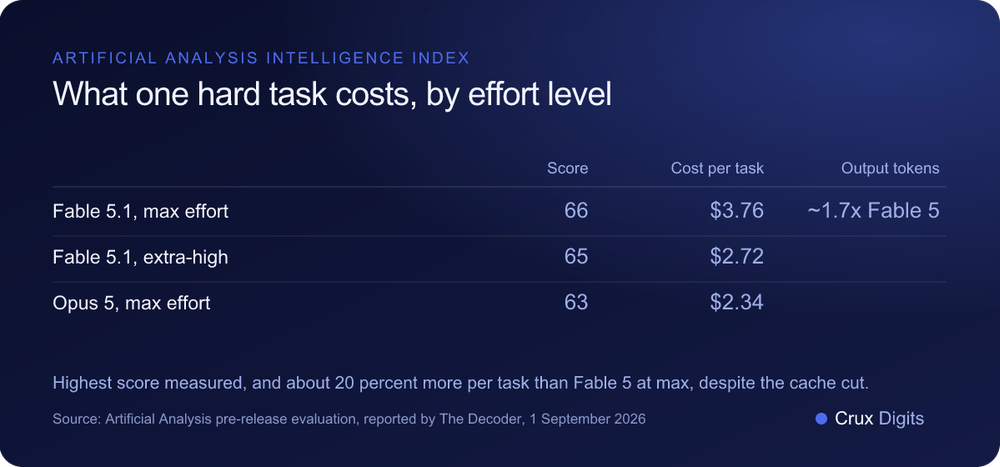
Both parties are right, because they are measuring different things. Anthropic's figure is what a bill looks like when most of your tokens are cached context flowing through a long agent loop. Artificial Analysis's figure is what one hard reasoning task costs when the model is allowed to think as long as it wants. Your workload sits somewhere between, and the honest way to find out where is to run it.
Digital Applied did the arithmetic for one common shape: 2,000 fresh input tokens and 1,000 output tokens per turn on top of a cached context. Against Opus 5, Fable 5.1 reaches cost parity around 140,000 cached tokens per turn, is 22 percent less expensive at 300,000 and 34 percent less at 600,000. Below roughly 140,000 to 215,000 cached tokens, Opus 5 is the less expensive model for the same shape. That is a useful rule of thumb: Fable 5.1 wins on cost only when a large, stable prefix is re-read many times. Everywhere else, Opus 5 costs half at list.
Effort levels: the dial that decides your bill
Fable 5.1 exposes five effort levels: low, medium, high, xhigh and max. Anthropic's claim, stated plainly in the announcement, is that at low or medium effort Fable 5.1 matches or beats Fable 5 at much lower cost, and that the higher tiers reach performance Fable 5 could not. The defaults differ by surface: high in Claude Code and the API, medium in Claude Cowork and on claude.ai.
Two practical notes follow. First, effort names are not comparable across models. A sweep you ran on Fable 5 at high does not transfer to Fable 5.1 at high; both ClaudeFast and Digital Applied recommend re-sweeping every workload. Second, Every's week-long hands-on found that xhigh and max are where the model starts to over-deliver: it spawned subagents that were not needed, ignored interruptions, and resisted course correction. Their team settled on high for interactive work and reserved the top tiers for long unattended runs. For most business use, medium is the tier to test first, because it is the one Anthropic itself picked for claude.ai.
The API now lets you change effort per message without invalidating the cache, through a beta header, which is how you run a low-cost planning turn and an expensive execution turn inside one conversation. That is the feature to build cost control around.
The benchmarks, with the numbers
These are Anthropic's own reported results, as VentureBeat points out, not independent proof. Anthropic's product page also gives a standard error of 3.5 to 4.5 points per model on Terminal-Bench-Science, so single-point gaps inside that band mean little. With that said:
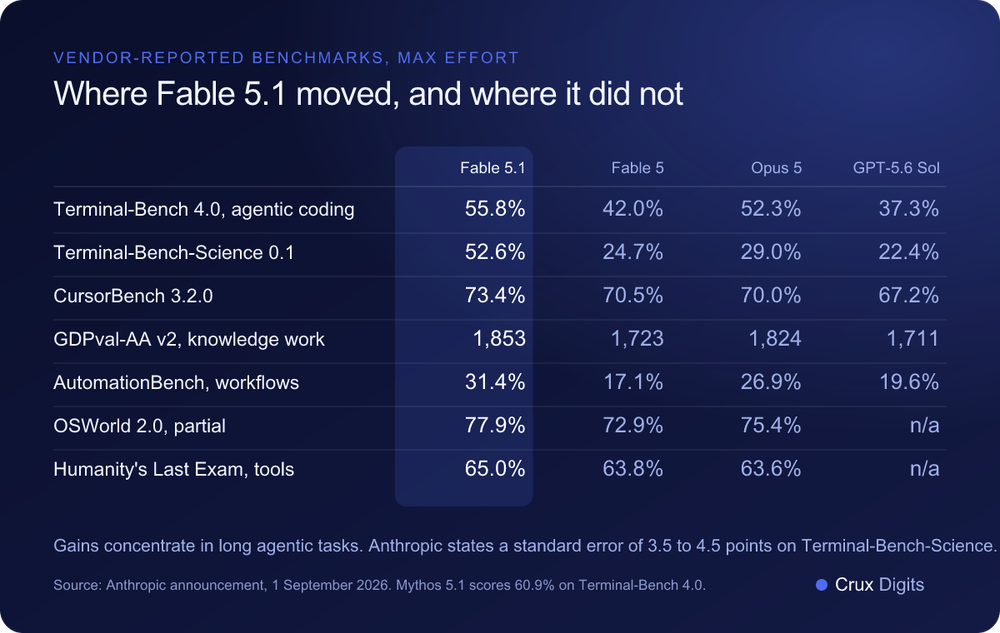
- Terminal-Bench 4.0 (agentic coding): Fable 5.1 55.8 percent, Mythos 5.1 60.9, Fable 5 42.0, Opus 5 52.3, GPT-5.6 Sol 37.3.
- Terminal-Bench-Science 0.1 (agentic research): Fable 5.1 52.6 percent, Fable 5 24.7, Opus 5 29.0, GPT-5.6 Sol 22.4. This is the largest single jump in the release.
- CursorBench 3.2.0: 73.4 percent against 70.5 for Fable 5 and 70.0 for Opus 5.
- GDPval-AA v2 (knowledge work): 1,853 against 1,824 for Opus 5 and 1,723 for Fable 5.
- AutomationBench (business workflows): 31.4 percent against 26.9 for Opus 5 and 17.1 for Fable 5.
- OSWorld 2.0 (computer use): 77.9 percent partial and 41.7 percent strict, on the August 2026 task release, which Anthropic notes is not comparable to earlier OSWorld numbers.
- Humanity's Last Exam: 60.9 percent without tools and 65.0 with tools.
Read as a set, the pattern is clear: the gains are concentrated in long, tool-using, agentic tasks, and the gap to Opus 5 is widest on scientific research and business workflow automation. On short single-shot coding the three Anthropic models are close. If your use case is a chatbot or a classifier, this release changes nothing for you. If it is a multi-hour agent, it changes a great deal. For the wider cross-vendor picture, our GPT-5.6 versus Fable 5 comparison and the Opus 5 review still hold; this post is about what moved since.
What it is like to use
The anecdote everyone is quoting is real and comes from the announcement itself. A senior portfolio manager at Millennium described a piece of code that crashed about once in a million runs, which nobody on the team had explained in four to five years. Every model tried, including Fable 5, missed it. Fable 5.1 disassembled an external vendor library, matched it against the core dump, and traced the crash to a bug in that library. VentureBeat adds a 38-hour unattended machine-learning run at Ramp, and a Browserbase result of 82 percent on its hardest browser-agent tasks against 74 for Opus 5 and 57 for Fable 5.
Every's review is the most useful independent account because it reports the failures too. On the positive side: fewer than half the tokens of Opus 5 for comparable agent results, roughly 60 percent faster in automated pipelines, clearer prose with fewer AI tells. On the negative side: it consistently overshot limits (a 1,000-word request came back at 1,288 words; a request for eight to twelve quotes returned 43), and five of 27 checkable quotations were not in the source material. Their verdict was to upgrade, but to keep Opus 5 for anything with hard limits or heavy multi-tool orchestration.
AWS's own product notes add a behavioural change worth knowing: the model is less likely to take shortcuts such as disabling a failing test, and if it gets stuck it says so rather than reporting success. Anyone who has reviewed an agent's cheerful summary of a broken build will understand why that matters more than a benchmark point.
Three things that break if you are on Fable 5
ClaudeFast and Digital Applied both document the same three API changes, and all three return 400 errors rather than degrading quietly:
- Forced tool use is rejected. A tool_choice of any, or a named tool, now fails. The replacement is auto plus strict mode on the tool definition.
- Thinking blocks do not travel backwards. Only Mythos 5.1 can read Fable 5.1's thinking blocks. A fallback chain that drops to Opus loses that context silently unless you enable the beta header that logs the drop.
- Conversation history is append-only. For API accounts created from 31 August 2026, editing an earlier message, the system prompt or the tool list invalidates every later thinking block. Anthropic frames this as an anti-distillation measure and says it will extend to all accounts with future releases.
On top of those, Digital Applied lists behavioural shifts that need prompt edits rather than code: fewer progress updates during long tool runs, less parallel tool calling, denser prose, and a higher rate of unmarked quotation when summarising sources. Two of their fixes are deletions: remove instructions that suppress formatting, and remove instructions to hold findings until the end.
Fewer refusals, and a new route to zero retention
The most practical improvement for everyday use is precision, not capability. Anthropic reports 60 percent fewer interventions per session from its cyber safeguards and 85 percent fewer false positives on benign biology and medical questions. MacRumors confirms Claude Code users should see the 60 percent figure directly. Fable 5.1 is now allowed to identify software vulnerabilities, though not to build exploits; those requests still route to an Opus model, and Anthropic says you are not charged Fable prices for rerouted work.
For European buyers the retention change may matter more. Enterprise Frontier Safeguards, rolling out in phases this autumn, lets enterprise customers keep their data on their own cloud while Anthropic retains the ability to detect misuse, which Anthropic says is the equivalent of a zero-data-retention agreement. Until it lands, eligible customers can already use Fable 5.1 with zero retention. Separately, generated text now carries an invisible watermark, with a detection API in private preview for regulators, fact-checkers and EU civil society groups.
Four things worth trying this week
If you have not sat down with a frontier model in the last few months, the gap between what you remember and what it now does is large. Four exercises, in the order we would run them:
- Audit something you already own. A codebase, a contract, a proposal, a website. Ask what is broken, what is missing and what it would change. The Millennium story is the extreme case; the ordinary case is that it finds the thing you have been meaning to look at for a year.
- Build one small agent that runs without you. The benchmark gains are all in long, tool-using work, and the stuck-says-stuck behaviour makes unattended runs safer than they were. Start with a single loop that reads, acts and reports.
- Give it the hardest unsolved problem you have. Not a task. The problem you have been avoiding. Write it out in full and read the answer at medium effort before you touch the dial.
- Run an effort sweep on a real workload. Low, medium and high on the same twenty inputs, with the bill next to the output. Anthropic's claim that low and medium match Fable 5 is only true for your work if you have checked it on your work.
What a Dutch or Belgian company should actually do
Anthropic's own guidance, quoted by Digital Applied, is to start with Opus 5 for most workloads and use Fable 5.1 for demanding reasoning and long-horizon agentic work. We agree, and the evidence in this post is why: Fable 5.1 only beats Opus 5 on cost when a large cached prefix is re-read many times, and it only beats it on capability in the long agentic tail. VentureBeat cites a Financial Times report that Fable 5 accounted for about 11 percent of Anthropic spend across roughly 70,000 companies, with enterprises reluctant to make it the default on cost grounds, and a ServiceNow example where employee usage rapidly consumed an annual budget. The economics that produced that hesitation have improved for agents and not changed for anything else.
Our recommendation for an SME with a live AI system: leave it on Opus 5 or Sonnet 5, and move only the agentic, long-context piece to Fable 5.1 after an effort sweep shows it pays. For an SME deciding whether to build at all, this release is a reason to run a properly scoped pilot rather than a reason to change budget. The cost of finding out is what moved, not the cost of being right. Which model you standardise on matters less than keeping the choice open, because this is the third time this year the answer has changed.
If you want the token maths done against your own usage rather than a benchmark, that is what our LLM optimisation work is, and our AI project cost guide sets out what a scoped build costs before any model choice enters into it.
We build custom AI and LLM systems that run in production: a clickable MVP by the second call, fixed steps, and you own the code.
AI development agency in the Netherlands →