OpenAI shipped GPT-5.6 on 9 July 2026 in three sizes — Luna, Terra and Sol — and it reframes the frontier race rather than settling it. The honest headline is that "best" has split into three answers: Anthropic’s Claude Fable 5 holds the quality and coding crown, GPT-5.6 wins on efficiency and agentic work at a fraction of the cost, and China’s open-weight models are collapsing the price of "good enough." Google’s Gemini is the one playing catch-up.
What OpenAI actually shipped in GPT-5.6
GPT-5.6 reached general availability on the morning of 9 July, confirmed in OpenAI’s own announcement and in Simon Willison’s same-day write-up. The family comes in three tiers, priced per million input/output tokens: Luna at $1 / $6, Terra at $2.50 / $15, and the flagship Sol at $5 / $30. All three share a one-million-token context window, 128,000 maximum output tokens, and a 16 February 2026 knowledge cutoff.
OpenAI’s framing is not "smarter at any cost" but "more useful work from every token." That efficiency thesis matters more than a single headline score, because reasoning models now spend wildly different numbers of hidden tokens on the same task — so a low sticker price per token can still produce an expensive answer, and vice versa. GPT-5.6 is tuned to close that gap, and the pricing of the three tiers is designed to let you pick your own point on the cost-versus-capability curve rather than paying flagship rates for everything.
Underneath the tiers sit genuinely new agent-engineering primitives, and for a practitioner these are the real story. Programmatic Tool Calling lets the model compose and run JavaScript that orchestrates its own tool calls, instead of round-tripping through the API for each one. A native Multi-agent capability lets a model spin up focused sub-agents for parallel work — the sub-agent pattern is now baked into the core API rather than hand-rolled. And explicit prompt-cache breakpoints borrow a trick Anthropic pioneered, giving you finer control over what gets cached and what gets paid for again. Taken together, these are the benefits that matter for anyone building agents: less expensive long runs, parallelism without glue code, and more predictable token bills.
Availability, though, is staged. OpenAI first placed the top Sol tier with only around twenty organisations, coordinating with the US government before a wider release, so full frontier access is still rolling out. On the consumer side it arrived first for paying users: GPT-5.6 is live on ChatGPT’s Plus and Pro tiers, while the free tier still defaults to GPT-5.5 Instant for now. For teams building on the API, that staggered rollout matters as much as any benchmark — the model you can test today is not always the one you can deploy at volume tomorrow.
GPT-5.6 vs GPT-5.5: what actually changed
GPT-5.5, launched in April 2026, remains available and is still the default many users saw until this week. The jump to 5.6 is less about a raw intelligence leap and more about the shape of the offering. Terra matches GPT-5.5-class performance at roughly half the price, Luna pushes usable capability to the lowest cost OpenAI has offered at the frontier, and Sol raises the ceiling on long-running agentic tasks. In other words, 5.6 is a repricing and an agentic upgrade as much as a model release — the kind of move that quietly changes unit economics for anyone running these models at scale, which is most of the reason it lands as a bigger deal than the modest version bump suggests.
A five-month sprint: the 2026 frontier in context
It is worth remembering how relentless this year has been before crowning anyone. Google opened 2026 with Gemini 3.1 Pro in February; OpenAI shipped GPT-5.5 in April; Anthropic launched Claude Fable 5 in early June and Claude Sonnet 5 at the end of the month; Google moved on the Gemini 3.5 generation — Flash first, with 3.5 Pro still rolling out in July; and OpenAI closed the first half with GPT-5.6 on 9 July. Five months, five frontier moves, and the lead changed hands more than once. That cadence is the single most important fact for a buyer: whatever tops a chart today will be contested within weeks, so the architecture that survives the next five moves matters more than the model that happens to lead this one.
GPT-5.6 vs Claude Fable 5: two definitions of "best"
First, know what Anthropic built Fable 5 for. It is pitched as the model for ambitious, long-running, asynchronous work — large-scale code migrations, multi-day agent sessions, deep research — with adaptive thinking always on, a one-million-token context and 128,000 output tokens. Anthropic’s own line is that the longer and more complex the task, the larger Fable 5’s lead grows. Its rollout has also been political: it reached general availability on 9 June, was pulled three days later for about three weeks under a US export-control order restricting foreign-national access, and returned on 1 July once the order was lifted — a reminder that at this frontier, availability can hinge on Washington as much as on engineering.
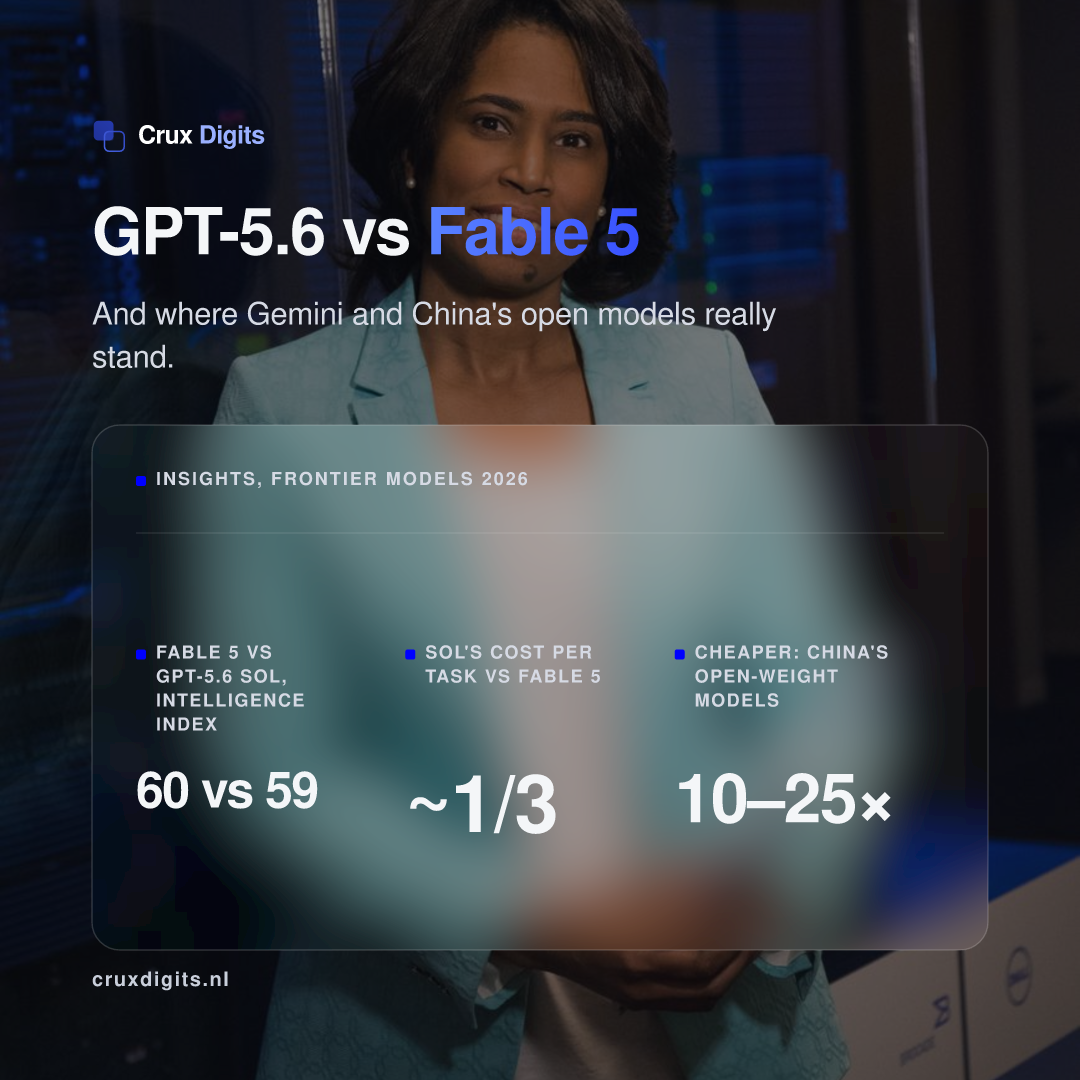
Now the scoring. On the independent Artificial Analysis Intelligence Index, Claude Fable 5 sits first at 60 and GPT-5.6 Sol (at maximum reasoning effort) second at 59 — a single point apart. But Sol reaches that score at roughly $1.04 per index task against Fable 5’s $2.75: near-identical intelligence for about a third of the spend. Anthropic’s list price tells the same story from the other side — Fable 5 costs $10 / $50 per million tokens, double Sol’s $5 / $30, and Claude Opus 4.8 sits at $5 / $25.
Flip to raw capability and Fable 5 pulls ahead where it counts for engineers. It leads WebDev Arena at around 1653 Elo — reported as the widest gap ever over a second-place model — and on Anthropic’s SWE-Bench Pro it posts about 80% against Sol’s 64.6%. That coding gap is real, but read it with care: the 80% figure comes from Anthropic’s own scaffolding, and the day before launch OpenAI published an audit arguing SWE-Bench Pro is partly broken, estimating that roughly 30% of its tasks are flawed. Convenient timing, but the methodological point stands: no single coding benchmark is gospel.
Where GPT-5.6 clearly wins is long-horizon agentic work. On Agents’ Last Exam, an evaluation of multi-step professional workflows across 55 fields, Sol sets a new high of 53.6 — 13.1 points clear of Fable 5, and OpenAI reports it still beats Fable at medium reasoning for about a quarter of the cost, with Terra and Luna beating Fable at roughly one-sixteenth. The practical read: Fable 5 is the sharper single mind for hard coding and dense knowledge work, while GPT-5.6 is the better-value engine for long, tool-heavy agent runs. Willison, who had early access, put it plainly — Sol is very competent, but not obviously better than Fable at complex coding.
Where Gemini stands
Google is not absent — it is just not on top this month. Its current flagship, Gemini 3.5 Pro, is still in limited preview as of early July — with general availability reportedly targeted for mid-July — yet it already flaunts a headline feature neither rival matches: a two-million-token context window, plus a "Deep Think" mode for the hardest reasoning. Gemini 3.5 Flash, which is already available, is the value play, fast and low-cost at around $1.50 / $9 per million tokens and competitive on agentic benchmarks like Terminal-Bench. The earlier Gemini 3.1 Pro still tops specific hard-reasoning tests such as GPQA Diamond and ARC-AGI-2, so Google’s bench is deep even when its flagship is not yet shipped.
But on the July snapshot of the Artificial Analysis Intelligence Index, Gemini does not appear in the top handful — the leaderboard belongs to Fable 5 and the GPT-5.6 tiers. Google’s edge is context length, price-performance and its enormous product surface — Search, Workspace, Android, a billion-plus users — not a benchmark crown. That distribution is a moat no benchmark captures, which is exactly why the interesting question for the rest of 2026 is what Google ships next, not what it shipped last.
The Chinese open-weight surge you can’t ignore
The most underpriced story in any Western model comparison is how fast the Chinese labs have closed the gap — and they did it mostly in the open. Four names matter for a European buyer:
- DeepSeek — the price destroyer. The V3.2 generation runs around $0.28 input / $0.42 output per million tokens, roughly 10 to 25 times less expensive than Western flagships, and ships open-weight so you can self-host it.
- Qwen (Alibaba) — the open workhorse. The Qwen3 line (including Max and Coder variants) is released under permissive Apache/MIT terms, leads on multilingual tasks, and is a genuine coding contender.
- Kimi K2 (Moonshot) — the agentic specialist. The K2.6 generation was reported as the first open-weight model to edge past a GPT tier (GPT-5.4) on SWE-Bench Pro, and its architecture leans hard into agent swarms of parallel sub-agents.
- GLM (Z.ai / Zhipu) — the open reasoner. The GLM-5 series is a roughly 750-billion-parameter mixture-of-experts model under an MIT licence, reported to beat earlier GPT and Opus tiers on agentic coding.
Two more labs round out the field — MiniMax and StepFun both ship capable low-cost or open models — and the whole Chinese cohort refreshes on a near-monthly cadence that Western quarterly cycles struggle to match. None of these has overtaken GPT-5.6 Sol or Fable 5 at the very top of the intelligence curve as of July 2026. But that is not the point. For a huge share of real work — classification, extraction, drafting, routing, retrieval — the open Chinese models are already "good enough," and they are 10 to 25 times less expensive, self-hostable, and improving fast. When the frontier labs argue about a single point on an index, the open-weight field is quietly resetting what the floor costs.
The caveats are equally real, and worth stating plainly. Benchmark claims from any lab — Chinese or American — deserve independent verification. Open weights still carry security and supply-chain questions. And hosting a Chinese-trained model, even on EU soil, is a decision your risk and compliance people should sign off on, not just your engineers. "Low-cost and self-hostable" is a strong argument, but it is not a governance-free one.
Speed, availability and what the benchmarks miss
Benchmarks measure a model on a good day; production measures it on every day, and three things that rarely make the leaderboard decide more real deployments than a point of index score. Rate limits and rollout: a frontier tier gated to a handful of partners is not something you can build a product on yet, however well it scores. Latency and throughput: an agent that makes fifty tool calls in a run feels the gap between a fast mid-tier model and a slow flagship far more than a user asking one question. And reliability of structured output — will the model return valid JSON on the thousandth call, not just the first — often matters more than another few points of reasoning depth. Test these on your own traffic before you trust any published number.
So which model is actually best?
There is no single winner, and any post that hands you one is selling something. Match the model to the job: Fable 5 for the hardest coding, refactors and dense analytical writing; GPT-5.6 Sol for long, tool-using agent runs where value-per-token compounds; Terra or Luna, Gemini 3.5 Flash, or a self-hosted Qwen/DeepSeek for the high-volume, unglamorous tasks that make up most production workloads; Gemini 3.5 Pro when you need a two-million-token context or its Deep Think mode.
The deeper lesson is to distrust any leaderboard as a purchase decision. Benchmarks are vendor-scored, harness-sensitive, and — as OpenAI’s own SWE-Bench Pro audit shows — sometimes measurably broken. The number that matters is accuracy and cost on your task, your data, in your language, measured on your own evaluation set. What changed this year is worth saying plainly: a single point of intelligence-index difference between the two leaders is now worth less than the three-to-one cost gap beneath it, and the open-weight floor has risen far enough that the least expensive sensible option is rarely the worst one. We wrote a fuller treatment of that trade-off in OpenAI vs Anthropic vs open-source LLMs.
What this means for a Dutch SME
For a Dutch mkb, the frontier war is mostly good news you should not overreact to. The single most valuable architectural decision is to stay model-agnostic: route your AI agents and automations through a thin abstraction so you can swap Sol for Terra, or a proprietary model for a self-hosted open one, without rewriting your product. Model prices have fallen and re-sorted several times this year alone; hard-wiring one vendor is the expensive mistake.
Second, right-size the model to the task. A 20-to-50-person company automating offertes, invoice handling or customer service almost never needs the $10 / $50 flagship; Terra, Luna or Gemini Flash will run those workloads at a fraction of the cost and latency. Reserve the flagship for the genuinely hard 10% — and even there, measure whether the quality gap justifies the price on your own cases. This is the same discipline behind reading where AI is heading in 2026 without chasing every release. One habit makes it concrete: keep a small private evaluation set of your own real tasks — twenty to fifty representative examples with known-good answers — and re-run it whenever a new model lands. It costs an afternoon, and it turns every release week from anxiety into a fifteen-minute decision.
Third, the Chinese open-weight models raise a real, two-sided question for European buyers. Because they ship open-weight, you can self-host them inside the EU, which keeps customer data on your own infrastructure — a genuine advantage under the GDPR. But "self-hostable" is not "govern-free": you still owe a security and supply-chain review, and for regulated or mid-market firms of 250 to 500 staff, a governance layer. If you want that decision made properly rather than by hype, that is the kind of vendor-neutral AI consulting and applied-AI delivery for larger organisations we do — and the same instinct sits behind our list of the best AI automation tools for 2026.
The pace-setters, and the question hanging over the rest of 2026
For now the tempo is being set in San Francisco. OpenAI’s GPT-5.6 and Anthropic’s Fable 5 are trading the top two spots week by week — one on efficiency and agentic reach, the other on raw quality — while China’s open labs reset the price of everything beneath them. Google has the deepest bench in the industry, a two-million-token context and a billion-user distribution, yet it spent this cycle answering rather than leading. So the real question is not who won July. It is how Gemini tries to catch up with what Anthropic and OpenAI just shipped — and whether Google’s next move turns its distribution advantage into a benchmark one. Let’s see how Gemini answers. We will be watching.
We build custom AI and LLM systems that run in production: a clickable MVP by the second call, fixed steps, and you own the code.
AI development agency in the Netherlands →