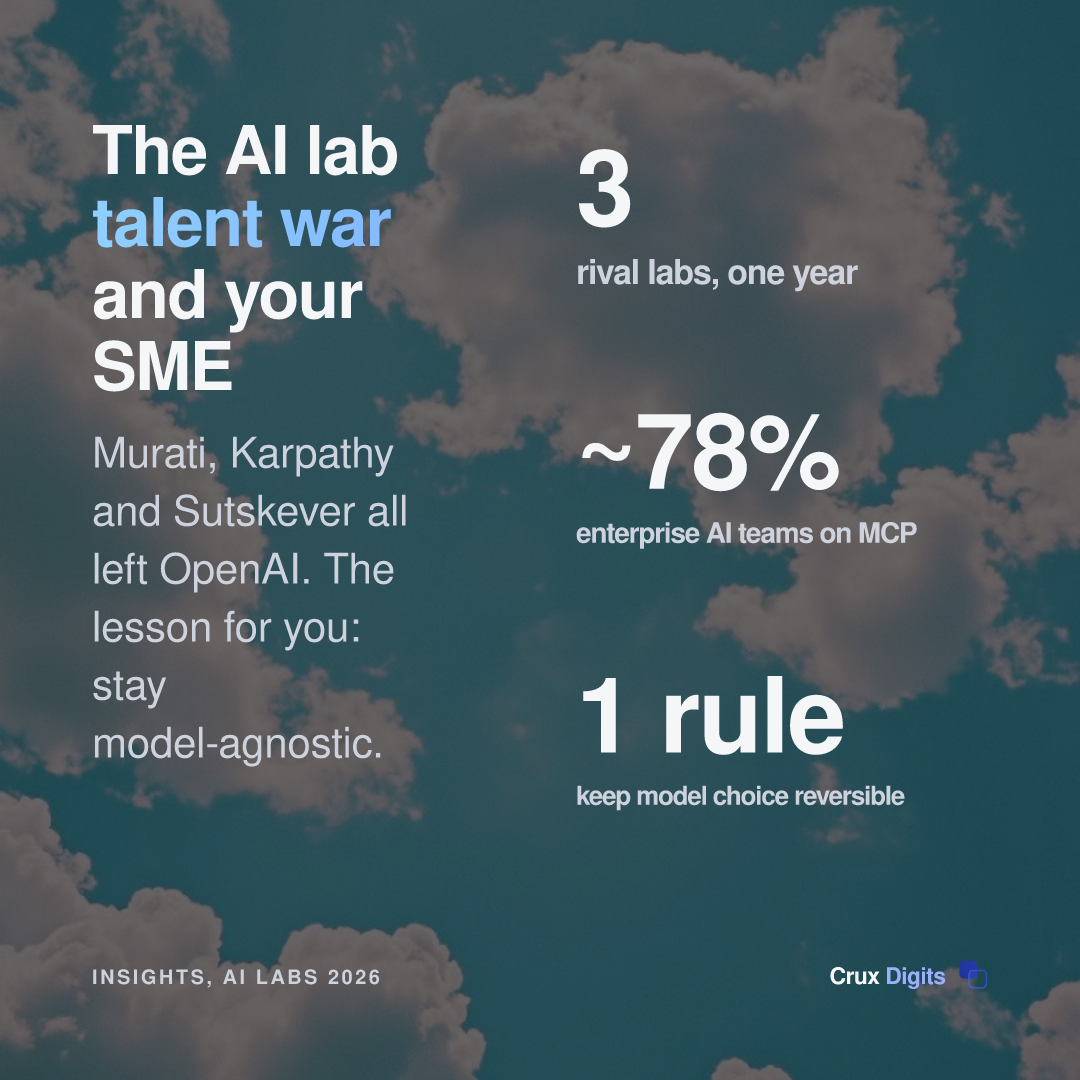
In 2026 the people who built modern AI scattered across rival labs: OpenAI’s former CTO Mira Murati now runs Thinking Machines Lab, co-founder Andrej Karpathy joined Anthropic, and former chief scientist Ilya Sutskever is building Safe Superintelligence in near-total secrecy. You will never hire any of them. But the talent war they touched off has one clear lesson for a Dutch SME: build so you can switch labs at low cost, because the frontier is moving faster than any single vendor’s roadmap.
What actually happened in 2026
Murati left OpenAI in 2024 and founded Thinking Machines Lab in early 2025 with a group of senior OpenAI researchers. The lab raised extraordinary sums — a multi-billion-dollar seed, then a Series B at a reported multi-billion-dollar valuation — and shipped its first product, Tinker, an API for fine-tuning open-weight models. Then the same talent market that built it began pulling it apart: by early 2026 several co-founders had left — some back to OpenAI, one to Meta.
In May 2026, Karpathy — one of OpenAI’s original eleven — joined Anthropic to lead a team using Claude to accelerate its own pre-training. Meanwhile Sutskever’s Safe Superintelligence has raised billions and, unusually, still has no public product; its entire pitch is safety-first research in stealth. Three of the most important people in AI, three completely different bets: a fine-tuning platform, AI that improves AI, and superintelligence-in-secret.
None of this is unusual any more. Across 2025 and 2026 the frontier labs paid record sums to pull senior researchers back and forth — seed rounds in the billions, valuations that doubled in months, co-founders who changed employer twice in a year. The takeaway for a business owner is not who is ahead. It is how unstable “ahead” has become.
Why this matters even if the drama feels far away
For an installer in Houten or a wholesaler in Nieuwegein, none of this looks like your problem. It is — indirectly. The tools you buy sit on top of these labs’ models. When talent and capability move this fast, three things follow: capability jumps arrive unevenly (the “best” model changes every few months), pricing and access terms shift, and the lab you standardised on last year may not be the one you’d pick today. Access terms shift too: a model you rely on can get more expensive, rate-limited, or deprecated with a few months’ notice. Betting your operations on a single lab is a bet that its roadmap and its people stay put. In 2026, neither is a safe assumption. See our primer on agentic AI for Dutch SMEs for where this is heading.
The pattern underneath the headlines
Strip out the valuations and the signal is useful. Karpathy’s mandate at Anthropic — using AI to speed up building AI — is where serious money now goes: compounding, self-improving systems, not just bigger models. Murati’s Tinker points the other way, toward fine-tuning open-weight models you can run yourself. And SSI’s silence is a reminder that “safety and control” is now a product category, not a footnote. For an SME the through-line is simple: capability will keep commoditising, and the durable advantage is not the model — it’s your data, your workflows, and how cleanly you can put a better model into production when it arrives.
There is a cost to getting this wrong, and it is rarely the licence fee. It is the rebuild: teams that wired everything to one provider’s bespoke features routinely spend weeks re-integrating when they finally switch — and many simply don’t, staying on a worse or pricier model because moving hurts. Model-agnostic design is how you keep that option open before you need it.
Three bets, and what each signals for your stack
Anthropic’s bet is AI that improves AI. Karpathy’s team is pointed at self-improving research pipelines. For you that means capability will keep jumping and, as labs compete, the price per token keeps falling — so plan for less expensive, better models every few months rather than a one-time purchase.
Thinking Machines’ bet is open-weight fine-tuning. Tinker makes it realistic to tune a model you host yourself. For an SME with privacy-sensitive data or high volume, a small private model is now a real option alongside the big API providers — worth evaluating, not adopting by default.
SSI’s bet is safety and control as the product itself. Sutskever raised billions to sell trust, not features. Expect “governed, auditable, EU-hosted” to become a normal line item you can buy — genuinely useful under the EU AI Act, and a fair thing to demand from any vendor.
What a Dutch SME should actually do
You don’t need to track every lab. You need an architecture that treats models as swappable. A practical six-month posture:
Stay model-agnostic. Choose tools and partners that let you switch between Claude, GPT, Gemini and open-weight models without a rebuild. Ask any vendor one question: what does it cost me to change model? That is what a good AI agent build should make low-cost.
Build on open standards. The Model Context Protocol (MCP) — now in production across most enterprise AI teams — lets agents talk to your systems in a standard way, so your integration work outlives any one model. Prefer tools that speak it.
Own your data and your workflow logic. The lab supplies intelligence; you supply context. Keep your data, prompts and process rules in your control, not locked inside a vendor’s black box.
Buy capability, not hype. Judge a tool by the job it does this quarter, not the founder’s pedigree — the same discipline that keeps AI pilots from failing.
Revisit quarterly. Put a 30-minute standing review on the calendar: is a better or less expensive model available, and how hard would switching be? For a 250–500-person firm, make one person accountable for it.
Concretely, the difference is architecture, not ambition. Picture two 30-person accountancy firms: the one that built its document intake against an open standard can point the same workflow at a newer model in an afternoon; the one that hard-wired a single vendor’s proprietary API rebuilds the integration from scratch. Same AI, very different switching cost — and that cost is the whole game.
Where this is going next
Expect the churn to continue: more labs, more defections, and at least one more “record” funding round before the year is out. The capability gap between the top models will stay narrow, which is good news for buyers — it pushes competition onto price, safety and integration instead of a single winner you must chase. The practical response never changes: keep your data close, your integrations standard, and your model choice reversible.
What not to do
Don’t re-architect around whichever lab is winning this month. Don’t sign multi-year commitments that assume today’s model rankings hold. And don’t confuse a famous founder with a finished product — Thinking Machines had the most celebrated team in AI and still lost co-founders within a year. Boring, swappable and well-integrated beats brilliant and locked-in.
The AI talent war will keep making headlines through 2026. The SMEs that benefit won’t be the ones who guessed the winner — they’ll be the ones who built so it didn’t matter. If you want a second pair of hands on a model-agnostic setup, that’s what we do.
A consultant tells you where AI pays off; Crux Digits also builds it. A fixed price per step, one named expert, from Utrecht.
AI consultancy in the Netherlands →