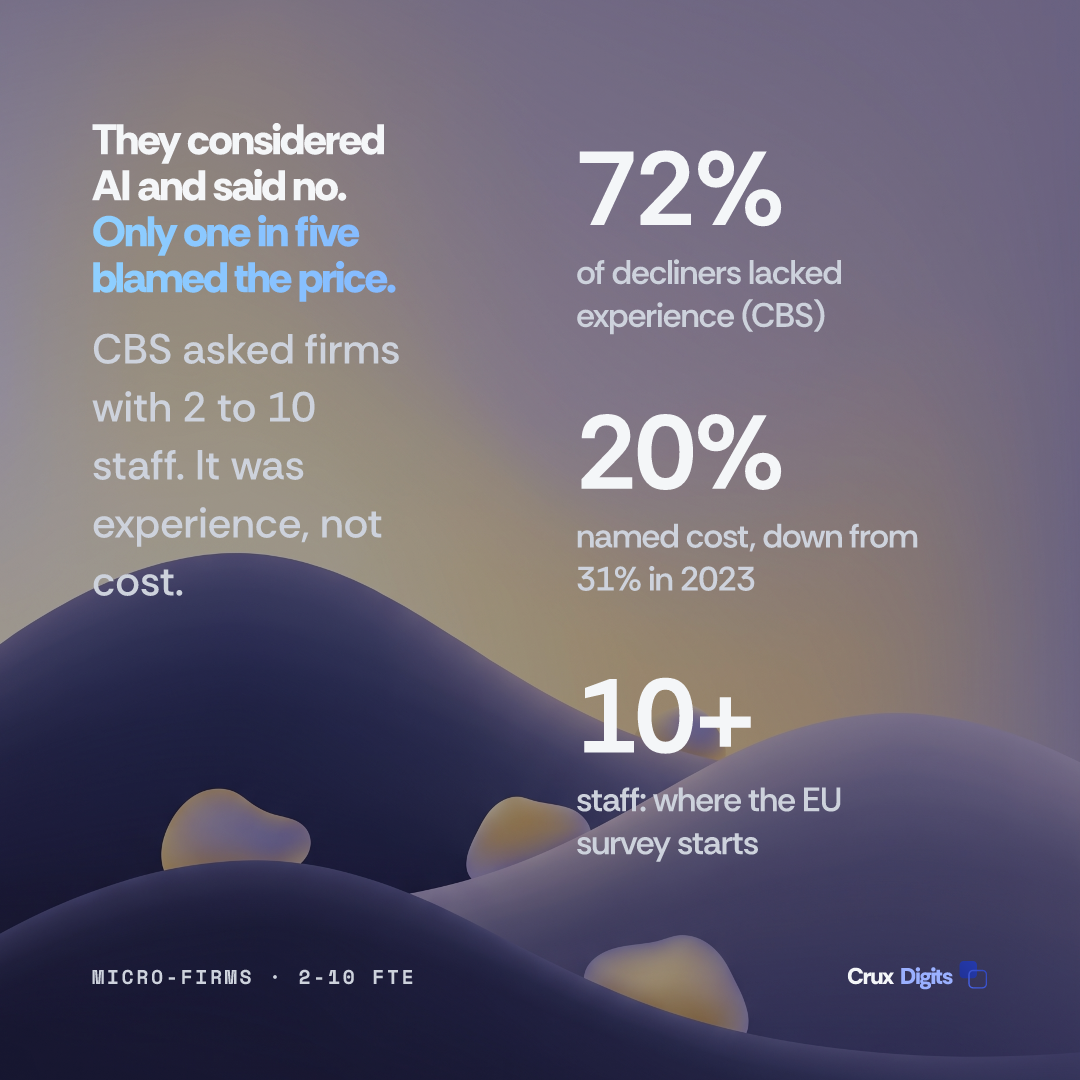
Of the Dutch micro-firms that considered AI in 2025 and decided against it, 71.6 percent gave lack of experience as a reason. Cost came near the bottom at 20.3 percent, and has fallen every year since 2023. If you employ two to ten people, what stands between you and a useful AI system is almost certainly not the price. It is that nobody has told you what to point it at.
How many small Dutch firms actually use AI?
On 16 March 2026 CBS published a report on AI use by Dutch micro-firms, covering companies with 2 to 9 staff over 2023 to 2025. These are rare statistics, and the reason they are rare matters.
In 2025, 13.8 percent of those firms used at least one of seven surveyed AI technologies. That was 10.6 percent in 2024 and 6.8 percent in 2023, so use has roughly doubled in two years. For comparison, 29.8 percent of firms with 10 to 249 staff used AI, and 66.2 percent of firms with 250 or more. Inside the micro band the gradient is steep in its own right: 11.6 percent at two staff, 14.1 percent at three or four, 19.0 percent at five to nine.
What they use is narrower than the word "AI" suggests. Text mining led at 9.8 percent, natural language generation at 6.5 percent, speech recognition at 4.4, machine learning at 2.6. Autonomous robots and vehicles sat at 0.5 percent. Reading and writing text, not machines that move.
The sector spread is enormous. Information and communication reached 50.4 percent, specialist business services 27.1, financial services 19.0, health and welfare 13.7, manufacturing 10.9, trade 9.0, construction 4.6, hospitality 4.2, transport and storage 3.6. One in two against one in twenty-eight, same size band, same year.
Why do the usual AI statistics not describe your company?
Because most of them cannot see you. The figures everyone quotes about European AI adoption come from the EU survey on ICT usage in enterprises, and its methodological note states plainly that it refers to enterprises with at least 10 employees. That is the survey behind the headline that 20.0 percent of EU enterprises used AI in 2025, up from 13.5 percent in 2024.
CBS makes the blind spot explicit: the number of Dutch firms with 2 to 10 staff is about five times larger than the number with 10 or more. Most Dutch companies are advised on the basis of a survey that starts above them, and that includes our own overview of AI adoption in the Dutch MKB. When an article says "most SMEs already use AI", check which SMEs it counted.
The Wennink report of December 2025 names digitalisation and AI as one of four pillars for future Dutch prosperity, and argues that mass application of AI in companies could deliver a structural productivity gain otherwise out of reach. CBS’s reading of its own numbers is dry: that mass application so far appears mainly a reality among the larger firms.
What actually stops a small firm that has considered AI?
This is the part of the CBS report with no equivalent anywhere else for firms this size. The list below covers firms with 2 to 9 staff that did not use AI in 2025 but had considered it. It ranks why the ones who looked walked away, not why all non-users abstain.
- Lack of experience 71.6 percent, up from 56.5 percent in 2023
- Privacy 48.8 percent, up from 34.1 percent
- Legal consequences 42.7 percent, up from 35.1 percent
- Hard to obtain 37.6 percent, up from 21.4 percent
- Incompatibility with existing systems 32.2 percent, up from 24.2 percent
- Ethical concerns 21.0 percent, up from 19.6 percent
- Cost too high 20.3 percent, down from 30.9 percent
- Not useful 16.9 percent, down from 21.1 percent
Six of the eight reasons rose over two years. The two that fell are the only two that amount to a business judgement: it costs too much, and it would not help us. Small Dutch firms are not concluding that AI is unaffordable or pointless, but that they do not know how, cannot trust it with their data, and cannot make it fit. Three problems, and only one is about technology.
Two caveats. The 2025 figures are provisional and carry wide margins: lack of experience is 71.6 percent, with a 95 percent confidence interval of 65.9 to 76.7. And the base is firms that considered AI, a self-selecting group. Neither touches the direction, which holds across all three years.
Why has cost stopped being the barrier?
Put that list next to a second CBS table and an explanation appears. Chapter 5 records how micro-firms obtained the AI they use, and the shift between 2023 and 2025 is severe:
- Commercial software used directly: 49.0 percent in 2023, 48.2 percent in 2025. Flat.
- Open-source software adapted in-house: 29.5 down to 18.0 percent.
- External suppliers hired to build or adapt: 23.5 down to 12.4 percent.
- Developed by own staff: 19.8 down to 10.1 percent.
- Commercial software adapted in-house: 18.5 down to 16.1 percent.
Read as shares of AI users, every build route lost ground. But AI use itself doubled over those years, so these are slices of a bigger pie. Multiply each share by the adoption rate and you get the share of all micro-firms per route: the two that mean commissioning or staffing a development project are flat. Hiring an external supplier went from about 1.6 to 1.7 percent of all micro-firms and building in-house from 1.3 to 1.4, while direct use of commercial software went from 3.3 to 6.6. Nothing shrank. Two thirds of the growth came through the one door that needs nobody to write code, and the pattern tightens as firms get smaller: 19.2 percent of firms with 5 to 9 staff hired an external supplier, against 6.2 percent of firms with two.
Our reading, and CBS publishes the two tables without connecting them, is that the acquisition route explains the blocker mix. If AI arrives switched on inside your existing package, the marginal price is close to zero, so "too expensive" stops being an objection anyone reaches for. But the same choice creates the objections that rose fastest. "Hard to obtain" and "does not fit our systems" are what you get when the only route available is whatever your vendor decided to ship. A bundled feature cannot be made to fit a process it was not designed for. You can only wait for the roadmap.
Which objection will your sector hit first?
The blocker mix is not uniform, and the sector breakdown is the most useful table in the report, though its intervals are wide enough that the ordering within a sector is indicative. Lack of experience leads in every sector CBS breaks out, so the useful question is which objection comes unusually close behind.
- Trade: lack of experience dominates at 79.5 percent, privacy 42.9, legal 40.8.
- Health and welfare: experience still leads at 71.1 percent, but privacy is unusually close at 60.6 and legal consequences at 56.4.
- Manufacturing: lack of experience 75.1 percent, and the lowest privacy concern of the six sectors CBS breaks out, at 25.2.
- Information and communication: the lowest experience barrier at 58.2 percent, with privacy almost level at 57.6.
- Specialist business services: experience 59.1 percent, privacy 49.7, hard to obtain 37.7.
Read that as a sequencing instruction rather than a statistic. A three-person wholesaler whose first blocker is knowledge should spend the first month on a supervised trial of one process, because the fastest cure for inexperience is a small piece of real experience. A three-person care practice where privacy and legal exposure sit almost level with inexperience should spend that month on the data-classification decision and the processing agreement, before any tool is opened. Same technology, opposite first move.
Is "we lack experience" a reason to stop?
Of the eight reasons CBS records, exactly one is a decision: "not useful", at 16.9 percent and falling. That is a firm that looked at the work and concluded the tool does not address it. Nothing to fix there; it is the honest answer and it is right more often than vendors admit.
The other seven describe a position, not a conclusion about AI. Privacy and legal exposure are scope and contract questions with known answers. Incompatibility is an integration question. Lack of experience is a question about who you ask, and it is the one most often answered badly. The standard response is training, which reliably produces people who can write a decent prompt and still cannot say which process is worth automating. Different skills, and the second is the gap that actually stalls projects.
There is also a regulatory reason this barrier is getting attention. Regulation (EU) 2026/1744, in force since 27 July 2026, rewrote Article 4 of the AI Act. Where it previously required providers and deployers to ensure, to their best extent, a sufficient level of AI literacy among staff, it now requires measures that support the development of AI literacy, and states that no specific level for any individual is required. An obligation of effort rather than result, and a second paragraph tasks the Commission and member states with supporting those efforts, with particular regard to SMEs.
The duty did not go away. Article 50 transparency is unaffected, and the deferrals elsewhere concern high-risk systems rather than the basics. Our AI Act checklist for the MKB sets out what a firm this size has to do. The point is narrower: the most-cited reason small Dutch firms walk away is now the thing EU law has asked member states to help them with.
What should you do this quarter with two to ten staff?
Five steps, in this order, and the order is the advice.
- Name the three tasks that ate the most hours this month. Not "admin". Name them: chasing missing hours before invoicing, retyping supplier order confirmations, answering the same six customer questions. If you cannot name them, that is week one, not a reason to buy software.
- Check your instinct against what comparable firms use AI for. Among micro-firms that use AI, the purposes were marketing or sales 32.7 percent, administrative or management processes 25.9, research and development 23.4, production 15.4, accounting 12.9, IT security 6.5 and logistics 2.3. One detail: research and development is the only purpose where the smallest firms lead, at 26.6 percent for two-person firms against 21.9 at five to nine.
- Decide the data boundary before you choose a tool. Which of those tasks touches personal data, client-confidential material, or pricing you would not send unencrypted? That answer constrains the shortlist, and it is less painful now than unwound later.
- Give one task a four-week supervised run. A human checks every output, and somebody counts the exceptions. Four weeks of counted exceptions tells you more than any demonstration, and converts "lack of experience" into evidence. Choosing which process goes first is worth more thought than choosing the tool.
- Only then ask what shape the answer takes. A feature you already own, a tool you buy, or a connection into the system your business runs on. For most Dutch firms this size that last question is really about getting AI to talk to Exact, AFAS or e-Boekhouden, which is where the incompatibility figure comes from in the first place.
None of this requires a budget decision in week one, which is the point. The CBS numbers say the firms that walked away did so mostly for reasons a month of supervised work would answer. If you would rather not spend it guessing, this is the kind of question we answer for firms your size, and often enough the answer is that one of your three tasks is worth it and two are not.
Last updated 16 September 2026. CBS figures published 16 March 2026 for reference year 2025; the 2025 figures are provisional.