Most articles about "AI for business" are written for enterprises with data-science teams and seven-figure budgets. That is not the Dutch MKB. If you run a company with 10, 50 or 200 people, the real question is narrower and more honest: which AI use cases return more than they cost, and how soon?
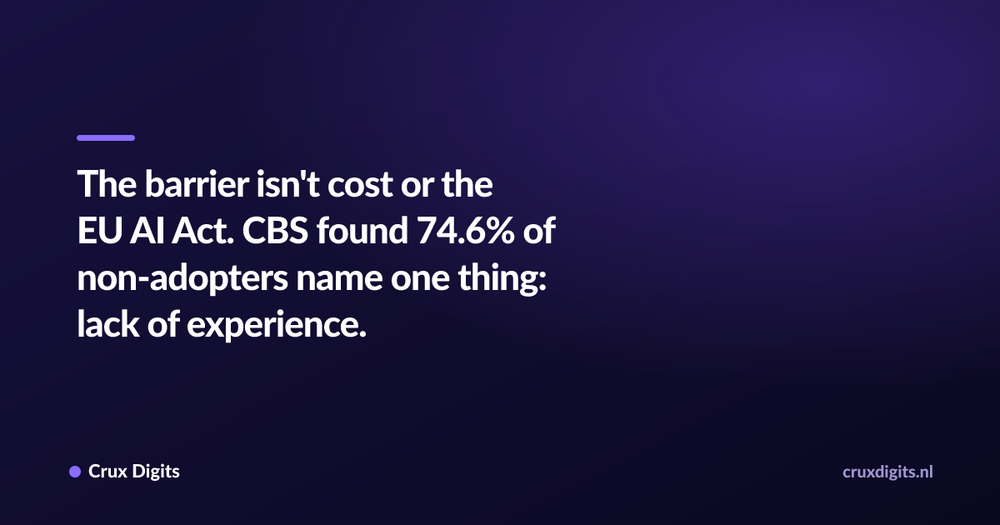
The gap is real. According to CBS (AI-monitor 2025), 29.8% of Dutch SMEs with 10–249 staff now use AI, rising to roughly 59% of large firms with 500+ employees, while only 13.8% of micro-firms (2–10 people) have started. CBS also found that 74.6% of non-adopters name a single top barrier: lack of experience. Not cost, not the EU AI Act — inexperience. And yet the Ministry of Economic Affairs report *AI-gebruik in het mkb: ambitie of aarzeling?* (2025) found that more than half of Dutch SMEs plan to invest in AI and automation.
So the intent is there. What is missing is a clear map of where AI actually pays back. Below are 12 use cases, grouped by function, each framed as problem → what AI does → the return. Every number is cited. We deliberately avoid the fantasy figures.
Front office: service, sales and marketing
1. Customer service automation. The problem: repetitive tickets — "where is my order", "how do I reset this", "what are your hours" — eat your team's day. Zendesk's 2025 CX Trends research indicates AI can fully resolve around 75% of routine customer questions and cut first-response time by up to 74%. Klarna reported average resolution dropping from 11 minutes to 2. The economics are stark: an AI-handled contact costs roughly $0.25–0.50 versus $3–6 for a human, and studies point to about 40% lower total support cost. For an MKB team drowning in email, this is often the fastest payback of all. See our thinking on AI customer service.
2. Marketing and content. CBS found marketing and sales is already the single most common AI use in Dutch micro-firms at 32.7%. The problem it solves is throughput: a two-person marketing function producing first drafts, product descriptions, ad variants and translations at a fraction of the hours. It does not replace a strategist; it removes the blank page. Natural-language generation is used by 14.6% of SMEs per CBS — modest, which tells you the room to grow is large.
3. Lead scoring. The problem: sales reps spend equal effort on leads that will never close and leads that were ready to buy. AI ranks inbound leads on likelihood to convert using your own CRM history, so the team calls the right names first. The return is not magic revenue — it is reclaimed selling time and a higher hit rate on the same pipeline.
4. Sales assistants. Internal AI assistants draft proposals, summarise long email threads, pull the right case reference and prep call notes. Federal Reserve and production-AI studies put the median time knowledge workers recover on production AI at around 6.4 hours per week, with broader estimates of ~5.4% of work hours (roughly 2.2h/week) saved. For a commercial team, those hours convert directly into more conversations.
Back office: documents, admin and reporting
5. Document and invoice processing. The problem: someone keys invoices, delivery notes and contracts into your systems by hand. AI reads them, extracts the fields and routes them for approval. Administration is already the second most common AI use in Dutch micro-firms at 25.9% (CBS), and it is where text mining — used by 21.3% of SMEs — earns its keep. This is unglamorous and one of the most reliable payback cases in the MKB.
6. HR administration. Contracts, leave requests, onboarding checklists and policy questions are repetitive and rules-based. An AI layer answers common employee questions and pre-fills paperwork, freeing a small HR function to do the human parts of the job. The saving compounds because it removes interruptions, not just tasks.
7. Recruitment screening. The problem: a single vacancy can draw hundreds of CVs. AI shortlists against role criteria and drafts first-round questions. This is exactly where the EU AI Act matters: recruitment screening is classified as high-risk, so you need human oversight, documented criteria and bias checks, and AVG (GDPR)-compliant handling of applicant data. Used carefully it saves days per hire; used carelessly it creates legal exposure. The tool must assist the decision, never make it.
8. Reporting and BI. Month-end reporting, ad-hoc "how did region X do" questions and dashboard commentary are slow. AI turns plain-language questions into queries over your own data and writes the first draft of the narrative. The return is faster decisions and fewer analyst-hours spent formatting rather than thinking.
Operations: forecasting, quality, maintenance and logistics
9. Demand forecasting. The problem: too much stock ties up cash; too little loses sales. AI models seasonality and trends more accurately than a spreadsheet, tightening inventory and cutting both stockouts and dead stock. For any MKB that holds goods, working-capital improvement is the return — often visible within a quarter.
10. Quality inspection (machine vision). On a production or packing line, AI cameras catch defects a tired human eye misses, consistently and at speed. The return is fewer returns, less rework and less waste. It suits manufacturers and food producers where a defect that escapes is expensive to fix downstream.
11. Predictive maintenance. The problem: unplanned downtime. AI reads sensor data to flag a failing motor or pump before it stops the line, so you service on schedule instead of in crisis. For asset-heavy MKB firms this is one of the clearest ROI cases — a single avoided outage can cover the project. We go deeper in predictive maintenance with AI.
12. Route and logistics optimisation. For anyone running vehicles, AI plans routes against traffic, time windows and load, cutting kilometres, fuel and driver hours. The saving is measurable on the first month's fuel bill and scales with fleet size.
What it returns — and what it honestly costs
Be sceptical of anyone quoting a fixed ROI. The honest picture: one 2025 study found high-return AI projects delivering around 150% first-year returns through savings, with the biggest productivity gains in software/IT and customer service (both ~32%) and procurement (27%). But full ROI usually takes time, and a poorly scoped project returns nothing. McKinsey estimates 60–70% of work hours go to tasks AI can partly automate — "partly" being the operative word.
One reassuring finding for owners worried about their people: a 2025 SMB workforce study found 82% of AI-adopting small and mid businesses grew their workforce rather than cut it. In practice AI removes the drudgery so the same team handles more, better work.
How to start
Do not try all twelve. Pick the one use case where you already feel the pain daily and the data already exists — usually service automation, invoice processing or forecasting. Prove it small, measure it honestly, then extend.
This is exactly how we work at Crux Digits. A fixed-price AI audit (€2,500) identifies where AI pays back in your specific business before you commit to building anything; a proof of concept (€20,000) proves one use case on your real data; production builds start from €50,000. One named expert owns your project, you own the code, and everything is built to be EU AI Act and AVG-compliant from the first line. If you want to see where you stand, our free scan is a sensible first step — and our overview of AI for the MKB covers the groundwork.
The barrier CBS identified — inexperience — is the one thing a good partner removes fastest.
The AI audit & strategy: in one to two weeks, a ranked list of use cases with a return per opportunity, and a plan you own.
AI audit & strategy →