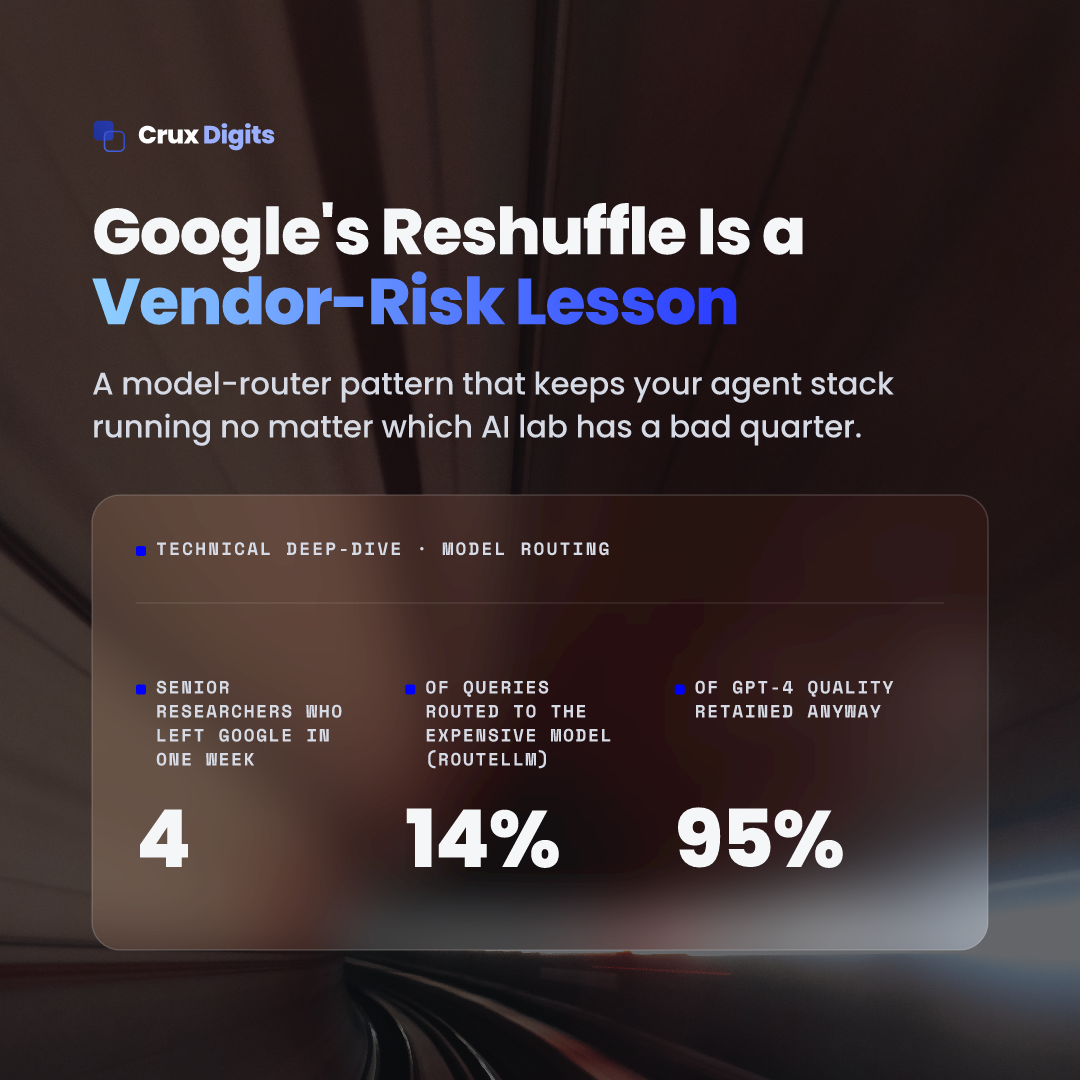
On 5 August 2026, Google reorganised its entire AI leadership in one announcement: DeepMind CEO Demis Hassabis stepped back to become chairman and Alphabet's chief scientist, day-to-day control of Gemini passed to Koray Kavukcuoglu, and chief scientist Jeff Dean left after 27 years to start a rival lab. If your production agent stack has a single provider's SDK wired directly into its business logic, this is what vendor concentration risk looks like in practice — and the fix is a model router, not a change of vendor.
What actually changed at Google this month
Hassabis moved out of DeepMind's CEO seat into a chairman and Alphabet chief scientist role, while continuing to run Isomorphic Labs, the company's drug-discovery spin-off. Kavukcuoglu, previously DeepMind's CTO, now runs Gemini model development and Google's developer AI platforms as SVP, reporting directly to Sundar Pichai — which makes him, in practice, the person who now sets the roadmap and priorities for every team building on Gemini or Vertex AI. On the same day, Jeff Dean announced he was leaving after 27 years, taking senior fellow Sanjay Ghemawat, Google Brain co-founder Quoc Le and DeepMind VP Oriol Vinyals with him to found Discovery Loop, a public-benefit corporation aimed at automating the scientific research loop. Google is a founding investor and cloud partner in the new venture, alongside Radical Ventures and Khosla Ventures.
Why this is an architecture problem, not office gossip
The reshuffle wasn't a bolt from the blue. Gemini 3.5 Pro had already missed three announced release dates; Google reportedly scrapped a near-ready version of the model and restarted pre-training from a native Gemini 3 foundation after persistent coding and reliability problems, and four senior researchers, including Gemini co-lead Noam Shazeer, had already left for OpenAI and Anthropic before the August leadership change was even announced. None of that is unique to Google — every lab has had a rough quarter in 2026. The point for an engineering team is narrower: if your architecture assumes any single lab's roadmap, you inherit that lab's internal turmoil. A delayed model, a reorganised team, a changed pricing tier or a deprecated endpoint are all the same failure mode wearing different clothes — model quality is not the only variable that can move under you.
What a model router actually is
A model router is a middleware layer that sits between your application and a pool of available LLMs, and its job is to send each request to the model that actually fits it — instead of paying frontier-model prices for a question a small model answers just as well. It decides per request based on signals like task complexity, cost per token, provider latency and load, and current availability, then forwards the call — or, in some implementations, just returns a recommendation and lets the calling application make the request. Most teams reach for one once LLM usage stops being an experiment and becomes shared infrastructure: several models in play, real cost pressure, and reliability expectations that can't tolerate a single provider outage taking down a whole feature.
Rule-based, semantic and predictive routing
Production routers tend to use one of three strategies, usually layered in this order as traffic grows.
- Rule-based routing: requests are assigned by predefined conditions — keywords, length thresholds, header tags. It's simple, predictable and easy to debug, but the rules need constant maintenance as the task mix shifts, and edge cases get misrouted.
- Semantic routing: queries and candidate routes are embedded as vectors and matched by similarity, so "what's my balance?" and "how much money do I have?" land on the same route despite sharing no keywords. It needs a sensible similarity threshold and a fallback for anything that scores below it.
- Predictive routing: a model learns from labelled preference data which provider will handle a given query best, then weighs quality against cost. The reference implementation here is RouteLLM, whose matrix-factorisation router reports retaining 95% of GPT-4's MT-Bench score while sending only 14% of queries to the expensive model. It needs training data and a reasonably stable query distribution to hold up — most teams should start rule-based and only reach for this once a simpler router demonstrably falls short.
Failure handling is the part that actually saves you
Cost optimisation is the reason most teams start building a router; resilience is the reason it matters during a week like Google's reshuffle. Different failure modes need different responses, and treating them all as the same retry-and-fallback case is a common mistake: a hard 5xx calls for an immediate switch to another model; a 429 rate limit means backing off and retrying after the provider's stated delay, not hammering it again; rising latency without an outright error means shifting new requests to a faster provider before users notice; and a content-filter rejection means the prompt tripped a safety check, not that the provider is broken, so it needs policy remediation rather than a retry. Two patterns do most of the work here, as Redis's write-up on production router architecture lays out: a circuit breaker that stops sending requests to a provider once its failure rate crosses a threshold, and multi-provider failover that shifts traffic to a second provider automatically. Neither brings a dead provider back online, but both stop a team from burning time and budget on calls they already know will fail — exactly the layer that would have absorbed a Gemini disruption during reshuffle week without anyone downstream noticing.
Build or buy: LiteLLM, OpenRouter and self-hosting
Two open paths cover most teams. LiteLLM is a self-hosted, open-source proxy that exposes a single OpenAI-compatible interface to over a hundred providers, with cost tracking, guardrails and load balancing built in — you run it yourself, so you control data residency and infrastructure cost. OpenRouter is a hosted gateway to hundreds of models behind one API: faster to start, less operational overhead, but you're trusting a third party with the routing layer itself. For most teams under real production load, a hosted gateway is the honest starting point; self-hosting earns its keep once request volume, data-residency requirements or margin pressure make the operational cost worth it — typically once a team is running agents in production for several clients rather than a single pilot.
What this means for a Dutch or Flemish engineering team
The lesson here is not "stop using Gemini." Gemini remains a competitive model, Google remains Discovery Loop's own cloud partner and investor, and nobody serious is betting Google exits AI over one leadership reshuffle. The lesson is architectural: a software team of roughly 20-50 FTE building agentic workflows for clients, or a mid-market team past pilot into production, should not let a single provider's SDK sit directly inside business logic. A thin interface — even just LiteLLM's OpenAI-compatible call signature — behind your agent framework of choice (LangGraph, Google ADK, Pydantic AI) costs a day or two to add early and becomes expensive to retrofit once three product teams depend on provider-specific prompt formats and response shapes. That is the same lesson our piece on the 2026 framework convergence drew from the architecture side, and the same one we made on the business side in why AI strategy shouldn't chase the best model — this is what it looks like to actually build that independence into code, not just into a vendor conversation.
A minimal viable router, in practice
You don't need RouteLLM-grade sophistication to get the benefit. A defensible starting point for a small team:
- Put one interface between your agent code and every model call, even while only one provider is live behind it.
- Configure a second provider as a cold fallback before you need it, not after an outage forces the conversation.
- Log timeouts, rate limits and content-filter rejections as distinct events — they need different automated responses, not one generic retry.
- Add a circuit breaker before you add a second routing strategy; resilience pays off before sophistication does.
- Review vendor concentration on your architecture review cadence, not just your contract renewal date — the Google reshuffle happened between quarterly reviews for most teams that got caught out by it.
Where to start
If your agents are still hard-wired to a single model provider, mapping the interface boundary is a days-not-months exercise, and it's worth doing before the next lab reshuffle rather than after. See how we approach production agent architecture on our AI agent development page.
We build custom AI and LLM systems that run in production: a clickable MVP by the second call, fixed steps, and you own the code.
AI development agency in the Netherlands →