I've sat through hundreds of first conversations with people weighing up AI. Call it an AI consultation if you like, though the word makes it sound more formal than it is. The best ones don't feel like meetings at all. They feel like two people leaning over the same problem, genuinely curious about it, trying to work out what's actually going on before anyone reaches for a solution. No deck. No pitch. Just thinking out loud together. This is about what that feels like — and why, after all these years, it's still the part of the work I care about most.
I won't pretend it's a method. There's no script I run. If anything, the moment a conversation starts following a script is the moment it stops being good.
It doesn't feel like a sales call
You can tell within a minute or two when a conversation is going to be good, and it has nothing to do with how the other person sells me on their company or how I sell them on mine. Nobody's selling. The vendor-and-buyer postures drop away, and what's left is the problem on the table and two people who find it interesting. I'm not waiting for my turn to talk. They're not bracing for a pitch. We're both just... in it. And that shift is not something you can will into being; it either happens because the problem is real and shared, or it does not happen at all. The most I can do is make room for it and stay out of its way.
I've written before about how I'd rather people self-select than be sold to, and this is the felt version of that. When neither person is performing, the conversation can go where the problem leads instead of where the agenda points. That's rare in business, and you notice it immediately when it happens.
The moment it turns into two people at a whiteboard
There's a specific shift I wait for. It usually comes a few minutes in, once the throat-clearing is done. Someone says the real thing — the actual frustration, the thing that's been nagging them — and suddenly we're not introducing ourselves anymore. We're drawing. Sometimes literally; more often just out loud, sketching the shape of the problem in the air.
That shift is everything. Before it, we're two parties evaluating each other. After it, we're collaborators looking at the same object from different angles. I might know more about what AI can and can't do; they know infinitely more about their business, their customers, the weird constraint that makes the obvious solution impossible. Neither of us has the full picture alone. The good conversation is the one where we build it together, in real time, and both of us learn something we didn't walk in with.
The questions that make a conversation good
If there's any craft to it, it's in the questions — and the good ones are almost never about technology. They're about the work. What does your week actually look like? Where does this go wrong today? Who feels the pain, and when? What have you already tried, and why didn't it stick? What happens if you do nothing?
Those questions aren't interrogation; they're genuine curiosity. I ask them because I can't help anyone until I understand their world, and because the answers almost always reveal that the problem they named at the start isn't quite the problem worth solving. The technology questions — which model, what stack, how much — can wait. They're easy once you know what you're actually building toward. I've come to believe the first ten minutes tell you almost everything, not because of any clever read, but because that's when the real questions get asked and honestly answered.
Why "the right problem" is the whole game
Here's the thing I keep coming back to: most AI work that disappoints didn't fail on the technology. It failed because it solved a problem nobody really had, or solved the wrong slice of a real one. The model worked fine. It just pointed at the wrong target. Plenty of careful people have made this point — getting the context and the intended use right is treated as foundational in frameworks like the NIST AI Risk Management Framework, and it's a recurring theme in the broader OECD work on AI. But you don't need a framework to feel it. You feel it in the conversation, the moment you realise you've both been talking about the symptom and the cause is somewhere else entirely.
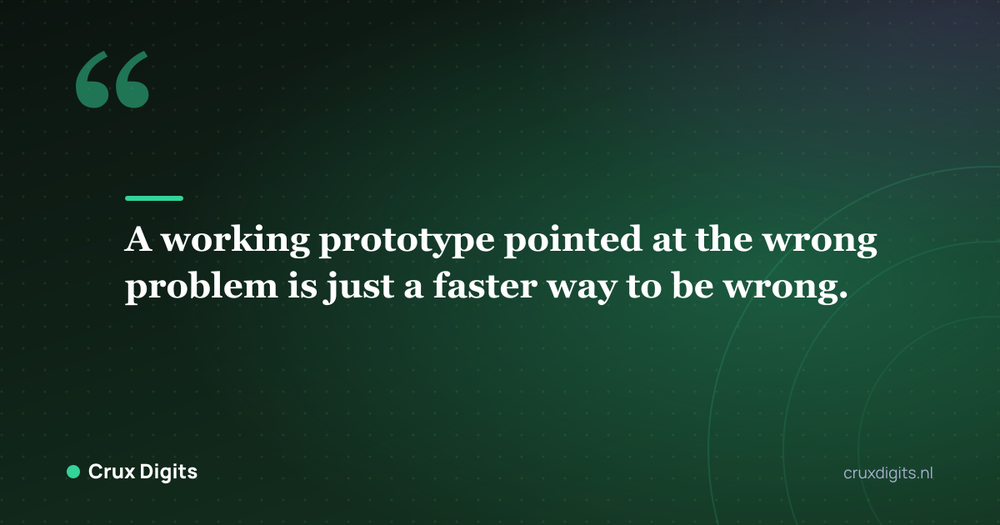
That's why a great conversation spends so long before any talk of solutions. We're not stalling. We're making sure that when we do build something, it's aimed at the thing that actually matters. A working prototype pointed at the wrong problem is just a faster way to be wrong.
What it feels like when it's working
When a conversation is really working, time does a funny thing. We look up and an hour's gone that felt like fifteen minutes. There's a particular energy to it — not hype, not excitement about AI for its own sake, but the quiet satisfaction of a problem coming into focus. Someone says "huh, I'd never thought about it that way," and means it. Or I say it, because they've just told me something that reframes the whole thing.
Often the best outcome isn't even a project. It's clarity. Sometimes the honest conclusion is that the problem is smaller than they feared, or that they don't need a model at all, just a tidier process. I'd rather reach that together and say so than manufacture a reason to work with each other. Strangely, those are often the conversations that lead somewhere later, because trust outlasts any single project. I've tried to describe that moment trust arrives before; it's the natural product of a conversation where nobody's hiding the ball.
And what it feels like when it isn't
The bad ones have a texture too, and I've learned to notice it early. They feel like talking past each other. One side wants a quote; the other wants context, and the two never meet. Or someone arrives certain they need a specific solution — "we need a chatbot," "we need an AI agent" — and every question I ask to understand why lands as friction rather than help. The conversation stays on the surface. We're exchanging information, not thinking together.
That's not anyone's fault, usually. People are busy and have been trained by years of vendor calls to expect a transaction. But you can feel the difference between a conversation that's solving a problem and one that's just negotiating one. When it's the latter, the kindest thing is to be honest about it rather than push. People often arrive braced for a polished pitch and are a little disarmed when the conversation is built to find the truth instead of sell a result.
You can't really fake it
I used to think you could engineer these conversations with the right framework or the right questions in the right order. You can't. The thing that makes them work isn't technique; it's that you actually care about the problem more than the deal. The moment care becomes performance, people feel it, even if they can't name it. Curiosity can't be scripted. Honesty can't be staged.
Which is freeing, in a way. It means the job isn't to be slick. It's to show up genuinely interested, say true things even when they cost you the project, and treat the person across the table as a collaborator rather than a target. Do that, and the good conversation tends to happen on its own. Every project I've enjoyed started this way — and, as I've said elsewhere, every project really does start with a feeling before it's ever a plan.
How to have one of these conversations
If you're on the other side — thinking about AI and dreading the vendor gauntlet — here's how to make a first conversation worth both people's time. Come with the problem, not the solution. You don't need to have decided you want a chatbot or an agent; you need to be able to describe what's frustrating or slow or uncertain. Be honest about what you've tried and what hasn't worked. And notice how the conversation feels: are you being listened to, or sold to? Is the other person curious about your world, or steering you toward theirs? You'll know within ten minutes. If it feels like two people solving a problem, you're in the right room. If it feels like a transaction, you're probably not.
That's really all an AI consultation should be: a conversation honest enough to find the right problem, and humble enough to admit when AI isn't the answer. The rest — the architecture, the proof of concept, the build — is just craft once the thinking is right.
A conversation I still think about
One that stuck with me started with a company convinced they needed a chatbot. They'd already half-specced it. But ten minutes in, asking the boring questions — who handles the messages now, what do people actually ask, what happens after hours — it became clear the chatbot wasn't the point. Their real problem was that enquiries arrived in five different inboxes and nobody owned them. A bot would have answered faster into the same chaos. What they needed first was a way to bring those streams together; the AI part came later, and smaller, and worked because it sat on top of something that finally made sense. We could have built the thing they asked for. It would have been a faster way to disappoint them.
I think about it because nothing technical was hard there. The whole value was in the conversation noticing the mismatch between the request and the problem. That's not a skill you can put in a proposal. It only happens when both people are willing to slow down and look honestly at what's in front of them.
The silence is part of it
Good conversations have pauses, and I've learned not to rush to fill them. When someone goes quiet after I ask "what happens if you do nothing?", that silence is usually them thinking the question through for the first time. The worst thing I could do is jump in with a solution to relieve the discomfort. The pause is where the real answer forms. A conversation that never breathes — that volleys back and forth with no gaps — is usually two people performing rather than thinking. The comfortable silence is a sign you're actually getting somewhere.
Why I don't bring a deck
I stopped bringing slides years ago. A deck turns a conversation into a presentation; it puts me in front of the room and the other person in the audience, and it quietly signals that I've already decided what they need before I've heard their problem. The moment you open a deck, the curiosity drains out. You're now defending a story instead of discovering one. The best tool for a first conversation isn't a polished narrative — it's a blank page and a real question. Whatever needs drawing, we can draw together. What I'd put on slides would only be guesses anyway, and guesses dressed up as confidence are worse than honest uncertainty.
None of this means structure has no place. Once we know the right problem, rigour matters enormously — scoping, building, testing, governing. But that comes after the understanding, never before it. Lead with the framework and you optimise the route to the wrong destination.
It goes both ways
People sometimes assume the consultant is there to give answers. The good conversations are the ones where I learn as much as I offer. Someone explains a constraint in their industry I had not appreciated, or describes a workflow so specific that it reshapes how I would approach the whole thing. I leave those conversations a little smarter, and I think the other person can tell that I am genuinely getting something out of it too. That mutual exchange is part of what makes it feel collaborative rather than transactional. A conversation where only one side is learning is a lecture or a sales call, depending on the direction. The ones worth having flow both ways, and you can feel the difference in the energy: nobody is waiting politely for the other to finish, because both of you actually want to hear what comes next.
Frequently asked questions
FAQ
What should a good AI consultation actually feel like?
It should feel like two people solving a problem together, not a sales call. Nobody's pitching; you're both curious about the actual issue and trying to understand it before reaching for a solution. You should feel listened to, asked real questions about your work rather than the technology, and comfortable hearing an honest "AI might not be the answer here." If it feels transactional, that's a sign it isn't a good one.
How do I prepare for a first AI conversation?
Come with the problem, not a predetermined solution. You don't need to have settled on a chatbot or an agent — you need to describe what's slow, frustrating, or uncertain in your work, what you've already tried, and what happens if nothing changes. The clearer you are about the problem, the faster a good conversation can get to whether AI genuinely helps.
Why focus on the problem instead of the technology?
Because most disappointing AI work fails on the problem, not the model. A system can work perfectly and still solve the wrong thing. Getting the context and intended use right is treated as foundational in serious AI risk frameworks, and it's what a good conversation establishes first. Once the right problem is clear, the technical choices are comparatively easy.
What if AI turns out not to be the right answer?
Then a good consultation says so. Sometimes the honest conclusion is that the problem is smaller than feared, or that a tidier process beats any model. I'd rather reach that together and tell you plainly than invent a reason to work with each other. That honesty is usually what builds the trust that leads somewhere later.
Is a great conversation enough, or do you need a process too?
The conversation comes first; the process follows. Frameworks and methods matter for delivery — scoping, building, governing — but they can't manufacture the understanding a genuine conversation creates. If the thinking is right, the craft is straightforward. If it's wrong, no process will save the project.
If this sounds like the kind of conversation you want
If you've been putting off looking at AI because you dread the pitch, this is the opposite of that. Book a free consultation and we'll just talk about your problem — honestly, no slides, no pressure. You can see our pricing and what we've built whenever you like, but start with the conversation. Worst case, you leave with a clearer view of your own problem. That's not a bad outcome for an hour.
A consultant tells you where AI pays off; Crux Digits also builds it. A fixed price per step, one named expert, from Utrecht.
AI consultancy in the Netherlands →