There is a specific moment in a first meeting when the room changes. The prospect stops sitting across from you, arms folded, mentally checking whether you are about to oversell them. They lean in, half to themselves, and say something like: "Okay, so here is what is actually keeping me up at night." That sentence is the whole job. Everything before it is theatre; everything after it is real work. After enough of these conversations, I have come to believe that building client trust is not the result of a good pitch. It is the result of what you do in the ten minutes before anyone pitches anything.
I run an AI consultancy. People arrive at our first call having been burned, or having watched a competitor get burned, by someone who promised that artificial intelligence would fix everything and delivered a slide deck and an invoice. So they are wary, and rightly so. The interesting thing is how predictable the trust-building moment is once you stop trying to manufacture it. Below is what actually earns it, what quietly kills it, and why it matters more in AI than in almost any other field right now.
What the moment actually is
Trust does not arrive as a feeling of warmth. It arrives as a shift in what the person is willing to tell you. Early in a call, a prospect gives you the sanitised version: the project as it appears in the board deck, the budget as it was approved, the timeline as it was promised upstairs. Then, if you have done your part, they switch to the unsanitised version. The real budget. The internal politics. The previous vendor who left them with half a system nobody can maintain. The thing they are quietly afraid of.
That switch is the moment a client starts trusting you, and you can almost hear it happen. It matters because the unsanitised version is the only version you can actually help with. You cannot scope a useful proof of concept against a fiction. So everything in a first conversation is, in a sense, in service of earning the honest answer. Research on trust backs the intuition: people open up in response to vulnerability and to being given real information, not to polish. Paul Zak's work in the Harvard Business Review found that sharing information openly and showing some vulnerability are among the behaviours that most reliably build trust. The pitch does the opposite of both.
Why building client trust starts before you pitch
The instinct, especially when you need the work, is to lead with capability. Show the logos, the case studies, the cleverness. But capability is what the prospect expects you to claim, so it carries almost no information. Everyone in the room knows you are going to say you are good at your job. Trust is built in the gaps where you behave differently from how a salesperson is supposed to behave.
So I have learned to spend the first part of a conversation doing the opposite of selling. I ask about the problem in detail before I have any idea whether we can help. I am genuinely willing to conclude, out loud, that the answer is no. That posture is disarming precisely because it is rare. The prospect has braced for a pitch and gets a diagnosis instead. We have written before about why we tend to end most discovery calls in under thirty minutes rather than stretch them into a sales performance, and the underlying reason is the same: the meeting is for understanding, not for convincing.
The things that actually earn it
If I had to name what flips the switch, it is a handful of small, specific behaviours. None of them are charisma. All of them are learnable, and most of them feel slightly uncomfortable the first few times because they cut against the instinct to win the deal.
Telling someone they do not need you
The fastest way to be trusted is to give advice against your own short-term interest. When a prospect describes a problem that a spreadsheet, an off-the-shelf tool, or a process change would solve, I say so. Sometimes the honest conclusion is that they do not need a custom AI system at all. We feel strongly enough about this that we wrote a whole piece arguing that most people do not need more software. Saying it in a sales conversation costs you a project today and earns you a reputation that brings three projects later. People remember the consultant who talked them out of spending money.
Naming the limits and the risks out loud
AI is sold with a great deal of magic. The trust-building move is to puncture it, carefully and specifically. I will say plainly that a language model will sometimes be confident and wrong, that a proof of concept might prove the idea does not work, that the data they have may not be good enough yet, that an off-the-shelf model could change underneath them. Naming the risks does not scare serious buyers away. It tells them you have actually built these systems and lived with the consequences, which is exactly what they are trying to find out.
Showing, not telling
Words are inexpensive and everyone uses the same ones. What is not low-cost is a concrete artefact: a rough sketch of how their specific problem would be approached, a realistic sense of where it gets hard, an honest account of a past project that went sideways and what we learned. When a prospect can see the shape of the actual work, the conversation stops being about whether to trust the brochure and starts being about the problem. Our case studies exist for this reason, but the live version, thinking through their problem in front of them, does far more in a first meeting than any reference ever could.
Dropping the jargon
Jargon is a tell. People hide behind it when they are not sure of something, or when they want to sound more impressive than the situation warrants. I have a personal rule about this, which I have written about separately, but the short version is that if I cannot explain what a system does to a smart non-specialist in plain language, I do not understand it well enough to build it for them. Plain speech is a trust signal because it is harder to fake. You cannot hand-wave in plain English.
Being genuinely willing to lose the deal
This is the one that underwrites all the others. If you are not actually prepared to walk away, every honest-sounding thing you say is still, on some level, a tactic, and people can feel the difference. The willingness to lose the deal is what makes the honesty real rather than performed. It is also, paradoxically, the best closing technique I know, though only because it is not a technique.
The things that quietly destroy it
Trust is asymmetric. It builds slowly through many small honest moments and collapses instantly with one wrong one. A few reliable destroyers, all of which I have watched undo a good first impression:
- Answering a question you do not know the answer to. The moment you bluff, and a technical buyer can always tell, every other claim you made is retroactively suspect. "I am not sure, let me check" is a stronger sentence than most people believe.
- Fake urgency. Manufactured scarcity and pressure to sign signal that you care about the contract more than the outcome. Serious buyers read it correctly and slow down.
- Over-precision. A confident, specific number for something that cannot be known yet, an exact timeline, a guaranteed accuracy figure, reads as either naive or dishonest to anyone who has done the work.
- Talking more than listening. If you leave a first meeting having spoken more than the client, you almost certainly learned too little to help, and they noticed.
Why this matters more with AI than almost anywhere else
Every consultancy needs trust, but AI has a particular trust problem in 2026, and it cuts both ways. On one side there is hype: years of promises that the technology would do more, sooner, and less expensive than it actually did. On the other side there is genuine fear, about jobs, about getting locked into a vendor, about regulation. The EU AI Act has sharpened the last of these considerably. From 2 August 2026, the bulk of its obligations and the Commission's enforcement powers come into effect, so a Dutch or European buyer is no longer just asking whether your system works. They are asking whether it will land them in front of a regulator. You can read the official timeline on the European Commission's AI Act page.
In that climate, the consultant who acknowledges the limits, the risks, and the regulatory weather honestly is doing something genuinely valuable, not just being nice. A buyer evaluating AI is wading through more marketing fog than almost any other category of purchase. Plain, vendor-neutral honesty is scarce, and scarcity is exactly what makes it trustworthy. This is why our whole approach to AI implementation leads with an audit rather than a build: we would rather spend a couple of thousand euros confirming the use case is real than fifty thousand discovering it was not.
How we try to run a first conversation
None of this is a script, and the moment it becomes one it stops working, because the willingness to be honest cannot be performed convincingly for long. But the shape is consistent. We listen first and at length. We ask what they have already tried and why it did not stick. We are specific about what AI can and cannot do for their particular case. We say no when no is the honest answer. And we are transparent about money early, which is why our pricing is published rather than hidden behind a discovery process designed to extract a budget before quoting against it.
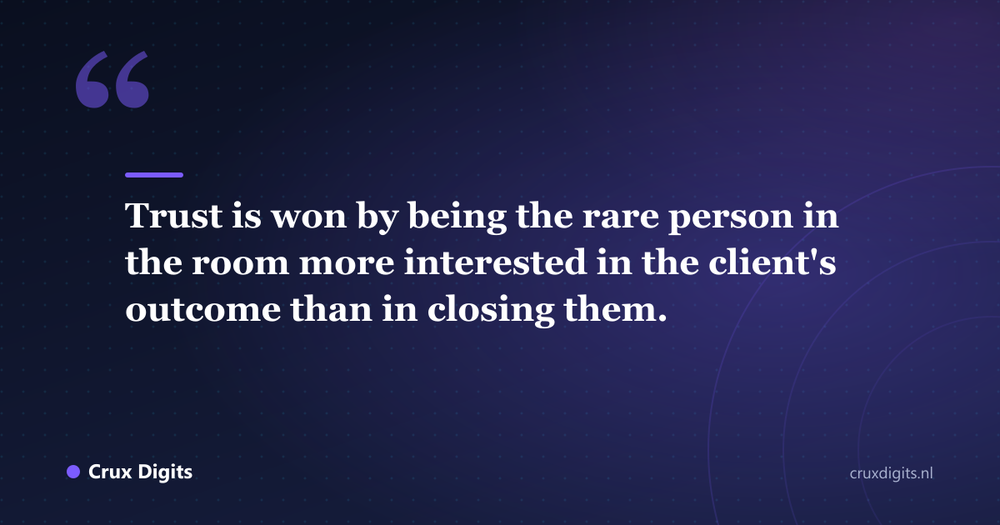
The reward for all of this is not really the deal. It is the moment I described at the top, when a guarded prospect exhales and starts telling you the truth about their situation. Once that happens, the rest of the engagement is straightforward, because you are both working on the real problem instead of negotiating around a performance. That is the whole of it. Trust is not won by being impressive. It is won by being the rare person in the room who is visibly more interested in the client's outcome than in closing them.
If that sounds like the kind of conversation you would actually want to have, get in touch and we will start with your problem, not our pitch. Review our transparent pricing, or book a free consultation and we will map your first use case together, honestly, including telling you if you do not need us.
A consultant tells you where AI pays off; Crux Digits also builds it. A fixed price per step, one named expert, from Utrecht.
AI consultancy in the Netherlands →