An AI mandate measures usage, and usage was never the thing in doubt. It cannot tell you whether the person who opened the tool noticed that the answer was wrong, and that is the only thing that decides whether AI helped. If you are weighing up whether to require your team to use AI, the decision is narrower than it looks, the evidence behind it is thinner than the headlines suggest, and in the Netherlands it carries a legal layer that most of the advice skips.
I get asked about this more often than I expected to in 2026, and the question nearly always arrives in the same shape. Everybody has the licence. Half of them never open it. Should I just make it compulsory. It is a fair question from a director who has now paid for the same capability twice, once in software and once in the time nobody spent learning it. It is also the moment an AI project stops being a technology decision and becomes a management one.
What does an AI mandate actually measure?
Three things get counted when AI use is made compulsory: licences issued, sessions opened, prompts sent. All three are inputs, and all three are easy to satisfy without changing how the work gets done.
It helps to separate what an employer can and cannot require, because they are not the same kind of thing. You can require an input: that a first draft of every quote goes through the tool. A person either did that or did not. You can require an output standard: that the quote leaving the building is correct, whatever produced it. That is observable too, because a wrong quote has consequences. What you cannot require is the part in between, where a person reads a fluent, plausible paragraph and decides it is wrong. That is judgement, and judgement does not respond to instructions. It responds to whether somebody has the context to spot the error, the time to look and the standing to say no.
A mandate sits entirely on the first of those three. It produces a number that goes up, leaves the second unexamined and the third untouched. Every time I have been asked to lift a usage number, the useful part of the conversation started when we stopped talking about the number.
Why the 2026 backlash numbers are probably not about your company
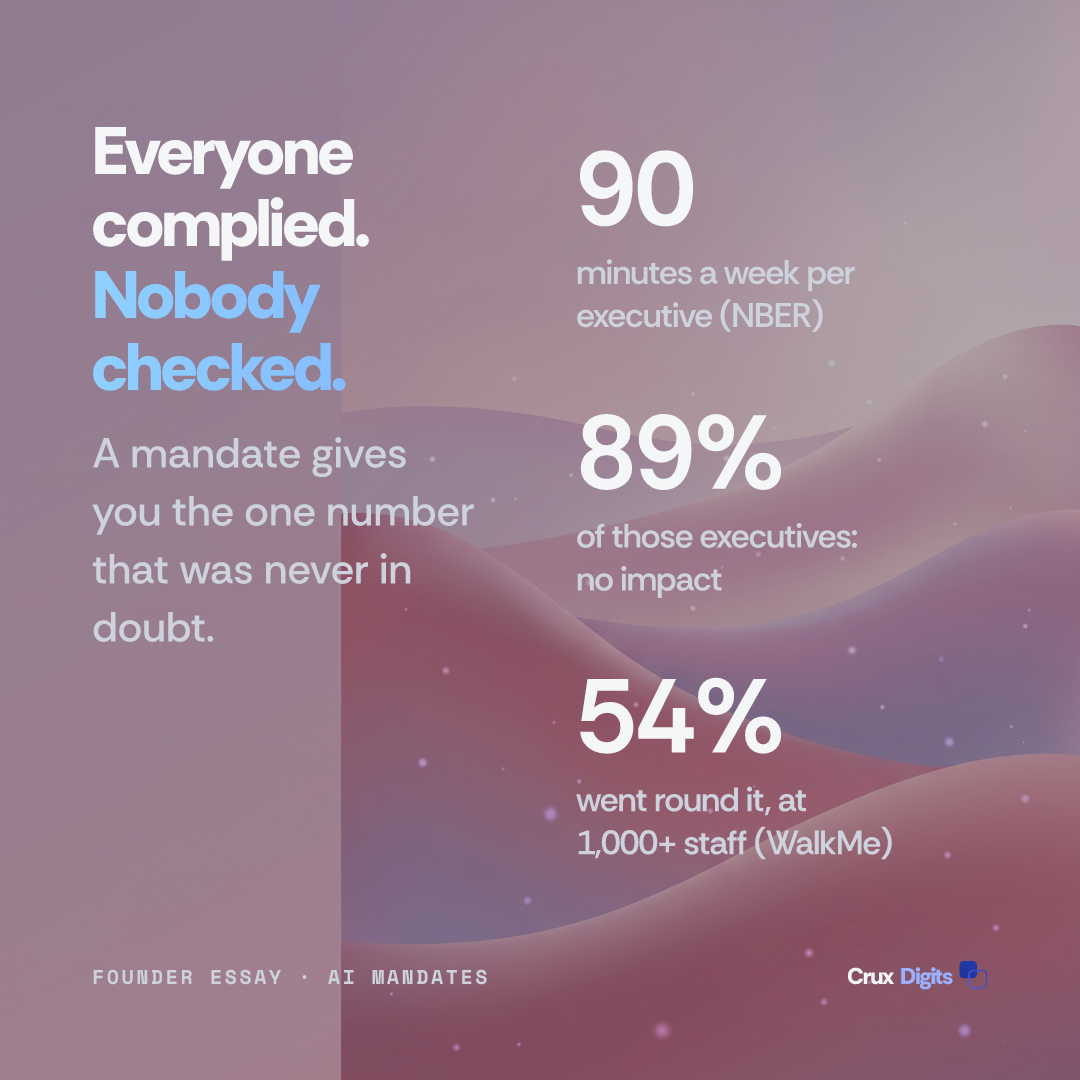
There is a lot of survey material about AI mandates going wrong. Most of it is vendor research, worth reading past the headline rather than quoting. WalkMe's State of Digital Adoption 2026, published in April, found that 54% of the workers it surveyed had bypassed AI tools and done a task manually at least once in the previous thirty days. A further 33% had not used AI at all. Nine per cent trusted AI for complex, business-critical decisions, against 61% of executives.
Then read the methodology. Three thousand seven hundred and fifty respondents across fourteen countries, two thousand of them workers, all at enterprises of a thousand or more. That is a real finding about a real kind of company. It is not one about a firm of twenty-five, and the difference is not simply scale.
In an organisation of a thousand, refusing a mandate is anonymous. You can be one of the fifty-four per cent without anybody knowing which one, which is why people answer a survey honestly. In a company of twenty-five, refusal is visible. Everyone knows who sits where and who sends what. So nobody refuses. They open the tool, paste in the question, read the answer and work the way they did in March. The dashboard stays green all quarter.
That is the failure mode a small company has, and it is invisible to every metric a mandate produces. It is why I say that AI adoption fails in the org chart rather than in the code. A mandate never reaches the org chart. It reaches the licence report.
How much AI do the people issuing the mandate use themselves?
The most useful number I read this year is not about workers at all. In Firm Data on AI (NBER working paper 34836), research teams at the Federal Reserve Bank of Atlanta, the Bank of England, the Deutsche Bundesbank and Macquarie University put identical questions to nearly six thousand senior business executives, mostly CEOs, CFOs and senior finance managers, between November 2025 and January 2026. Sixty-nine per cent of firms reported some current use of AI. More than two-thirds of the executives used AI themselves in a typical week. Averaged across all of them, the quarter who never did included, that came to about an hour and a half.
Ninety minutes a week. A perfectly reasonable amount for somebody whose week is mostly meetings, and a good deal less than most mandates quietly imply for the people receiving them.
The same survey carries the number that should slow anybody down before writing that memo. More than ninety per cent of those executives reported no effect of AI on employment over the previous three years, and 89% reported no impact on labour productivity, measured as sales per employee. The paper puts the reported productivity gain at 0.29% over those three years. Looking forward, the same people expect AI to raise labour productivity by 1.4% over the next three years.
Read that honestly and it is not a story about AI failing. It is about a technology that has not yet shown up in these firms' accounts, while the people running them expect it will. That is a defensible position. It is a very hard one to convert into a requirement for somebody else, because you are asking your team to act today on a forecast your own numbers have not yet supported. One caveat: the survey covered the United States, the United Kingdom, Germany and Australia, with no Dutch firms in it.
May a Dutch employer simply require it?
Mostly yes, which surprises people on both sides of the argument.
Article 7:660 of the Burgerlijk Wetboek obliges an employee to comply with the employer's rules about performing the work and about good order in the business, given within the limits of generally binding provisions or of the contract. That is the instructierecht, the same provision that carries rules about email and internet use, about clothing, about protective equipment. A rule saying the first draft of a quote is produced in a particular system sits comfortably inside it. The outer limits are the contract, goed werkgeverschap under article 7:611, and the binding rules the instruction must stay within, which for anything touching customer or personnel data means the AVG.
So the legal question is rarely whether you may. It is what else you switched on. The moment the mandate arrives with a report of who used which tool and how often, you have moved from an instruction about the work to a facility for observing performance, and a different part of Dutch law applies. I have written about where the works council fits into an AI rule and where it does not, so here is only the practical version: decide first whether you are running a tool or running a measurement of people, because the paperwork is not the same.
Belgium is a different country with a different rule, and this is one of the places where assuming otherwise gets expensive. Under collective labour agreement no. 39 of 13 December 1983, an employer averaging at least fifty employees who invests in a new technology with important collective consequences for employment, work organisation or working conditions must supply written information and consult worker representatives at least three months before implementation begins. Consequences count as important and collective when they touch 50% and at least ten workers of a given occupational category, or of the affected categories together where those number under a hundred. The sanction is not theoretical either. An employer who skipped the procedure may not end a contract unless he proves the reason had nothing to do with the technology, and that burden sits with him from the day the information was due until three months after the technology is actually running. If he ends it anyway he owes three months' gross pay on top of ordinary severance. Dutch law has no comparable three-month clock with a dismissal penalty attached to it.
I am not a lawyer and this is not legal advice. If your mandate touches monitoring or personnel data, involve one.
What the AI Act asks of you, and what it does not
There is one obligation here that does exist, and it points the other way. Article 4 of the AI Act asks providers and deployers to act on the AI literacy of their staff. The Digital Omnibus on AI, Regulation (EU) 2026/1744, adopted on 8 July 2026 and in force since 27 July, rewrote it. The duty used to be to ensure, to your best extent, a sufficient level of AI literacy. It is now a duty to take measures to support the development of that literacy, and you are no longer required to guarantee any particular level for any given individual.
That is lighter than it was. It is still a duty, and it is a duty about capability. Nowhere in it, before or after the rewrite, is there a requirement that anyone use an AI system. The law asks you to make people able. A mandate asks them to comply, which is the least expensive substitute for what the regulation actually asks, and the one I see most often. If the real question is why people who could use the tool do not, that is about capability and confidence, and I have argued before that most firms do not have the AI skills gap they think they have.
What I ask a director to require instead
Three things, all enforceable, all moving the burden of proof somewhere more useful.
One. Require the attempt on a named task, not on the job. "Every incoming quote request goes through the drafting step before anyone writes one by hand" is a rule you can check, and one somebody can follow while still disagreeing with it. "Use AI more" is neither. A named task also gives you what a usage count never does: a denominator. You know how many requests came in, so you know what the number ought to be.
Two. Require the check, and put a name on it. Whatever produced the text, one person sends it and answers for it. It sounds obvious, and it is the thing most often left unsaid, which is how you get a team that has quietly concluded the tool is now responsible. It is not, and saying so out loud is worth more than any policy document.
Three. Require the report-back, with a date on it and an exit in it. Four weeks, one page, three lines: what it did well, what it got wrong, and what would have to be true for it to be worth keeping. Say plainly, in advance, that "drop it" is one of the permitted answers. A requirement with no exit is not a trial. It is a decision you have already taken and are asking other people to ratify, and people can tell the difference.
The point is narrow. A mandate asks the employee to prove they complied. This asks the tool to prove it earned its place. The first produces a number you could have predicted. The second produces an argument you can act on, including the argument that you should stop.
What should you count instead of seats and prompts?
None of this is hard. It costs about ten minutes a week, which is the real price of knowing.
- Rework rate on the named task: how often the output came back, got rewritten or was corrected by whoever received it. This moves first when a tool genuinely works.
- Time from request to sent: measured end to end, not time to first draft. The draft is the part that got faster. The sending is what you invoice.
- The exception list: which cases nobody used it for, and why not. In my experience this is the most informative thing the exercise produces.
- Whether a second task followed: one person finding a second use unprompted says more than fifty people hitting a target.
- One honest sentence per person at four weeks: not a form and not a score out of ten. A sentence, from the person who used it.
For the longer version, I have written about what to measure in an AI pilot. And if nobody in the company has the hours to run any of it properly, that is worth knowing before you buy anything else. It is usually the point where a structured training block for the team does more good than another licence.
When is a mandate the right call?
I do not think mandates are always wrong. There are two cases where I would write one. The first is where the requirement is a prohibition: no customer data, no personnel files and no unpublished financials go into a tool that is not on the approved list. That is enforceable, and it is the shape a mandate is good at. The second is where the tool has become the system of record. If quoting now happens inside the quoting system, "use it" is not an AI mandate at all. It is a process change with an AI component, and process changes are supposed to be compulsory.
The honest counter-argument deserves stating. Plenty of managers will tell you that without a push nothing moves, and they are not wrong about inertia. The executives in WalkMe's own sample leaned that way: 62% agreed the risk of unsanctioned shadow AI is overstated next to not taking enough advantage of AI in the first place. A push is defensible. My argument is narrower than "do not push". It is that a push and a metric are different objects, and that the moment a push acquires a target number you stop learning from it.
The version nobody writes down
The uncomfortable reading of most AI mandates is that a company writes one once the money is spent and the answer is not in yet. That is not an answer to the question, because the number it produces is the number you already had.
If you are in that position, the less expensive move is to pick one task, put four weeks on it, name the person who decides, and write down in advance what would make you stop. You will know more after that month than a year of usage reports would have told you, and if the task was the wrong one you have lost four weeks and learned where to point next.
Last updated 22 September 2026.
A consultant tells you where AI pays off; Crux Digits also builds it. A fixed price per step, one named expert, from Utrecht.
AI consultancy in the Netherlands →